

Super Bowl Staffing: Four Hiring Channels, but Only One Is Yours
Super Bowl LXI will take place on February 14, 2027, at SoFi Stadium in Inglewood, California. The NFL and Los Angeles Host Committee are preparing a week of events across the region, creating staffing needs far beyond the stadium itself.
That does not mean there is one Super Bowl staffing roster.
Different organizations can recruit and manage workers for different parts of the experience. Stadium operations, NFL-related functions, host-city programs, and sponsor activations can each follow separate staffing processes.
For brands and agencies, that distinction matters. If you are producing a Super Bowl-week activation, you generally cannot assume that stadium personnel or host committee workers will cover your guest experience.
California currently projects approximately $477 million in regional economic impact from Super Bowl LXI. That scale helps explain why the surrounding event ecosystem requires multiple workforce systems, not one universal staffing pool.
The first question for a planner is therefore not, “How many staff do we need?”
It is:
Who owns this part of the experience?
Once you know that, you can determine the right staffing partner, timeline, access requirements, roles, and contingency plan.
Executive Summary
Super Bowl staffing is divided across multiple hiring channels, including stadium operations, NFL-related contractors, host committee programs, and sponsor activations.
For brands and agencies, understanding who owns the staffing requirement is the first step to building the right team.
Learn how each staffing channel works, when recruitment typically begins, and what to include in your Super Bowl activation staffing plan.
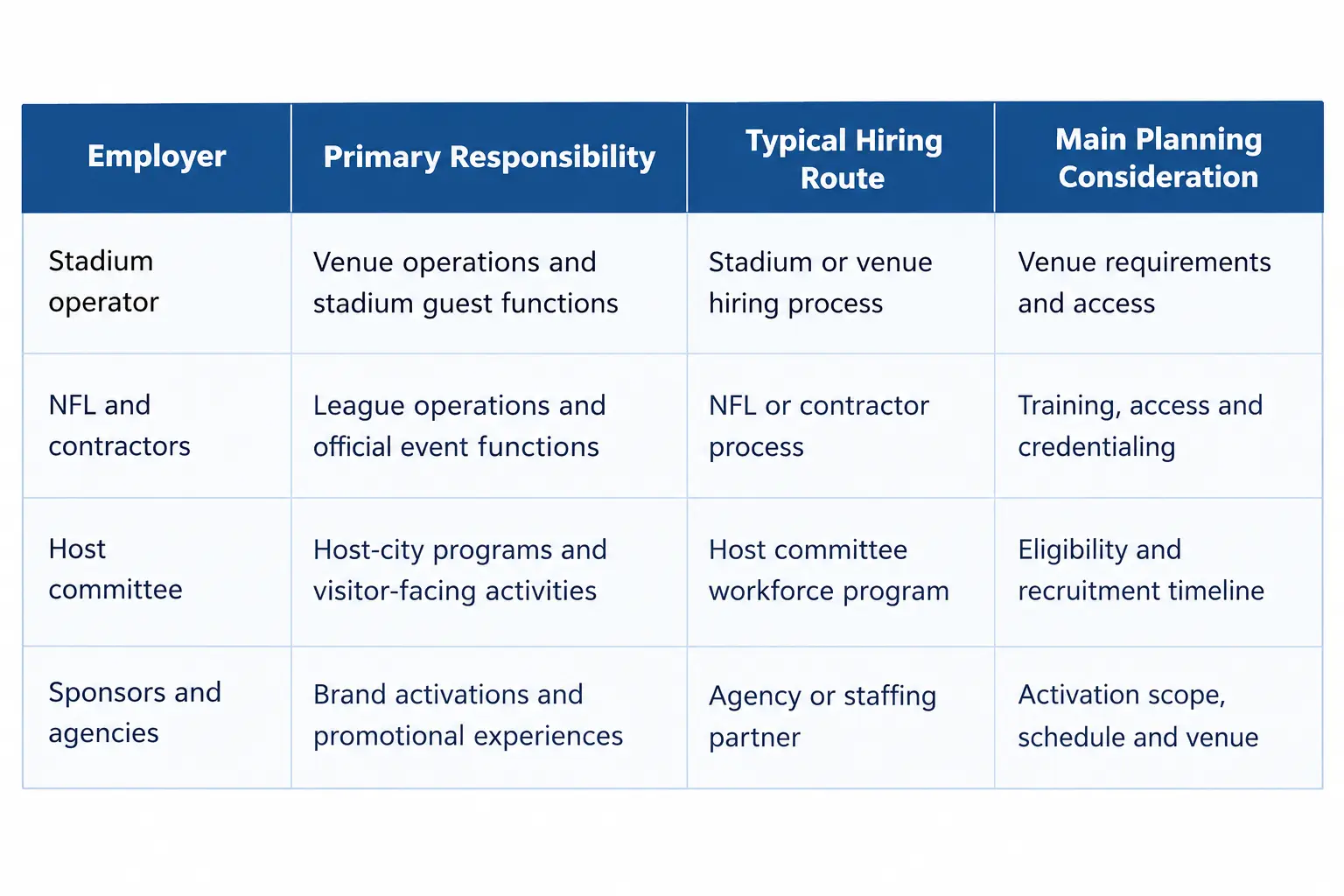
Four Employers Can Shape Super Bowl Staffing
The clearest way to understand Super Bowl staffing is to separate the major hiring groups.
These four categories describe a recurring structure, not a fixed rule for every Super Bowl. Host committees negotiate responsibilities with the NFL and their host cities, so the workforce model can change. That is exactly why it helps to start from a staffing plan you can actually fill in rather than assuming last year's structure applies.
Historical planning for Super Bowl 50 illustrates how permanent stadium personnel worked alongside temporary staff brought in for the event and trained for their roles. That same venue, Levi's Stadium in the Bay Area, went on to host Super Bowl LX in February 2026. The Bay Area Host Committee's post-event report found the game generated roughly $720 million in regional economic activity, more than triple what Super Bowl 50 produced at the same stadium a decade earlier.
That creates four separate planning paths:
- A stadium operations worker may answer to a different employer than someone in an NFL-related function.
- A host committee worker follows an entirely separate recruitment process.
- A brand ambassador at a sponsor activation may work for a staffing company or agency with no connection to the other three groups.
So the first staffing question is not "How many people do we need?" It is "Which organization owns this part of the experience?"
The NFL and Stadium Handle Official Operations
The stadium and NFL side of Super Bowl staffing covers the official event environment.
Historical Super Bowl planning provides a useful example. For Super Bowl 50, MPI described a workforce that combined regular stadium personnel with staff brought in specifically for the event. Temporary staff also received training connected to the event operation. That kind of decision, bringing in short-term labor rather than stretching a permanent crew, is really a question of when temporary event staffing is worth it, and the answer inside an official footprint looks different than it does for a private activation.
That distinction matters for anyone planning around the official footprint.
The hiring process for these roles is not the same as booking a short-term promotional team:
- Official event positions can involve role-specific training.
- They typically carry access and badge requirements.
- They may include background or security processes that need to be completed before the worker arrives.
For Super Bowl LXI, planners should therefore treat official-footprint staffing as its own operational system.
Credentialing Can Become the Timeline Constraint

Recruitment and access are not always the same thing.
A late staffing decision may leave enough time to find interested workers but not enough time to complete the requirements attached to an official role. That gap is one of the more common blind spots in large-event planning. It is worth checking whether your event security plan template is missing a staffing line before assuming credentialing will keep pace with hiring.
That is particularly relevant when a position sits inside the official event footprint.
Sponsor activations outside that footprint can follow a different process:
- They still need to meet venue, city, and client requirements.
- They are not automatically subject to every official-event staffing process.
- They can move on a faster hiring timeline as a result.
The practical lesson is simple: identify the location and ownership of the role before setting the staffing timeline.
Host Committee Staffing Changes by City
Host committee staffing can look very different from one Super Bowl city to another.
Super Bowl LVIII, Las Vegas:
- CBS San Francisco reported that around 7,000 volunteers worked with the Las Vegas Super Bowl Host Committee.
- Roles included visitor-facing positions at the airport and other locations.
Super Bowl LX, Bay Area:
- The Bay Area Host Committee recruited around 2,000 paid temporary positions.
- Its FAQ explained that California law required workers to be paid unless they were volunteering for a qualifying 501(c)(3) organization or local government.
- The committee identified itself as a 501(c)(6), so it could not use unpaid volunteer positions through that organization.
- That paid model scaled up fast: California's governor's office reported the game supported approximately 5,000 jobs and drew about 90,000 out-of-region visitors, and the host committee's own post-event figures put worker earnings at more than $330 million in labor income across the region.
These numbers should not be compared as if they measure the same workforce. The Las Vegas figure described a volunteer greeting program. The Bay Area figure described paid temporary positions across a different host committee operation.
The comparison does show something important for Super Bowl LXI planning: host-city workforce models depend on the local structure and applicable rules. It is also a pattern that shows up well beyond the Super Bowl. Several of the same staffing mistakes host cities make on festivals in major U.S. markets tend to repeat whenever a city assumes one workforce model will cover every event type.
Historical examples reinforce that point. A 2016 investigation reported thousands of volunteers working around Super Bowl 50, including visitor greeting and other host-city activities.
For brands planning in Los Angeles, that means the host committee workforce should not be treated as a general-purpose staffing pool for private activations.
The workforce may overlap in geography and timing, but the organizations behind it remain separate.
Sponsors and Agencies Run Separate Activations
This is where many brand marketers will recognize their own staffing needs.
Sponsors and agencies manage a separate part of Super Bowl staffing when they operate brand activations, promotional experiences, booths, experiential programs, or other off-site events. This is a large enough slice of the labor market to matter on its own. The American Staffing Association's fourth-quarter 2025 data shows U.S. staffing companies employed an average of about two million temporary and contract workers per week, a pool that activation staffing draws from alongside every other industry.
Those activations can take place at hotels, convention spaces, private venues, hospitality locations, or other properties around Los Angeles.
The activation therefore needs its own staffing plan. Depending on the experience, that plan may include:
- Brand ambassadors
- Experiential marketing staff
- Promotional staff
- Booth and conference staff
- Production teams
- Run-of-show coordinators
- Greeters and ushers
- Crowd-control staff
The exact mix depends on the activation. A small branded experience with steady traffic may need a different team from a multi-zone activation with timed programming and heavy arrival peaks. Even something as basic as staff dress code and what to wear on shift can change depending on whether the team is working a hotel ballroom or an outdoor fan zone.
The staffing company or agency also needs to understand the operating schedule. A team scheduled only around guest arrival may have a different structure from one supporting setup, live operations and breakdown. That kind of detail is covered in live event staffing best practices for brand activations, including how to structure a booth team using a trade show booth staff schedule.
That is why activation staffing should be planned separately from stadium or host committee staffing.
Host-City Staffing Shows the Scale of the Operation
The scale of Super Bowl staffing becomes clearer when you look at the wider host-city operation.
A DECA Direct analysis of Super Bowl LX estimated roughly $3 million in host-city event staffing expenses, covering areas such as security, ushers, support staff and overtime. That sits inside a much larger operation: the Bay Area Host Committee's own post-event report priced the wider impact at approximately $720 million in total regional economic activity.
These figures are useful for understanding scale. They are not individual staffing rates or a pricing guide.
The larger point is that workforce planning sits inside a much broader operating system. Staffing has to connect with:
- Transportation
- Venue access
- Production schedules
- Security
- Guest movement and other event functions
That connective tissue is exactly what the event operations plan template built for keeping large events under control is designed to cover.
That is also why separating the four employer groups matters:
- A host committee may be solving a citywide visitor experience problem.
- A stadium operator is solving a venue operations problem.
- The NFL and its contractors are handling official league requirements.
- A sponsor or agency is solving a brand experience problem.
Those are related activities, but they are not the same staffing assignment.
CEO Excerpt:
The week around the Super Bowl is staffed by several organizations, and they do not share one roster. The gaps between those groups are where operational problems can start. Good planning begins by understanding who owns each part of the experience, then making sure every staffing responsibility has a clear owner. - Daniel Meursing
Staffing Plans Should Include the Exit
A staffing plan should account for what happens after the scheduled program ends.
Super Bowl 50 offers a useful historical example. MPI reported that some staff members waited two to three hours for transportation after the event because large numbers of people were leaving at the same time. The affected staff were compensated for the additional waiting time.
That was one documented incident, not evidence that the same problem will occur at Super Bowl LXI. Organizers also expected transportation planning to improve in future years.
The planning lesson remains relevant. A shift does not necessarily end when the final guest leaves. For large events, egress can create another operational peak. Hundreds or thousands of workers may finish at roughly the same time. Transportation, pickup locations and site access can then become part of the workforce plan. That is exactly the gap that shows up when planners map event staffing around the problems that actually break events instead of only planning for guest-facing hours.
For an agency or brand, the staffing brief should cover more than guest-facing hours. It should also clarify:
- Setup and arrival requirements
- Staff briefing time
- Operating hours
- Break coverage
- End-of-shift procedures
- Transportation or pickup expectations
- Who owns the final release of staff
Working this detail into a production schedule that names an owner for every task is what helps prevent a staffing plan from ending too early.
The Bottom Line on Super Bowl Staffing
Super Bowl staffing involves multiple employers, not one universal workforce.
- The stadium operator, NFL and its contractors, host committee, and sponsors or agencies can each have different responsibilities.
- The exact boundaries can change by host city, so planners should confirm the process that applies to their specific role or activation.
- For job seekers, the relevant route depends on the role. Host committee programs and NFL-related contractors are separate from sponsor activation staffing.
- For brands and agencies, the key question comes earlier: who owns the staffing requirement?
Once that is clear, the planner can define the team, timeline, access requirements and operating plan around the actual experience.
If you are planning a brand activation, start with the activation itself rather than assuming the stadium or host committee workforce will cover it.
Ready to elevate your next event?
Join thousands of event planners who trust EventStaff.com for reliable, professional staffing solutions.
Trusted by event professionals nationwide
1k+
Events Staffed
2 million+
Guests Served
97%
Positive reviews