
Is Your Event Security Plan Template Missing a Staffing Line?
You have been asked for a security plan by a venue, insurer, permit office, or client. Now you need to turn an event date, a floor plan, and an estimated attendance into a document that another party can review and approve.
A complete event security plan template needs seven working blocks: risk profile, venue map, post assignments, staffing calculations, access rules, communications, and incident escalation. Each block should explain who is responsible, where they will be positioned, and what triggers action. The finished plan also needs separate staffing lines for licensed security and trained crowd managers. Combining both under a general “security staff” total leaves the organizer unable to show which requirement has been addressed.
Executive Summary
This event security plan template helps you profile the event, mark venue posts, calculate licensed security and crowd managers, establish access rules, and document escalation procedures. Complete each block, confirm the requirements with the appropriate authorities and providers, then export the article as your working plan.
Your plan needs seven decisions before approval
A blank security-plan document can look deceptively simple. It may provide fields for the event name, venue, and expected attendance, then leave the organizer to decide what operational detail belongs underneath them. The finished document needs to do more than describe the event. It should show how staffing and decisions will work across setup, guest arrival, live hours, and teardown.
The CISA planning tool covers venue characteristics, existing plans, policies and procedures, crowd management, and physical security. CISA describes its output as an overarching framework, which means organizers still have to turn those planning considerations into event-specific posts, assignments, and escalation routes.
Use the following table as the control page for the plan. If a block cannot be completed yet, name the person responsible for obtaining the missing information and set a deadline. A visible gap with an owner can still be resolved. An empty field passed between teams rarely receives the same attention.
.webp)
Document ownership should appear before the operational sections. Several versions may circulate as attendance, layouts, vendors, or timings change. Recording the version number and approval date allows the venue and providers to confirm that they are working from the same plan.
.webp)
The same guest count can hide a different risk
Attendance gives you scale, but it says very little about how the event will operate. Two events with 150 guests can create entirely different staffing plans once the audience, layout, access, alcohol service, and operating hours are examined.
Consider a seated corporate lunch in a hotel ballroom. Guests arrive through one managed lobby, registration is invitation-only, the program finishes in the afternoon, and the venue controls back-of-house access. The plan may still require security and crowd management, but the number of posts is limited and the audience behavior is relatively predictable.
Now consider a publicly promoted late-night event with the same 150-person attendance. It has an open bar, valet arrivals, VIP guests, vendor deliveries continuing close to doors, and access from more than one side of the venue. Security may need to cover credentials, restricted access, the valet transition, and incident response. Crowd managers may also be needed around arrival routes, guest movement, exits, and any point where queues affect circulation.
The headcount stayed the same while the coverage requirement changed significantly. This is why a provider who gives you a final number from attendance alone has not yet collected enough information. Complete the risk profile first, then use it to explain which conditions moved the staffing requirement up or kept it toward the lighter end of the planning range.
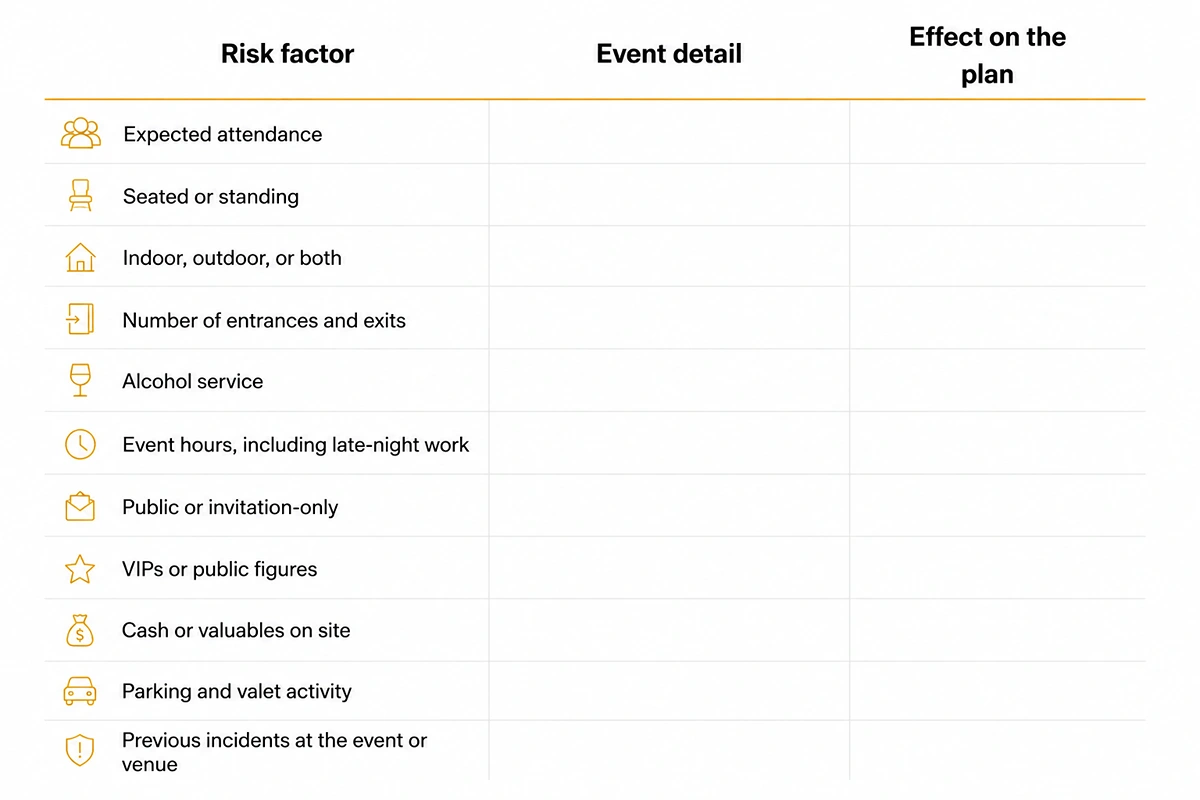
Use the final column to record the practical consequence. “Open bar” is an event detail. “Review bar-area coverage and tighten the licensed security range” turns that detail into a planning action. “Three entrances” is a fact. “Confirm whether all three remain open and assign a provider to each active point” makes it useful.
These are planning considerations rather than instructions for conducting a threat assessment. Your venue, insurer, permit office, licensed security provider, or local authority may set requirements that override the working ranges in this template.
CEO Excerpt
“When I review an event staffing plan, I start with the floor plan before I look at the guest count. Entrances, exits, service areas, VIP spaces, and loading access tell you where coverage is required. Attendance helps test the number, but the venue layout shows where people must actually be positioned.” — Daniel Muersing, CEO of Eventstaff
Your floor plan may demand more people than the ratio
A guest ratio is a volume calculation. It produces a broad number based on attendance and event risk, but it cannot see the loading door behind the stage, the second guest entrance, the VIP room, or the car park separated from the main building.
A post map is a coverage calculation. It identifies every location that needs someone present and shows when that position becomes active. Both calculations are useful because they answer different questions. The ratio asks how much general coverage an event of this size and profile may need. The map asks whether every operational position can actually be staffed.
Mark each entrance, restricted area, service zone, and perimeter position on the venue plan. Add the event phase because every post may not operate for the same hours. A loading entrance could need coverage during setup and teardown, the guest entrance may activate before doors, and a VIP room could require a fixed position throughout live hours.
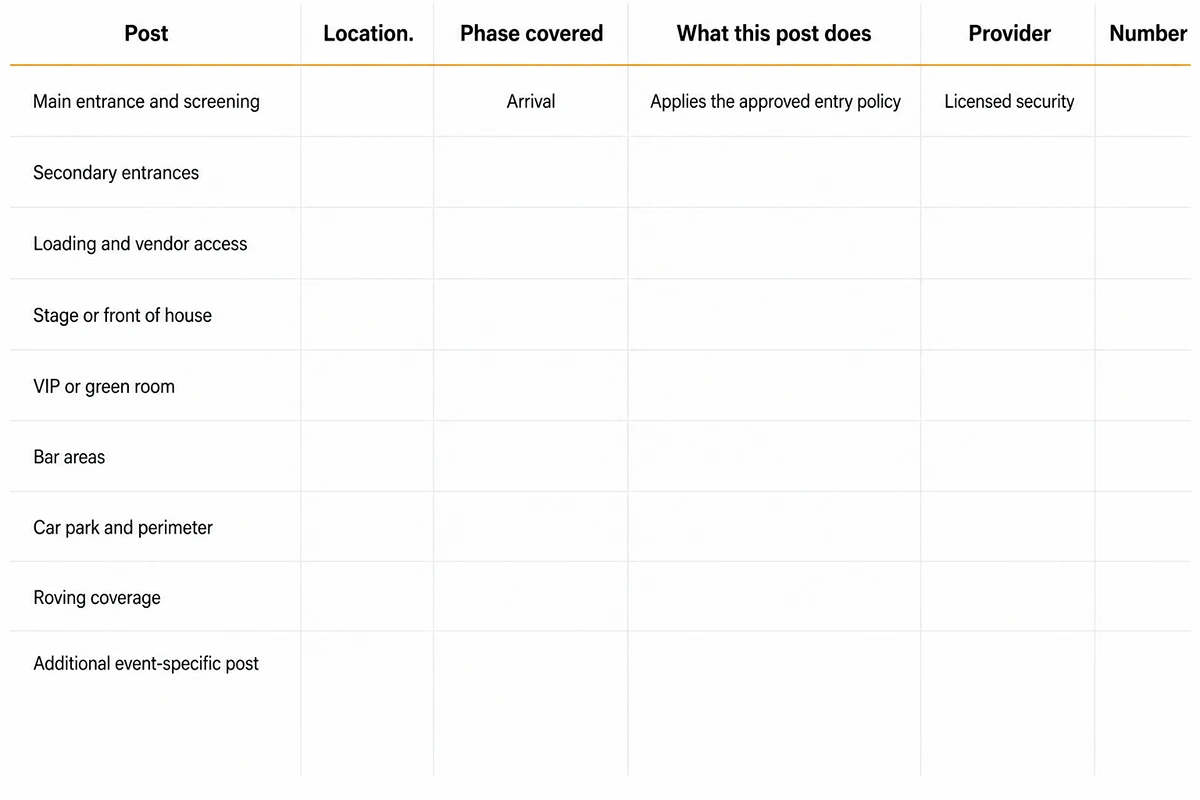
Suppose an attendance ratio suggests six licensed security guards. The floor plan identifies two guest entrances, one vendor entrance, a VIP room, a car park, and one roving assignment. Those six positions consume the entire ratio-based number before any additional event-specific coverage is considered. If the venue also requires a back-of-house post or security supervisor, the map produces the higher planning requirement.
Count the posts first, work out the ratio separately, and take the higher figure forward for professional review. The list above is a starting point. Your licensed security provider should inspect the actual layout, schedule, venue rules, and risk profile before confirming assignments.
A guest ratio cannot see an unstaffed entrance
Security providers commonly use guest ratios to begin a conversation about team size. A widely used range for lower-risk functions, such as seated corporate events, conferences, and private weddings, is approximately one licensed security guard per 50 to 100 guests. Standing events, open bars, late operating hours, festivals, and open outdoor footprints often move toward one per 25 to 50 guests.
VIP or executive protection should be assessed separately by a qualified provider. Published planning guidance often shows much tighter coverage, sometimes around one professional per 10 to 20 protected guests, but the final requirement depends on the individuals, venue, movements, access arrangements, and responsibilities involved.
.webp)
For a 500-person seated corporate event, the broad lower-risk range produces approximately five to ten licensed security guards. Five reflects the lightest end of one per 100 guests, while ten reflects one per 50. The risk profile and floor plan decide which part of that range deserves further consideration.
Imagine the event has two guest entrances, a vendor entrance, a VIP room, a parking area, and two internal restricted zones. That creates seven potential fixed posts before a supervisor or roving position is considered. A five-guard plan would leave at least two identified positions uncovered. The floor-plan calculation therefore moves the discussion above the lightest ratio result.
Alcohol service, cash or valuables, public figures, several entrances, outdoor exposure, and late hours can tighten the range further. Record the two calculations independently so the client and providers can see how the working number was reached.
.webp)
These figures are broad industry planning ranges rather than statutory requirements. A venue, insurer, permit office, or licensed provider may set a different minimum. Contract licensed security through an appropriately qualified provider and ask for the final number, posts, operating hours, and supervision structure in writing.
One missing staffing line can weaken the whole plan
A plan that places everyone under “security staff” makes it difficult to prove which functions have been covered. Licensed security and trained crowd managers should appear on separate lines because their numbers come from different planning bases.
Licensed security assignments may include screening, restricted access, security incidents, and security-specific posts. Crowd managers focus on guest movement, clear egress, occupancy awareness, exit information, and crowd conditions during normal and emergency operations. They may work beside one another at the same event while retaining different responsibilities and escalation boundaries.
The Event Safety Alliance publishes separate standards for event security and crowd management. ANSI ES1.40-2023 is intended to work alongside ANSI ES1.9-2020, which defines crowd management and distinguishes it from crowd control. That pairing reflects the planning reality: related functions still need their own assignments.
For assembly occupancies, the NFPA crowd-management guidance describes a minimum of one trained crowd manager or crowd manager supervisor. When occupant load exceeds 250, additional trained crowd managers are generally required at a ratio of one for every 250 occupants.
A state fire marshal reference cites the NFPA definition of an assembly occupancy as a gathering of 50 or more people for specified assembly uses. That definition cannot be applied in isolation, because each jurisdiction adopts and administers its own code requirements.
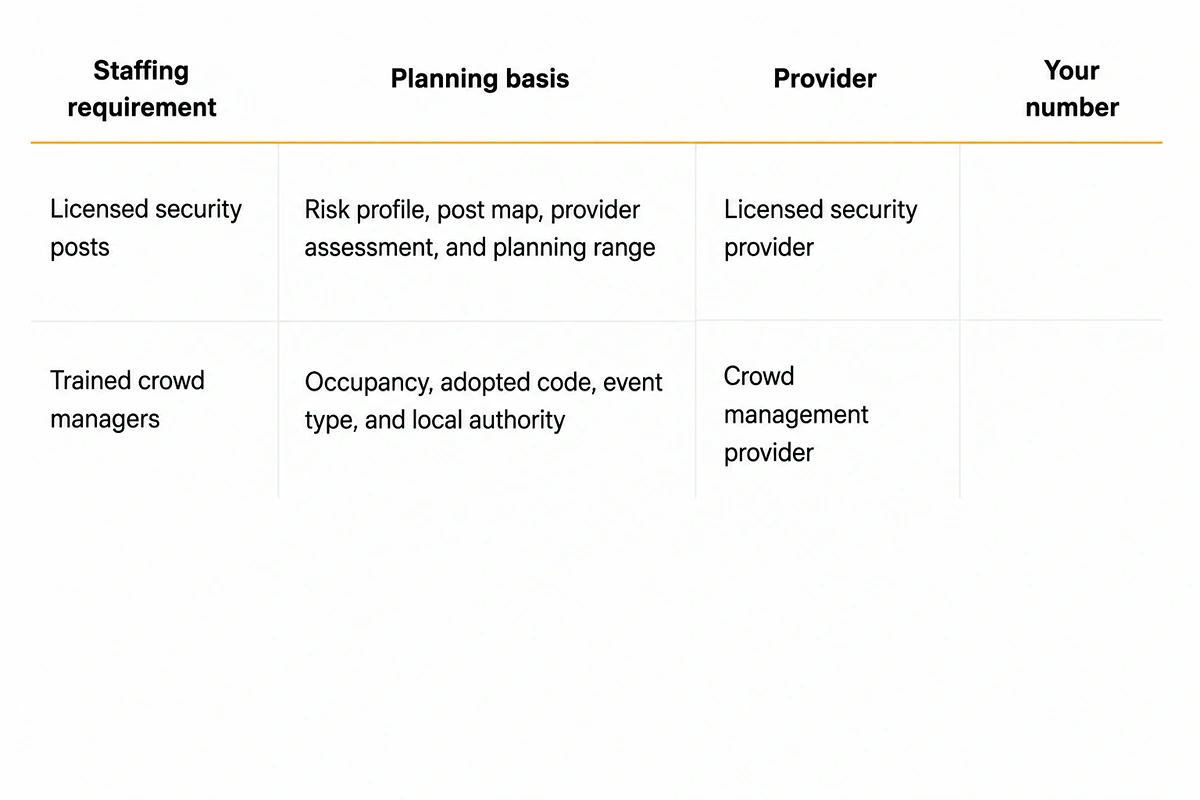
For a 500-person event, the licensed security calculation might produce five to ten guards before post adjustments. The crowd-manager calculation is completed separately using the applicable occupancy and code requirements. One total does not cancel, absorb, or automatically satisfy the other. The procurement plan may therefore require two providers with separate scopes.
George Washington University’s safety office summarizes an important qualification from NFPA 101:12.7.6.1. The authority having jurisdiction may permit a reduced crowd-manager ratio when an approved supervised sprinkler system and the nature of the event warrant it. Its crowd-control regulations also reference IFC 403.12.3.1 for certain outdoor gatherings above 250 people.
Ask the venue or fire marshal which code edition applies, how the space is classified, whether the venue already supplies qualified crowd managers, and how many additional people the event must provide. Record the answer and the approving authority inside the plan. If the event needs trained crowd managers, you can talk to Eventstaff about movement, egress, queue, and guest-flow positions.
Entry disputes begin with rules nobody documented
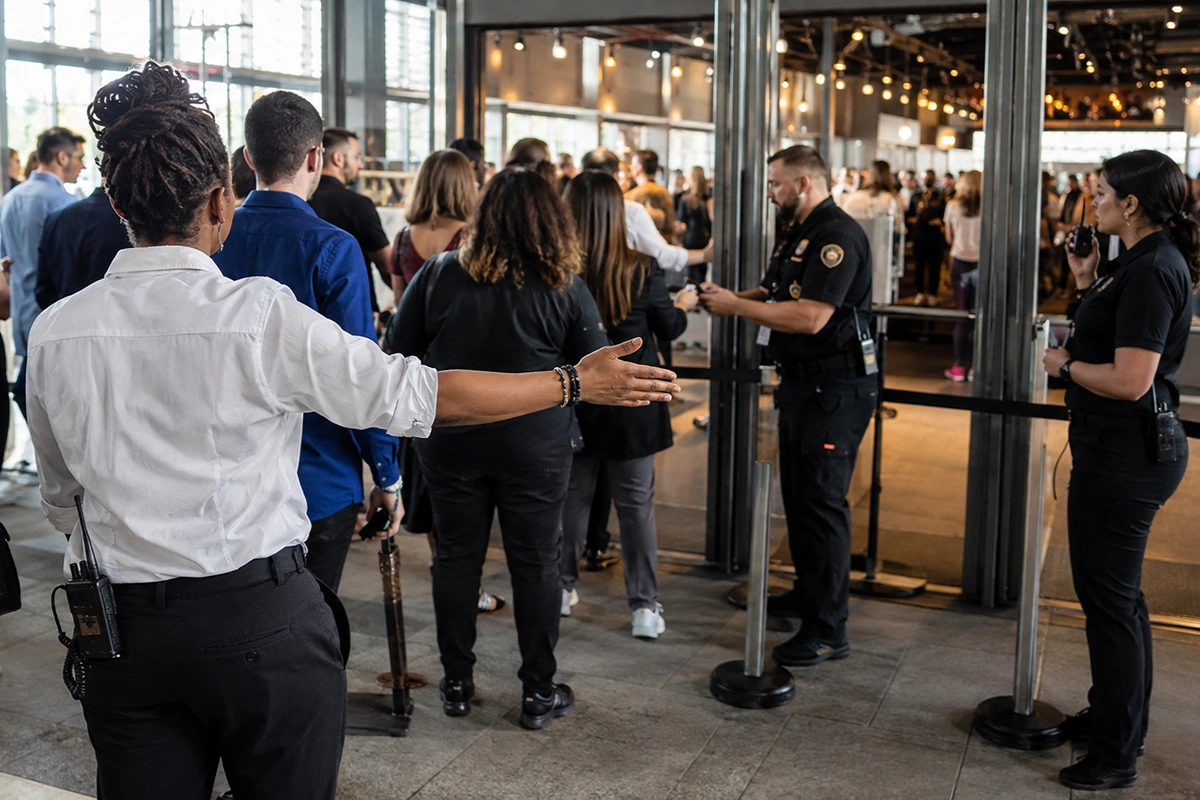
An entry team needs an approved procedure before facing an intoxicated guest, an unlisted arrival, an incorrect credential, or a prohibited item. Without one, the decision falls to the person standing at the door, and different entrances can begin applying different standards.
List every entry point and define who may use it. Then record the credential, bag policy, prohibited-item policy, and refusal route. These policies should come from the organizer, venue, and licensed security provider. The event security plan explains how approved rules move from a document into a consistent door process.
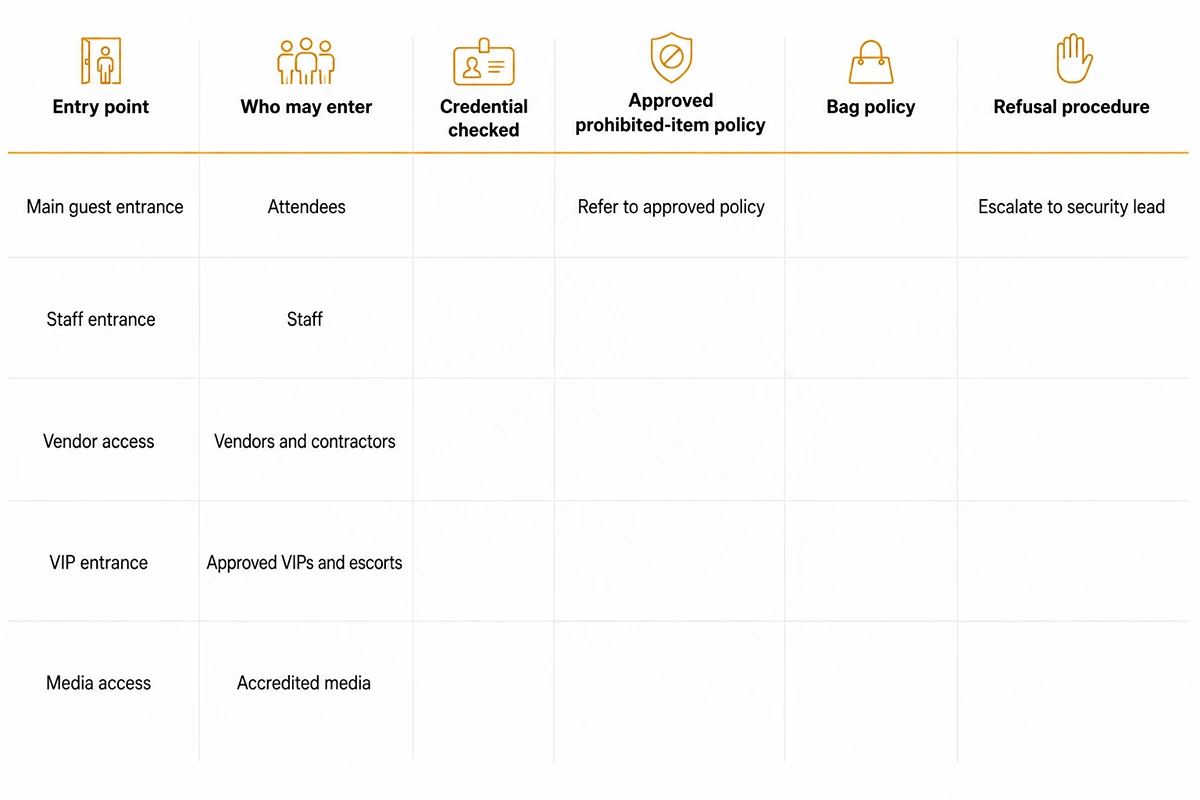
Create credential tiers for attendees, staff, vendors, contractors, VIPs, and media. Name who can resolve a guest-list error, who can approve a vendor arriving outside the scheduled window, and who owns security refusals. A greeter can direct someone to the resolution desk, while the licensed security lead handles decisions that fall within the approved security procedure.
The refusal route should protect the rest of the entry operation. If every disputed credential remains at the screening point, one unresolved guest can slow the entire line. Specify where the person waits, who reviews the issue, and how the outcome returns to the entry team.
A contact list cannot make the decision for you
A list of names and phone numbers helps only after the team knows when to use them. The incident section should define the trigger, first on-site role, escalation owner, emergency-services threshold, and person responsible for notifying the client.
.webp)
Avoid directions such as “escalate if necessary.” Write the approved condition. If a queue reaches a marked exit route, the plan might trigger a second lane or move arriving guests to a pre-approved area. If a credential dispute lasts longer than the door team can resolve without affecting throughput, it may move to a named supervisor away from the main line.
The venue and appropriate providers must approve those procedures before doors. The template records the decision and ensures the people on the floor know where their authority ends.
.webp)
Check whether every team can actually communicate. Separate contractors may arrive with incompatible radios, shared channel assumptions, or no agreed phone backup. A short communications test before doors can uncover these gaps while there is still time to correct them.
Finish the section with an incident log. The person completing it should record what happened, where and when it occurred, who became involved, what action was taken, and how the incident ended.
.webp)
Eventstaff covers the crowd management line
Eventstaff supplies non-armed crowd management personnel, including crowd control staff, greeters, and ushers. These teams can support queues, guest movement, directional communication, egress awareness, and behavioral crowd-management positions identified in the completed plan.
Eventstaff does not supply licensed or armed security guards, medical personnel, or fire marshals. Those services must be contracted from appropriately qualified providers. Keeping those scopes separate allows each provider to brief its team accurately and removes uncertainty about who handles a refusal, medical incident, security escalation, or crowd-flow adjustment.
The integration point should be documented before the event. If crowd managers observe congestion near an entrance, the plan should state who receives that information and who can alter access. If licensed security pauses an entry point, greeters and ushers need an agreed route for redirecting arriving guests. Clear handoffs allow both teams to work alongside the venue without stretching either role beyond its assignment.
The event risk assessment template feeds the risk-profile block in this document. The crowd management plan template expands the movement, queue, occupancy, and egress decisions. Eventstaff’s event safety plan guide covers the wider medical and emergency-planning context.
Bottom line
Complete the risk profile before calculating staff. Mark every fixed and roving post on the floor plan, then compare that coverage requirement with the appropriate planning range. Take the higher figure forward to your licensed security provider and ask them to confirm the final posts, operating hours, supervision, and staffing number.
Add crowd managers on a separate line. Confirm the applicable requirement with the venue and authority having jurisdiction, record the code edition or local direction used, and identify who will provide the qualified personnel.
Your event security plan template should also define who may enter, where disputes are resolved, how teams communicate, and what conditions trigger escalation. Once the plan identifies the non-armed crowd management positions required across queues, egress, movement, and guest direction, get crowd management staffing from Eventstaff.
Ready to elevate your next event?
Join thousands of event planners who trust EventStaff.com for reliable, professional staffing solutions.
Trusted by event professionals nationwide
1k+
Events Staffed
2 million+
Guests Served
97%
Positive reviews