
Your Event Staff Dress Code Needs More Than Smart Black
You have booked the team, and now the staffing partner wants to know what everyone should wear. Four functions should shape the answer: safety, brand identification, guest recognition, and physical endurance. “Smart black” covers none of them with enough precision to brief a worker arriving for the first time.
A useful event staff dress code explains which colors are required, how guests will identify the team, what footwear suits the work, and whether the standard changes between setup and show hours. It also settles who supplies branded items or protective equipment. The result is a practical booking specification that workers can follow without having to interpret what the host meant.
Executive Summary
Event staff dress code requirements should trace to safety, brand identification, guest recognition, or physical endurance. Write the standard by role and event phase, explain who supplies each item, and give workers enough detail to arrive ready for the conditions and responsibilities of their shift.
Your dress code needs seven clear decisions
A host needs to give the staffing partner a complete specification. Terms such as “formal,” “smart,” and “event-ready” can mean different things to the client, agency, and individual worker. They also leave the most practical questions unanswered: Can guests identify the team? Will the footwear support a long standing shift? Does the loading crew need protective equipment?
Start by confirming the seven decisions below. Assign ownership beside every item because a requirement is useless when the client assumes the agency supplies it and the agency expects it to be waiting at the venue.
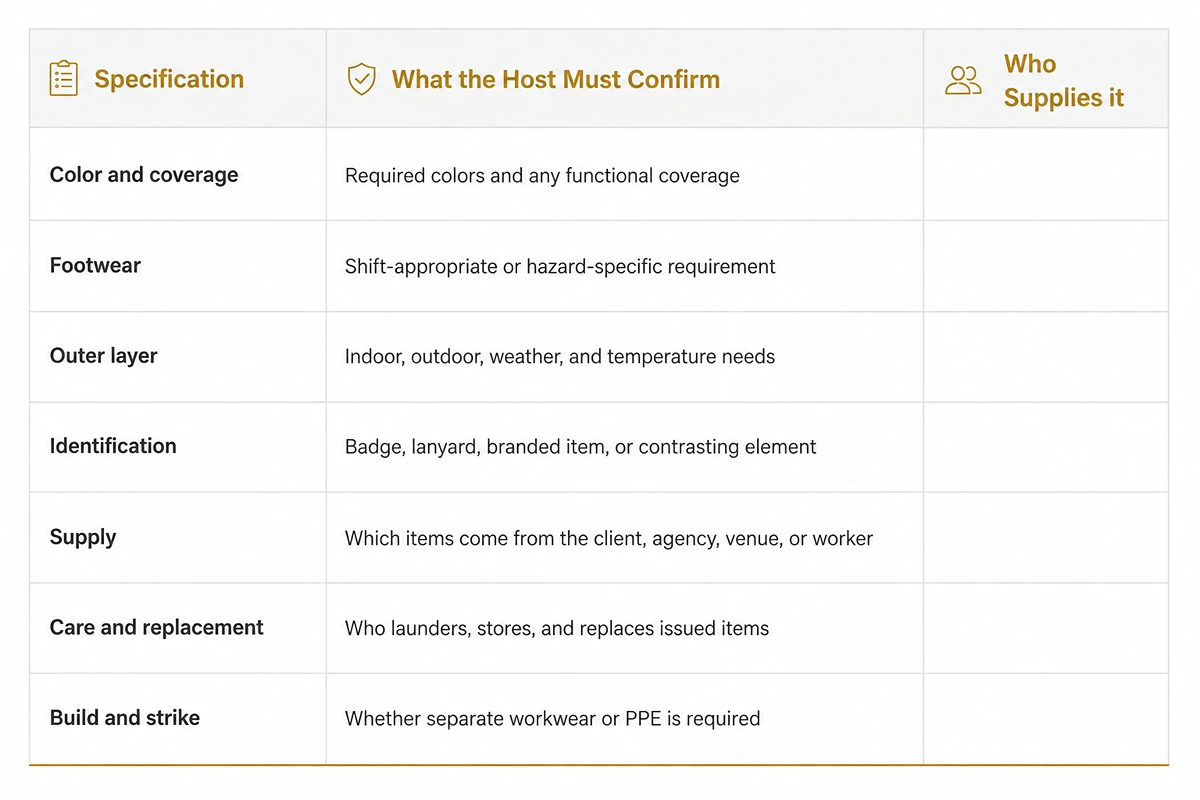
Place the final standard in the booking so it does not depend on an email sent the night before. Include reference images only when they clarify color or branding. The written specification should still be complete enough to follow on its own, including what happens if the weather, venue, or assigned role changes.
Every clothing rule needs an operational reason
Every requirement should serve one of four functions. Safety responds to hazards and working conditions. Brand identification shows that someone belongs to the organizer, venue, or activation. Guest recognition helps attendees locate assistance quickly. Physical endurance supports the length and movement demands of the shift.
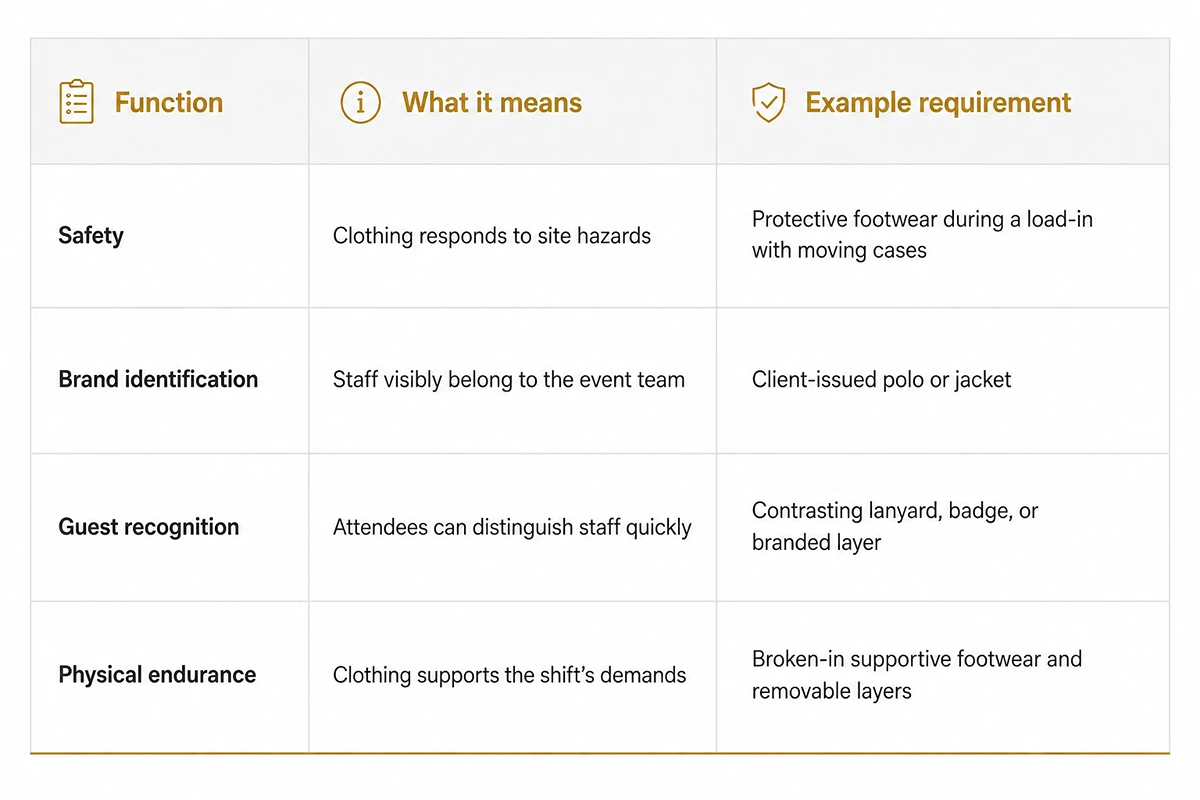
The reasoning should appear in the instruction. “Closed-toe protective footwear is required during load-in because cases and equipment will move through the dock” gives the worker a condition and a purpose. “Wear suitable shoes” leaves them guessing about both.
Apply a simple test before adding any rule: could you explain how it helps someone perform the job? If the answer is unclear, the requirement is probably a preference. Preferences are difficult to brief, easy to enforce unevenly, and likely to create disagreement without improving the event.
CEO Excerpt
“The dress codes that work are the ones you can explain clearly to someone arriving for their first shift. Staff should understand how every item helps them do the job, whether that means being visible to guests, moving safely through the venue, or staying comfortable enough to perform consistently for the full shift.” -- Daniel Muersing, CEO of Eventstaff
One dress code cannot cover every event role
Registration staff, ushers, production support, and load-in workers may all work on the same event, but they do not perform the same tasks or operate in the same conditions. A single standard usually describes the front-of-house look and leaves everyone else to improvise.
For guest-facing roles, the clothing’s most valuable operational function is often recognition. Guests entering an unfamiliar venue navigate by finding someone who appears to know the room. If the staff blend into the audience, simple questions about registration, seating, accessibility routes, or session locations travel further before reaching the right person.
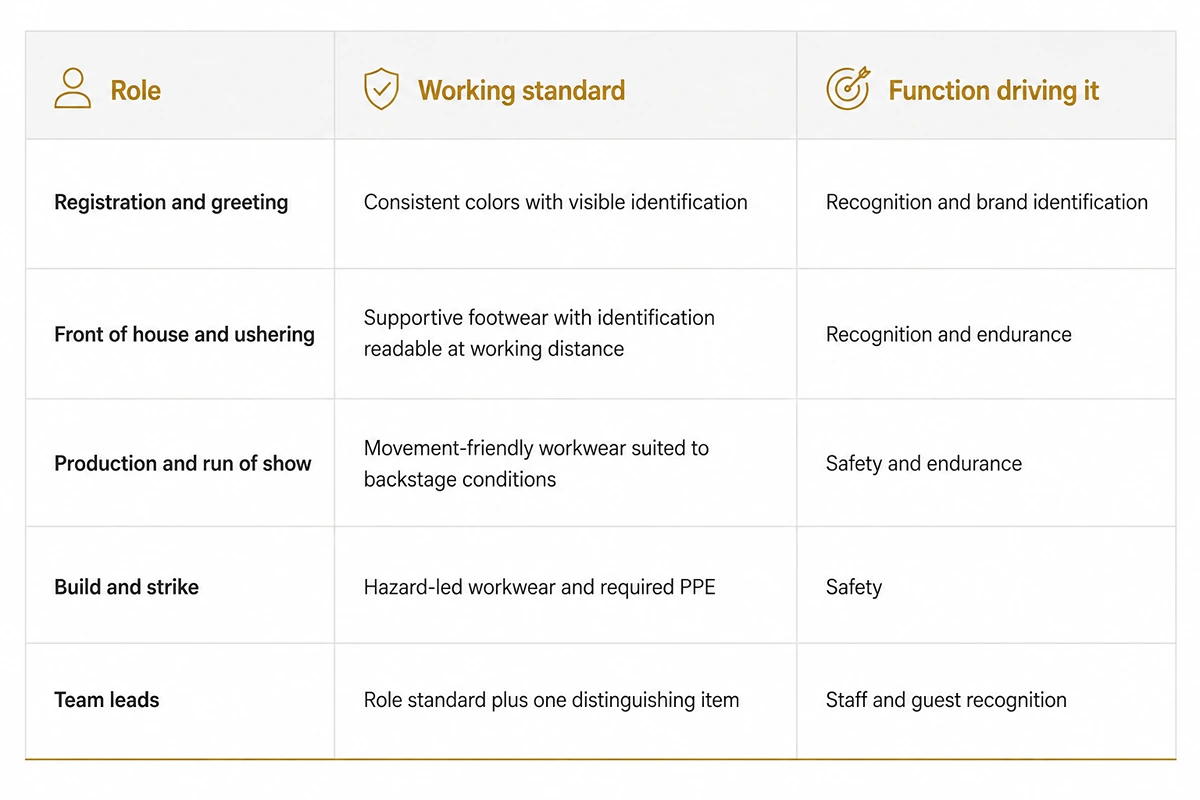
Choose the recognition element after considering what guests will wear. At a formal dinner, a team dressed identically to attendees may be difficult to find. A contrasting jacket, branded lapel badge, colored lanyard, or clearly marked credential can preserve the event’s visual standard while making assistance visible.
Team leads need an additional signal because workers must locate them quickly as well. The distinguishing item should remain visible when the room becomes busy and should be explained during briefing. This operational principle may sit alongside venue or client identification rules, which can take precedence.
Test the proposed standard in the room instead of approving it from a product image. A small badge may appear clear at a desk yet disappear across a crowded foyer. Ask how a guest will identify an usher from several yards away, how registration staff will remain visible behind counters, and how workers will recognize their lead when several suppliers share the same neutral colors.
If you need staff briefed against a clear role-based specification, you can talk to Eventstaff before finalizing the booking.
The event type changes what the standard must solve
Event type matters because it changes the environment, guest clothing, movement pattern, and length of the shift. Simply assigning a level of formality misses those variables. A corporate conference and trade show may both request business clothing while creating very different demands for identification and footwear.
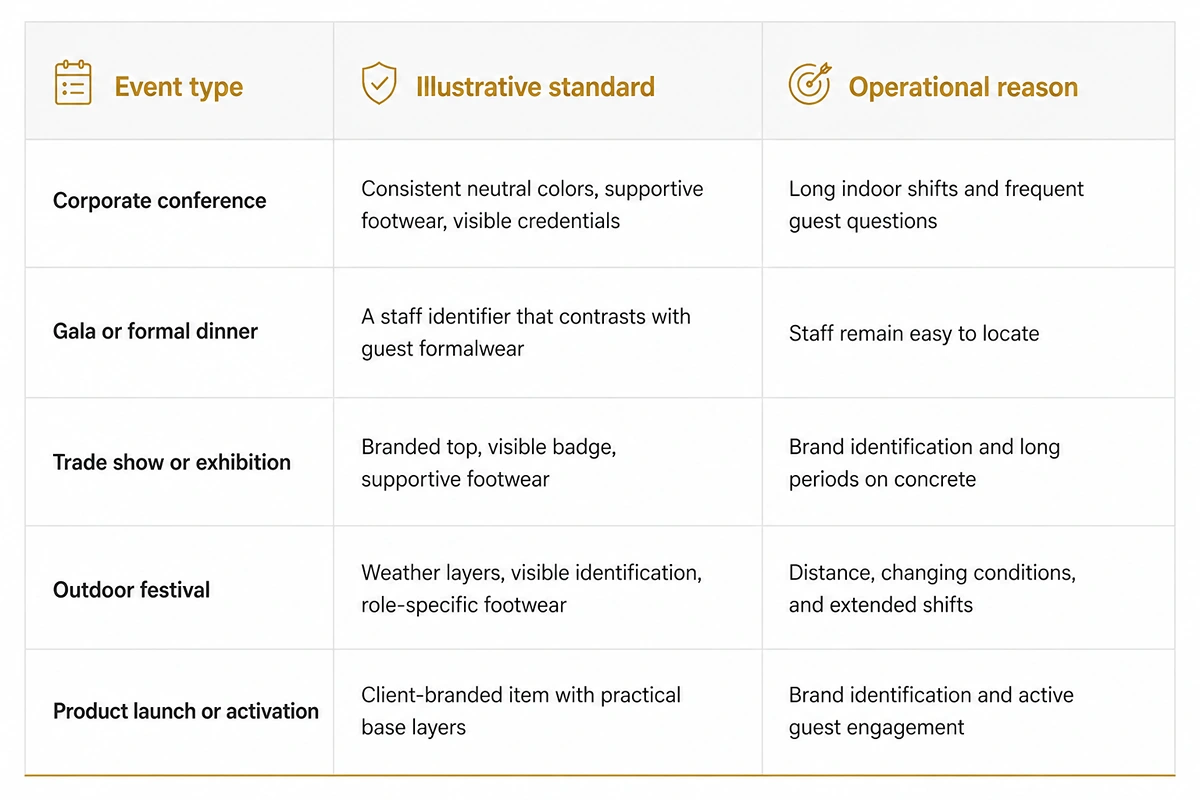
For a gala, ask what visual cue will separate an usher from a guest before specifying another formal outfit. For a trade show, test whether the footwear and layers still work after several hours on concrete under exhibition-hall lighting. At an outdoor festival, the standard must account for weather changes without allowing an unplanned coat to cover the only branded item.
The host should therefore confirm whether the event is indoor or outdoor, seated or standing, and client-branded or venue-branded. Add the season, expected temperature range, shift length, and guest dress. Those details let the agency brief clothing that supports the work while maintaining a coherent event identity.
Plan for transitions as well. A product-launch team may begin outside managing arrivals, move indoors for demonstrations, and finish by helping guests collect items near an open loading entrance. The standard needs an approved layer and footwear that can handle the full route, or the host needs to divide the assignments and brief each group separately.
Build and strike start with the site hazards
Build and strike require their own standard because the venue can function as a work site during those phases. Cases, trolleys, staging sections, vehicles, tools, and overhead activity change what clothing needs to accomplish. Front-of-house logic should begin only when the environment and assignment have changed.
OSHA requires employers to assess workplace hazards and use appropriate protective equipment where hazards are present. Its foot protection standard addresses areas where falling or rolling objects, sole-piercing objects, or remaining electrical hazards create a danger to feet. The Event Safety Alliance also treats installation, setup, removal, and operation as defined phases within its live-event standards.
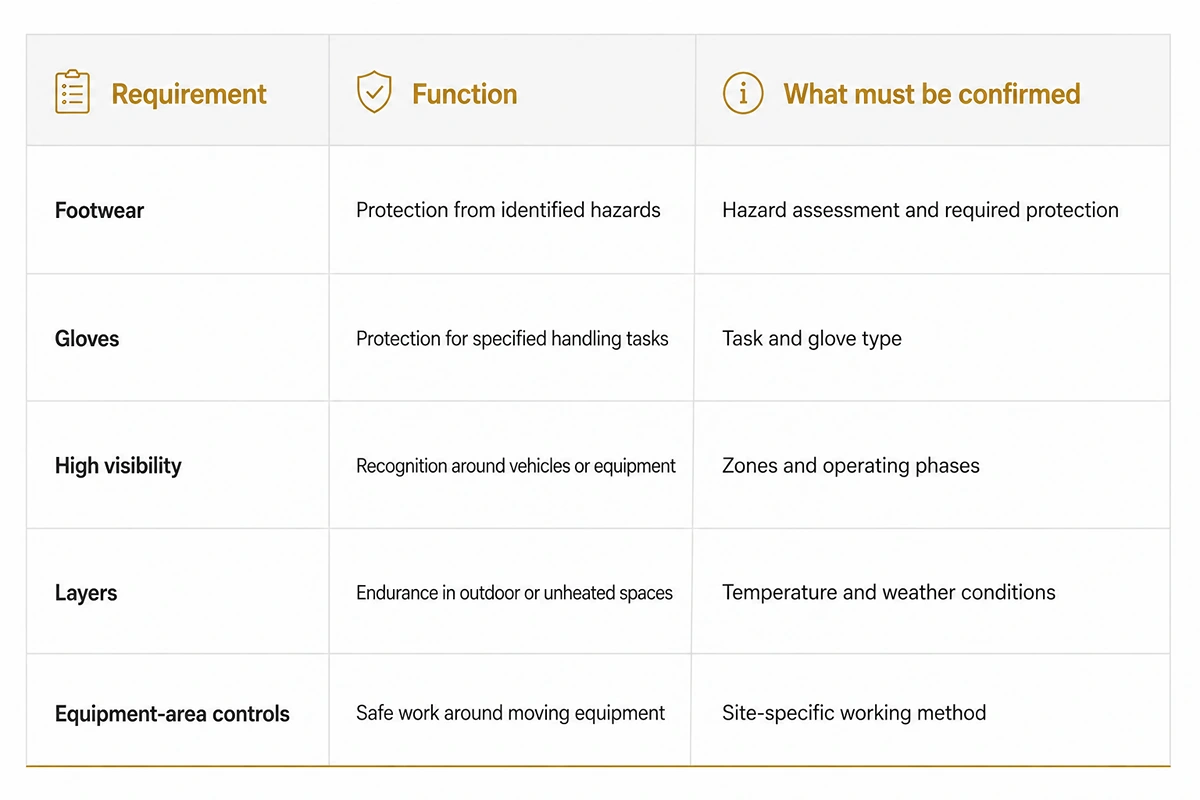
Protective equipment and uniforms need separate lines in the booking. The first responds to hazards; the second usually supports identification and consistency. Before arrival, the client, venue, staffing agency, and relevant contractor should agree who assesses the site, who supplies and pays for required equipment, and who checks compliance.
Requirements depend on the actual hazards and employment structure. A host should never assume that “closed-toe shoes” automatically satisfy a protective-footwear requirement. The responsible employer and site lead must confirm what applies to the work and how religious, disability-related, or other required accommodations will be handled safely.
What to wear when you are working an event
If you are working the shift, begin with the confirmed role instructions. The event name alone cannot tell you what the assignment requires. Check whether you are assigned to guest arrival, front of house, production support, outdoor work, or build and strike, then confirm what the client supplies and what you must bring.
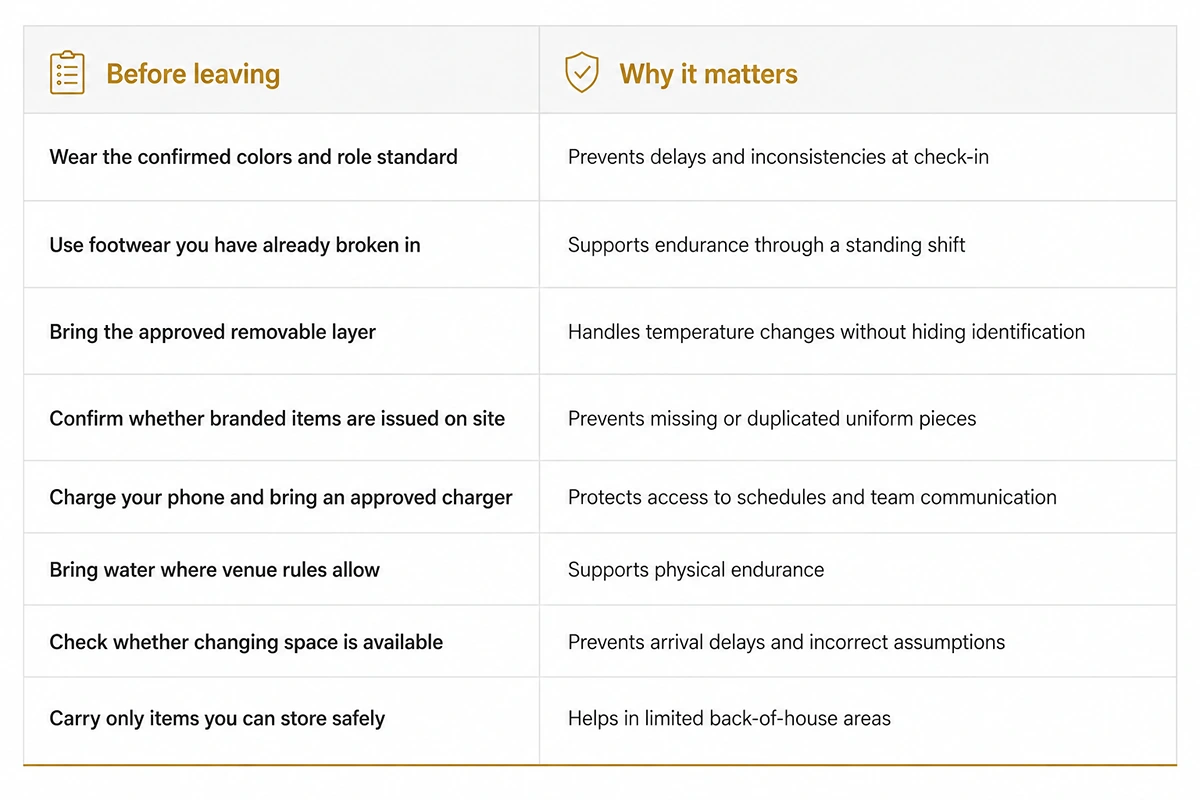
Arrive in the required base standard unless the briefing says changing space is available. Wear footwear that has already handled a comparable shift; event day is a poor time to discover pressure points after the first hour. Bring a removable approved layer when temperatures may change, especially when the shift moves between a loading area, ballroom, entrance, and outdoor arrival point.
At briefing, expect the team lead to check identification, confirm roles, explain communication channels, and cover any weather or venue changes. Ask questions before deployment if an issued item does not fit, obscures required identification, conflicts with an accommodation, or appears unsuitable for the assigned work.
Write one standard that works across your team
A function-led standard creates consistency without dictating how every worker must look. It specifies the result the job requires, then allows compliant ways to achieve it. This approach reduces avoidable conflicts and gives managers a clearer basis for enforcement.
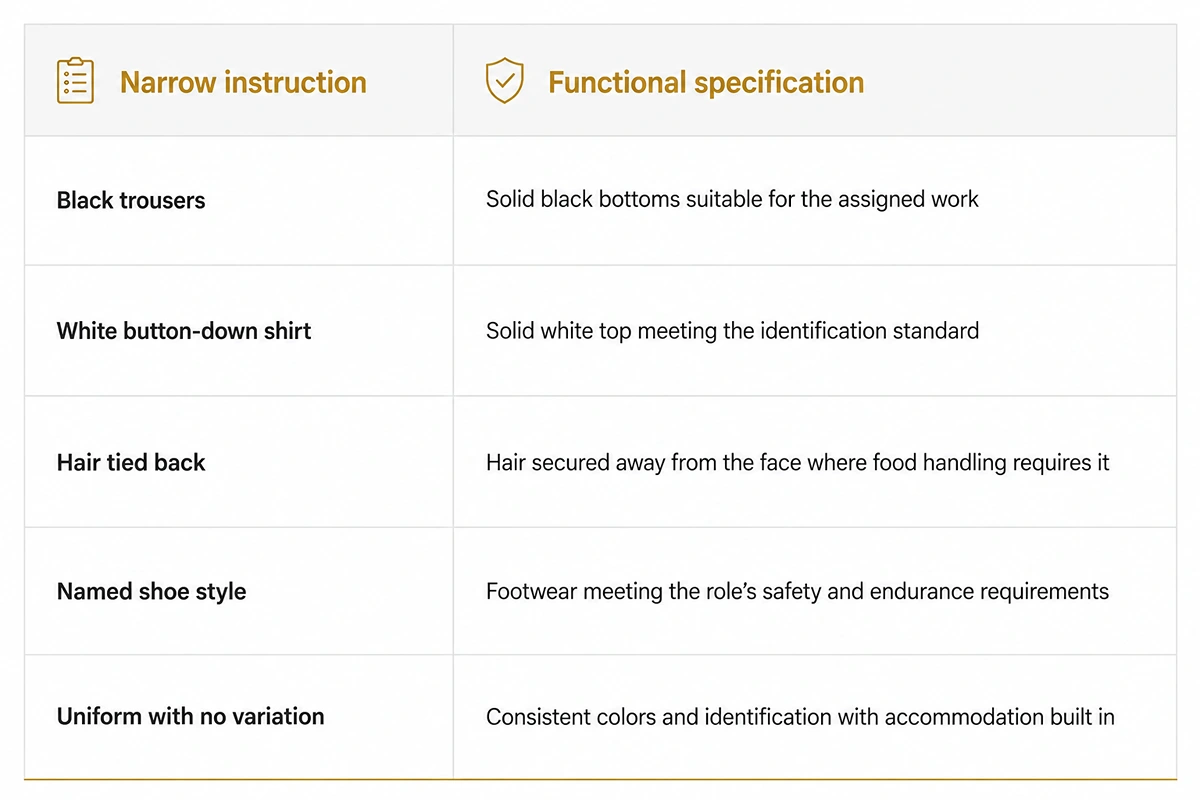
Specify color when it supports identification. Specify coverage where the work, weather, hygiene procedure, or hazard requires it. Describe the necessary function instead of prescribing garments, hairstyles, grooming choices, or appearance preferences that do not change job performance.
The EEOC guidance says covered employers must reasonably accommodate sincerely held religious dress and grooming practices unless doing so would create undue hardship. Following Groff v. DeJoy, the EEOC describes undue hardship as a burden that is substantial in the overall context of the employer’s business. Customer preference does not provide a defense for religious discrimination or justify moving someone away from a customer-facing role.
Resolve accommodation questions before the shift wherever possible. A client specification should not arrive at the venue door as an instruction for a team lead to interpret under time pressure. Functional drafting creates fewer conflicts because workers can meet the purpose of the standard through more than one garment or method.
This section provides practical drafting guidance and does not constitute legal advice. Federal, state, and local requirements may apply, and organizations should have their own employment policies reviewed by qualified counsel.
Ownership gaps cause dress code failures on shift
The host normally defines the event standard, while the staffing agency translates it into instructions the team can follow. Branded items, venue PPE, laundering, replacement, and on-site enforcement still need named owners. If those responsibilities remain assumed, the failure appears during check-in when there is little time to correct it.
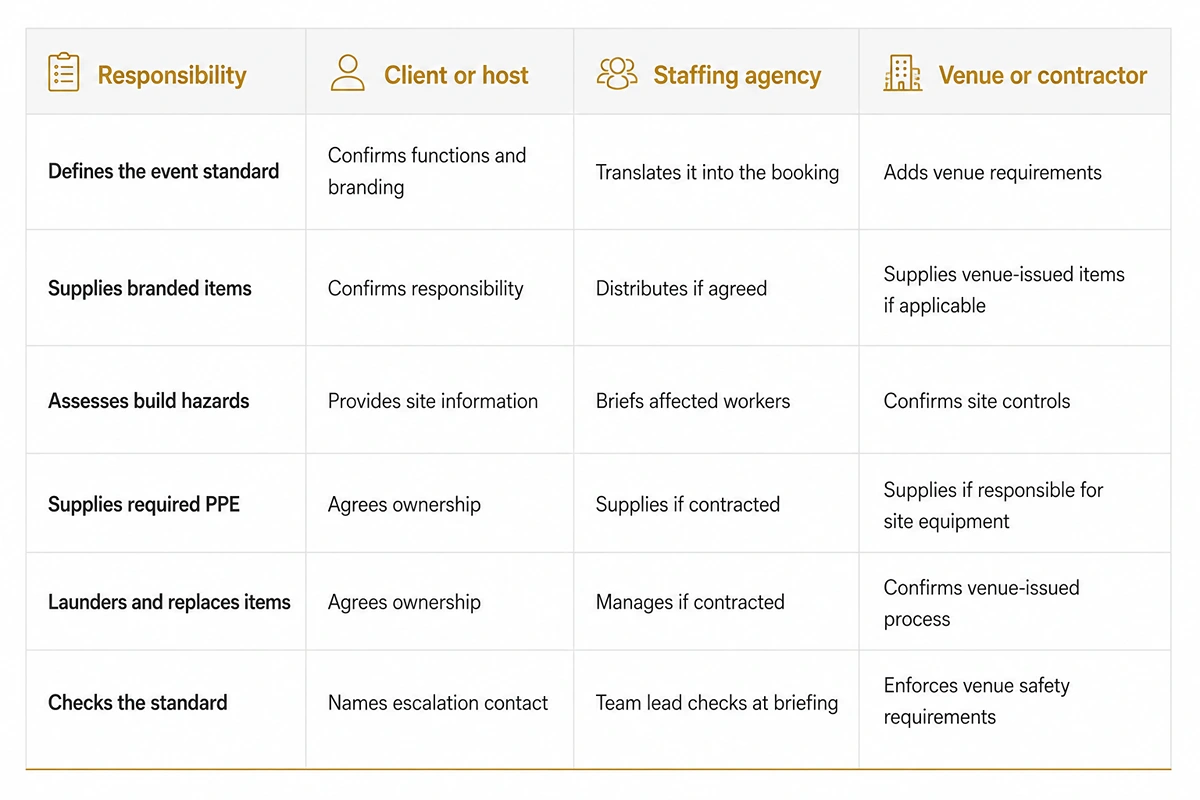
With Eventstaff, the client places the functional standard in the booking and confirms which items will be supplied. Eventstaff briefs the team, while the team lead checks the agreed standard and identification during the pre-shift briefing. Any conflict involving an accommodation, site condition, or missing supplied item should be escalated before deployment.
The booking should also explain what happens when the standard changes. If a sponsor replaces the branded top, the venue introduces a high-visibility requirement, or weather creates a need for additional layers, the revision must reach every worker and supplier. Record who approves the change and whether replacement items will be issued before the shift.
The same ownership belongs in the broader staffing plan. A team can arrive correctly dressed and still lose time if nobody has confirmed where branded items are collected or where build PPE is checked. Clear handoffs allow hospitality staff to move from arrival into briefing and assignment without the dress code becoming an event-day problem.
Bottom line
Begin your event staff dress code with four functions: safety, brand identification, guest recognition, and physical endurance. Write separate requirements by role and phase, especially when the same event includes a loading dock, guest-facing floor, outdoor entrance, and long standing shifts.
Specify colors, functional coverage, identification, and working conditions. Confirm who supplies branded items, who assesses hazards, who provides required protective equipment, and who checks the standard at briefing. Build accommodation into the wording and send unresolved policy questions to your own employment counsel.
The final test is practical: can a worker understand every requirement, prepare correctly, and explain how it helps them do the job? Once the specification meets that standard, get event staff who are briefed against it before arrival.
Ready to elevate your next event?
Join thousands of event planners who trust EventStaff.com for reliable, professional staffing solutions.
Trusted by event professionals nationwide
1k+
Events Staffed
2 million+
Guests Served
97%
Positive reviews