

The Event Operations Plan Template That Keeps Large Events Under Control
You have been asked for an operations plan, and the person requesting it expects nine supporting attachments covering responsibilities, communications, medical arrangements, safety, the site, and weather. They may be your venue, insurer, client, or a public safety agency.
This event operations plan template gives you the complete structure in one place. It adapts FEMA’s Incident Action Plan format into plain event language, with a cover sheet and separate annexes for each operational period. Complete one package for build, each show day, and teardown, then issue the relevant pages to the people responsible for delivering them.
Executive Summary
Event operations plan template blocks use a cover sheet plus nine attachments for each operational period. Build, show days, and teardown receive separate objectives and assignments, while unchanged communications, medical, safety, and site information can carry forward.
What goes in an event operations plan template
Your event operations plan begins with a cover sheet stating the period’s objectives and safety emphasis. Nine attachments then show who is in charge, what each team must do, and which supporting arrangements apply.
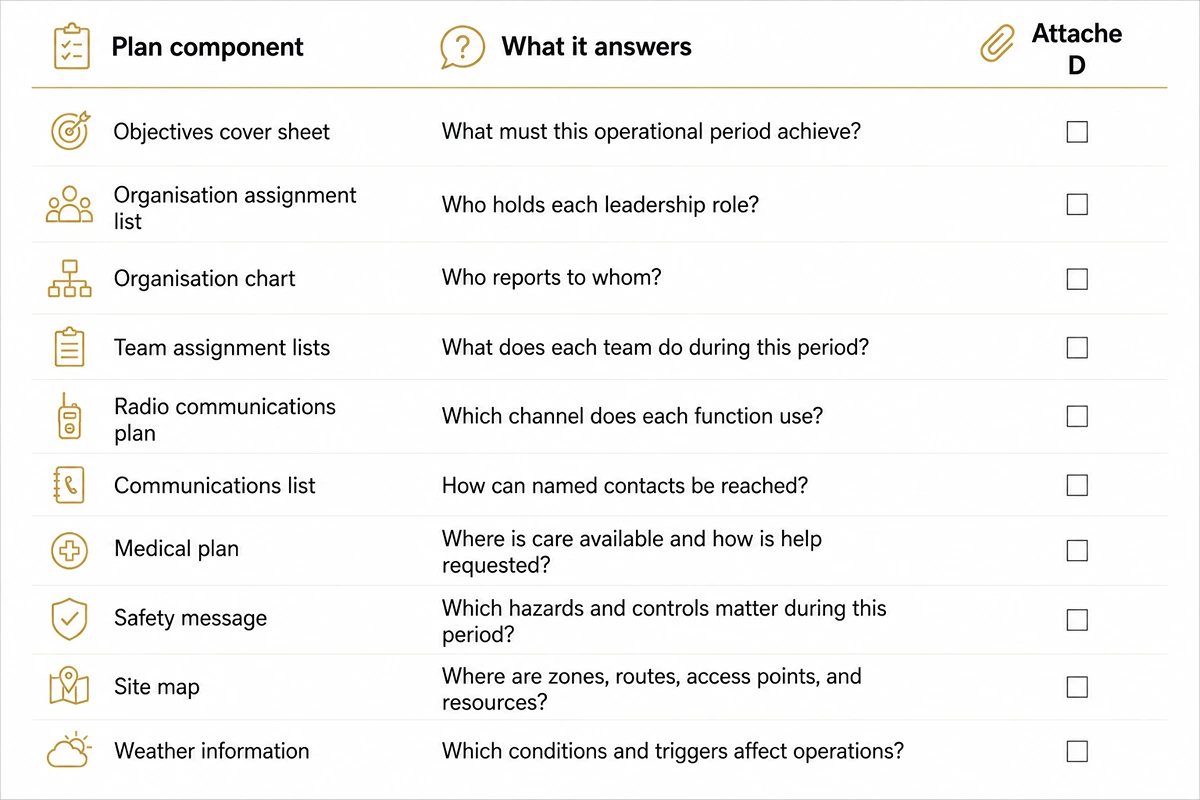
The cover sheet acts as the front door to the document. A supervisor should be able to open the event action plan template, identify the active period, see its objectives, and confirm which annexes have been issued.
Not every attachment will apply to every event. An indoor conference may not require a weather annex, while a complex outdoor event may need several pages of forecasts and trigger points. Record exclusions deliberately so an empty checkbox means “reviewed and unnecessary” rather than “forgotten.”
Build your event operations plan on the action plan
FEMA publishes its Incident Command System forms as US government resources that event teams can access and adapt. The ICS Forms Center provides the individual documents, while the forms booklet shows how they fit together.
The attraction of this structure is practical. Objectives, assignments, contacts, radio channels, medical details, safety information, and maps remain connected without being trapped inside one long document. A single annex can be updated and redistributed when one operational detail changes.
The framework serves this event operations plan template. You do not need to recreate an emergency-management organisation around a private event or use every field appearing on the original government forms.
Two terms need translating. An operational period is a defined working window such as build day, show day, or teardown. The incident commander becomes the person who holds operational authority during that period.
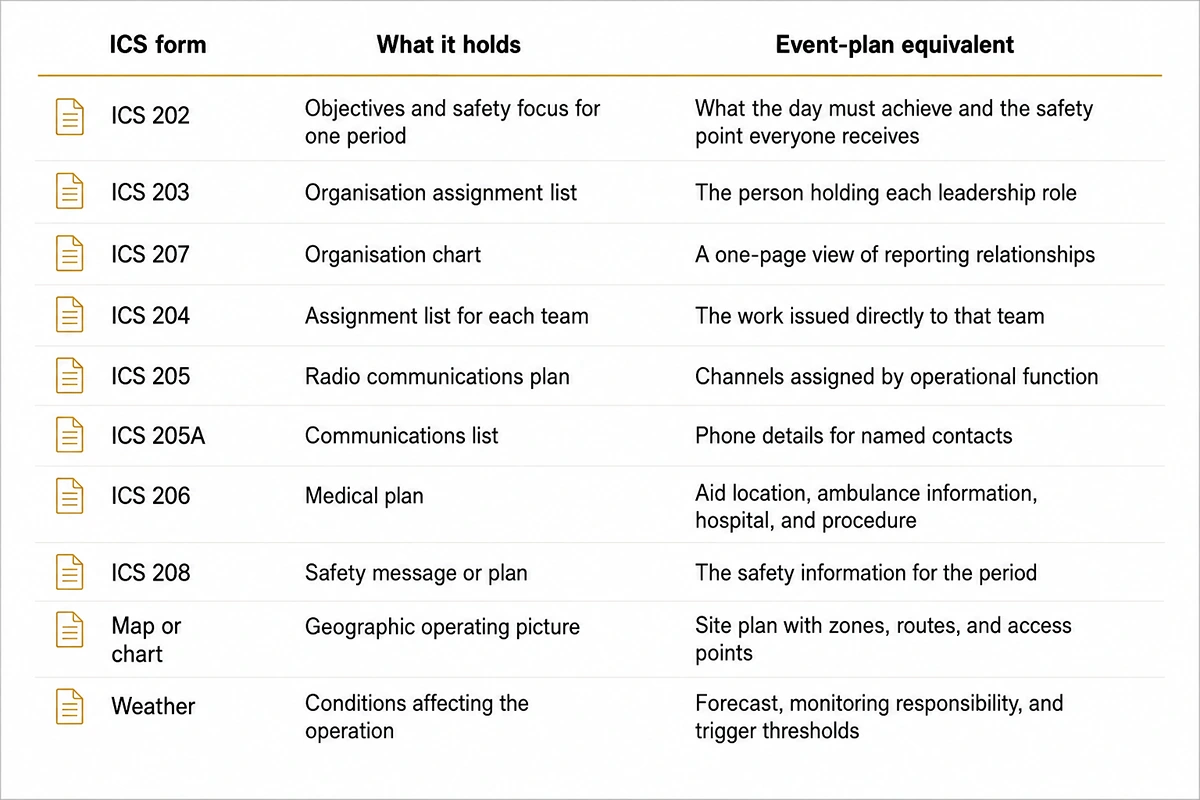
The FEMA course summary explains the preparation and distribution of the main forms. Anyone who wants the underlying command-system training can also take FEMA’s free ICS introduction.
The mapping table is a starting structure rather than a demand to preserve government terminology. Rename fields so event teams understand them immediately, but retain the operational relationships between objectives, named leaders, assignments, communications, and supporting annexes.
CEO Excerpt
“The plans that hold up are the ones where every person can find their own page within thirty seconds. A supervisor should not have to search through a long document to discover who reports to them, which channel they use, or what their team owns. The structure has to support decisions while people are already moving.” -- Daniel M., CEO of Eventstaff
Write one plan for each operational period
FEMA’s ICS 202 and ICS 204 forms are scoped to a named start and end time. Applying that rule to an event produces a practical insight: build, individual show days, and teardown should not share one set of objectives and assignments.
The people, companies, access conditions, hazards, and priorities change between periods. Build day may involve freight access, installation, electrical work, unfinished guest areas, and production testing. Show day introduces registration, speakers, attendees, scheduled programming, brand activity, and public-facing service expectations.
Teardown changes the operation again. It may begin after guests leave, involve loading docks and moving equipment, and place a different person in charge. Giving it a separate plan prevents load-out details from being reduced to a paragraph at the end of show-day instructions.
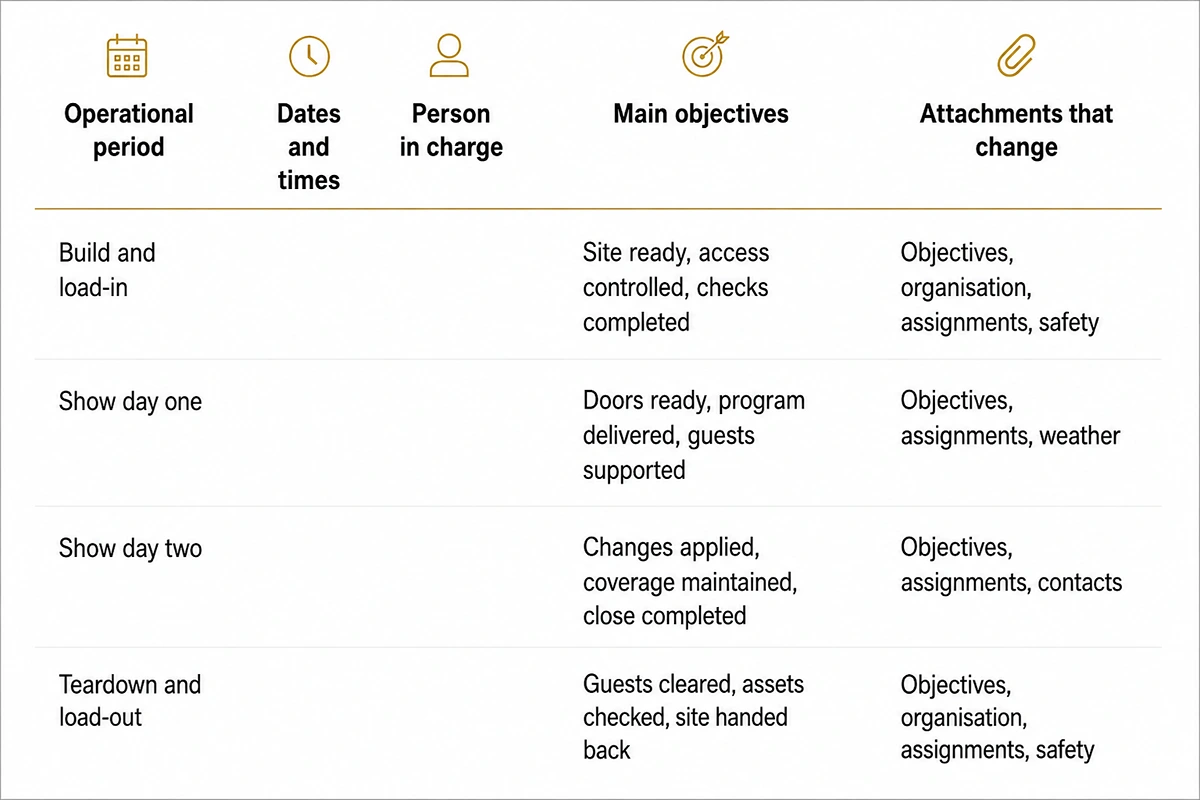
Most annexes can carry over with controlled updates. A site map may remain unchanged, while contact details, team assignments, or weather information require revision. Objectives should always be reconsidered because they belong to a specific period.
On a multi-day event, each show day also deserves its own review. Day-two assignments may change after registration demand falls, a room allocation changes, or the first day reveals a weak handover. Reissuing the relevant pages gives teams current instructions without rebuilding every unchanged annex.
Separate packages take longer to prepare. They are also the reason teardown, second-day corrections, and changing leadership arrangements are planned rather than improvised. ICS was designed for incident management, so this use for planned private events is an adaptation rather than a requirement. Scale the periods to your event. A single-room conference may need only a show plan and a combined build-and-close plan.
Set objectives and name who is in charge
The objectives cover sheet should give the period a clear beginning, end, operational purpose, command emphasis, and safety message. Keep objectives specific enough to confirm whether they were achieved.
Complete the objectives cover sheet
.webp)
“Deliver a successful event” cannot direct a team. “Complete registration setup and scanner testing by 7:15 a.m.” defines an outcome and deadline. “Confirm every emergency exit before guest arrival” identifies another result that can be checked and reported.
Objectives should also reflect the current operational period. Build-day objectives may cover access, installation, testing, and handover readiness. Show-day objectives may focus on guest arrival, program delivery, room changes, and a controlled close. Teardown objectives should cover asset checks, equipment returns, loading access, and venue handback.
The minute-by-minute timing within a period belongs in the run of show, which attaches to or accompanies the event operations plan.
Next, convert the organisation into named accountability. The FEMA model separates the organisation assignment list from the visual organisation chart, but both should show the same reporting structure.
.webp)
A department or company name does not complete the assignment. Every active row needs a human who can receive information and make or escalate decisions. If the person changes between periods, update both the organisation list and chart so teams do not follow a previous day’s reporting line.
Your staffing plan supplies the shifts and headcounts behind these leadership rows. The event operations plan records how those resources fit into the active command and reporting structure.
Give every team its own assignment list
The team assignment list translates the event operations plan into work. Create a separate page for registration, production, conference support, booth teams, brand ambassadors, crowd management, and each external operational group.
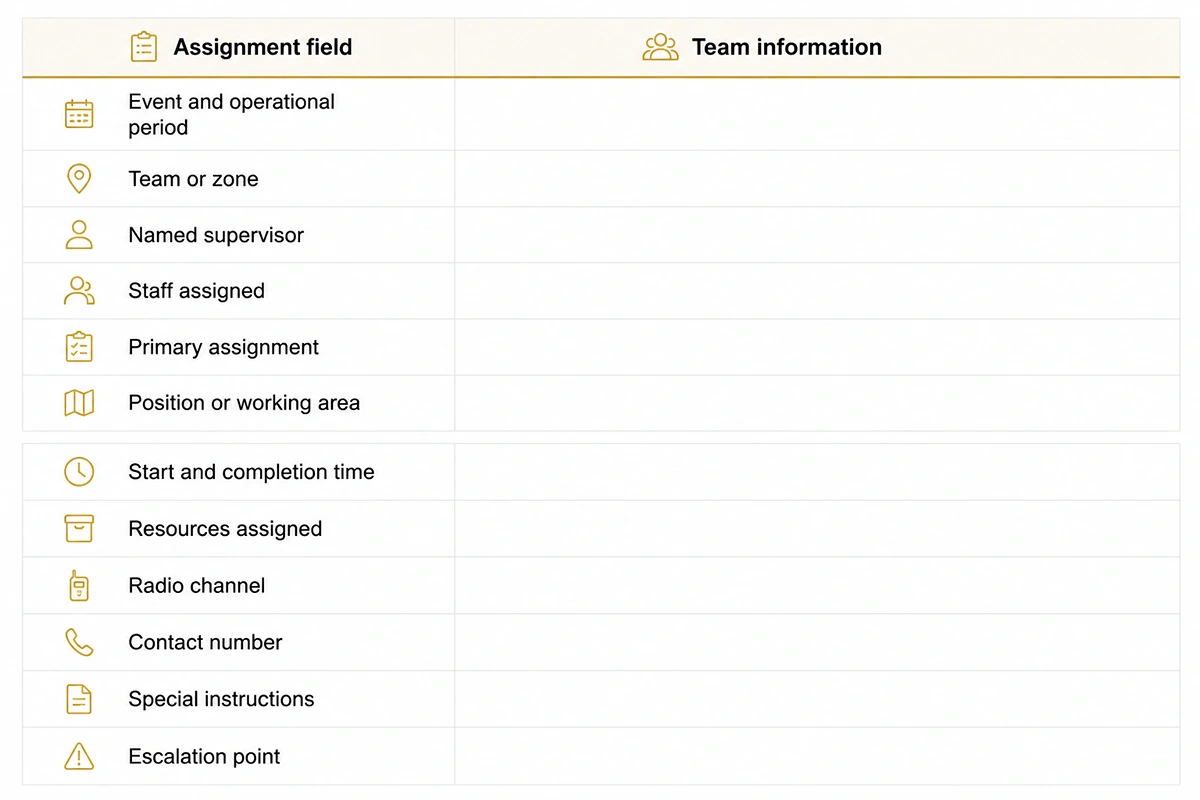
The assignment must describe what the team owns during the named period. “Support registration” leaves scope open. “Operate six badge stations from 7:30 to 10:00 a.m., route exceptions to the help desk, and report queue spillback to the registration lead” gives the team an executable instruction.
Resources should also be specific. Registration staff may need scanners, chargers, badge stock, credentials, and access to an exception list. Production support may need radios, cue sheets, room keys, carts, or approved access routes. Listing those resources allows the supervisor to confirm readiness before the assignment begins.
Information from the radio plan should be repeated on the assignment page so team members do not search for their channel. FEMA’s structure also treats the assignment list as something issued to the team, rather than a document stored only in the master plan.
The pre-shift briefing is how these assignments reach the crew on the day. For large deployments, an event team leader confirms attendance, communicates changes, manages breaks, and keeps assignments aligned with live conditions.
Need the crew your plan assigns? Talk to us.
Attach communications, medical and safety annexes
The communications and medical annexes are where an event operation connects most directly with venue teams and public safety resources. Many US fire, police, and EMS organisations use NIMS and ICS structures, making familiar information fields easier to recognise when an incident requires coordination.
Complete the communications annex
.webp)
Record who monitors each channel, rather than stopping at the channel number. Add phone contacts for people who do not carry radios and state how teams escalate when their primary method fails.
The plan should also separate routine traffic from emergency communication. A production channel carrying cue calls should not become the only route for reporting a medical issue. Confirm which function receives the first call, who contacts external help, and who keeps the event operations lead informed.
Complete the medical annex
.webp)
The medical plan should be completed with the medical provider, venue, and relevant agency rather than guessed by the event team. Include the physical access route for responders because the nearest entrance may be blocked by guests, production equipment, or controlled access.
Complete the safety-message annex
.webp)
The safety message must match the operational period. Build may prioritise powered equipment, overhead work, and incomplete public areas. Show day may focus on guest access, protected exits, room capacity, or weather. Teardown may return to loading activity, fatigue, and moving equipment.
The risk assessment attaches as the safety-analysis annex. A crowd management plan and security plan attach separately where required. Eventstaff’s crowd-planning guide owns the wider crowd methodology.
Using this familiar structure can make coordination more direct when an external agency becomes involved. Private events are not generally required to use ICS, however, and an agency is not obliged to accept a privately adapted plan. The benefit is practical interoperability rather than compliance status.
Log what happens and close the plan out
The checklist on the objectives cover sheet is a small but important control. It lets a supervisor see which annexes are attached without searching the complete document. An unticked item must be identified as unnecessary or incomplete.
Complete the plan-contents checklist
.webp)
Separate annexes allow controlled updates. If the hospital, radio channel, team supervisor, or weather trigger changes, the relevant page can be reissued with its revision time while the remaining package stays in force.
The cover sheet should show which version is active. Supervisors must be told which page changed, when it became effective, and whether previous copies should be destroyed or visibly marked as superseded.
FEMA’s supporting forms also recognise that operations require live records and a managed close. Use these event equivalents during and after each period.
.webp)
The activity log should record operationally important decisions, such as opening an overflow desk, moving a team, holding a room, changing a vehicle route, or replacing a radio channel. It becomes the factual record used to brief the next period and improve later events.
A planned close matters because staff, radios, credentials, equipment, vehicles, and vendor responsibilities remain active after guests leave. Treat teardown and demobilisation as an operational period with objectives, assignments, sign-out, equipment return, and a documented venue handback.
The checklist does not mean every annex is mandatory. Its value lies in forcing a decision. An indoor executive conference may exclude weather information, while an outdoor event may require detailed monitoring and triggers. Record the reason rather than filling irrelevant boxes.
Event operations plan support from Eventstaff
Eventstaff can supply the conference and registration staff, production support, booth staff, brand ambassadors, crowd control, greeters, and ushers named in your team assignment lists. Medical providers, licensed or armed security, and fire marshals remain external vendor or agency lines.
Our production teams work from named periods, supervisors, assignments, channels, and escalation points so instructions can move cleanly from the plan to the floor. They can also support check-in, room changes, speaker movements, activation coverage, and guest direction without blurring the authority established in the event operations plan.
With 500+ events staffed and 2M+ attendees, Eventstaff can provide the people required to deliver complex corporate events across build, show, and close.
Bottom line
Use the event operations plan template to create one package for each operational period. Start with the objectives cover sheet, attach only the annexes that apply, place a human name in every active role, and issue each team its own assignment page.
The completed event action plan template should show what is attached, what has changed, and what remains outstanding. It should also give supervisors a clear record of the decisions, resources, and handovers that shaped each period.
Once the assignment lists identify your staffing requirements, staff your event with Eventstaff.
Ready to elevate your next event?
Join thousands of event planners who trust EventStaff.com for reliable, professional staffing solutions.
Trusted by event professionals nationwide
1k+
Events Staffed
2 million+
Guests Served
97%
Positive reviews