
If someone’s asked you for a brand activation agency budget, you’ve probably noticed that the quotes and online guides are miles apart. One source says a pop-up starts at $5,000, another says $25,000, and both sound sure of themselves. Part of the reason is demand. The US spent $52.80 billion on experiential marketing in 2023, almost half the world’s total and the latest full-year figure from PQ Media, so every brand is chasing the same agencies and crews.
Most cost guides give one agency’s own ranges and stop there. This one puts the published ranges side by side with their sources, works out what the staffing line costs in five US cities, and shows you how to judge the whole budget by what each real interaction costs. By the end, you’ll have a number you can defend and the right questions to ask about any quote.
Executive Summary
A brand activation agency usually charges $50,000 to $250,000 for an activation in one city, according to Trademark, with sampling at the low end and tours well above it. This guide covers price ranges by type, where the money goes, staffing costs in five cities and cost per engagement, with every figure sourced.
How much a brand activation agency charges by activation type
Most brand activations cost between $50,000 and $250,000, and a mid-scale activation in one city often runs about $100,000, according to Trademark. At the low end, a retail demo or local pop-up can cost $5,000 to $25,000, while multi-city tours and big festival setups start around $250,000 and can pass $1 million.
Barnastics publishes the most detailed breakdown by format, and Action Flipbooks and Top of Mind PR add their own figures. Here’s how the published ranges line up:

The ranges agree more than they first look. Barnastics, Trademark and Action Flipbooks all put a polished activation in one city somewhere between $50,000and $300,000, and all three put tours and festival setups in six or seven figures. These are the agencies’ own estimates with no audit behind them, but when three firms land in the same place, you’ve got a fair benchmark for checking a quote.
Why the same activation gets such different quotes
If two quotes for what sounds like the same pop-up are $50,000 apart, check these three things first:
• Custom building. A set built from scratch for your brand costs far more than a rented or reusable one, and it’s often the biggest line in the quote.
• The city. Venue fees, permits and staff pay all run higher in New York or Los Angeles than in Dallas or Atlanta, as the staffing table further down shows.
• How many days it runs. Every extra day adds staff hours, venue time and storage, so a four-day event costs a lot more than a one-day event with the same set.
CEO Excerpt
Brands negotiate every dollar on the build and then accept whatever staffing line comes attached to the quote. That’s backwards. The set gets photographed, but the staff are the only part of the budget every attendee actually talks to. Before you compare totals, ask each agency who’ll be on the floor, how they’re trained on your product and who’s leading them on the day. Those answers tell you more than the bottom line. -- "Daniel M., CEO, EventStaff"
Where the money goes in a brand activation agency budget
Barnastics also publishes a typical split of an activation budget, which is handy for checking whether a quote looks lopsided:
• Building the set: 20% to 40%, covering the structures, signs and displays
• Production management: 15% to 25%, for the people who run the timeline, the vendors and the setup
• Staffing and labor: 10% to 25%, for everyone who works the activation or helps set it up
• Strategy and creative: 10% to 20%, for the idea, the design and the plan
• Venue, permits and insurance: 5% to 20%
• Technology, sign-up tools and content: 5% to15%, such as screens, sign-up forms and photo or video
This is one agency’s own guide, and the split moves with the format. Sampling leans on staff and logistics, while pop-ups lean on the venue and the set. Use it as a sense check, so if a quote for a simple sampling run puts half the budget into building a set, ask why.

What brand activation companies include in their fee
The agency’s own fee pays for the thinking and the running of the activation: the strategy, finding and managing vendors, keeping production on schedule, coordinating staff and reporting on results afterwards. Some agencies show this as a separate fee, while others fold it into every line. Ask each agency to split its quote along the lines above, so you can compare two quotes line by line and spot where one is padding or cutting corners. For a fuller picture of the role itself, see what agencies do.
What the staffing line costs in five US cities
To make the staffing line real, take a simple three-day pop-up with four brand ambassadors working eight-hour shifts, which comes to 96 staff hours. Instawork publishes average pay for temporary brand ambassador shifts by city, and says a business pays that rate plus a 20% to 65% markup to cover payroll taxes, workers’ comp insurance and fees. Here’s what that works out to:
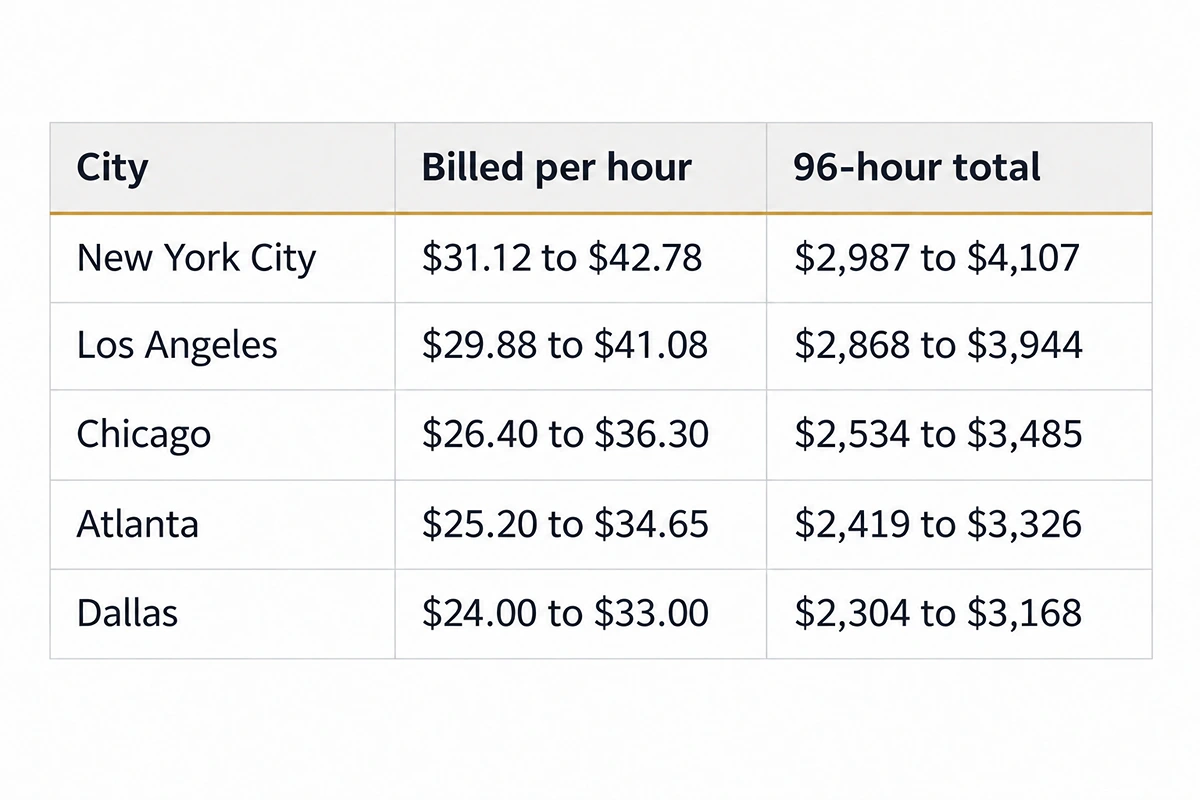
A New York staff hour costs about 30% more than one in Dallas, because average pay is $25.93 there against $20.00. Keep in mind these are rates for shifts booked through a staffing app, before any team lead, training, travel or overtime.
What the hourly rate leaves out
Treat these figures as the floor. A shift booked through an app gets you a person for the hours you booked, and that’s all. It doesn’t include training on your product, someone checking they’ve worked an activation like yours before, a backup if somebody doesn’t show, or anyone running the team. That’s why agency-managed teams cost more, and our premium staffing budgets guide covers those higher market rates.
Someone also has to run the activation on the day: scheduling shifts, setting up the space, fixing problems and keeping count of results. That’s the job of a production team, and four brand ambassadors on their own won’t cover it. For pay by role, see our hourly staffing rates guide.
Even so, staffing is a small line. On a $50,000 pop-up, the 96-hour team above comes to under 10% of the budget, which is below the 10% to 25% Barnastics suggests, because that range assumes longer runs, team leads and specialist roles. It’s the cheapest line to get right, and it’s the only part of the budget attendees actually meet.
How to judge a brand activation agency quote by cost per engagement
Cost per engagement is your budget divided by the number of people who actually do something with the activation, such as trying a sample, playing the game or giving you their email. It’s the best figure for comparing an activation with your other marketing, because it counts real interactions and ignores people who simply walked by. Here’s how much the choice of number changes the picture:
1. $75,000 ÷ 10,000 attendees who saw theactivation = $7.50 per attendee
2. $75,000 ÷ 800 people who engaged with it =$93.75 per engagement
Same activation, same budget, and the second figure is more than 12 times the first. The example comes from Extraordinary, a production company, and the numbers are illustrative, but the lesson holds. Cost per attendee makes every activation look cheap, so always ask which per-person number an agency is quoting. Then agree in writing, before the event, exactly what counts as an engagement, so nobody can redefine it afterwards to make the results look better.
Check the activation can handle the crowd
A target also has to be physically possible. Hitting 2,000 engagements in a six-hour day means dealing with about 333 people an hour, or more than five a minute. Ask the agency how many people each station and each staff member can handle in an hour, then do the sum yourself. If the setup can’t move that many people, the target won’t happen, however good the idea is. Our activation ROI guide covers the full method for measuring results.
Hidden costs brand activation companies leave out of a first quote
First quotes tend to cover the headline items and leave the smaller ones for later. Before you sign, ask each agency whether these are included:
• Permits from the city or venue, which can take weeks to come through
• A certificate of insurance, the proof of cover most venues need before you can set up
• Venue overtime if setting up or taking down runs past the agreed hours
• Shipping and storage for the set before and after the event
• Power and Wi-Fi, which many venues charge for separately
• Travel, hotels and meals for any staff brought in from out of town
• Rush fees when the timeline is short
• A written report after the event, if you want the results pulled together
Trademark suggests holding 15% to 25% on top of the quote for overtime, permits, shipping and changes along the way. It’s an agency’s estimate, but it’s a sensible starting point.
When to hold a bigger buffer
Lean toward the top of that range when the timeline is tight or the site is outdoors. Barnastics suggests allowing four to eight weeks to plan a sampling run, eight to twelve weeks for a custom pop-up and three to six months or more for a large or multi-city activation. Book inside those times and rush fees become likely, while outdoor sites add weather, power and permit risks on top.
How to bring a brand activation agency quote down without losing results
The safest savings come from doing less and doing it well. One strong city usually beats five cities with a small budget each, because every extra market adds travel, permits and a new crew to train. One main experience is easier to run than several, since each extra station needs its own build and its own staff. And because building the set is often the biggest line, swapping a set built from scratch for a rented or reusable one is where the largest savings tend to sit.
Timing saves money too. Booking within the planning times above avoids rush fees, and a set designed to pack down and travel can be reused in the next city, which spreads its cost across several events. The one line worth leaving alone is staffing. As Daniel says above, it’s the part every attendee meets, and as the city table shows, it’s a small share of the total.

Planning your brand activation budget
Start with your goal and your city. Check the published range for your format in the table above, price the staffing line for your market, and set a cost per engagement target before you ask for quotes. Then ask every agency to split its quote the same way, so you’re comparing like with like. If you’d like help with the people side, talk to us about staffing your brand activation.
Ready to elevate your next event?
Join thousands of event planners who trust EventStaff.com for reliable, professional staffing solutions.
Trusted by event professionals nationwide
1k+
Events Staffed
2 million+
Guests Served
97%
Positive reviews