

The Trade Show Booth Staff Schedule Template
This trade show booth staff schedule template helps you plan how many people to book, organise them into daily shifts, protect breaks, and maintain the right roles during busy floor periods. It brings together a worked day-one rota, blank grids for days two and three, and the underlying coverage calculations behind each shift. By working through the booth profile first, then completing each table with your show hours, team size, appointments, and expected traffic, you can build a rota that reflects real show conditions rather than guesswork and helps avoid under- or over-staffing on the show floor.
Executive Summary
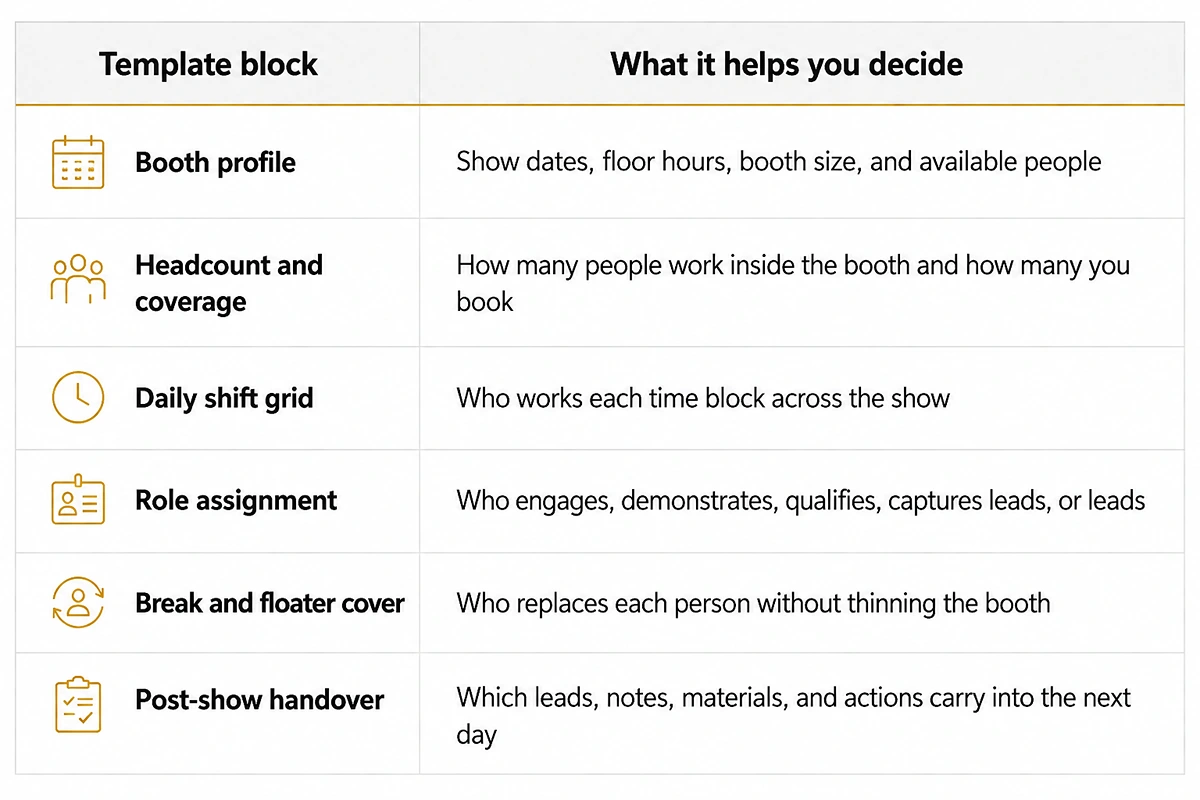
Trade show booth staff schedule template blocks include headcount, daily shifts, roles, peak coverage, breaks, and handovers. Keep at least two people active in a staffed booth and book enough additional people to preserve that coverage throughout the day.
What the trade show booth staff schedule template covers
The six blocks move from basic show information to a completed booth staff schedule. Fill them in order so the headcount, daily shifts, and break rota remain connected.
For wider event roles, access, and contingencies beyond the booth, use the staffing plan template.
Work out your booth headcount before building the rota
The most widely used industry benchmark is one active staff member per 50 square feet, with a working minimum of two people on the floor. This ratio is used as a quick planning tool to translate booth size into a realistic engagement capacity, helping exhibitors avoid under-staffing during peak traffic or leaving key areas unattended.
Pure Exhibits’ staffing guidance presents that ratio as a starting point and explains why two active people protect conversations when another visitor approaches. It ensures one staff member can stay engaged while the other acknowledges, queues, or redirects additional attendees.
In practice, this baseline also helps account for natural interruptions such as product demonstrations, lead capture, or short breaks. These moments can quickly reduce effective coverage if only a single person is assigned per zone.
For example, a 10x10 booth may technically function with two people, but adding a third allows continuous engagement without leaving the stand unattended. Larger spaces like a 20x20 booth scale this logic across multiple engagement points or demo areas.
The ratio is not a strict rule but a planning reference. It should be adjusted based on show traffic, appointment density, and the complexity of conversations required.
The floor figure tells you how many people can actively work inside the booth. The booking figure adds relief for breaks, meetings, handovers, and short absences.
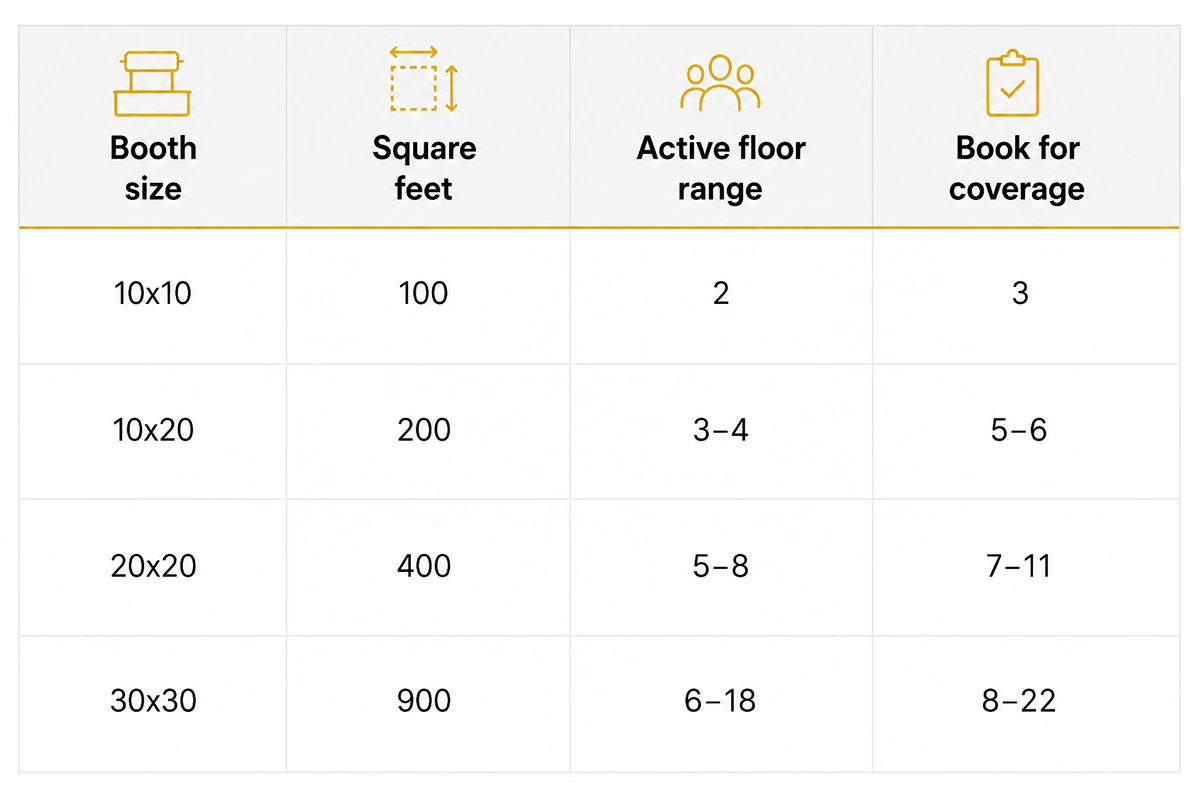
The upper figures apply the one-per-50-square-foot benchmark across the full footprint. Many larger booths dedicate space to storage, meeting rooms, displays, or stages, leaving less active engagement space. Calculate staffing against the usable booth area and the number of roles or zones that must operate simultaneously.
A 10x10 booth demonstrates the coverage problem clearly. Two people may be the correct number on the floor, but booking only two leaves one person alone whenever the other takes a break, attends a meeting, or handles an off-booth task. Across an eight-hour day, those gaps can accumulate quickly.
Book three people so two can remain active while the third rotates out. Scale larger booths using the same principle: booth capacity sets the active headcount, while the break pattern determines the number booked. These are industry planning benchmarks rather than requirements. Show hours, break lengths, appointments, booth format, and local practice can all change the multiplier.
CEO Excerpt
“The exhibitors who struggle usually have enough people to make the booth look occupied at opening. They have not worked through what happens at lunch, during client meetings, or late in the afternoon. I want to see who replaces every person before the show starts, because that is when a headcount becomes a usable schedule.” - Daniel M., CEO of Eventstaff
Check your capacity against the show’s actual audience
Booth size is only one input. The schedule must also account for the number of people the team may realistically need to engage, qualify, and follow up with during the show, since audience demand can quickly exceed what a small team can handle.
Trade Show Advisor reports CEIR research estimating that 16–20% of show attendees may have some level of interest in a given exhibitor’s product or service. At a show with 5,000 attendees, that produces an interested-audience range of 800–1,000 people. This matters because even a modest percentage of “qualified interest” can translate into hundreds of meaningful conversations, which directly impacts how many staff you need on the floor at any one time and how aggressively you must structure shifts, breaks, and coverage to avoid missing high-value visitors.
Use the following capacity check before finalising your booth staff schedule.
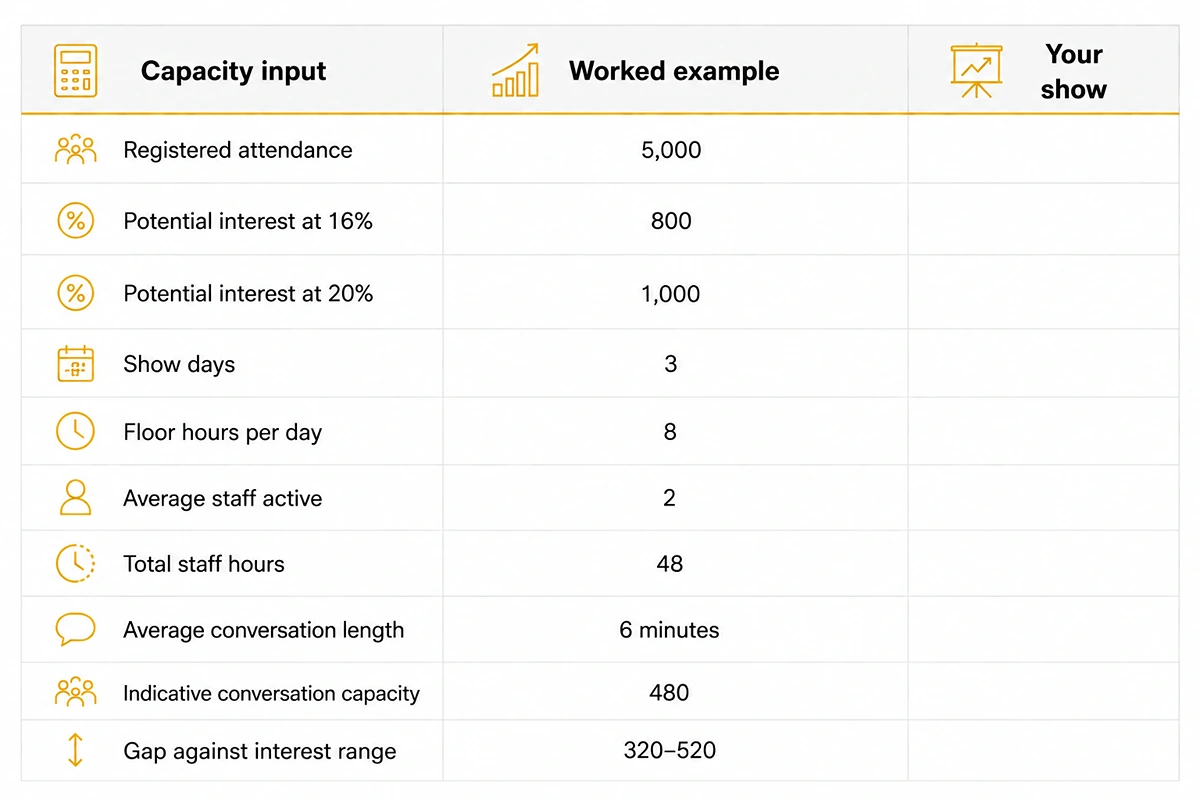
Calculate total staff hours as:
show days × floor hours × average active staff
Then estimate conversation capacity as:
staff hours × 60 ÷ average conversation minutes
The result is a sanity check rather than a lead forecast. Interest does not guarantee a visit, and some visitors will speak to more than one person. Demonstrations, scheduled meetings, note-taking, and handovers also reduce theoretical capacity.
However, a large gap tells you the rota has limited ability to absorb the show’s potential demand. Scheduling more people during verified peak periods increases capacity without requiring more booth space or a redesigned exhibit.
It also helps to think in terms of conversation flow rather than raw headcount. Even a well-staffed booth can become congested if too many staff are tied up in long discussions at the same time. By mapping when those deeper conversations are most likely to happen, you can deliberately stagger your senior staff so there is always someone available to open new interactions and keep the booth visually active.
Finally, remember that capacity is not just about handling volume but about protecting quality. When teams are stretched too thin, qualification becomes rushed, follow-ups are missed, and valuable prospects slip through unnoticed. A properly balanced rota ensures that every visitor is acknowledged, every lead is captured cleanly, and no opportunity is lost simply because everyone was busy at once.
Short on people for your next show? Talk to us.
Build the daily shift grid around floor hours
Trade show traffic rarely arrives evenly. Pure Exhibits’ 2026 trade show statistics report that 76% of attendees arrive with a pre-planned list of booths. Appointments, keynotes, sessions, demonstrations, and hosted events then influence when those visits occur.
Check the organiser’s agenda, your appointment calendar, and previous show reports before assigning coverage. Use quieter periods for breaks and handovers rather than assuming every hour needs the same headcount.
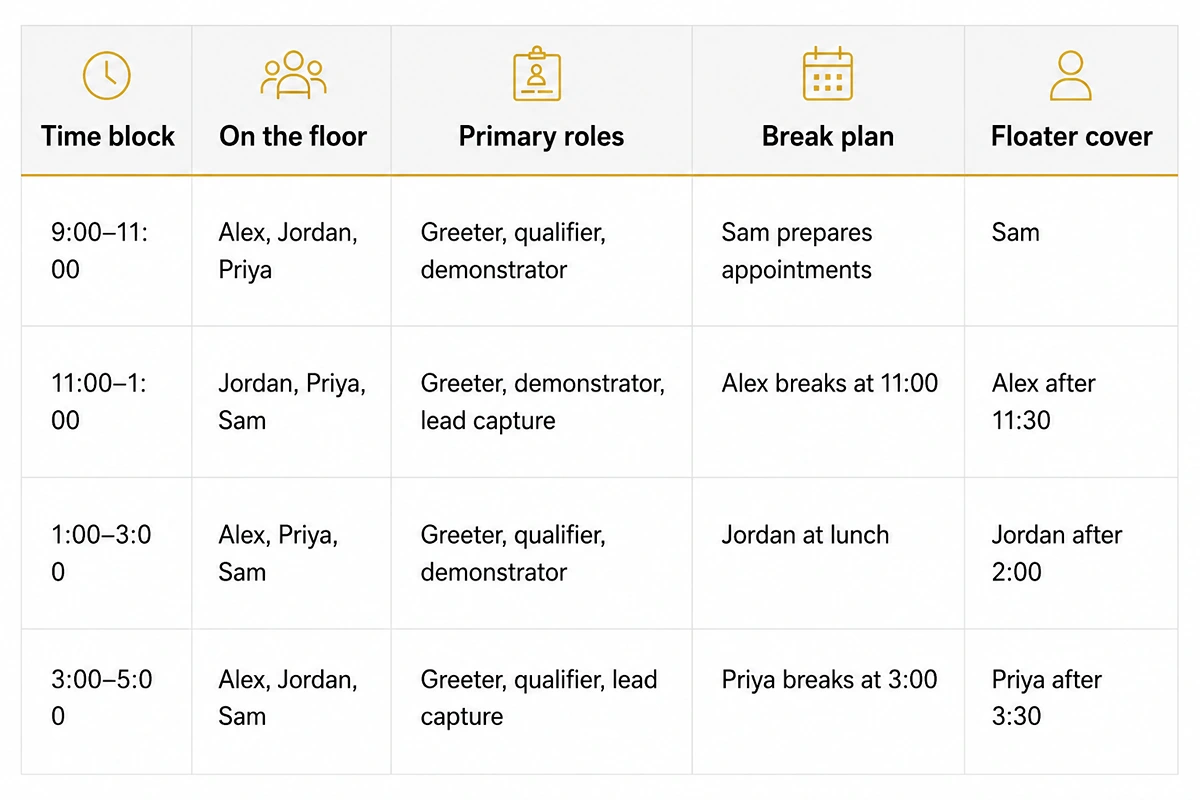
Worked day-one booth staff schedule
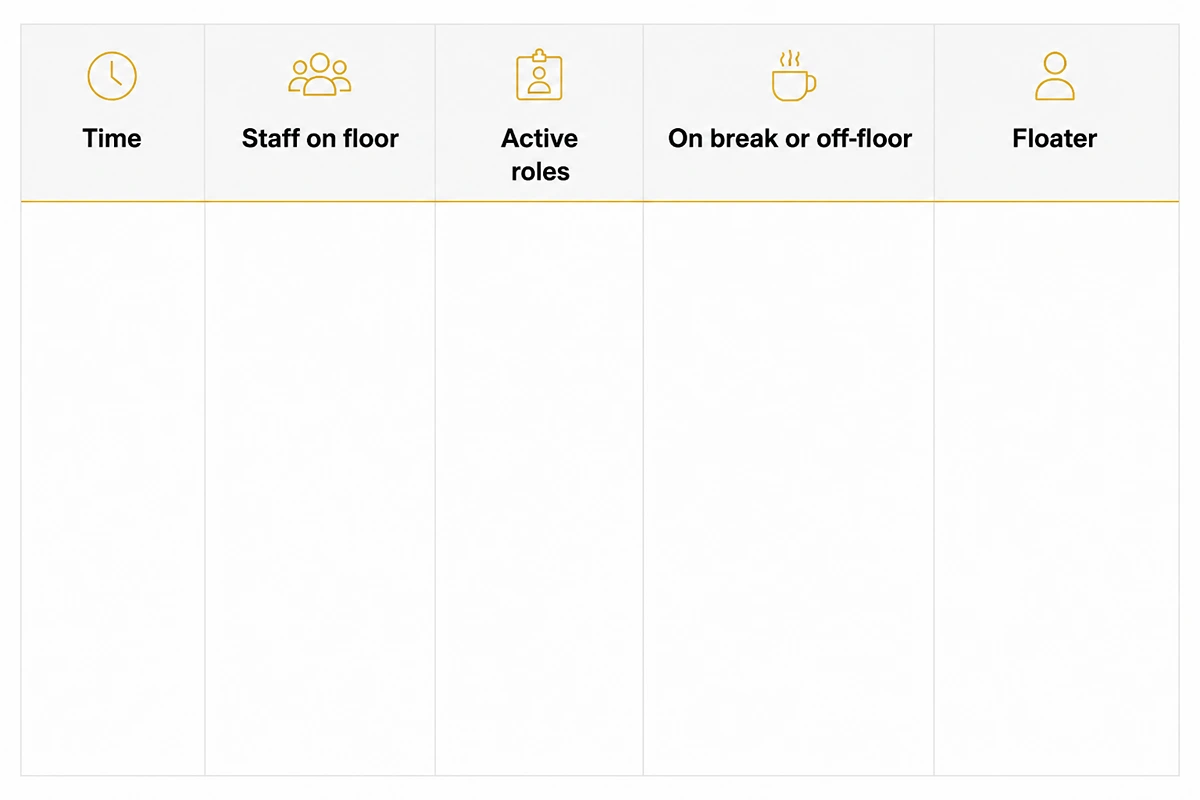
Complete your day-two schedule
Complete your day-three schedule
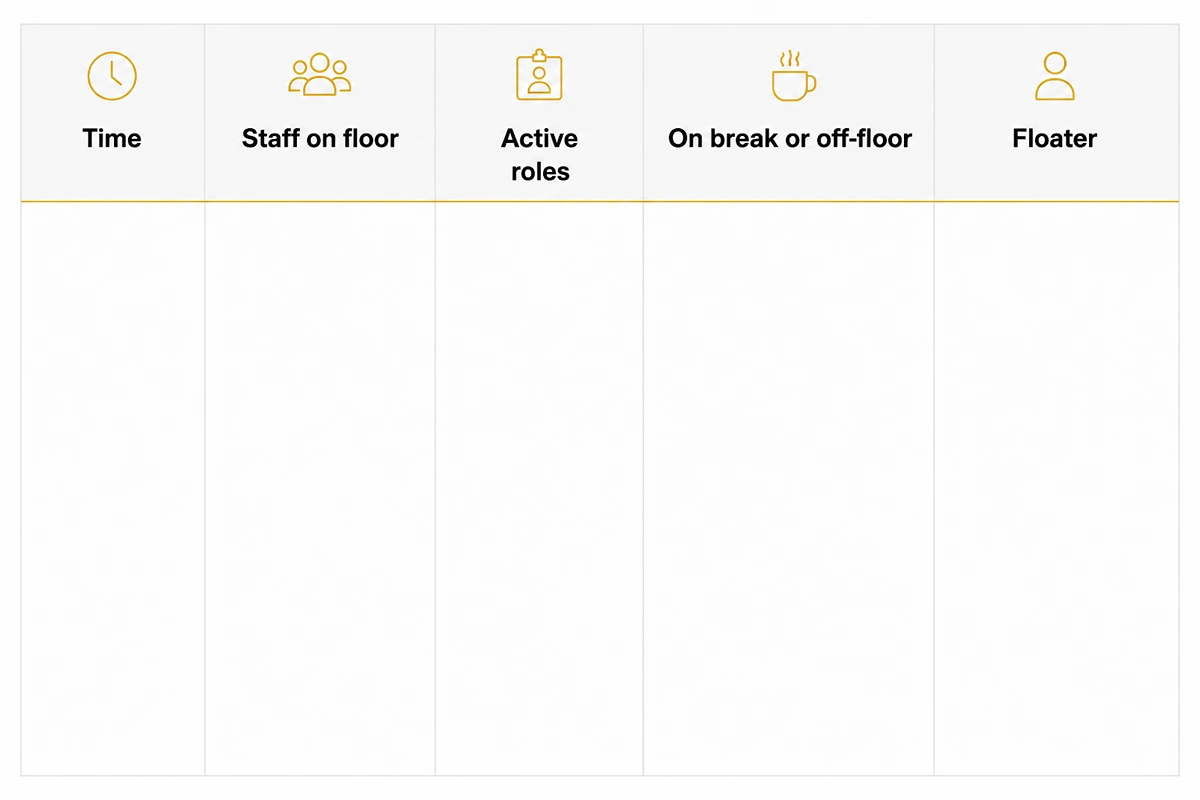
The first day may deserve additional coverage when appointments and pre-planned visits concentrate there, but verify that against the particular show. The final day may also thin before close, although departures, closing sessions, or final buying windows can alter the pattern. Build the trade show booth staff schedule around evidence from the event rather than a generic traffic curve.
Protect your peak hours with fresh staff
Research synthesised in ShowHero’s 2026 industry report places average booth dwell time at approximately 4.2 minutes, compared with 5.8 minutes in 2019. It also reports that 71% of attendees cite visual presence as a driver of unplanned visits and that 54% of purchases or follow-up conversations begin with an unplanned booth visit.
These figures are attributed by ShowHero to underlying CEIR, Exhibitor Magazine, and IAEE research. They show why walk-by traffic needs active coverage alongside booked meetings.
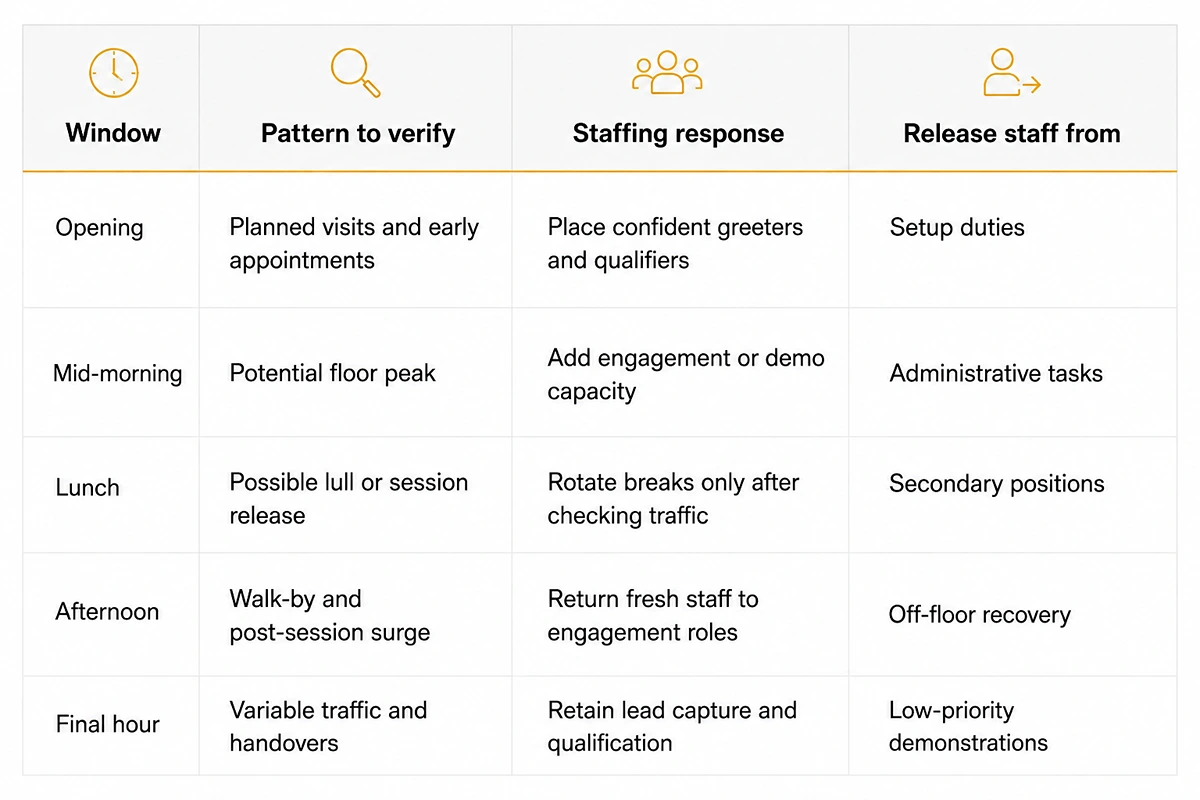
A shorter interaction window increases the cost of a slow opening. Eventstaff’s 60-minute training format gives ten minutes to qualification methodology and twenty minutes to roleplay because staff must establish relevance quickly.
A person several hours into an unbroken shift may take longer to open, qualify, or record the next action. Rotation therefore protects throughput as well as staff welfare. Schedule fresh people at doors, verified session releases, and the strongest afternoon window.
The 4.2-minute figure is an average across multiple booth types and show formats. Product demonstrations may run considerably longer, while sampling interactions may be much shorter. Replace the average with your own expected interaction length when completing the schedule.
Schedule breaks and floater cover together
A break schedule written after the shift grid will usually collide with it. Add breaks while assigning floor roles so every absence has a named replacement.
Industry guidance varies by role and show length. Pure Exhibits recommends avoiding more than three to four consecutive hours on the floor without a break, while Eventstaff’s booth-team guide recommends shorter rotations for intensive greeting roles and 15-minute recovery breaks every two to three hours.
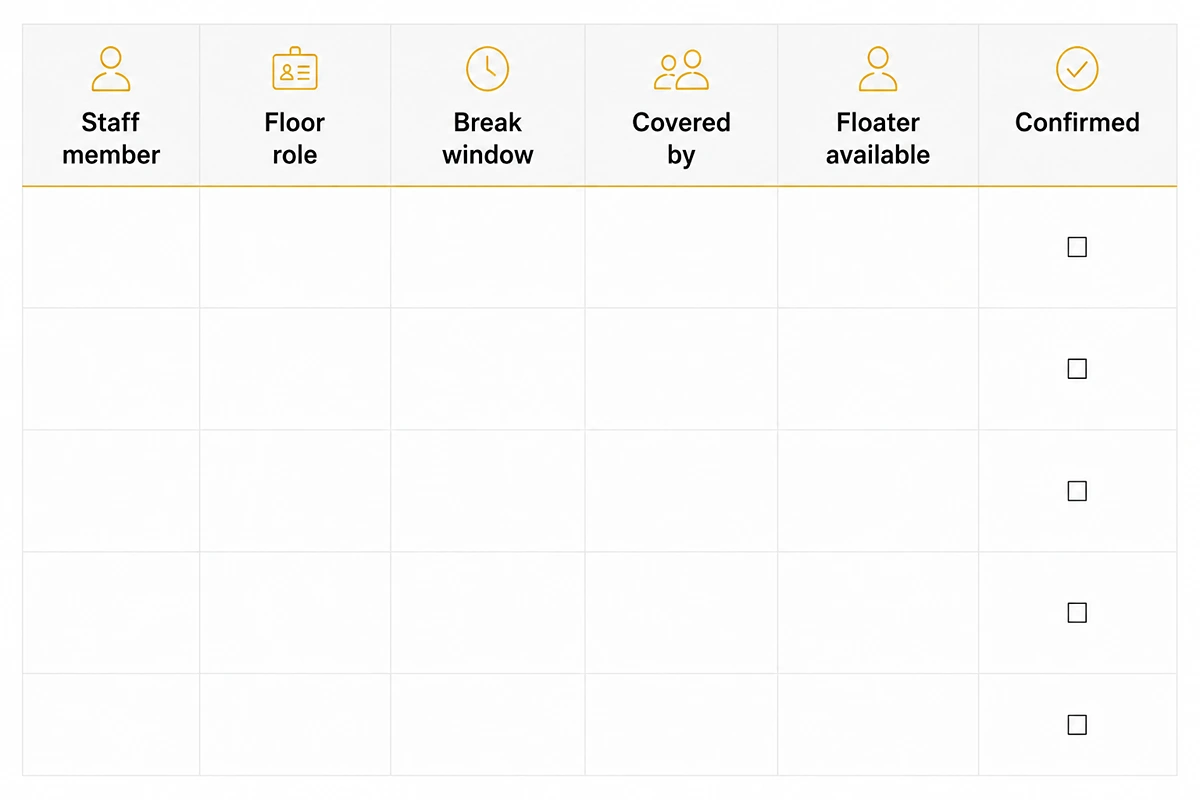
For larger deployments, Eventstaff uses zone-based rotations with approximately one floater for every 10–12 staff. A floater should be briefed for multiple roles and given a clear activation order rather than being left to circulate without purpose.
Keep a backup buffer for no-shows, delayed arrivals, meetings, and unexpected traffic. The appropriate buffer depends on the show and travel risk. Use the booth staff schedule to show who covers each break, then confirm that the replacement possesses the required product, demonstration, qualification, or lead-capture knowledge.
Brief and train your booth staff before day one
A shift grid assumes that each person knows what to do when the handover occurs. Eventstaff’s trade show training covers product context, demonstration skills, qualification, customer etiquette, roleplay, and materials within a focused 60-minute module.
Every person on the rota should be able to qualify around three questions: the prospect’s problem, timeline, and authority. That frame helps staff decide whether to continue, route the visitor to a specialist, or record an appropriate follow-up within a short conversation.
Exponents’ training guidance reports CEIR findings that training represented roughly 1% of trade show budgets in 2012 and approximately 2% by 2017. The schedule should therefore include training and the pre-opening briefing as planned time rather than informal preparation.
For larger teams, designate a lead who owns attendance, role changes, breaks, and handovers. Eventstaff’s team-leader guide explains how that responsibility works across live event deployments.
Trade show booth staffing support from Eventstaff
Eventstaff supplies booth staff, brand ambassadors, and product demonstrators against a completed booth staff schedule. The additional team can cover greeting, demonstrations, qualification, lead capture, and breaks while internal sales or product specialists focus on technical and high-intent conversations.
With 500+ events staffed and 2M+ attendees, Eventstaff can fill the gaps that small internal teams struggle to absorb across multi-day shows. Installation crews and licensed security remain separate vendor functions rather than rows on this rota.
Bottom line
Use the trade show booth staff schedule template to size the active team, book enough people for full floor coverage across all show hours, and validate staffing levels against the expected audience size and traffic patterns. It also helps you identify when to place fresh, well-rested staff into verified peak periods so engagement and lead capture remain consistent throughout the event. Write breaks and shifts together so each absence has a clearly assigned named replacement, ensuring there are no gaps in coverage and the booth remains fully operational at all times.
Once the completed trade show booth staff schedule template reveals the remaining gaps, get booth staff from Eventstaff.
Ready to elevate your next event?
Join thousands of event planners who trust EventStaff.com for reliable, professional staffing solutions.
Trusted by event professionals nationwide
1k+
Events Staffed
2 million+
Guests Served
97%
Positive reviews