
Your Event Production Schedule Template Needs More Than Times
Six production phases sit between first site access and final venue handback. Several vendors have one load-in window, each supplier has its own order of work, and everyone arrives expecting the space they need to be ready. The event production schedule template has to turn those competing assumptions into one sequence.
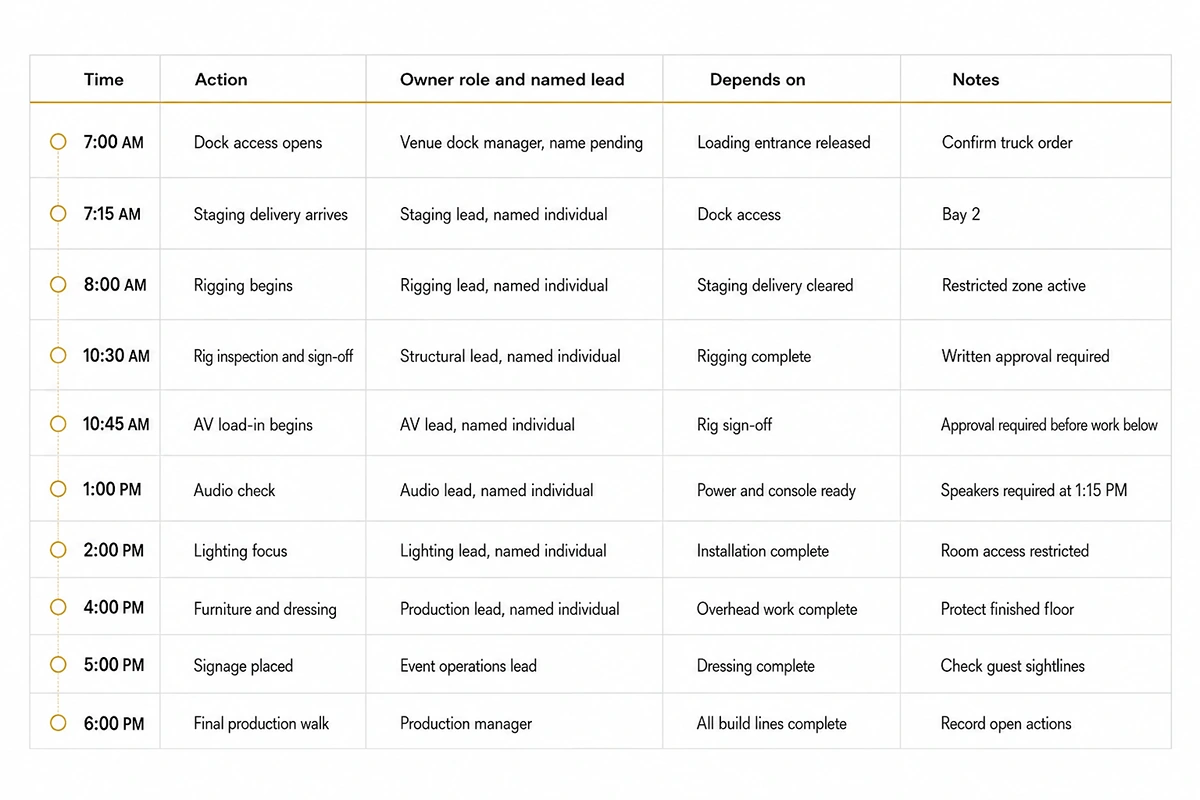
Every line needs a time, an action, an owner, a dependency and notes. Together, those five fields show what happens, who accepted responsibility and what must finish before the next activity can begin. This guide builds the complete show-week document from pre-load-in through strike, including the handovers and sign-offs that often disappear between supplier schedules.
Executive Summary
Event production schedule template fields should cover pre-load-in, build, rehearsal, show day, strike and handback. Give every action a time, named owner and dependency, then schedule handovers, sign-offs and contingencies as individual lines so the whole crew can work from one document.
Your schedule needs five columns and six phases
A production schedule becomes useful when each supplier can locate its call time, required action and starting condition without reading the entire document. Five columns provide that information: time, action, owner, dependency and notes. Keep them consistent across every phase so people do not have to interpret a new format halfway through the week.
The six phases should remain visible at the top level. They help the production manager check whether the document continues through strike and venue handback, and they give suppliers a quick way to filter the lines that affect them.
Each phase should end with a condition that allows the next one to begin. “Load-in complete” is too broad when scenery has arrived but remains unassembled, or when staging is in place but has not been released for overhead work. Write the outcome that the receiving team needs: access route cleared, inspection recorded, power available or work zone released. The schedule then controls progress through completed conditions as well as clock times.
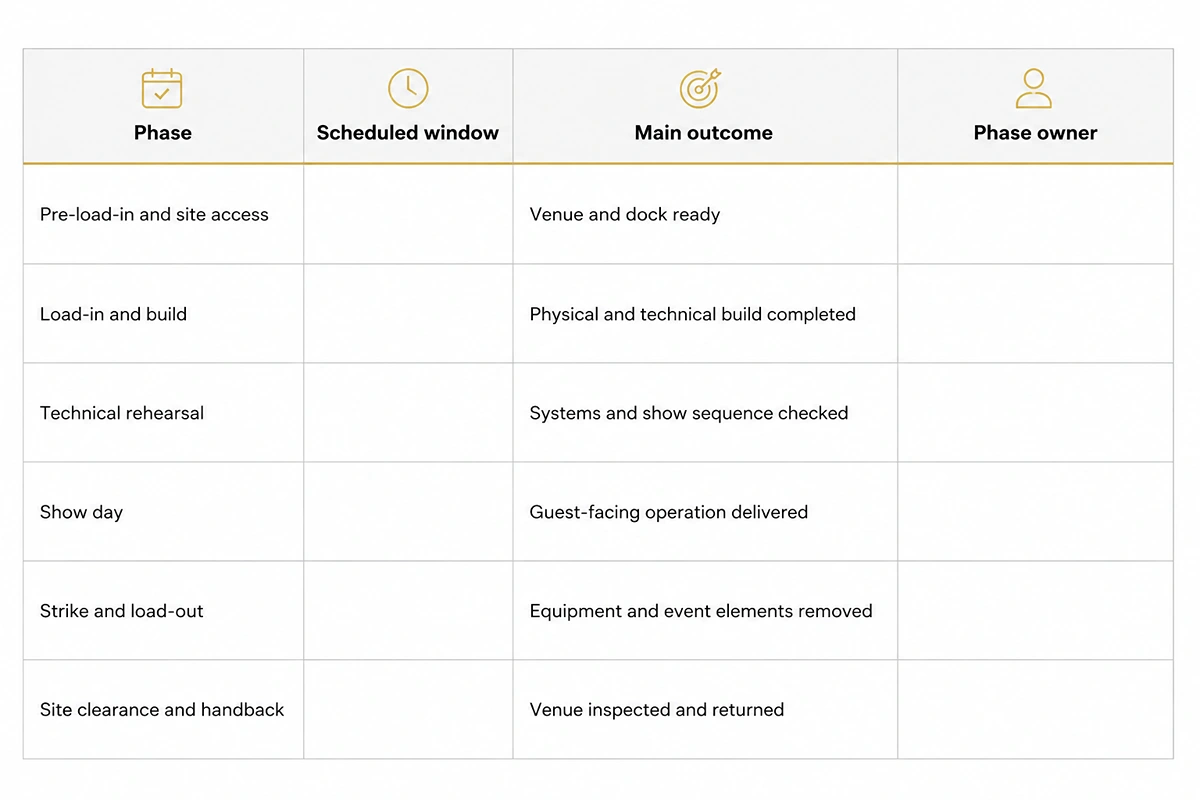
Complete the phase windows before adding detailed actions. If load-in ends at 4:00 PM but technical rehearsal needs the room at 3:30 PM, the conflict becomes visible before individual vendors begin filling the sheet. Phase-level timing provides the frame; the detailed lines reveal whether the frame can hold the actual work.
Add a revision number, issue time and document owner at the top of every printed or shared copy. Show-week information changes quickly, and an old schedule can remain open on a supplier’s phone after a new dock order has been issued. Version control gives the production manager a simple way to withdraw an outdated sequence and tell every lead which document now governs the site.
Which event schedule does your team actually need?
The phrase “production schedule” is used for several useful documents. Choosing the right one depends on how close the event is and how precisely the work needs to be controlled.
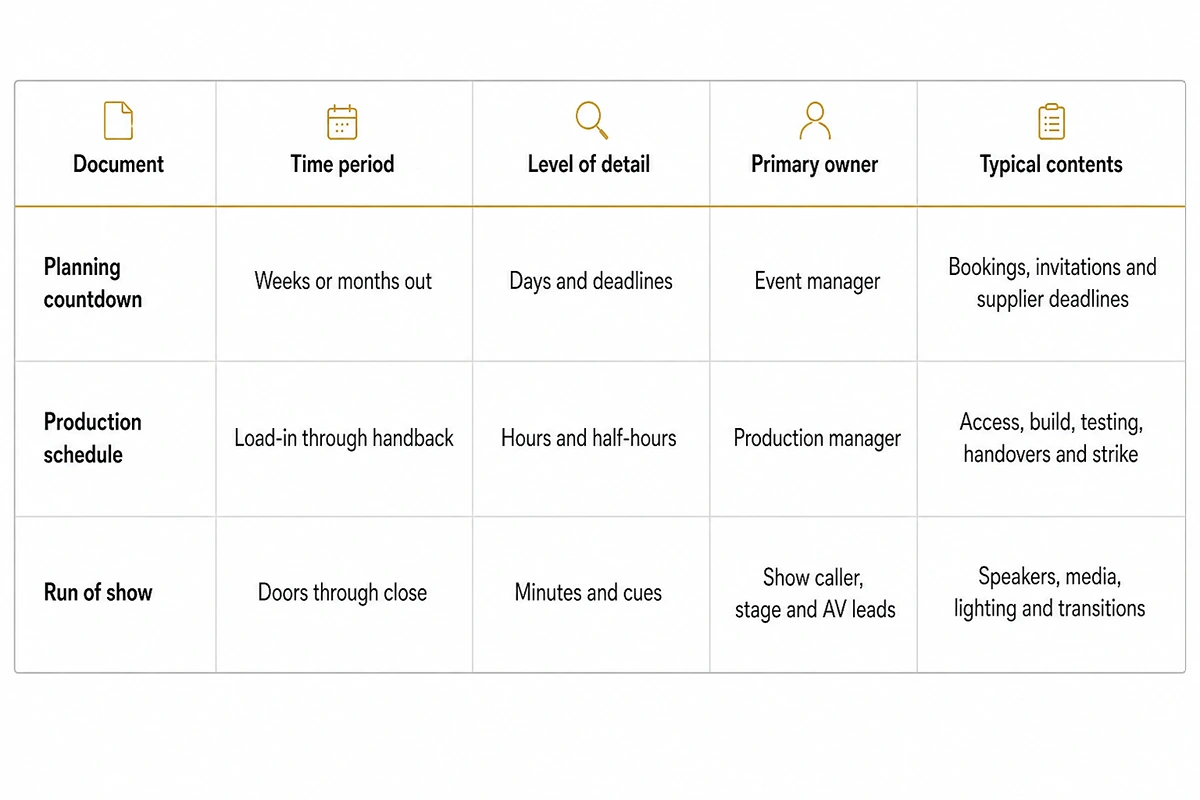
A planning countdown begins weeks or months out. It tracks venue booking, supplier deadlines, invitations, approvals and other milestones owned by the event manager. Eventstaff’s corporate planning checklist covers that longer planning window.
The event production schedule covers show week on site. It coordinates dock access, deliveries, build activity, inspections, technical checks, guest-facing operations, strike and handback. The production manager maintains the working version, while each supplier confirms the actions and dependencies assigned to its team.
The run of show sits inside the show-day phase. It controls doors-to-close activity at minute and cue level, while the production schedule shows the larger operational block that contains it.
If your immediate question concerns invitations or a deadline several weeks away, use the planning countdown. If trucks, crew and vendors need to know where they fit during show week, continue with this template.
CEO Excerpt
“The schedules that hold are the ones where every line has a name on it. A time and a task can look complete, but neither tells the crew who accepted responsibility. Once an owner is visible, the team can confirm the handover, raise a conflict and keep the next part of the build moving.” -- Daniel Muersing, CEO of Eventstaff
Put an owner on every line before adding detail
Production managers often respond to uncertainty by adding more rows. Greater detail helps only when every row identifies who accepted the action. “Stage set” may describe an outcome, yet it gives nobody authority to confirm completion or tell the next supplier that the working area has been released.
Temporary structures show why ownership cannot be assumed. ANSI E1.21-2024 addresses design, manufacturing, use and maintenance for temporary ground-supported structures. A structure can involve the production company, riggers, stage management and structural specialists, with different responsibilities passing between them.
Use an owner role and named lead on every schedule line. “AV vendor” identifies a company. “AV lead, Sam Rivera” identifies the person expected to confirm progress and receive changes. If the individual has not been assigned, write “AV lead, name pending” so the unresolved ownership stays visible.
An owner also needs enough authority to deliver the line. Naming a general contact who cannot approve overtime, accept a handover or release a work zone creates the appearance of accountability without the decision-making power behind it. Confirm what each lead can approve and name the escalation contact for decisions that sit outside that authority. This becomes especially important overnight, when the person who signed the supplier contract may no longer be on site.
Ask each lead to accept their lines before the schedule is issued. That review often exposes missing access, labor or approval requirements because the named person can see exactly what the document expects from them.
Ownership should also survive a shift change. If the named lead leaves before the activity finishes, add the receiving lead and handover time instead of leaving the original name against work they can no longer supervise. The schedule then reflects who has authority at that hour, which matters more on site than the person who originally supplied the estimate.
This ownership method is an operational inference from the way standards distribute responsibilities across several parties. It is a drafting principle, not a measured finding about the frequency of production delays.
Mark every handover before the schedule breaks
Tasks have clear beginnings and endings on paper. The harder moment comes when one party’s completed work becomes another party’s permission to start. Those joins need their own schedule lines because the next team may require an inspection, released work zone, cleared route or formal acceptance before moving.
Consider an illustrative rigging handover. The rigging lead reports the physical work complete, while structural sign-off remains pending. AV arrives at the scheduled time but cannot begin work underneath. Every supplier may have met its individual call time while the overall build stops because the schedule never named who would deliver and receive the approval.
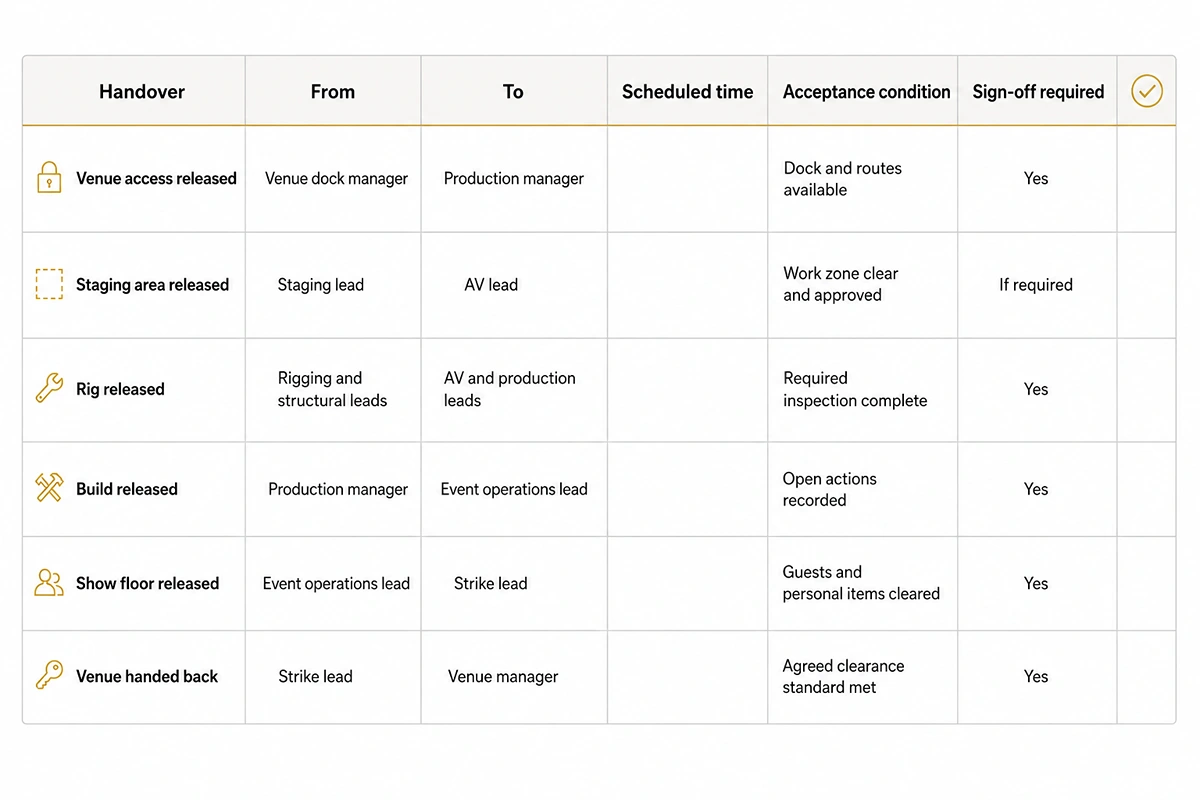
Place both names on a handover: the person releasing the work and the person accepting it. Add the condition that defines completion, then give any required inspection or sign-off its own timed line in the main event production schedule.
Use plain acceptance language that can be checked. “Ready for AV” is open to interpretation, while “required inspection recorded, work zone released and access route clear” describes conditions the receiving lead can verify. If acceptance fails, the line should also show who records the open action and who decides whether the following activity moves, pauses or changes location.
This recommendation is inferred from activities that span several parties and phases. The exact handovers depend on the build, contracts, venue rules and supplier responsibilities, so the production manager should confirm them with every affected lead.
Failed handovers also need a visible response. Add an “open action” line directly beneath the delayed acceptance, with a new owner, revised completion time and the schedule lines affected. This prevents the problem from disappearing into calls and radio conversations while the printed document continues to show the original sequence. Everyone can then see whether the next team should wait, change location or move to another task.
Schedule strike with the same detail as load-in
Many schedules become vague after guests leave. Load-out appears as one block even when signage, furniture, AV, rigging and staging have to be removed in a controlled order. The result is a late phase with fewer instructions, reduced supervision and several suppliers waiting for access to the same route.
The Event Safety Alliance’s rigging standard places design, planning, installation, setup, removal and operation within its scope. Removal therefore deserves planned times, qualified owners and dependencies wherever the work requires them.
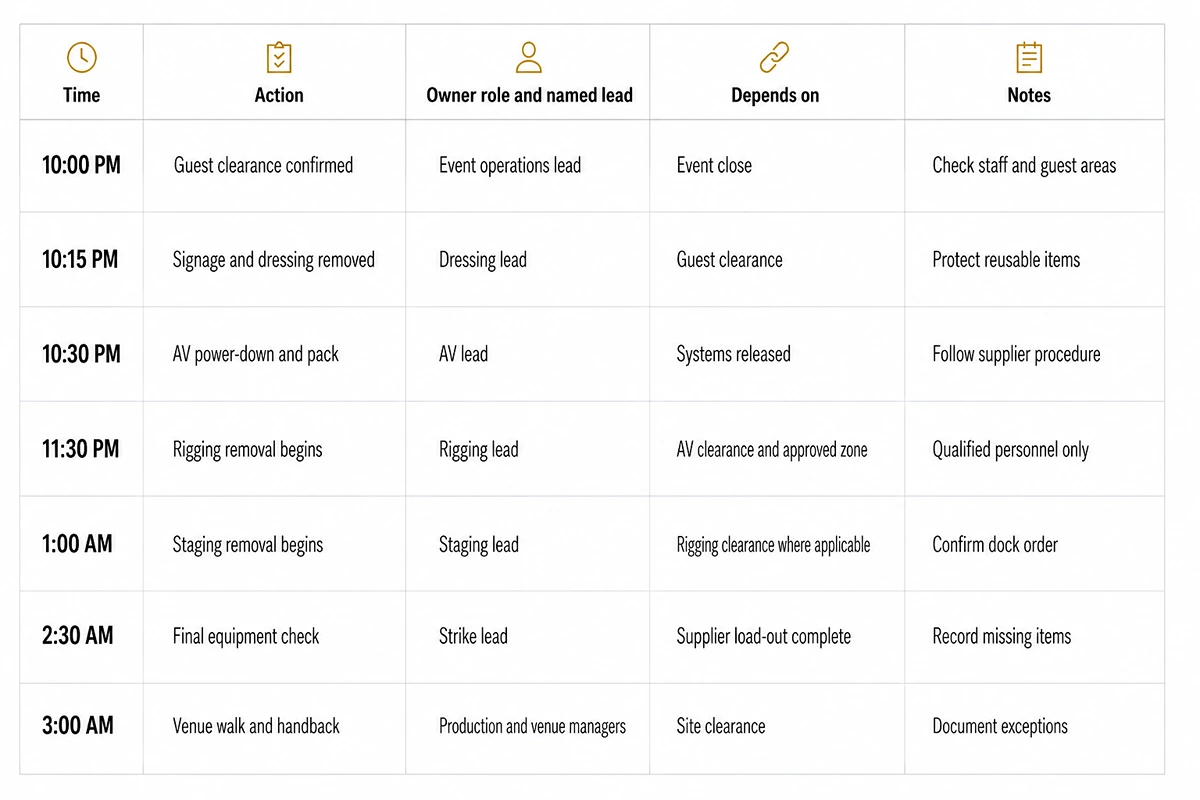
Work backward from the venue curfew, dock close and handback inspection. This reveals when the first strike activity must begin and whether the booked team can complete the sequence within its shift. It also prevents the final venue walk from becoming an informal task handled after suppliers have already left.
A complete strike schedule may require qualified people during late or overnight hours. Confirm those needs when vendors quote and crew accept shifts. The exact removal process depends on what was installed, so use the procedures and personnel specified by the responsible suppliers.
The loading route deserves the same attention as the removal work. Suppliers may pack faster than vehicles can reach the dock, causing cases and dismantled materials to collect inside the venue. Schedule vehicle calls, temporary holding areas and route clearance beside the strike actions. If the venue permits only one truck at a time, the dock order becomes a dependency that controls when each supplier can finish.
Plan the handback standard before strike begins. The venue representative should state what “clear” means, which areas will be inspected, how damage or abandoned items will be recorded, and who remains authorized to accept the space. Without that agreement, the production team may believe the job has finished while the venue still expects floor protection, waste removal or restoration work.
Contingencies need a threshold and decision-maker
“Monitor weather” does not give the crew a scheduled action. It leaves four questions unanswered: which condition matters, what approved threshold triggers a decision, who has authority to call it and how much time the response needs.
ANSI ES1.7 covers weather-preparedness planning for live events and related temporary structures. For an outdoor or partially outdoor build, place the approved weather decisions beside the work they could interrupt.
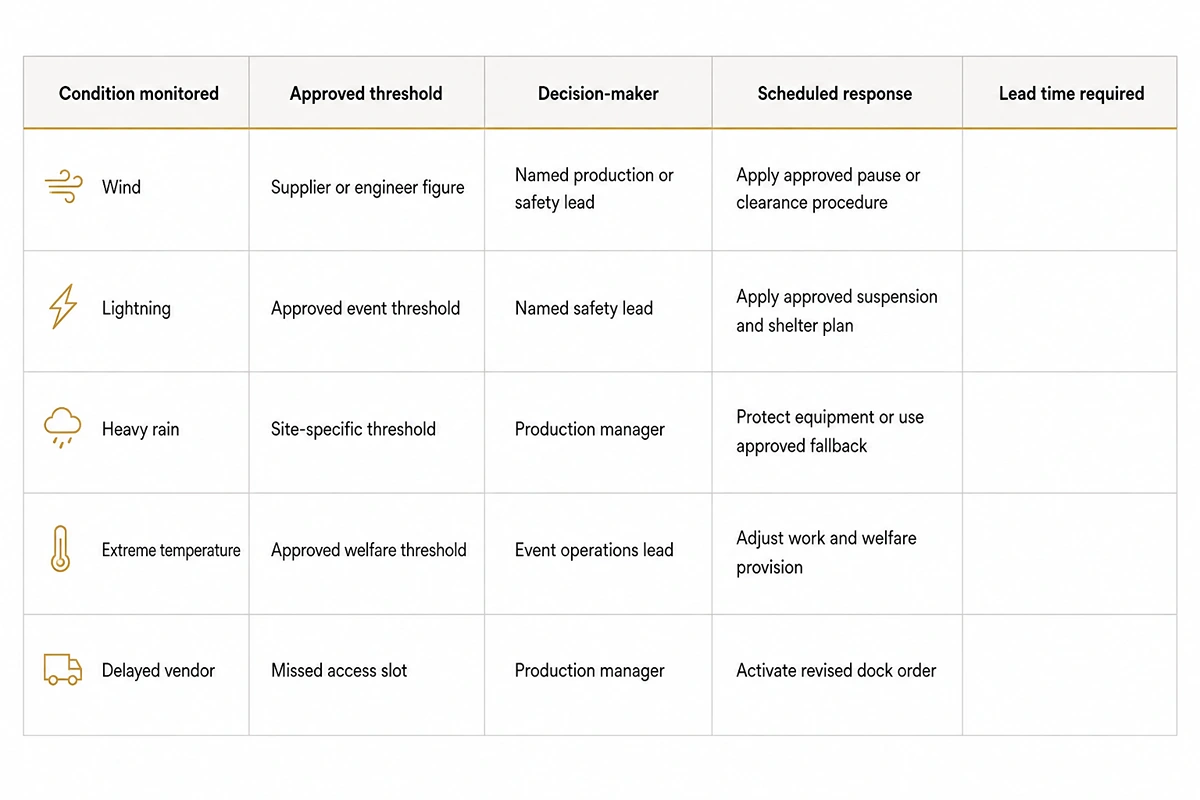
The threshold should come from the engineer, supplier documentation, venue, approved safety plan or other responsible authority. The template should never invent it. Once confirmed, add the decision-maker and action so the crew knows who calls the change and what happens next.
Include operational contingencies as well. A late truck may lose its dock slot, which changes the order for every vehicle behind it. Scheduling the fallback route in advance gives the production manager an agreed response without pretending every delay can be absorbed by the original sequence.
A contingency also needs to preserve dependencies. Moving a staging delivery later may block furniture access, shorten the technical-build window and push rehearsal into an occupied room. The response line should therefore name every activity that must be reviewed after the trigger is called. The aim is to create a usable revised sequence, instead of solving the first disruption and allowing its effects to surface several hours later.
Let the schedule reveal the crew you need
The completed schedule already shows how long each phase runs, how many activities overlap and where handovers require both teams to be present. Use that information to build the crew request. It reflects the actual work more accurately than calculating people from floor area alone.
Start by marking activities that happen simultaneously. If furniture placement, signage, registration setup and technical testing all occupy the same hour, the crew cannot complete them as a sequence. Each active line needs the people, supervision and access required to move during that window.
Then test the shift boundaries. A person booked for load-in may reach the end of an agreed shift before rehearsal, while the same role appears again during strike. Separate calls, relief coverage or a revised assignment may be required. The schedule exposes that decision early enough for the staffing plan to address it instead of asking an already-finished team to stay.
Convert each schedule line into labor demand by asking four questions: how many people perform the action, how long are they needed, what supervision is required, and can those people move to another task afterward? Add the answers across every overlapping window. This produces a crew profile by hour, which is more useful than one total headcount for the entire day.
Allow for handovers inside the labor calculation. The outgoing team and incoming team may need to overlap while equipment, keys, radios, open actions or venue areas change hands. If that overlap is missing from the booking, one team leaves before the next has received enough information to continue. Schedule the briefing time as paid working time and assign an owner to it.

Keep staffing roles separate from supplier lines. Production teams support the scheduled build, show and strike activity assigned to them. Conference and registration staff may enter during guest-facing phases, while crowd control staff, greeters and ushers support arrival and movement where the plan requires them.
AV equipment, staging, rigging, lighting rental, catering and entertainment remain specialist or vendor responsibilities. Naming them in the event production schedule coordinates their activity; it does not turn them into general crew positions.
The event staffing plan can convert these phases into call times, shift lengths and headcount. If the schedule reveals overlapping build, show or strike requirements, you can talk to Eventstaff about translating those hours into a production-team booking.
Eventstaff turns the schedule into a crew booking
A completed production schedule gives Eventstaff the information needed to brief a production team accurately. Share the phase windows, call times, assigned activities, venue restrictions, overlapping work, handover periods, strike requirements and named supplier contacts.
Eventstaff can then align production teams with the relevant build, show and strike lines. Where the document also identifies guest registration, conference support or crowd management requirements, those roles remain separately named so each team receives the correct responsibilities and reporting structure.
The schedule should also show whether one team can cover consecutive phases or whether working hours require separate calls. Giving production teams the final working version before arrival allows the briefing to focus on execution, changes and site conditions instead of reconstructing the sequence at the venue.
Bottom line
Build your event production schedule template across all six phases, from pre-load-in access through venue handback. Give every action a time, named owner, dependency and notes, then make handovers and sign-offs visible as individual schedule lines.
Apply the same discipline to strike that you use for load-in. Add approved contingency thresholds with named decision-makers, and derive staffing from working hours, simultaneous activity, supervision and handover needs. Ask every supplier lead to confirm their lines before the production manager issues the controlled version.
Once the event production schedule shows where production support is required across build, show and strike, build your production team with Eventstaff.
Ready to elevate your next event?
Join thousands of event planners who trust EventStaff.com for reliable, professional staffing solutions.
Trusted by event professionals nationwide
1k+
Events Staffed
2 million+
Guests Served
97%
Positive reviews