

Esports Event Management: What a Tournament Floor Needs
Esports event management starts after the venue, competition format, and broadcast plan are set. The next challenge is building a floor team that can handle spectators, queues, session changes, sponsor areas, crowd surges, and an unpredictable finish.
A tournament floor is not just a smaller concert floor. The audience moves around production boundaries while the competition continues on stage. The staffing plan has to account for both, and the stakes keep rising: the global esports audience reached 640.8 million viewers in 2025, a scale that has pushed live tournament floors closer to the crowd sizes seen at major stadium events.
This guide explains how to plan the live-event side of esports event management, including the roles you need, how staffing changes throughout the tournament, how to handle finals overruns, and what every floor worker should know before doors open.
What Does Esports Event Management Include?
The phrase esports staffing can describe two very different activities.
One side involves recruiting players, coaches, analysts, production specialists, and other competitive or technical talent. The other involves staffing the physical event where spectators attend the tournament.
This guide focuses on the second, and if you're weighing which side needs attention first, it's worth reviewing the common staffing mistakes hosts make at U.S. festivals before locking in a floor plan.
Esports Event Management Is About the Live Floor
The live floor includes:
- Guest entrances and check-in
- Queues and crowd movement
- Viewing areas
- Sponsor and activation spaces
- Stage surrounds
- Restricted production areas
- Re-entry points
- Guest assistance
- Session transitions
- Final egress
That distinction matters when planning a tournament. Recruiting a competitive roster is a team-building problem. Staffing a tournament venue is a live-event operations problem.
Your staffing plan therefore needs to start with the audience experience and the physical venue.
Why Does an Esports Tournament Floor Need Its Own Staffing Plan?
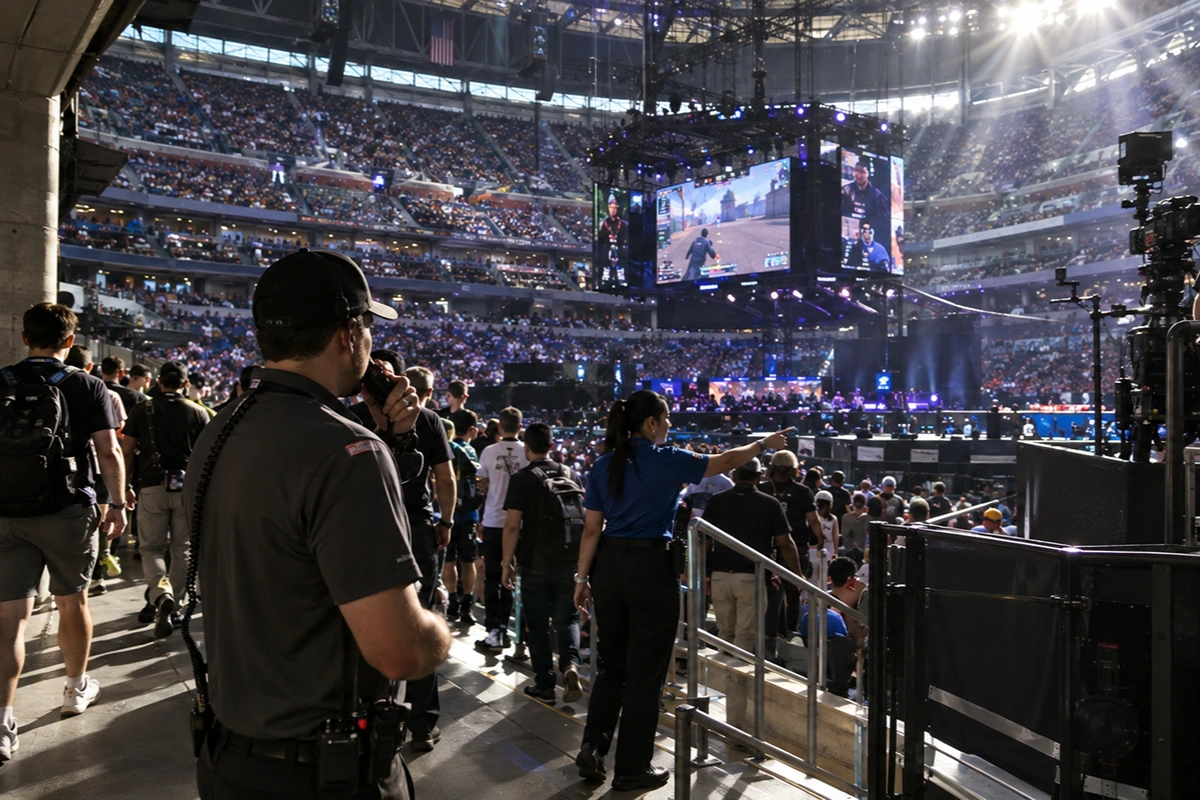
A tournament floor has two operating environments happening at the same time.
The competition needs controlled production areas, technical equipment, player spaces, and stage access. The audience needs clear routes, viewing areas, restrooms, food and beverage access, sponsor activations, and assistance.
The two systems have to work beside each other.
The 2019 Fortnite World Cup provides a useful example of the scale involved. Epic Games reported that over 19,000 fans attended the three-day finals at sold-out Arthur Ashe Stadium in New York.
That scale creates a different crowd-management problem from a small gaming meetup.
Keep Audience Routes Away From Production Boundaries
A route can look open to a guest but still be unavailable because it crosses a production or competition area.
The floor team should know:
- Which areas are public
- Which areas require credentials
- Where spectators can queue
- Where lines cannot form
- Which routes must remain open
- Where guests can re-enter
- Which areas may become restricted during later sessions
Staff should not have to make these decisions themselves during a crowd surge.
The event plan should define the boundaries first, ideally mapped out the same way you would in an event operations plan template built to keep large events under control. The floor team then enforces those boundaries consistently.
What Staff Does a Live Esports Tournament Need?
The exact roster depends on venue size, attendance, schedule, access controls, sponsor requirements, and the complexity of the audience experience.
However, most live tournaments can organize floor staffing around several core functions.
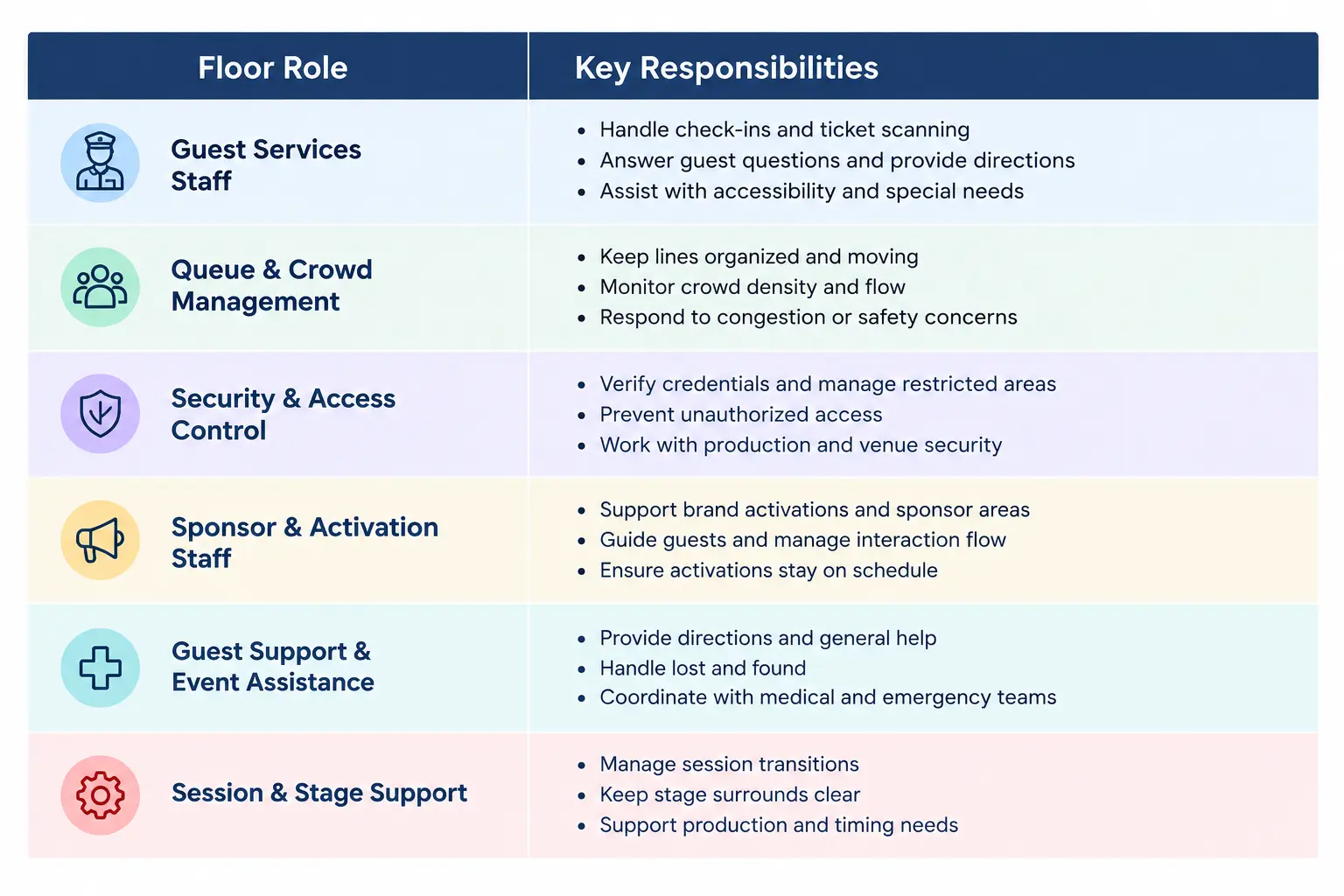
The important point is to staff around functions, not simply headcount. A practical way to do this is to work from an event staffing plan template you can actually fill in rather than guessing at ratios.
A 300-person tournament with a complicated sponsor activation may need a different floor structure from a 1,000-person tournament with a simple audience layout.
How Should You Schedule Staff Across a Tournament Day?
A long tournament should not use one flat staffing level from doors open through load-out.
The audience does not behave the same way throughout the day.
Instead, build staffing around the published session schedule, the same way you would build an event production schedule with named owners for each shift.
Staff the Transitions, Not Just the Hours
A typical tournament may move through these phases:
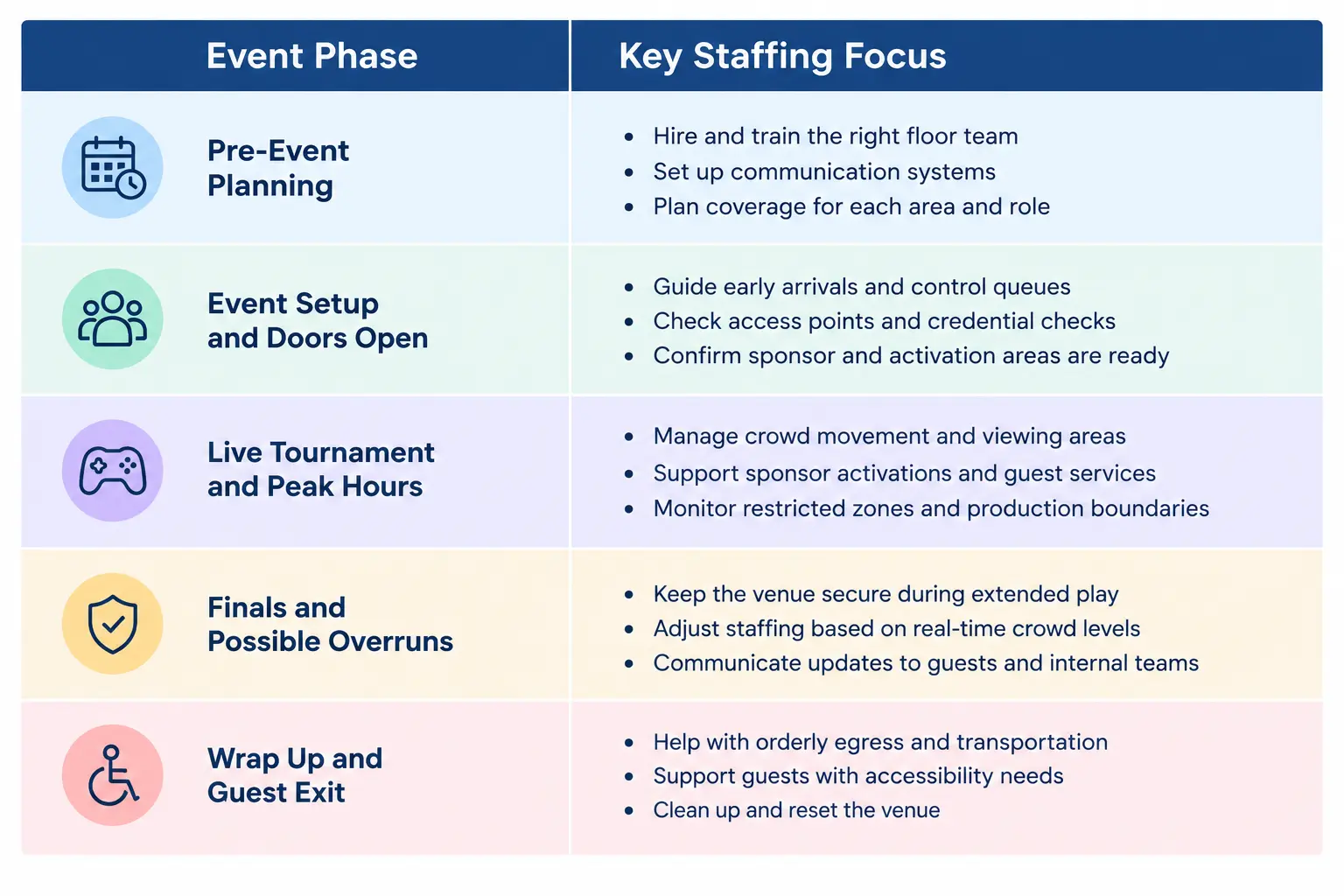
The exact structure will vary by venue and competition format.
The planning principle remains the same:
Staff the moments when guest behavior changes.
Doors may create a short, intense arrival peak. The middle of the day may require fewer staff. Finals may concentrate hundreds of people around one viewing area. Load-out reverses the direction of movement toward exits.
A flat roster can therefore waste labor during quiet periods while leaving the team stretched during transitions.
How Do You Plan Staffing for Tournament Surges?
Start by identifying where guests are most likely to concentrate.
Common pressure points include:
- Main entrances
- Credential or ticket checkpoints
- Popular viewing areas
- Restrooms
- Food and beverage areas
- Sponsor activations
- Merchandise areas
- Re-entry doors
- Stage-adjacent areas
- Final-session exits
Then ask three questions for each location:
- How many people can gather here?
- How quickly can they arrive?
- What happens if the normal route becomes blocked?
These questions are more useful than simply dividing attendance by a generic staff ratio, and they're the same questions behind a solid crowd management plan template for live events.
For example, an activation that creates a long queue needs a different staffing response from an activation that guests visit continuously throughout the day.
The same principle applies to entrances. If most guests arrive within a short window, entry staffing needs to be concentrated around that window rather than spread evenly across the entire event.
What Happens When an Esports Final Runs Overtime?
The finals shift is one of the hardest parts of tournament staffing because the competition does not necessarily end when the published schedule says it will.
A final can move later because an earlier match runs long, breaks take longer, or the competition itself requires more time.
For EWC 2026 in Paris, the published Counter-Strike 2 finals schedule stated that the grand final would not start before 1:30 p.m. and depended on the preceding match finishing. That illustrates the planning issue clearly: one session can push the next session later.
Decide Who Stays Before the Final Starts
Do not wait until the scheduled finish time to decide what happens to the floor team.
Choose one of these approaches in advance:
- Contract a later end time for the relevant staff.
- Keep a smaller late team after the main roster releases.
- Create a defined handoff between teams.
- Assign a floor lead who remains responsible until the audience has cleared.
The actual overrun cannot be predicted precisely.
Instead, treat it as a staffing risk that needs an agreed response, the way you would flag any other exposure in an event risk assessment template for live events. If overruns keep catching your roster off guard, it's also worth reading how to plan event staffing around the problems that actually break events.
The same applies to egress.
If the final ends later than expected, the audience will leave later too. Your exit coverage needs to remain active until the floor has actually cleared.
What Should Esports Floor Staff Be Briefed On?
A staffed floor is not automatically a prepared floor.
Before doors open, every worker should understand the parts of the event that affect their decisions.
At minimum, the briefing should cover:
- Session schedule
- Entry procedures
- Re-entry rules
- Restricted areas
- Viewing-area capacity procedures
- Sponsor zones
- Production boundaries
- Emergency procedures
- Escalation contacts
- Finals overrun plan
- Final exit plan
The goal is not to give every staff member the entire production brief.
The goal is to tell each person what changes their actions on the floor. Restricted-area and escalation procedures, in particular, tend to work best when they're written down the same way you'd document them in an event security plan template that accounts for a staffing line.
Brief the Exceptions, Not Just the Job Description
"Welcome guests" is not enough.
A better briefing explains what the employee should do when something unusual happens.
For example:
- If re-entry becomes congested: Know which entrance handles returns and who can change the flow.
- If a viewing area reaches capacity: Know who makes the one-in-one-out decision and where guests should be redirected.
- If someone attempts to enter a restricted area: Know which staff member owns the escalation.
- If production needs a route cleared: Know which floor lead receives the request and how guests should be redirected.
This is where experienced staffing makes a difference.
The team does not need to improvise every decision during a live tournament.
How Should Esports Events Handle Flashing Lights and Accessibility?
Esports venues often use large screens, rapid visual transitions, lighting effects, and other high-impact visuals.
The Epilepsy Foundation notes that flashing lights and certain visual patterns can trigger seizures in about 3% of people with epilepsy, a condition known as photosensitive epilepsy.
Floor staff are not responsible for diagnosing a medical condition. They should, however, know the venue's accessibility and emergency procedures.
Your event plan should establish:
- Where guests can seek assistance
- Who handles accessibility concerns
- How staff escalate a medical concern
- Which areas offer alternative viewing options, where applicable
- How emergency procedures are communicated
The key is to give staff a clear escalation path rather than asking them to make medical judgments.
How to Build an Esports Event Staffing Plan
A practical planning process can be reduced to seven steps.
- Map the Guest Journey: Identify every point where a spectator enters, moves, waits, watches, shops, engages, or exits.
- Mark Production Boundaries: Separate public routes from player, production, technical, and restricted areas.
- Divide the Day Into Staffing Phases: Use the tournament schedule to identify arrival, transition, peak, and exit periods.
- Assign Functional Roles: Determine where you need greeters, ushers, queue staff, crowd staff, brand ambassadors, guest services, and floor leads. If some of these needs are seasonal or short-notice, it helps to know when temporary event staffing is actually worth it.
- Identify Surge Points: Mark entrances, re-entry points, viewing areas, activations, and exits that may experience concentrated traffic.
- Plan the Finals Overrun: Decide who stays if the competition runs beyond the scheduled finish.
- Brief the Entire Team: Give every worker the schedule, boundaries, escalation contacts, guest-flow instructions, and exceptions relevant to their position.
Sponsor-heavy tournaments should layer in one more consideration: activation zones draw their own crowds, so it's worth reviewing live event staffing best practices for brand activations alongside the seven steps above.
This approach produces a staffing plan that follows the event instead of forcing the event into a fixed staffing template.
.webp)
Plan Your Esports Event Staffing Before the Tournament Floor Gets Busy
The strongest esports event management plans do not treat staffing as a fixed headcount.
They match the team to the way guests actually move through the venue.
That means planning around session transitions, protecting production boundaries, preparing for finals overruns, briefing staff on exceptions, and maintaining clear ownership when the floor changes.
If you are planning a tournament, fan event, esports championship, or gaming activation, a professional staffing partner can help translate your venue plan and tournament schedule into a practical floor roster. Contact Event Staff to plan the roles, shifts, guest-flow coverage, and on-site staffing needed for your esports event.
Ready to elevate your next event?
Join thousands of event planners who trust EventStaff.com for reliable, professional staffing solutions.
Trusted by event professionals nationwide
1k+
Events Staffed
2 million+
Guests Served
97%
Positive reviews