

The Event Risk Assessment Template Planners Need Before Approval
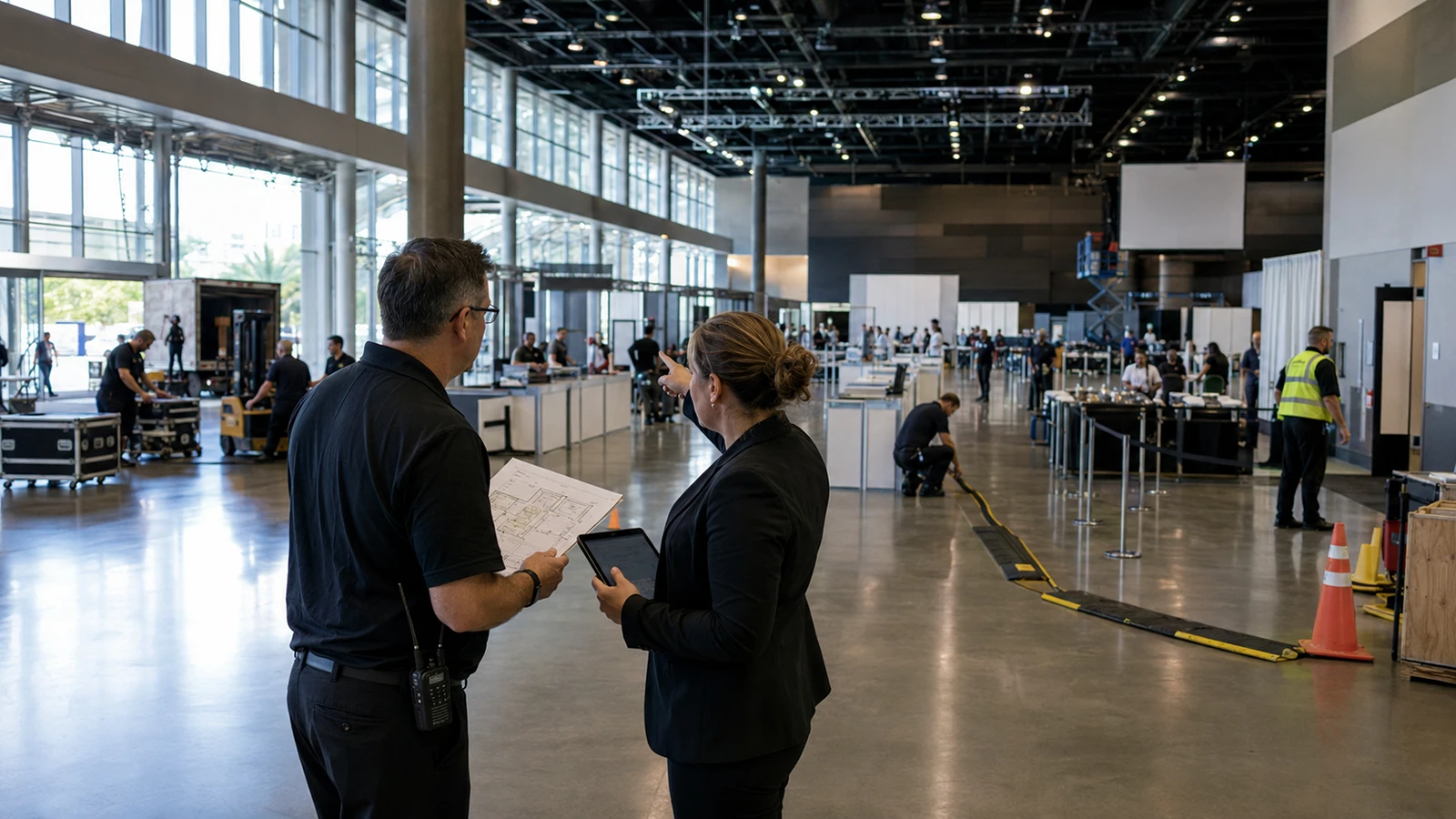
You have been asked for an event risk assessment template, and the blank page is probably the hardest part. A venue, insurer, permit office, or legal team may have asked for the document, but most downloadable grids still expect you to invent the hazards yourself. This version starts with nine live-event categories, then shows how to score the risks, name the owner, and turn the control into an action.
Executive Summary
This event risk assessment template shows planners how to turn a blank risk register into a usable document. You will build an event profile, edit nine live-event hazard categories, score each risk, name the owner behind every control, check occupancy questions with the right authority, review the document when plans change, and turn people-owned controls into a staffing action list.
The Blank Template Is the First Problem
An event risk assessment identifies what could go wrong at an event, judges how likely and how serious it is, and records the control measures that reduce it. That sounds simple until you are staring at a blank document with a deadline and no clue whether to write about queues, forklifts, weather, vendors, food, medical cover, or temporary structures first.
A useful event risk assessment template should have six parts: an event profile, a hazard register, a scoring method, control measures, named owners, and a review log. The event profile tells you what kind of event you are dealing with. The hazard register records what can go wrong. The scoring method ranks what gets fixed first. The owner column stops vague controls like “monitor exits” from floating around with nobody responsible for them.
For live events, the document also has to think outside guest hours. The Event Safety Alliance’s standards cover live-event areas such as crowd management, weather preparedness, emergency planning, site design, pyrotechnics, rigging, and temporary staging. That gives the reader a useful reminder: the assessment should cover the build, the show, and the teardown, not only the guest-facing part of the day.
EventStaff would use the finished document to understand where people are genuinely required. Some rows may call for crowd management, setup support, queue staff, or conference staff. Other rows may call for licensed security, EMTs, fire marshals, structural engineers, AV suppliers, or caterers, which EventStaff does not provide. That separation makes the final crew plan more believable.
The Wrong Event Profile Creates the Wrong Risk List
The event profile should come before the hazard register because it filters the whole document. A seated indoor conference and an outdoor product launch with tents should not produce the same risk list. One may mostly need registration flow, speaker support, room movement, accessibility routes, and help desk coverage. The other may need weather thresholds, shade, vendor insurance, generator checks, public queues, and temporary structure sign-off.
This is where the first short table earns its place. The reader can fill it in quickly before touching the risk rows.
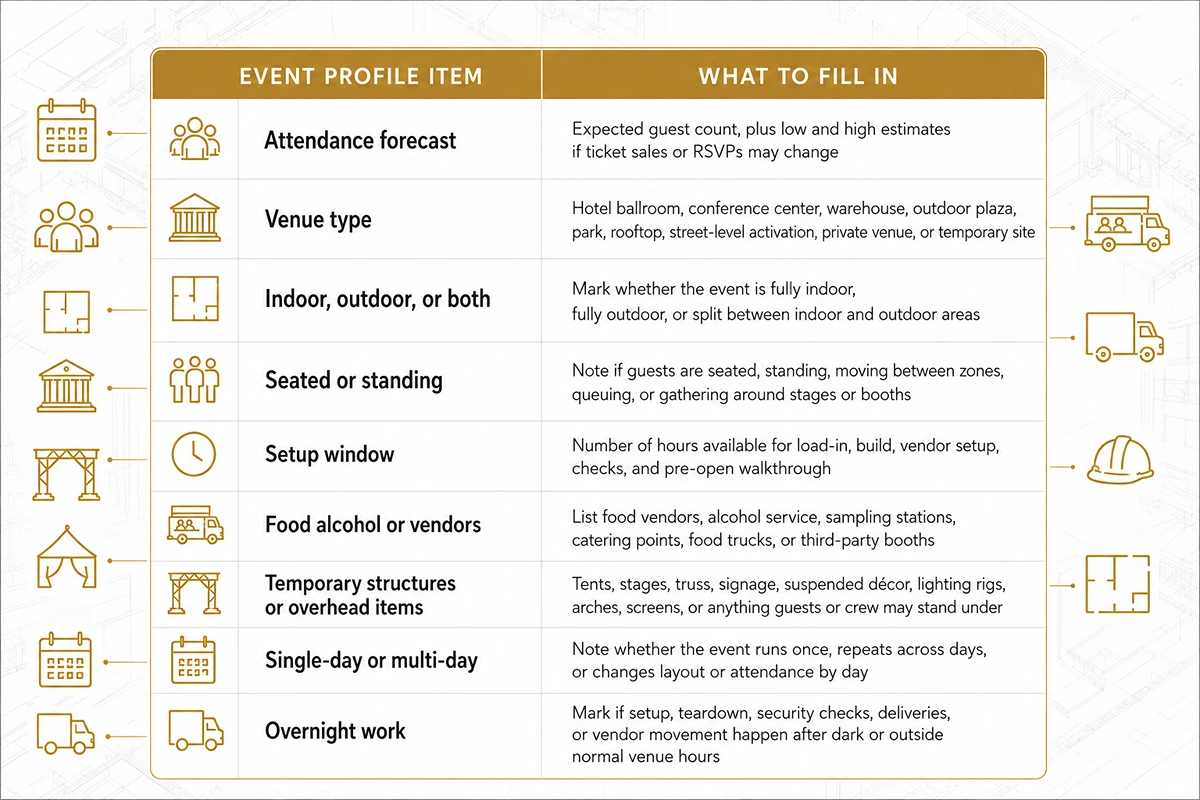
A real use case makes this clear. A 300-person hotel ballroom meeting probably does not need a long weather section, but it may need tighter rows for check-in, session doors, AV handoffs, and VIP movement. A 300-person outdoor activation may need fewer session-flow rows but stronger rows for wind limits, sun exposure, vendor stock, load-in traffic, and people queuing near public sidewalks. ANSI E1.21-2024 sets design and performance parameters for temporary structures used at outdoor entertainment events, and it is also referenced by the 2024 International Fire Code, which is exactly why temporary structure details should appear in the profile before setup starts.
EventStaff would read this profile before suggesting a crew. A simple indoor meeting may point toward conference staff. A public-facing activation with entry pressure may call for crowd management staff. A tight load-in may need production support. The profile tells the staffing plan where to begin.
A Blank Hazard Register Leaves Planners Guessing
A blank hazard register is where most non-safety people get stuck. They know something could go wrong, but they do not know what to write first. A better event risk assessment template gives them starter rows they can edit instead of forcing them to invent the whole document under pressure.
The core nine categories should be crowd and egress, setup and teardown, weather and environment, power and technical, fire and life safety, medical and welfare, security and access, food and vendors, and transport and load-in. This does not mean EventStaff owns every control. It means the document is honest about what live events actually involve. Crowd routes may need staff. A suspended item may need a written plan from production. A medical row may need a medical provider. A pyrotechnics row may need permits and licensed operators.
Here is the second and final short table I would keep in the blog:
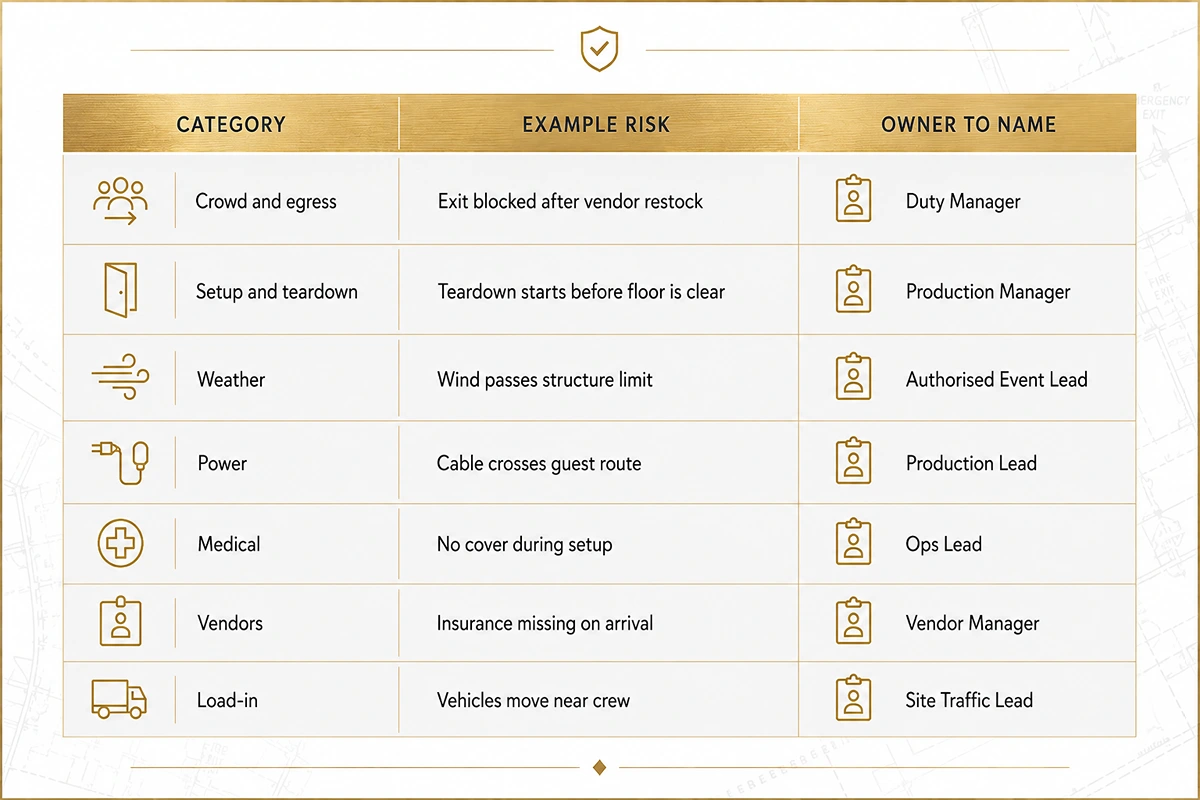
A commonly missed point is phase. Exits are often checked once before doors, then vendor stock appears halfway through the event. Medical cover may be booked for show hours, while setup crew is already working. Teardown can become rushed late at night when tired suppliers are trying to leave quickly. Event Safety Alliance guidance treats live-event safety across the full job, and ANSI’s temporary structure standard covers design, manufacturing, use, and maintenance, so the safer register tags each hazard to setup, event, or teardown rather than pretending the risk begins when guests arrive.
EventStaff would use this register to separate people-owned controls from specialist-owned controls. Queue pressure, entry surges, pinch points, setup support, and guest movement may point toward event staffing. Engineering sign-off, EMT coverage, fire approval, catering compliance, and licensed security should stay with the right specialist. That line keeps the assessment useful and stops the article from sounding like every risk magically turns into staffing.
CEO Excerpt
If I were advising a planner who has never written a risk assessment, I’d tell them to stop trying to sound like a safety consultant. Write down what can actually go wrong in the room, at the door, during setup, and after guests leave. Then put a name beside every control. A risk nobody owns is usually the one that gets missed. - Daniel Muersing
Scoring Stops Every Risk From Looking Equal
Scoring is the part of the event risk assessment that stops the document from becoming a polite checklist nobody uses. A blocked exit, a missing vendor certificate, a cable across a guest route, and a late first-aid booking should not all sit in the same mental pile. They create different levels of pressure. The score tells the planner what gets handled before setup, what gets handled before doors, and what can be watched during the event.
For this event risk assessment template, keep the scoring method simple enough for a non-safety person to use. Score likelihood from 1 to 5. Score severity from 1 to 5. Multiply both numbers. A low score can stay on the watch list. A high score should stop the next phase until someone fixes the control. A 5×5 matrix works well for live events with vendors, temporary structures, outdoor exposure, crowd flow, or overnight work. For a small single-room meeting, a 3×3 score may be enough, as long as the ranking is still honest.
Use the score to create a real order of work. If vendor insurance is missing, the vendor should not enter the site yet. If a guest exit is blocked by décor, the event should not open yet. If a cable run crosses the main guest route, the answer is not “monitor it.” The control is matting, ramps, rerouting, or removing the run before doors.
A quick scoring band can look like this:
- 1–4: monitor and review
- 5–9: control before doors
- 10–14: control before setup begins
- 15–25: stop until resolved
A real event example: a rooftop product launch may have two weather-related rows. “Light rain affecting guest comfort” may score lower if the venue has covered areas and indoor fallback. “Wind above the structure limit for a temporary canopy” scores much higher because the action may involve stopping setup, clearing the area, or removing the structure. ANSI E1.21-2024 covers design and performance parameters for temporary structures, and the listing notes that the 2024 version is referenced by the 2024 International Fire Code, so outdoor structure rows should never be treated as soft admin lines. (ANSI Webstore)
EventStaff would use high-scoring, people-owned risks to shape the crew list. If the top scores involve entry surge, pinch points, queue spillover, or teardown exclusion zones, those rows may point toward crowd management, setup support, or backup crew. If the top score involves engineering sign-off or medical cover, that belongs to the right specialist, not EventStaff.
A Control With No Owner Usually Dies on the Floor
A control with no owner usually sounds fine in the document and fails on the floor. “Keep exits clear” looks responsible until the décor team, caterer, venue, and production crew all assume someone else checked the corridor after restock. The fix is boring and practical: write the role beside the control. Not the company. Not “venue.” Not “supplier.” Write “duty manager” or “production manager” or “security supplier lead.”
The reason is simple. Live events often split one risk across several parties. ANSI E1.21-2024 says temporary ground-supported structures involve design, manufacturing, use, and maintenance considerations, and the standard’s own description shows how one structure can pass through several hands before guests ever see it. (ANSI Webstore) The inference here is not a measured statistic about failed controls. It is a practical lesson from how live-event responsibilities are divided: if several teams touch one hazard, the event risk assessment needs to name who owns the control before setup starts.
Use owner language that someone can act on:
- “Duty manager checks exits after every vendor restock”
- “Production manager confirms structure sign-off before anyone works underneath”
- “Ops lead blocks vendor access until insurance is on file”
- “Crowd management lead posts staff at the bar walkway pinch point”
- “Event director confirms the medical escalation route before doors”
- “Security supplier lead owns back-of-house accreditation checks”
That level of detail sounds small, but it changes the document. A control becomes easier to check because the person, action, and timing are visible. “Monitor crowding near entrance” is weak. “Crowd management lead opens second queue lane if the line reaches the west doors” gives the team a trigger and an owner.
EventStaff would turn the people-owned controls into staffing posts. If the register calls for queue lanes, pinch-point cover, setup walkers, production runners, or extra teardown support, EventStaff can build those roles into the staffing plan. If the control needs a licensed security provider, EMT, fire marshal, engineer, AV supplier, or caterer, that row should stay with that specialist.
Occupancy Rules Are Where Guesswork Gets Risky
Occupancy is the one section where the template should slow down and stay careful. Requirements depend on the jurisdiction, the code edition adopted there, the venue, the event type, and the authority having jurisdiction. The event risk assessment template should not tell the reader what the law requires for their event. It should tell them exactly what to ask the venue, fire marshal, or permit office in writing.
Ask these questions before the document is signed:
- What is our occupancy classification?
- What is the approved occupant load for the space?
- How many trained crowd managers does the venue expect for this headcount?
- Does our layout trigger a life safety evaluation?
- Do our queues, stages, bars, tents, or temporary structures change the permit conditions?
- When does inspection happen relative to doors?
- Does the venue’s crowd manager coverage extend to our event, or do we supply it?
NFPA’s crowd managers article explains that assembly occupancies require at least one trained crowd manager or crowd manager supervisor, and for occupant loads above 250, most facilities need additional coverage at one per 250 occupants. (NFPA) George Washington University’s regulations page quotes NFPA 101:12.7.6.1, which states that the authority having jurisdiction may reduce the ratio where an approved supervised sprinkler system and the nature of the event warrant it, and it also references IFC 403.12.3.1 for outdoor events over 250 persons.
A practical example: a 600-person seated ballroom conference and a 600-person outdoor standing event may both appear as “600 attendees” in the event profile, but the occupancy and crowd manager questions may be answered differently. Seating layout, exits, sprinkler status, outdoor conditions, queue position, bar placement, and inspection timing all affect what the authority wants to see.
EventStaff can provide non-armed crowd management staff where the completed assessment calls for guest movement support, queue control, entry pressure, or pinch-point coverage. EventStaff does not decide occupancy classification, issue permits, provide fire marshals, or replace licensed security. That boundary should stay visible in the article because it makes the EventStaff recommendation more trustworthy.
The Assessment Goes Stale When the Event Changes
An event risk assessment can go stale faster than people expect. The first version may be fine when the layout is clean, the guest count is steady, vendors are confirmed, and the weather looks harmless. Then ticket sales jump, the sponsor adds a branded arch, the food vendor asks for a new back-of-house route, or the forecast shifts 48 hours before load-in. The document has to move with those changes, or it becomes a file the team submitted rather than a tool they can use.
The review points should be fixed before the event week. A planner should reopen the assessment when:
- attendance moves into a higher band
- layout, seating, staging, or queue routes change
- temporary structures or overhead items are added
- weather forecast shifts inside 72 hours
- a vendor changes equipment, timing, or access needs
- the venue adds a permit or inspection condition
- setup or teardown moves into overnight hours
Weather deserves special attention because a weak weather row can look complete while still failing on the day. “Monitor wind” is not enough. A usable row names the number, the person allowed to call the stop, and the action after the call. The Event Safety Alliance lists weather preparedness among its live-event standards and guidance areas, and ANSI E1.21-2024 covers operating limits and design parameters for temporary structures. The template’s job is not to invent the wind number. That comes from the supplier, engineer, or structure documentation. The template’s job is to make sure someone has the number before setup begins.
A practical example: if a brand activation adds a covered queue line two days before opening, the review is not just “new tent added.” The assessment should ask who signed off the structure, what wind threshold applies, who can pause use, where guests move if the queue relocates, and whether staff needs to redirect people before the line reaches the sidewalk.
EventStaff would adjust the staffing plan when the review changes the controls. If the queue moves, the staff map changes. If teardown shifts later, backup cover changes. If a new pinch point appears, crowd management posts may move before the event opens.
Some Risks Need Staff and some need specialists.
Event risk assessment staffing should come after the register is written, not before. The completed assessment shows which risks require people and which risks belong with another supplier. That distinction keeps the document honest. A blocked exit may need a venue duty manager. A queue spillover may need crowd management staff. A missing first-aid cover row needs a medical provider. A structure sign-off needs the supplier or engineer.
EventStaff can help with the people-owned controls that sit inside the live event flow. That includes non-armed crowd management, production support, conference staff, setup crew, queue cover, guest direction, check-in pressure, and backup coverage. EventStaff has staffed 500+ events and supported 2M+ attendees, but the register should still name the right specialist when a control falls outside staffing.
A useful way to think about the handoff:
- If guests are bunching at entry, EventStaff can staff the queue and pinch point.
- If setup crew are short for a tight load-in, EventStaff can support the crew plan.
- If a conference has registration pressure, EventStaff can place conference staff.
- If a row requires EMTs, fire marshals, structural engineers, licensed security, AV teams, catering staff, bartenders, or bussers, it belongs elsewhere.
That boundary makes the recommendation stronger. It avoids the vendor-pitch problem and tells the planner what to do next with each row.
EventStaff would turn the finished event risk assessment into a crew list. If the assessment shows entry surge, public queues, tight load-in windows, teardown cover, or guest movement issues, event staffing can be mapped directly to those rows instead of added as a vague headcount line.
A Finished Template Should Turn Into an Action List
A finished event risk assessment template should leave the planner with a short action list, not a pile of disconnected notes. Profile the event first. Edit the nine hazard categories instead of inventing them from scratch. Tag each hazard to setup, event, or teardown. Score likelihood and severity. Put a role beside every control. Agree on weather calls before setup. Review the document when the event changes.
The best version also feeds the next document. The assessment shows what can go wrong and what controls are needed. The event risk management plan or safety plan turns those controls into the operating plan for the day. If the assessment flags crowd pressure, unmanaged queues, setup gaps, or pinch points, get event staffing before the risk becomes something the floor team has to improvise.
Ready to elevate your next event?
Join thousands of event planners who trust EventStaff.com for reliable, professional staffing solutions.
Trusted by event professionals nationwide
1k+
Events Staffed
2 million+
Guests Served
97%
Positive reviews