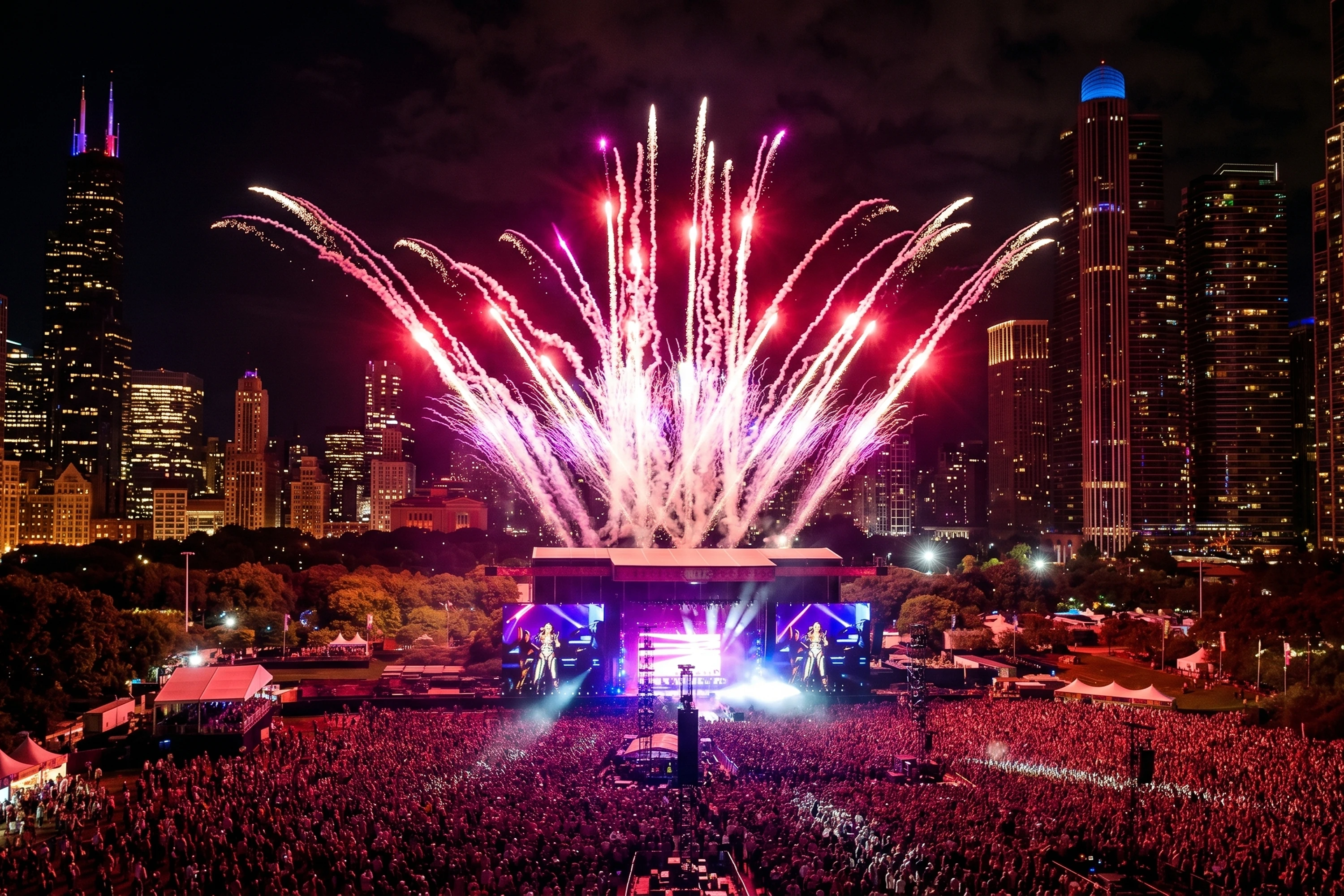
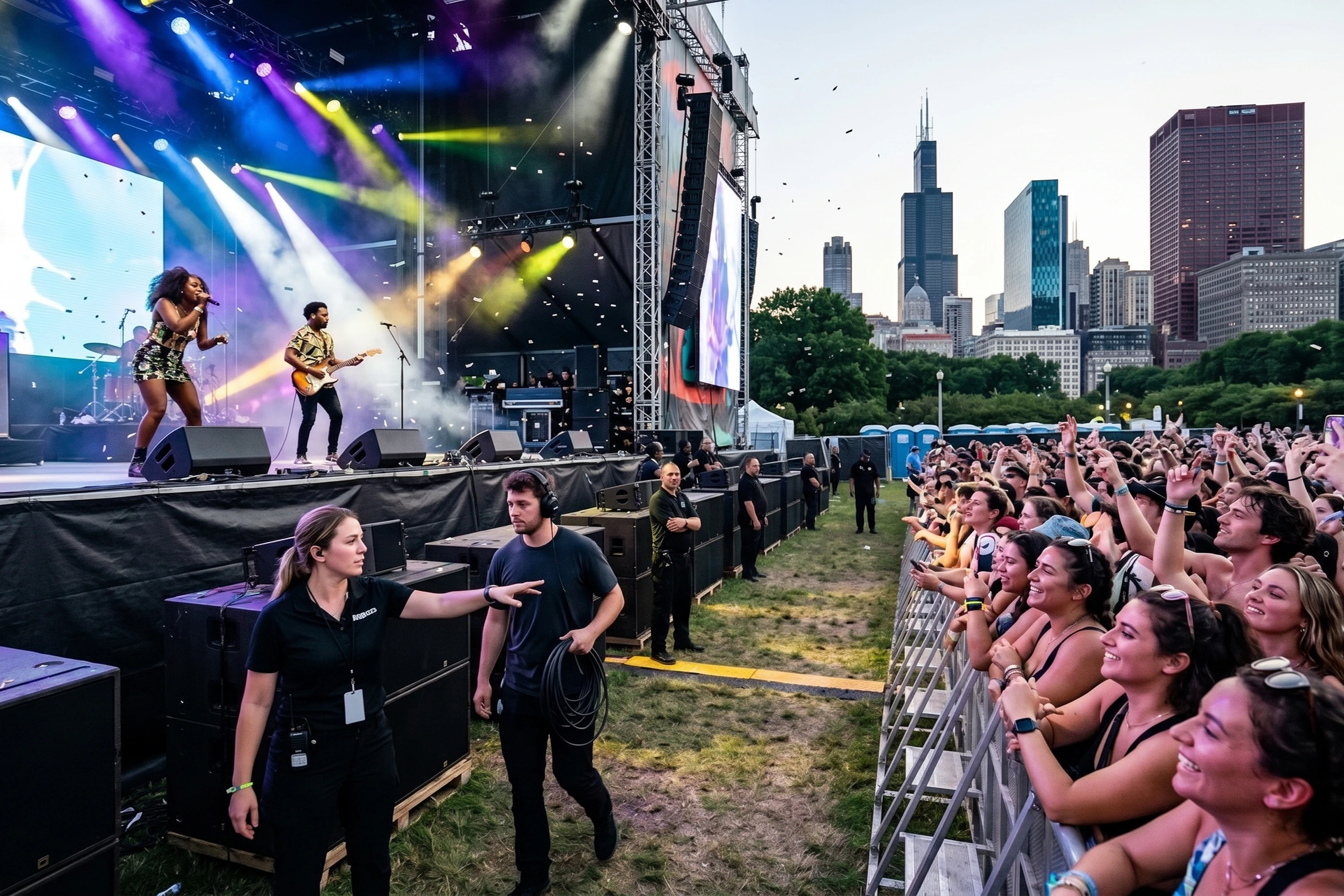
Lollapalooza 2026 returns to Grant Park in Chicago from July 30 to August 2, and the official festival site presents it as a four-day event with 170+ artists across 8 stages. That public framing is exactly why it makes sense as an Eventstaff case study. This is not a single-stage crowd story or a simple admissions story. It is a layered event environment where entry, movement, hospitality, premium access, food and beverage, and partner activity all have to perform in front of a very large public audience.
The setting matters just as much as the lineup. Grant Park is one of Chicago’s signature public spaces, and Chicago’s official tourism organization describes it as a lakefront destination near Millennium Park, Buckingham Fountain, the Art Institute, and major downtown visitor routes. That means Lollapalooza operates in a location where public visibility is already high before the festival even opens. Guests arrive with strong expectations about access, clarity, speed, and presentation because the event is not hidden away in an isolated venue. It is placed in the middle of one of the country’s most recognized urban event settings.
That is what makes this a meaningful study in festival staffing, festival logistics, and large event staffing. The value is not in retelling the festival as a cultural moment. The value is in examining how a multi-day, multi-stage event in a highly visible public park has to support repeated pressure at the points where guests feel the event most directly.
CEO Excerpt
“At a festival like Lollapalooza, staffing decisions shape how the event feels long before anyone judges the programming. Guests experience the event through entry, movement, service, and support. When those systems are staffed well, the whole event feels stronger.” - CEO, Eventstaff

Why Lollapalooza 2026 Is a Strong Festival Staffing Case Study
Some events are large but operationally narrow. Others are high profile but too dependent on one venue format to teach broader lessons. Lollapalooza is useful because it combines scale, density, repeated daily pressure, and a public urban footprint. That gives the case study much more substance than a general festival recap.
- The event is built around repeated operational cycles, not one peak moment.
A four-day festival requires far more than a strong opening. Entry waves happen again each morning and afternoon. Food and beverage pressure rises and falls several times a day. Stage transitions create recurring circulation surges. Premium guest expectations do not soften because it is day three. This repeated pressure is what turns festival staffing into a systems question rather than a one-time deployment question. ()) - The official event presentation already shows several guest-facing systems at work.
Lollapalooza promotes not only tickets and lineup, but also food, premium experiences, hotels, and a long roster of partners. That means the event is structured around more than performance viewing. Guests are moving through service environments, branded environments, hospitality environments, and information environments throughout the day. A case study that ignores those layers would miss most of the staffing reality. - Chicago gives the event a sharper operational profile than a more isolated site would.
Chicago’s official festival guide positions Lollapalooza among the city’s headline seasonal events, which reinforces that it sits inside a market already accustomed to public gatherings, destination visitors, and strong event expectations. In that context, weak staffing does not just create inconvenience. It becomes visible as poor event discipline in a market that notices when things feel loose.

The Grant Park Setting Changes the Staffing Equation
The venue section in many case studies is often too shallow. Here it needs to be substantial because the location directly shapes how staffing value appears.
- Grant Park is a public, urban, high-visibility environment.
When an event sits in a destination park in downtown Chicago, guest behavior is shaped by the city as much as by the event map. People arrive from hotels, rideshares, public transit, walking routes, and other downtown destinations. That means staffing plans have to respect the fact that the guest ex perience begins before the guest reaches a gate. A closed private venue gives organizers more control over the approach. Grant Park gives them less margin for ambiguity. - The site places event execution in public view.
In a convention center or stadium, some operational friction is easier to hide. In Grant Park, movement patterns, line build-up, and access confusion are much easier to see. That changes the value of staffing. A calm, visible, well-placed team does more than solve a functional issue. It reinforces confidence in the event’s professionalism. That is a major reason large event staffing matters more in this type of setting than many planners initially assume. - The downtown footprint raises the importance of readable movement.
Guests do not only need access. They need confidence. They need to know where they are heading, how quickly they are moving, and whether the event around them feels stable. In a major park, circulation is part of the event’s public face. That means festival logistics and staffing have to be designed together, because a strong site plan with weak visible support still feels fragile in practice.
Where Festival Staffing Pressure Builds First
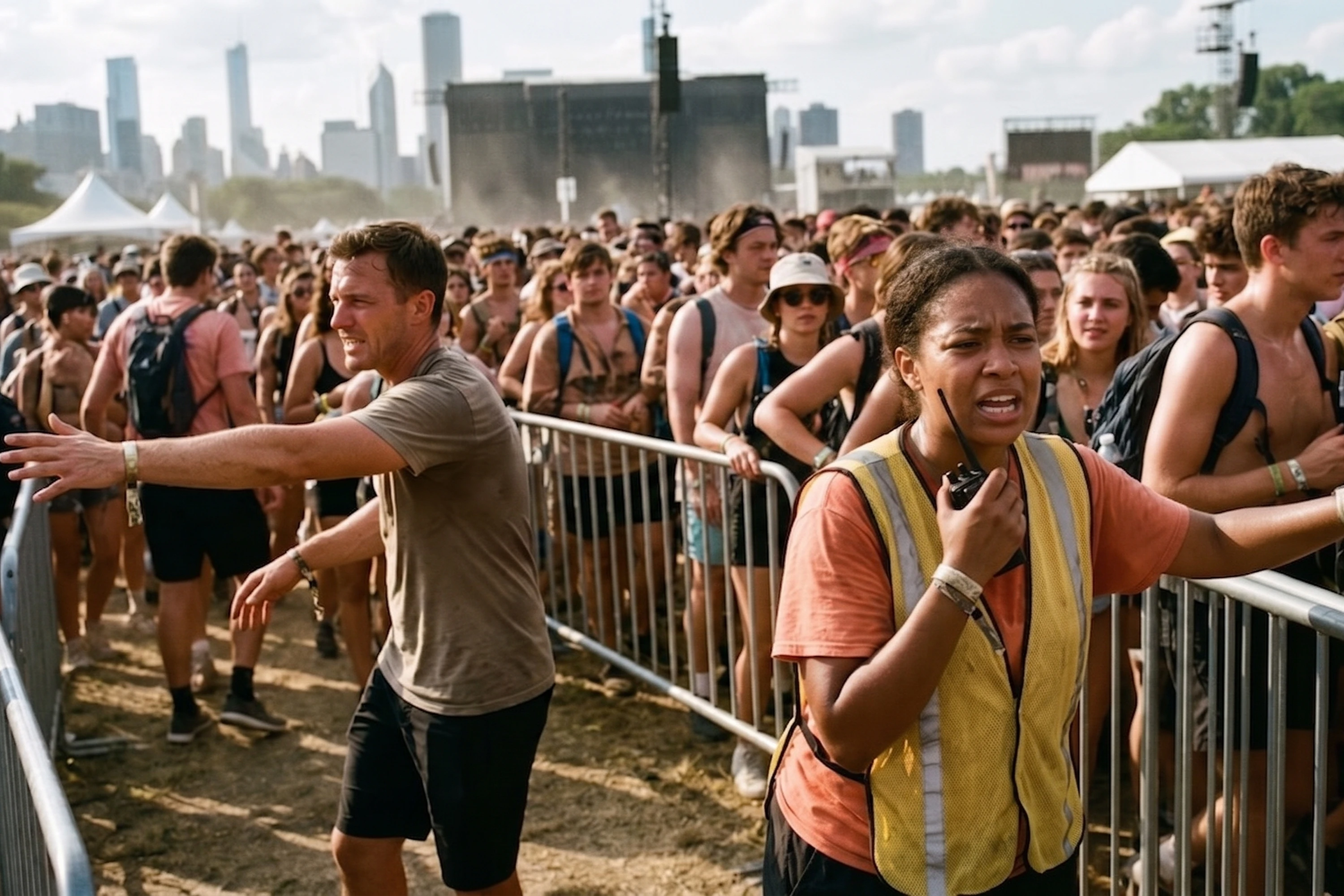
The main value of the case study sits here. Large festivals rarely feel strain evenly. They feel it first where guests stop, queue, hesitate, merge, wait, or try to make quick decisions in a busy environment. That is where staffing influences whether the event feels controlled or increasingly reactive.
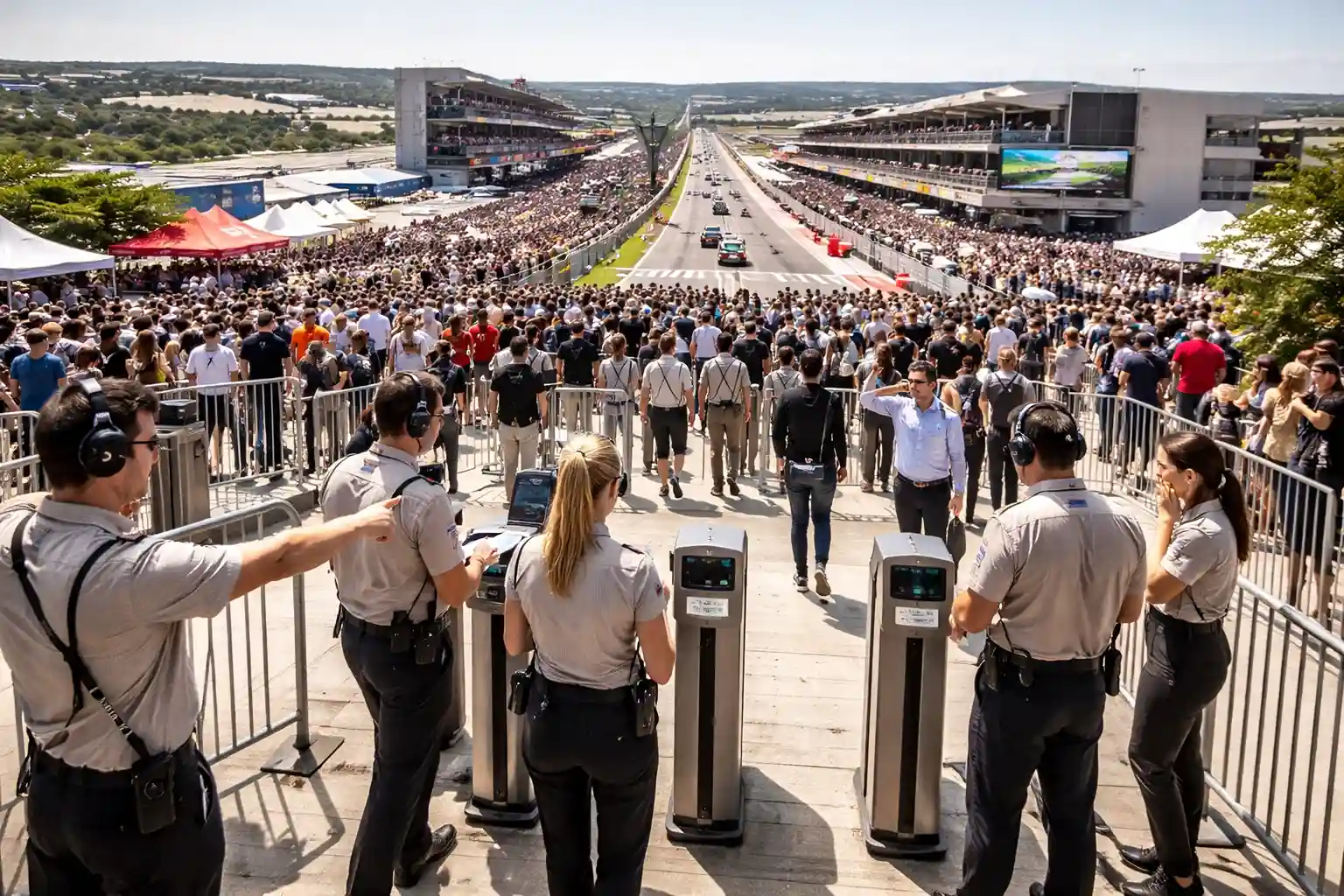
Admissions and entry flow
The first pressure point is usually admissions. This is the first moment where guests form an opinion about whether the event is functioning at the pace its scale demands.
- Entry is where the festival first proves it can absorb volume.
At the gate, the guest experiences the event through waiting time, clarity, pace, and staff confidence. This is the first operational promise the festival makes. If entry feels uncertain or slow, the event starts behind in the guest’s mind before the rest of the site has a chance to make a better impression. - Entry pressure changes the shape of the rest of the day.
Slow admissions do not stay isolated to the perimeter. They compress arrivals into later windows, make first-wave circulation less even, and create sharper bursts in concessions, information points, and nearby service zones. That is why good admissions staffing is not simply about checking access. It is about protecting the timing architecture of the day. - The strongest gate model is layered rather than generic.
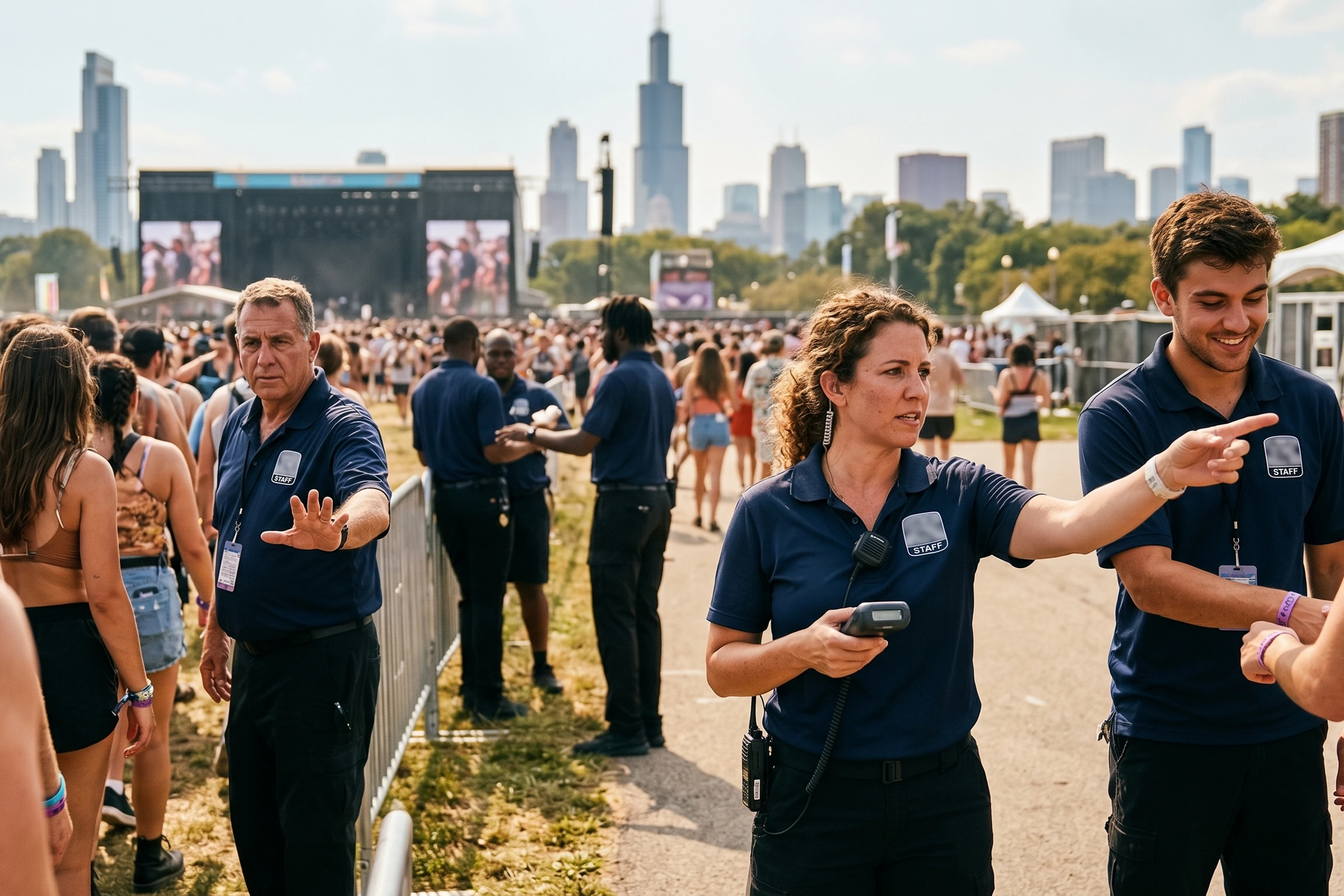
Ticket validation support, line guidance, guest-facing greeters, and directional teams all handle different parts of the same pressure system. A gate with enough personnel but poor role definition can still feel messy. A gate with clearly assigned responsibilities feels faster even when demand is high. That distinction is central to good festival staffing.
Cross-site movement and guest circulation
After entry, circulation becomes the next major pressure system. This is where event quality often becomes visible in more subtle but equally important ways.
- A multi-stage format creates recurring movement surges.
The official event presentation emphasizes eight stages, which signals that guests will not remain fixed in one place. They will move between performances, service points, activation zones, and premium areas throughout the day. That produces pulse-based movement rather than steady circulation, which means staffing has to respond to rhythm as much as volume. - Movement problems usually begin at intersections rather than across the whole grounds.
Most festivals do not become difficult because every path is overwhelmed at once. Pressure grows where routes cross, where people pause to reorient, where nearby lines spill outward, or where the next step in the guest journey is unclear. These are the places where staff presence has disproportionate value because early clarity prevents much larger disruption a few minutes later. - Guest circulation is both an operational and perception issue.
People judge how professionally an event is run by how easily they can move through it. When movement feels legible, guests are more patient in other areas too. When movement feels uncertain, delays elsewhere become less tolerable. That is why circulation should be treated as a central part of festival logistics, not as a secondary crowd-management concern.
Service zones and concessions
Food and beverage are often described in lifestyle terms. In operational terms, they are one of the clearest strain multipliers on a festival site.
- Lollapalooza actively markets food and drink as part of the experience.
The festival promotes food, drinks, and sweets from Chicago favorites, which means service zones are part of the event’s identity, not merely support amenities . That raises the importance of staffing them correctly because the guest expects these areas to be appealing, efficient, and integrated into the day rather than frustrating interruptions. - Concession pressure spreads beyond the point of sale.
When service slows, queue length affects adjacent paths, guest patience, and nearby zone behavior. A long food line does not only delay transactions. It changes how open the site feels and how easily nearby guests can circulate. This is why concessions should be viewed as a movement issue as well as a service issue. - Service staffing protects both throughput and perception.
Waitstaff, event servers, bussers, and bar-support personnel shape whether these zones stay efficient under load. Their work influences how quickly guests are served, how orderly the area remains, and whether the festival continues to feel well organized when demand spikes. This is one of the strongest areas where festival logistics and large event staffing directly reinforce each other.
Premium access and hospitality zones
Premium experiences create a separate service standard inside the broader event.
- The event publicly sells premium access, so the premium experience is part of the promise.
Lollapalooza highlights premium perks and ultimate access on its site, which means guests in these areas arrive expecting smoother handoffs, better information, faster resolution, and more polished service. Staffing here has to meet a higher standard because the guest is evaluating the event against a more explicit promise. - Premium environments are judged on subtle execution.
General admission may absorb some friction because scale is obvious. Premium spaces are judged on tone, speed, confidence, and consistency. A slow access check, uncertain guest support, or loosely managed entry point can damage the perceived value of the premium product much faster than a similar issue in a general zone. - This is where hospitality staff have outsized strategic value.
Guest-facing teams in premium zones are not decorative. They are part of how the event protects its highest-value experience layers. Their role is to reduce hesitation, support confident movement, and preserve the sense that the guest is being looked after without the process feeling heavy or theatrical.
Sponsor activations and branded touchpoints
Lollapalooza is also a sponsor environment, and that creates another staffing layer.
- The partner roster shows how much branded activity is built into the event.
The 2026 site lists major brands including T-Mobile, Bud Light, Allianz, Airbnb, Toyota, Hulu, Chase, Uber, and Uber Eats, among many others. That means sponsor-facing activity is not a side feature. It is part of the public event environment and part of what guests move through during the day. - Activations create local pressure systems of their own.
A branded installation can behave like a miniature venue inside the festival. It can pull a line, create dwell time, interrupt a nearby path, or attract guests who are less certain about where to stand and where to move next. Understaffed activations do not only hurt the sponsor outcome. They also risk creating friction around them. - Promotional staffing protects both interaction quality and site usability.
Booth staff, brand ambassadors, and experiential teams help ensure an activation feels inviting and organized rather than clumsy and obstructive. At a festival like Lollapalooza, activation staffing should be treated as part of the operating map, not as an isolated marketing detail.
End-of-day transition and multi-day continuity
The late-day and next-day layers are where operational maturity becomes easier to judge.
- Exit conditions test whether the event can stay clear when guests are tired.
A crowd leaving is different from a crowd arriving. Attention is lower, patience is thinner, and urgency is often higher. Staff need to be placed where clarity matters most because guests at that point are less willing to decode a vague environment. - Multi-day events need recovery discipline, not just opening discipline.
The first day can hide a lot. By day three or four, service consistency, staffing fatigue, and reset quality become more visible. That is why a real case study cannot stop at daytime guest experience. It has to account for how the event restores itself for the next operating cycle. - Continuity shapes perceived quality.
Guests may never talk about overnight readiness explicitly, but they feel it in the form of clean circulation, sharp service zones, and a site that still seems prepared rather than worn down. Strong staffing plans account for that continuity because guests experience it as part of the event, not as back-of-house work.
How Festival Logistics and Large Event Staffing Work Together
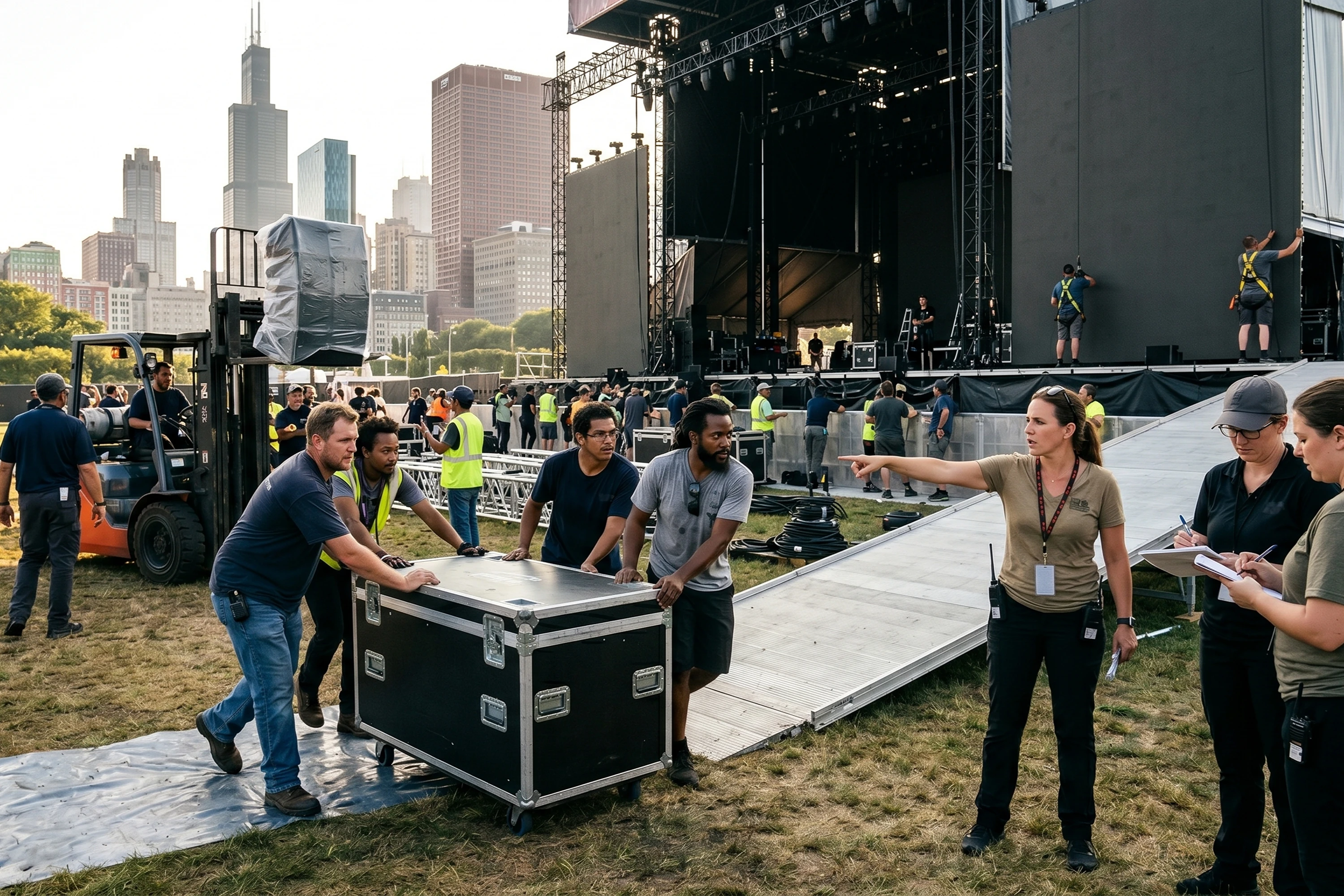
At this scale, logistics and staffing are inseparable. A weak staffing plan can undermine a good site plan, and a weak site plan can waste a strong team.
- Logistics tells you where people will strain the site.
Routing, stage placement, concessions, sponsor areas, premium entrances, and information touchpoints all shape where guests hesitate or converge. Those choices determine where staff need to be if they are going to change the experience meaningfully. - Staffing turns the plan into something guests can actually feel.
Guests do not experience the site map as a document. They experience it through whether someone is there when confusion appears, whether a queue stays readable, whether service keeps moving, and whether movement feels supported. Staffing is the live layer of logistics. - Large event staffing works best when it is pressure-zone based.
Even distribution may look balanced on paper, but guests do not place equal demand on every zone. Some areas remain stable while others repeatedly surge. Strong staffing strategies identify the areas where visible support changes outcomes most and build from there.
How Eventstaff Services Map to a Festival Like Lollapalooza
This is where the case study becomes commercially useful without drifting into promotional copy.
- Hospitality staff belong where guest confidence matters most.
Premium access, guest information points, branded lounges, and support-sensitive touchpoints all benefit from staff who can maintain clarity and calm while preserving a polished tone. - Crowd-management support belongs where the site needs to stay legible.
Directional teams, queue guidance, and crossover-point support are especially valuable in environments where repeated movement surges can quickly make a busy area feel uncertain. - Promotional staffing belongs where sponsor execution meets site behavior.
Activations need staff who can create engagement without letting the zone become messy, slow, or disruptive to nearby movement. - Service staffing belongs where throughput and guest patience are linked.
Busy food and beverage areas are one of the most visible pressure points on any festival grounds. Staff there do more than serve. They help keep the broader site functional. - Large event staffing is the layer that connects all of these systems.
A festival like Lollapalooza does not ask for one staffing solution. It asks for coordinated support across several overlapping operating environments. That is exactly why the term fits this case study.
What Event Planners Can Learn From Lollapalooza 2026
The value of a case study is in the transferable lesson. Lollapalooza is useful because it makes those lessons concrete.
- Plan around pressure points, not abstract volume.
The event does not feel difficult because it is large in general. It feels difficult where admissions compress, where traffic crosses, where service spills outward, and where premium expectations stay high under load. - Treat movement and service as linked systems.
A concession slowdown affects circulation. A weak entry process affects later service timing. A poorly staffed activation can affect nearby guest flow. These are connected systems, and they should be planned that way. - Think in multi-day operating cycles.
The first day is only one test. The stronger question is whether the event can stay composed through repeated surges, repeated resets, and accumulated fatigue. That is where staffing maturity becomes more visible.
Final Words
Lollapalooza 2026 works as a serious Eventstaff case study because it makes the operational reality of large festivals easier to see. The event’s own public structure points to a multi-stage, premium-aware, sponsor-heavy, service-rich festival in one of Chicago’s most visible public settings. That combination creates a useful lens for understanding how festival staffing actually performs under repeated pressure.
The broader takeaway is simple. Festivals of this scale hold up when staffing is built around the places where guests feel strain first. Entry, movement, service, premium access, activations, and continuity all need deliberate support. That is where festival logistics becomes visible to the guest, and where large event staffing shifts from background function to event-defining system.