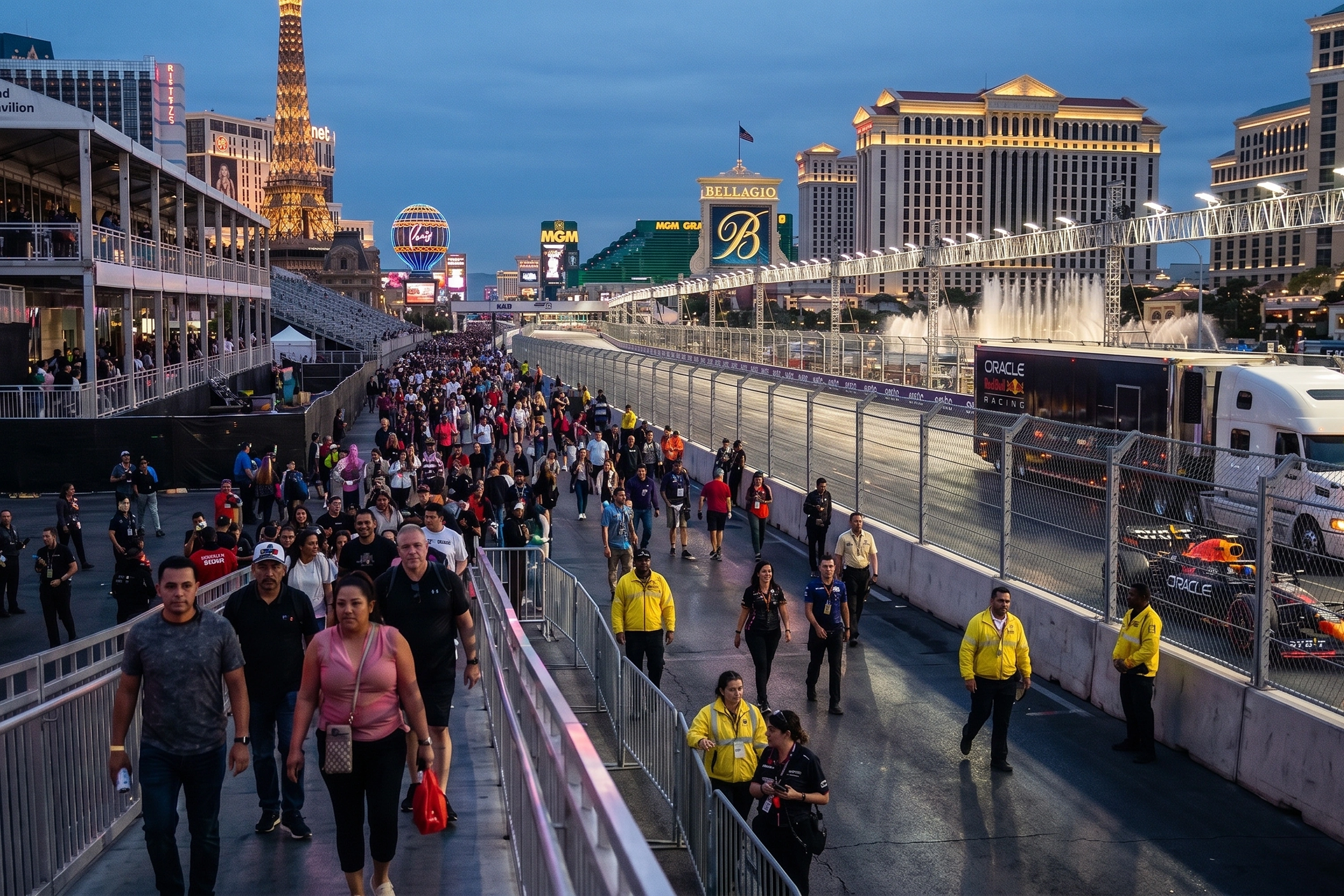
The 2025 Formula 1 Heineken Las Vegas Grand Prix offers a serious event operations case study because it was staged across one of the most active hospitality corridors in the United States. The Las Vegas Strip served as a race circuit, visitor district, hotel corridor, nightlife zone, restaurant market, rideshare environment, pedestrian network, worker access route, and global broadcast setting within the same event window.
That operating environment created a delivery challenge with several connected layers:
- Race organizers had to protect a temporary street circuit that used public roads.
- Public agencies had to manage closures, traffic routing, emergency access, and public communication.
- Resorts had to keep guests, employees, vendors, restaurants, casino floors, and hospitality programs moving.
- Event teams had to support ticketed spectators, VIP guests, sponsors, media, production crews, and staff across a shifting footprint.
- Transportation providers had to give visitors practical alternatives when normal road behavior no longer applied.
The official Las Vegas Grand Prix recap described the 2025 weekend as the event’s third running from November 20 to 22, with the Strip transformed into a global stage for racing, entertainment, and luxury hospitality. Formula 1 also reported that the 2025 race weekend was sold out and drew more than 300,000 attendees.
Those numbers matter, but the more important case study is how the event appears to have been delivered. A large crowd can be planned around when it arrives through a few controlled gates. The Las Vegas Grand Prix required a wider model because movement happened across streets, resorts, pedestrian bridges, hospitality areas, ticketed zones, curbside edges, transit stops, and private venues.
For Eventstaff, this case is useful because it shows what modern large-scale event planning now demands. Strong delivery depends on staffing, venue operations, crowd flow management, transportation planning, guest communication, public agency coordination, and live service recovery working from the same operational picture.

Case Background
The Las Vegas Grand Prix is a temporary street-circuit event staged through the resort corridor in Paradise, Nevada. The official track layout lists the Las Vegas Strip Circuit at 3.8 miles, with 17 turns and two DRS zones, taking drivers past major hotels, casinos, and Strip landmarks.
From an event operations standpoint, that track layout creates a major delivery requirement. A permanent racing venue already has defined entries, parking patterns, grandstands, service roads, security layers, and back-of-house access. A street circuit has to build many of those controls into an active urban setting.
The race footprint had to support several workstreams at once:
- Track safety and circuit control.
Barriers, fencing, lighting, marshal points, restricted zones, security lines, and operational access had to protect the race environment during practice, qualifying, and race activity. - Hospitality and venue operations.
Resorts along and near the route had to continue operating while absorbing changes to arrivals, valet behavior, pedestrian routes, restaurant timing, elevator demand, lobby pressure, and guest questions. - Spectator access and crowd flow management.
Attendees needed to reach the right ticketed areas through a footprint where familiar Strip movement patterns were altered by closures, barriers, security posts, and designated routes. - Public street and traffic management.
Clark County’s public guidance outlined race-week closures, including road closures beginning November 19, event-related closures beginning at 1 p.m. from November 20 to 22, and a full 24-hour closure of Koval Lane between Rochelle Avenue and Harmon Avenue from November 15 to 24 - Transportation alternatives.
The Las Vegas Monorail positioned itself as a race-week option for fans attending the 2025 Grand Prix, which mattered because road-based movement near the circuit could face delays, detours, and constrained drop-off points
The event also took place at night. That changed the operating environment in practical ways. Guests may have already spent hours in restaurants, casinos, sponsor events, or hospitality areas before moving toward the race. Staff had to guide visitors when lighting conditions, alcohol consumption, fatigue, traffic restrictions, and heavy pedestrian movement could overlap.
The case background is therefore wider than the race program. It includes the temporary conversion of a working hospitality district into a controlled event environment, then the gradual return of that district to normal use after each operating window.
Why the Las Vegas Grand Prix Was a Difficult Event to Deliver
The Las Vegas Grand Prix was difficult because several operating systems had to work together without sharing the same natural rhythm. A race schedule is fixed. Hotel operations are continuous. Restaurant demand moves in waves. Casino floors remain active. Nightlife peaks late. Rideshare demand reacts in real time. Workers arrive by shift. Visitors move based on habit, landmarks, signage, and visible crowds.
That mix creates difficulty in specific ways.
- The race required hard control of public roads.
During race activity, the circuit environment had to be protected. Roads used for the track could no longer function as flexible city streets. That affected vehicles, pedestrians, emergency access, loading, service routes, hotel approaches, and curbside behavior. - The surrounding hospitality economy still had to serve guests.
Resorts could not operate as if the race audience was the only audience in the corridor. Hotels still had check-ins and check-outs. Restaurants still had reservations. Casinos still had guests. Employees still had shifts. Vendors still had delivery windows. Each group needed route clarity that matched the temporary event conditions. - The event audience had different access needs.
A grandstand ticket holder, suite guest, sponsor attendee, media crew, contractor, hotel guest, rideshare driver, restaurant customer, and production assistant each needed different information. A general statement about road closures would not be enough for those groups. They needed practical instructions tied to where they were going and when they were moving. - The Strip’s normal wayfinding habits created friction.
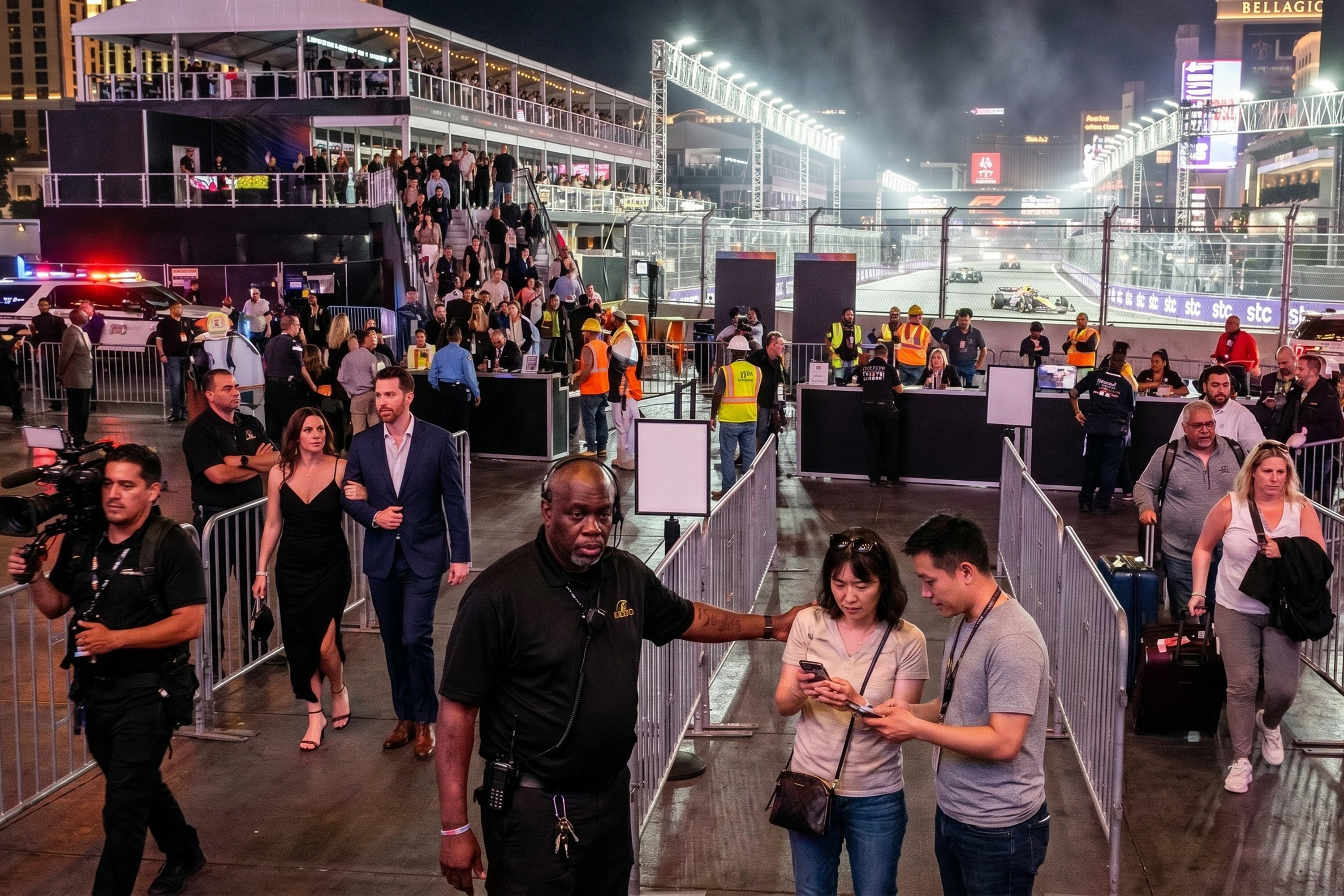
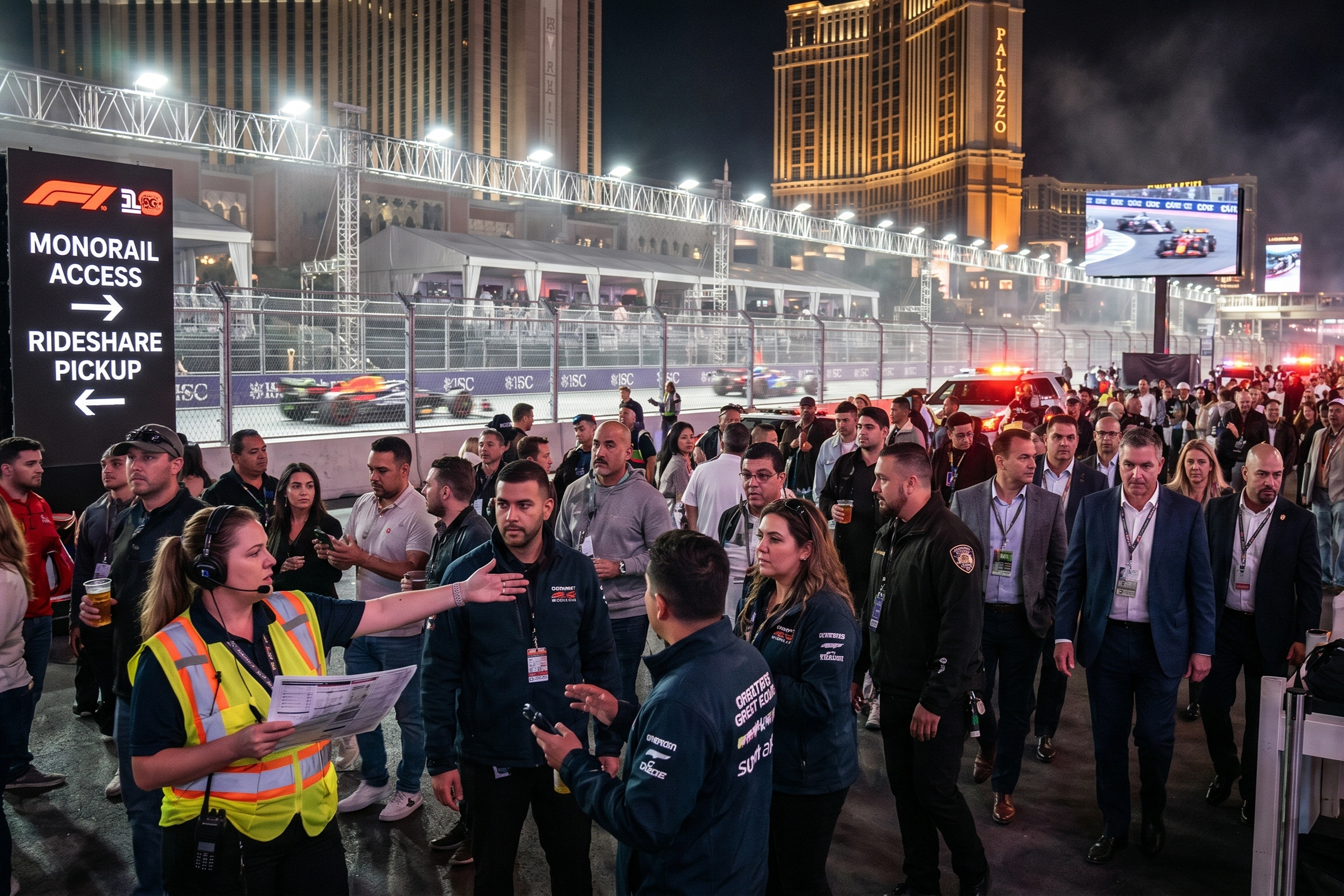
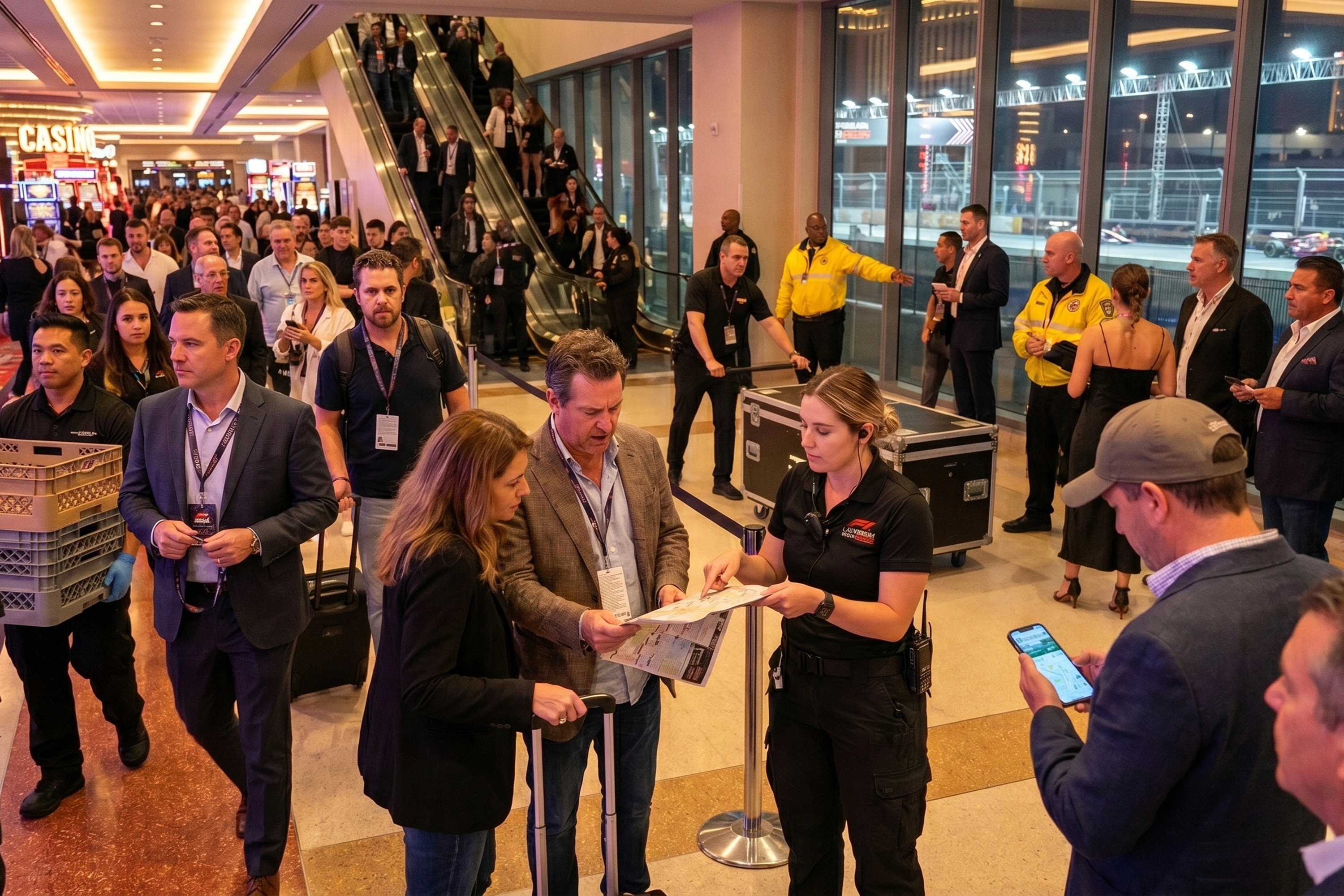
Many visitors navigate Las Vegas through visible hotels, pedestrian bridges, casino entrances, valet areas, and rideshare pickup points. A temporary street circuit interrupts that familiar logic. Guests may walk toward a known bridge or entrance before realizing the route has changed. Staffed decision points become important because they prevent guests from discovering restrictions too late. - The event footprint touched public and private spaces.
The guest journey could move from a hotel lobby to a sidewalk, from a pedestrian bridge to a ticketed zone, from a rideshare edge to a hospitality entrance, or from a casino walkway to a security checkpoint. Each handoff required alignment between venue operations, event staff, security, public agencies, and private property teams. - The race schedule compressed certain movement windows.
Arrival could be staggered across dinner, hospitality, and pre-session activity. Departure after a major session was more concentrated. Crowd flow management after the race or qualifying required a separate plan because more guests were likely to move at the same time. - Public communication had to translate into field behavior.
Clark County could publish closure times, F1 could provide digital routing, and hotels could notify guests. Those tools only work fully when guests understand them and act on them. When they do not, front-line staff become the point where the plan is interpreted in real time.
Local reporting also emphasized that 2025 brought some of the earliest Strip closures since the race began, with closures beginning at 1 p.m. on race activity days (). That timing increased the operational impact beyond the evening race window because afternoon arrivals, worker commutes, vendor movement, restaurant preparation, and early guest travel could all be affected.
For large-scale event planning, this is one of the most important points. The difficult part of delivery was not limited to peak spectator volume. The difficulty came from mixed-use movement across a corridor where thousands of people had different destinations, different levels of preparation, and different expectations of service.
How the Event Operations Model Appears to Have Been Structured
The event operations model appears to have been built around layered control. The public information available points to a system that combined closure timing, ticketed zone routing, digital guidance, transportation alternatives, resort coordination, and staff-supported guest movement.
The first layer was street and circuit control.
Clark County’s closure schedule shows that race-week control started before the main event days and continued through the event window. This type of phased closure model supports safety, build readiness, traffic adjustment, and controlled movement around the circuit.
That layer likely required several operational decisions:
- Closure timing had to match race activity and preparation needs.
Road restrictions could not begin only when cars were on track. Track preparation, safety checks, barrier integrity, staffing, signage, security sweeps, and production readiness all required time before each session. - Traffic routing had to account for non-attendees.
Many people affected by the closures were not going to the race. They may have been hotel guests, workers, local drivers, vendors, restaurant customers, or residents. Public communication had to explain what changed without assuming everyone understood Formula 1 scheduling. - Reopening had to be managed carefully.
Temporary reopening is a live operations task. It requires confirmation that roads are safe, equipment is secured, pedestrians are controlled, and traffic can return without conflicting with remaining event activity.
The second layer was ticketed zone movement.
Formula 1’s guidance for getting to and from the Las Vegas Grand Prix directed attendees to use the official F1 Las Vegas app for digital maps, customized routes to designated ticketed zones, and real-time road opening and closure information .
For a street-circuit event, that zone-specific model is critical.
- A guest needed instructions for their assigned area, not the whole event.
Sending every attendee toward the same general destination would increase congestion and misrouting. Zone routing helps separate guests before they reach the busiest access points. - Digital guidance had to be reinforced in the field.
Apps are useful before and during travel, but guests often need confirmation when they reach a hotel exit, sidewalk split, bridge approach, or security checkpoint. Staff and signage had to support the same route logic. - Real-time information had to account for shifting conditions.
Temporary streets, closures, pedestrian paths, and access points can change by day and time. The app’s value depended on how well it matched live field conditions.
The third layer was venue operations across the resort corridor.
Hotels and hospitality venues along the Strip were part of the operating environment. They were not merely nearby businesses affected by the event. They shaped how guests arrived, moved, waited, asked questions, entered hospitality areas, and recovered from confusion.
Venue operations teams likely had to think through:
- how hotel guests would be briefed before arrival
- how valet and rideshare adjustments would be communicated
- where internal signs would be placed
- which lobby exits should be staffed
- how restaurant reservation timing would be affected
- how employees would reach the property
- how vendors would access loading points
- how security teams would handle guest questions beyond their usual scope
- how VIP groups would move between suites, sponsor areas, hotels, and ticketed zones
This is where staffing quality matters. A front-line staff member in a lobby, bridge approach, hospitality corridor, or credential area may be the person who determines whether a guest feels lost or supported.
The fourth layer was transportation substitution.
During major Strip events, the transportation model cannot rely entirely on curbside access. The Monorail gave attendees an alternative to road-based movement, which could reduce some pressure from rideshare, taxis, personal vehicles, and hotel driveways.
However, transit alternatives still need operational support.
- A station exit has to connect to the right pedestrian route.
- Guests need to know walking distances and zone connections.
- Staff need to direct guests who exit at the wrong station or misunderstand the route.
- Departure plans must account for increased demand after major sessions.
- Transit messaging must be shared before guests are already stuck in traffic.
The fifth layer was front-line communication and issue resolution.
Public notices, digital maps, hotel emails, road closure updates, security briefings, and signage all support the plan. Still, live event delivery depends on what happens when a guest asks, “Where do I go now?”
For that moment, staff need more than a posted assignment. They need:
- current route knowledge
- clear terminology for zones and entrances
- escalation contacts
- awareness of ADA support points
- credential troubleshooting direction
- confidence in handling frustrated guests
- updates when field conditions change
- supervisor support when instructions conflict
That is why event operations and staffing cannot be separated at this scale. The operating model exists on paper first, but guests experience it through people, routes, signs, queues, checkpoints, and the answers they receive under pressure.
The Pressure Points That Likely Carried the Most Risk
The highest-risk pressure points were likely found around the edges of the race environment, where normal city behavior met temporary restrictions. These points mattered because they shaped how guests, workers, vendors, and non-attendees experienced the event.
- Hotel entrances and lobby exits carried guest perception risk.
A visitor staying on the Strip expects the hotel to feel accessible, even during a major event. If road closures affected valet, rideshare, walking routes, or familiar entrances, guests needed immediate guidance. A confused hotel arrival can quickly become a service complaint because the guest sees the problem as part of the destination experience. - Rideshare and taxi edges carried compression risk.
When road access narrows, more guests may collect around fewer pickup and drop-off areas. After a race session, that pressure increases because many people want to leave at once. Crowd flow management at these edges requires signage, queue support, staff direction, and coordination with security or transport leads. - Pedestrian bridges carried route-choice risk.
The Strip depends heavily on pedestrian bridges and elevated crossings. During the race, a normal crossing choice may have led guests toward a restricted area or a longer path. Staffed bridge approaches would be valuable because they help guests make the right decision before they join the wrong flow. - Credentialing carried delay risk.
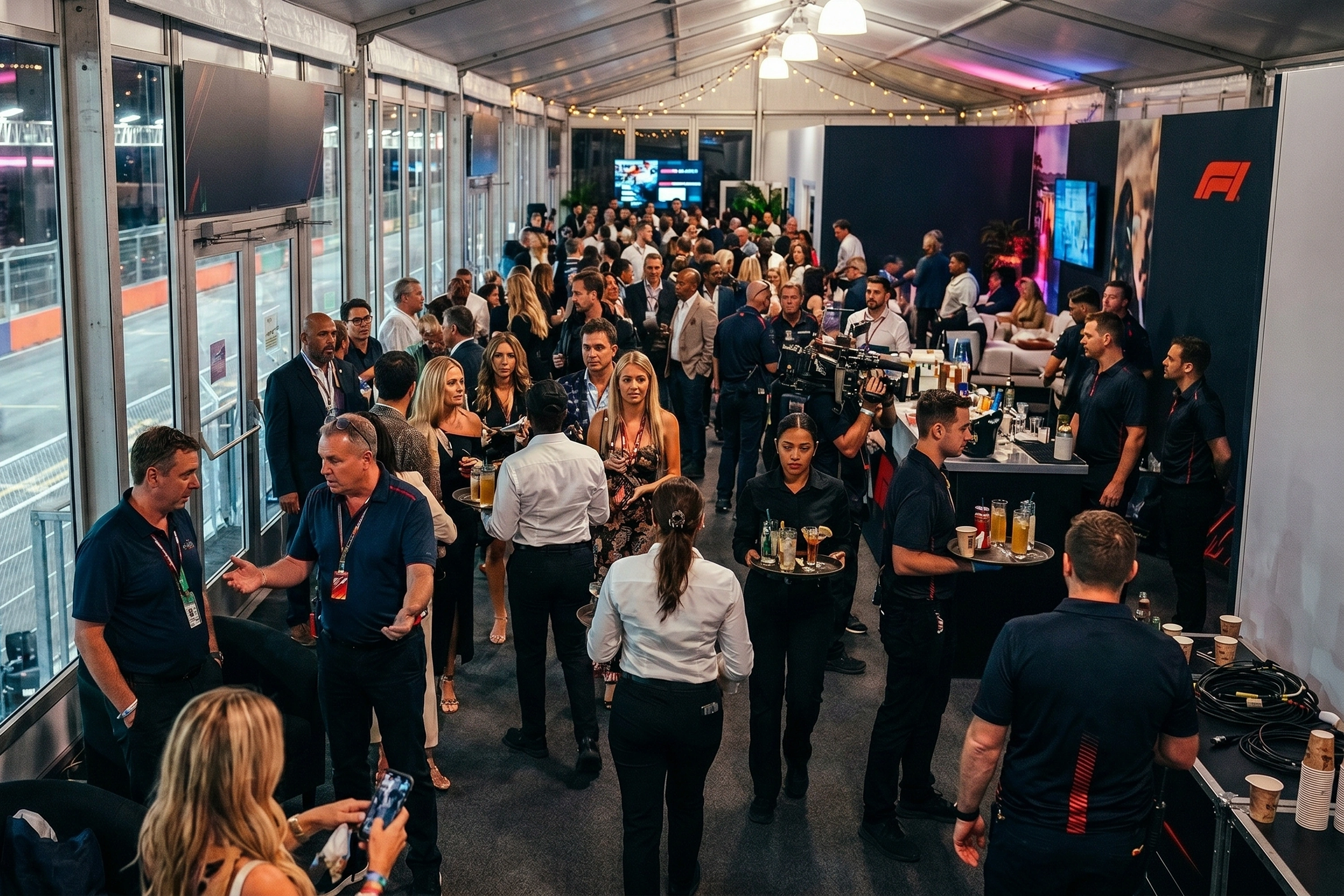
Formula 1 hospitality includes multiple access levels, from general ticketed areas to suites, sponsor environments, media spaces, staff credentials, and contractor passes. A credential issue at a busy point affects more than one guest. It can slow a queue, pull staff away from primary posts, and create visible uncertainty. - VIP hospitality carried recovery risk.
Premium guests expect precise movement. If a sponsor guest, executive group, or hospitality attendee is dropped in the wrong place or directed to the wrong entrance, the service recovery has to be fast. The operational plan needs trained staff who can resolve the issue without making the guest feel passed from one team to another. - Worker movement carried back-of-house risk.
Large-scale event planning often focuses heavily on the public experience, but a major event can weaken behind the scenes if staff, vendors, production assistants, food and beverage teams, cleaners, or technical crews cannot reach their posts. A late worker arrival can leave a check-in point exposed. A delayed vendor can affect hospitality service. A missed equipment movement can affect readiness. - Public-private handoffs carried ownership risk.
Guests do not always know whether a question belongs to the hotel, race organizer, transport provider, law enforcement, private security, or event staff. From the guest’s perspective, the experience is connected. If the handoff between teams is weak, the guest may feel unsupported even when each organization is technically doing its own job. - Post-session departure carried timing risk.
Egress is often harder than arrival because people leave in a compressed window. Guests are tired, groups split and reconnect, rideshare demand rises, sidewalks fill, and some visitors change plans toward nightlife rather than hotels. The event needed a departure model that treated egress as a distinct operating phase. - Communication carried consistency risk.
The event had several communication channels: public agency updates, official app guidance, hotel information, signage, staff scripts, media coverage, and transport notices. If any channel used different terms, outdated instructions, or incomplete routing, staff would have to repair the confusion in real time.
These risks show why staffing at a citywide event is a control function. Staff do not simply occupy posts. They reduce uncertainty, redirect movement, protect the guest experience, support venue operations, and help the larger plan adapt to live conditions.
What the Organizers Seem to Have Gotten Right
The 2025 Las Vegas Grand Prix appears to have reflected a more mature event operations model than a first-year event. The public materials suggest an emphasis on planning visibility, early communication, ticketed-zone routing, transportation alternatives, and clearer public guidance.
Several choices stand out.
- The event treated public information as part of delivery.
Clark County’s closure guidance gave the public specific dates, times, and affected areas. That type of detail helps people plan around disruption. It also gives hotels, workers, vendors, and local businesses a more useful base for their own communication. - Race week was managed as a sequence, not a single day.
The closure information showed that setup, race-week preparation, active event windows, and reopening all mattered. Strong large-scale event planning requires that full sequence. Practice, qualifying, race night, and breakdown all create different movement patterns. - The official guidance pushed guests toward assigned zones.
This likely helped reduce unnecessary cross-footprint movement. When attendees understand their ticketed zone and route before entering the busiest area, staff have fewer avoidable problems to solve at gates and checkpoints. - Digital tools were used to support changing conditions.
The official app guidance was important because a street-circuit footprint changes by time and day. A static map alone would not provide enough detail for guests navigating closures, zone entrances, and pedestrian routes. - Transportation alternatives were made visible.
The Monorail’s race-week positioning gave guests a practical way to avoid some road pressure. For events along the Strip, reducing vehicle demand near the event footprint can improve arrival, departure, and curbside management. - The model appears to have accounted for the hospitality character of Las Vegas.
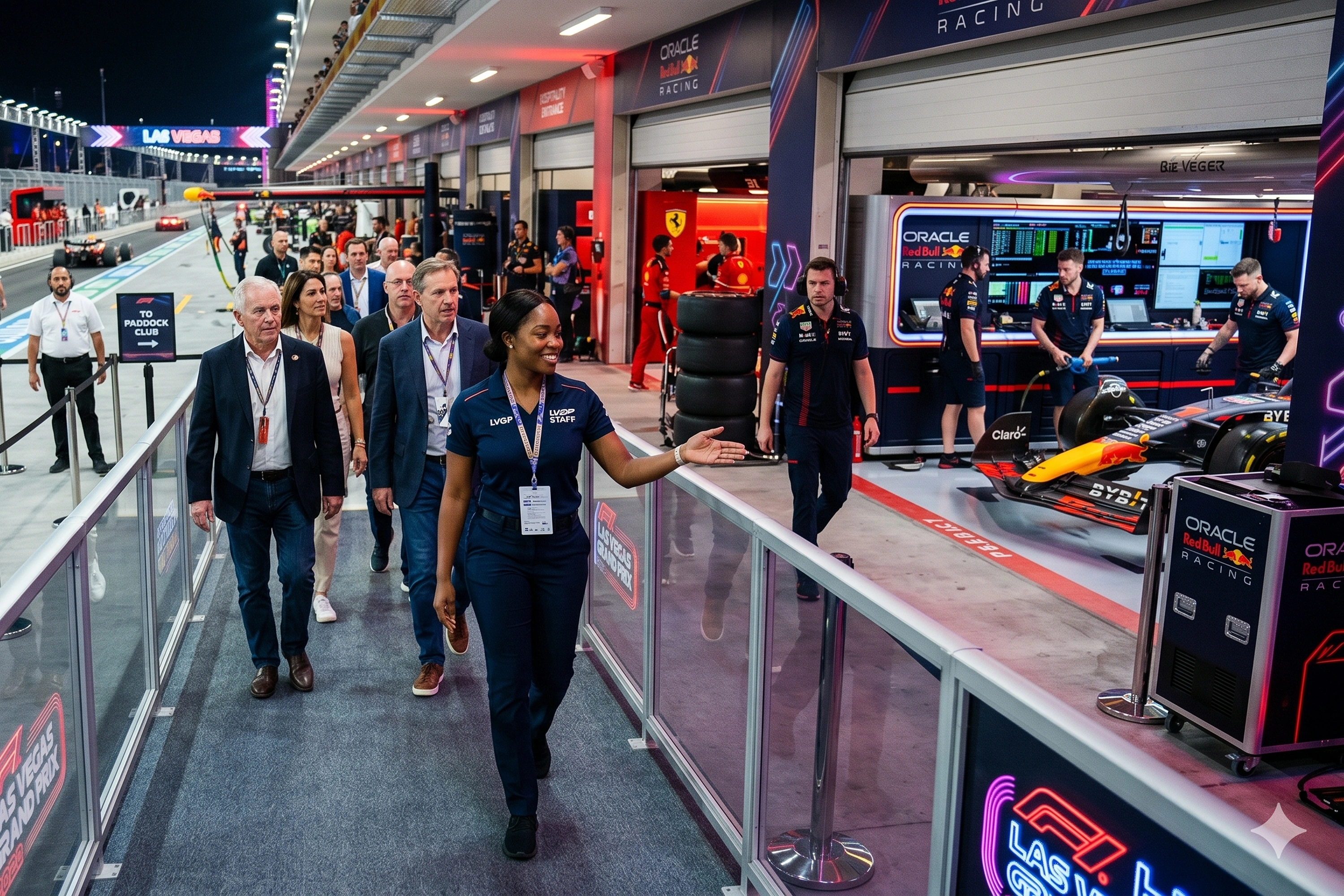
The event was built around racing, but the location required attention to hotels, suites, sponsors, restaurants, nightlife, and premium guest expectations. That matters because Las Vegas guests judge events through the full hospitality journey, not only through the programmed experience. - The operating model gave staff a clearer framework.
When closures, zones, app routes, and transport alternatives are defined publicly, staff can direct guests with more confidence. That helps reduce improvisation at the front line.
The strongest takeaway is that these pieces had to work together. A closure notice without staff support would leave too much interpretation to guests. A digital map without physical wayfinding would be weaker once crowds formed. Transit options without pedestrian guidance would still create confusion at station exits. Resort communication without event alignment would leave hotels answering questions without the full field picture.
Major event delivery improves when every layer reinforces the same instructions.

Where the Model Still Carried Risk
The Las Vegas Grand Prix could be well planned and still carry risk because the event depended on human behavior across a dense, active corridor. People miss updates. Drivers follow old habits. Guests trust familiar entrances. Workers rely on usual routes. Crowds make decisions based on what they see in the moment.
Several risks likely remained.
- Published information may not have reached every affected person.
Road closure updates are essential, but visitors may skim them or assume they do not apply to their hotel, reservation, or transportation plan. This creates a gap between available information and practical understanding. - Non-race guests may have experienced the event as disruption.
A guest arriving for a hotel stay, dinner reservation, casino visit, or show may not view the race as the reason for their trip. If their route changed, their first concern would be access, not event scale. Staff needed to support those guests with the same care as ticket holders. - Early closure timing increased the need for daytime readiness.
Closures beginning at 1 p.m. meant the event affected afternoon movement. That required earlier staff briefings, earlier signage visibility, earlier hotel messaging, and more careful coordination with employee shifts and vendor access. - The visitor mix made one-size messaging weak.
Las Vegas serves international tourists, corporate groups, domestic leisure travelers, nightlife guests, casino guests, local workers, and sports fans. Some guests need precise maps. Some need direct staff guidance. Some need ADA support. Some need language-sensitive assistance. Event operations had to support those different needs without slowing the field response. - Staff knowledge had to remain current.
In a changing footprint, outdated information can create bigger problems than silence. A staff member who gives an old route, wrong zone name, or stale closure time can send guests into a delay. Supervisors, radios, briefing sheets, and real-time updates matter because the field plan may shift by hour. - Venue operations could be strained by questions beyond normal service.
Hotel and restaurant teams may face questions about road closures, ticketed zones, walking routes, transportation, and security checkpoints. If they are not briefed, they may unintentionally give incomplete guidance. A citywide event needs shared information across both event teams and venue teams. - Egress could expose weaknesses hidden during arrival.
Arrival may look stable because guests come in waves. Departure reveals whether the plan can handle concentrated movement. If rideshare points, pedestrian bridges, hotel entrances, and transit stations all receive demand at once, small delays can become highly visible. - Local business impact remained a reputational consideration.
Even when a major event succeeds for attendees, surrounding businesses and workers may still feel access pressure. Repeat citywide events rely on local cooperation, public confidence, and business tolerance. Operational planning has to reduce unnecessary disruption for people who are not attending the event.
These risks are not criticisms of the event. They are the normal realities of delivering a large live event across a working city district. The main lesson is that successful event operations require constant translation between the plan and the people moving through it.
Lessons for Future Festival, Venue, and Large-Scale Event Planning
Build the access plan around how people actually move.
Guests do not move through a footprint like planners reading a map. They move based on habits, visible signs, hotel familiarity, rideshare app prompts, group decisions, staff instructions, and the flow of people around them.
A stronger access plan should account for:
- Different preparation levels.
Some guests will read every instruction before arrival. Others will arrive with only a ticket, a hotel name, or a rideshare destination. The plan has to support both groups. - Familiar routes that may no longer work.
A guest who used a bridge, valet, casino entrance, or sidewalk earlier in the trip may assume the same route is available during the event. Staff and signage should correct that assumption before the guest reaches a restricted edge. - Decision points before congestion points.
The best place to solve a route issue is before guests join the wrong crowd. Staff should be placed at route splits, lobby exits, bridge approaches, and transportation edges, not only at gates.
Treat hotels and venues as operating partners.
Venue operations are central to citywide event delivery. Hotels, restaurants, casinos, clubs, retail locations, and private hospitality spaces influence how guests understand and experience the event.
That partnership should include:
- property-specific arrival instructions
- internal signage that matches official event language
- front-desk and concierge briefing
- restaurant timing coordination
- valet and rideshare adjustment plans
- employee access routes
- vendor delivery windows
- guest complaint escalation paths
- VIP movement coordination
- ADA route planning
If a guest reaches a hotel confused, the hotel becomes part of the event’s service system. Strong planning gives the venue team clear, current, and practical information.
Staff the transition points with experienced people.
The most valuable staff posts are often the places where guests make choices. These points may look less important than main entrances, but they are where confusion is either prevented or allowed to grow.
Important transition points include:
- pedestrian bridge approaches
- hotel lobby exits
- rideshare boundaries
- ticketed zone decision points
- credential troubleshooting areas
- hospitality check-in paths
- shuttle and transit connections
- ADA assistance points
- post-event dispersal routes
At these locations, staff need more than warmth. They need route fluency, calm communication, and the ability to escalate problems quickly.
Make crowd flow management a dedicated discipline.
Crowd flow management should be planned as its own system, not treated as a byproduct of security or signage. The Las Vegas Grand Prix shows why movement requires active design across the full event journey.
A strong crowd flow plan should define:
- where guests will slow down
- where groups may stop to reorient
- where queues could form
- where pedestrian routes narrow
- where rideshare demand may collect
- where ADA guests need support
- where staff should redirect movement
- where signage needs to appear before the decision point
- where supervisors can observe and adjust
The goal is to reduce avoidable friction before it becomes a crowd problem.
Design communication for repetition and clarity.
For large-scale event planning, one message rarely reaches everyone. Guests need to encounter the same instruction through several channels.
A strong communication model includes:
- pre-arrival emails
- official app guidance
- hotel lobby signage
- transport provider updates
- staff scripts
- physical wayfinding
- social media updates
- public agency notices
- plain-language instructions for affected non-attendees
The point is not to overwhelm guests. The point is to give them the same answer wherever they look.
Protect premium hospitality from basic movement failures.
Premium guests do not judge the event only by the suite, view, or sponsor experience. They judge the arrival, credentialing, walking route, staff confidence, wait time, and recovery process.
For VIP and sponsor hospitality, planning should include:
- assigned arrival paths
- dedicated credential resolution
- trained hospitality staff
- clear handoffs between hotel and event teams
- discreet support for misdirected guests
- transfer guidance between venues
- fast escalation when plans shift
- arrival and departure timing support
A premium experience can be weakened by a basic movement problem. The event may look polished inside the hospitality space, but the guest journey begins before the guest reaches it.
Plan egress as its own operating phase.
Departure should not be treated as arrival in reverse. It has different behavior, timing, and pressure.
Post-event movement needs dedicated planning because:
- guests leave in shorter waves
- rideshare demand rises quickly
- groups split and reconnect
- guests may be tired
- sidewalks and bridges can compress
- some visitors move toward nightlife instead of hotels
- transport choices change in real time
- service recovery becomes harder when patience drops
The staffing plan for departure should include supervisors, route updates, transport coordination, visible guest services, and active crowd flow management.
Use staff as a live information network.
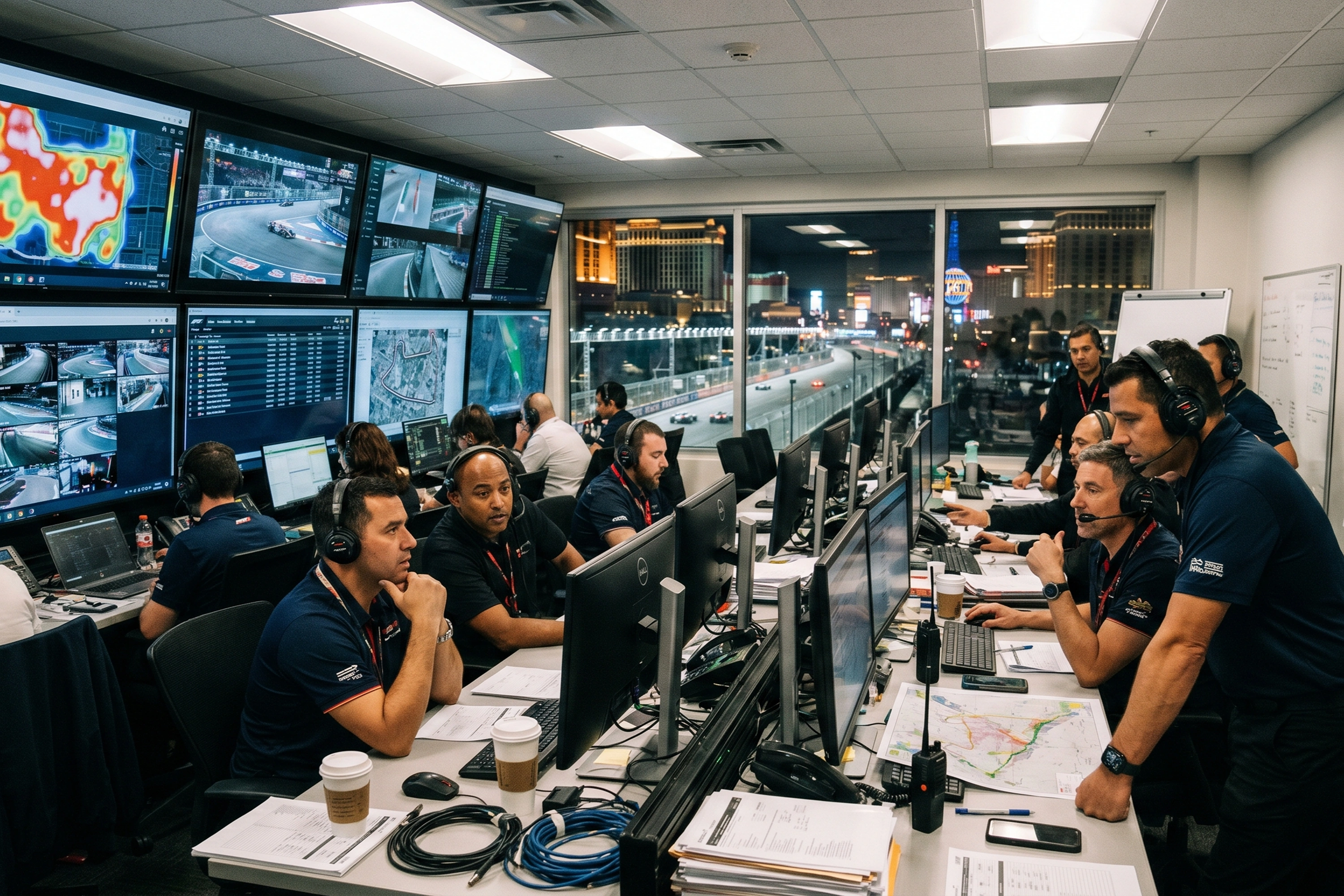
Trained staff can help operate the event by reporting what they see. They are often the first to notice where guests are confused, where signs are being missed, where routes are failing, or where lines are growing.
A stronger staffing model should capture field intelligence such as:
- repeated guest questions
- confusing zone names
- missing or poorly placed signage
- slow credential lines
- pressure at rideshare edges
- ADA support gaps
- hotel access confusion
- crowd buildup near bridges
- conflict between digital guidance and field conditions
That information should move quickly to supervisors. Staffing becomes more valuable when it helps the event adapt during live conditions.
CEO Excerpt
“The Las Vegas Grand Prix shows where major event delivery is headed. The hardest work now happens where transportation, hospitality, security, staffing, and guest expectations overlap. When an event takes over a live city environment, success depends on how clearly people are moved, informed, and supported from arrival through departure.” - CEO, Eventstaff
Final Assessment
The Las Vegas Grand Prix event operations model offers a valuable case study because it shows how complex modern live events have become. The event was a race, but its delivery depended on a broader system involving public roads, resort properties, hospitality zones, pedestrian routes, transportation alternatives, security perimeters, digital guidance, and front-line guest support.
The strongest lesson is integration. Road closures had to align with hotel access. Digital maps had to match field instructions. Transportation alternatives had to connect with pedestrian routes. Venue operations had to support event routing. Crowd flow management had to account for bridges, sidewalks, lobbies, rideshare edges, and post-session movement. Public notices had to give enough detail for visitors, workers, businesses, and non-attendees to act on them.
The 2025 race appears to have benefited from clearer public communication, phased closure planning, ticketed-zone guidance, official digital routing, and transportation alternatives. Those choices likely helped reduce some of the confusion that can come with building a temporary race circuit through a high-demand tourism corridor.
The model still carried risk because public information does not guarantee public understanding. Guests may miss updates. Workers may follow familiar routes. Rideshare drivers may move toward old pickup points. VIP guests may expect direct access when the footprint requires a controlled route. Crowds may compress after a session even if arrival was well managed.
For event professionals, the case study is useful because it shows that the most important delivery work often happens outside the most visible part of the event. The race defined the program, but the guest experience was shaped by access, staffing, signage, transportation, hospitality, communication, and service recovery.
That is the operational standard future festivals, races, parades, conventions, brand activations, and citywide events should study. A major event succeeds when the full environment remains understandable, navigable, and controlled for the many different people moving through it.