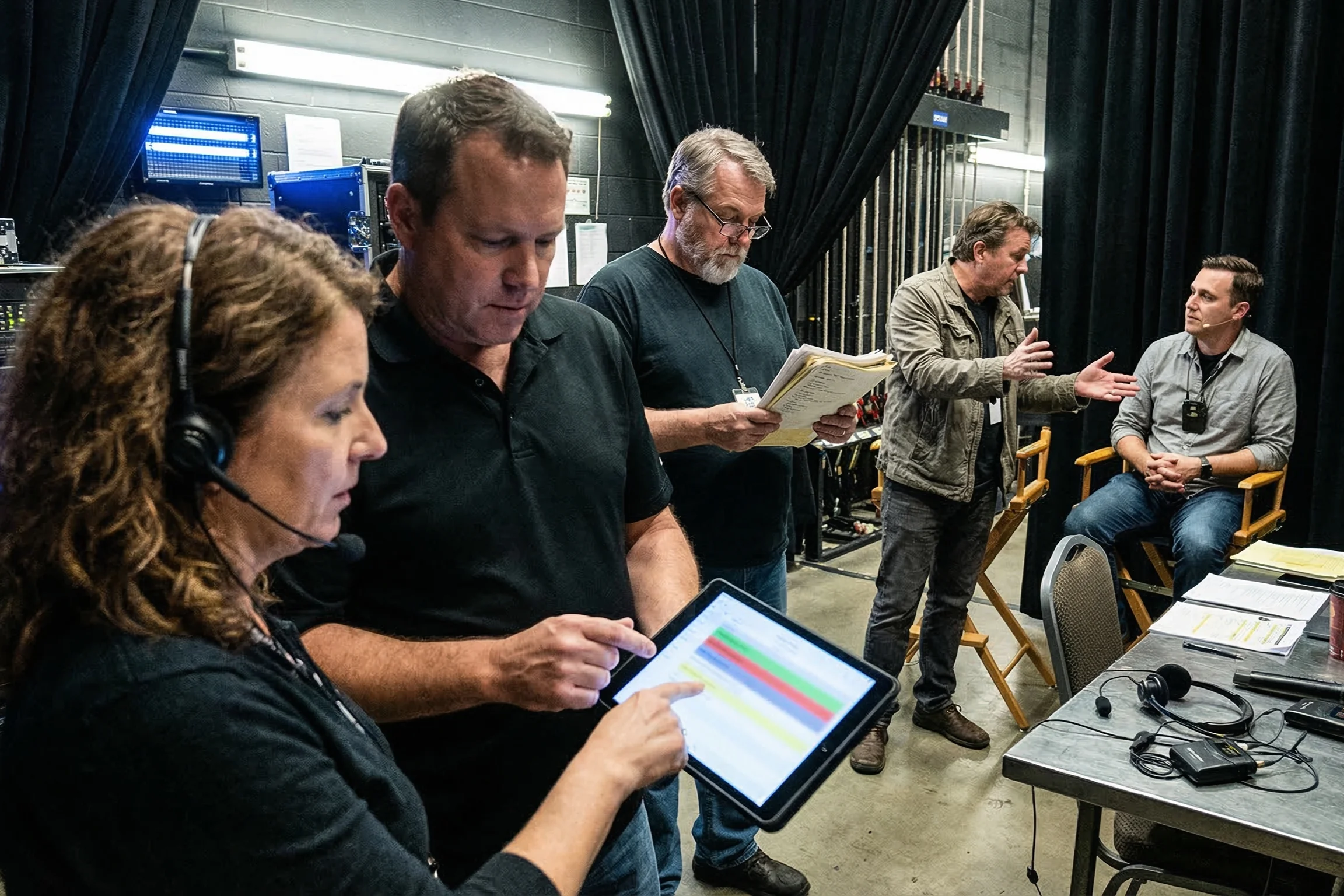

Introduction: Event Hospitality Staffing Strategies for Conferences and Festivals
Event hospitality staffing determines whether a conference or festival opens with control or congestion. In compressed arrival windows, when 300 to 1,000 attendees enter within 45 minutes, even small gaps in registration or guest services coverage can trigger visible disruption. Lines extend beyond queue space. Sponsors observe crowd buildup. Supervisors move from oversight into frontline troubleshooting.
That first 30 to 60 minutes shapes the entire guest experience.
For event planners, agency producers, and brand teams, the challenge is not total headcount. It is deployment precision. Event hospitality staffing must be structured around throughput, zone ownership, and surge protection, not just attendance forecasts. When conference event staff are positioned strategically across registration, wayfinding, VIP routing, and lounge areas, guest flow stabilizes before pressure escalates.
This guide outlines practical event hospitality staffing strategies for conferences and festivals, including:
- How to size staff based on arrival compression
- Which roles protect flow during peak windows
- How to deploy conference event staff by zone
- When to layer shifts to prevent overtime exposure
- What metrics confirm your staffing model worked
If your goal is smooth entry, protected sponsor visibility, and controlled session turnover, the right event hospitality staffing strategy begins before doors open.
Executive Summary
Event hospitality staffing for conferences and festivals must be built around arrival pressure, defined roles, zone deployment, and layered shifts, not just total headcount. When conference event staff are sized to throughput and surge windows, guest flow stabilizes, wait times shrink, and operational disruptions are prevented before they escalate.
Why Does Event Hospitality Staffing Determine Guest Experience So Quickly?
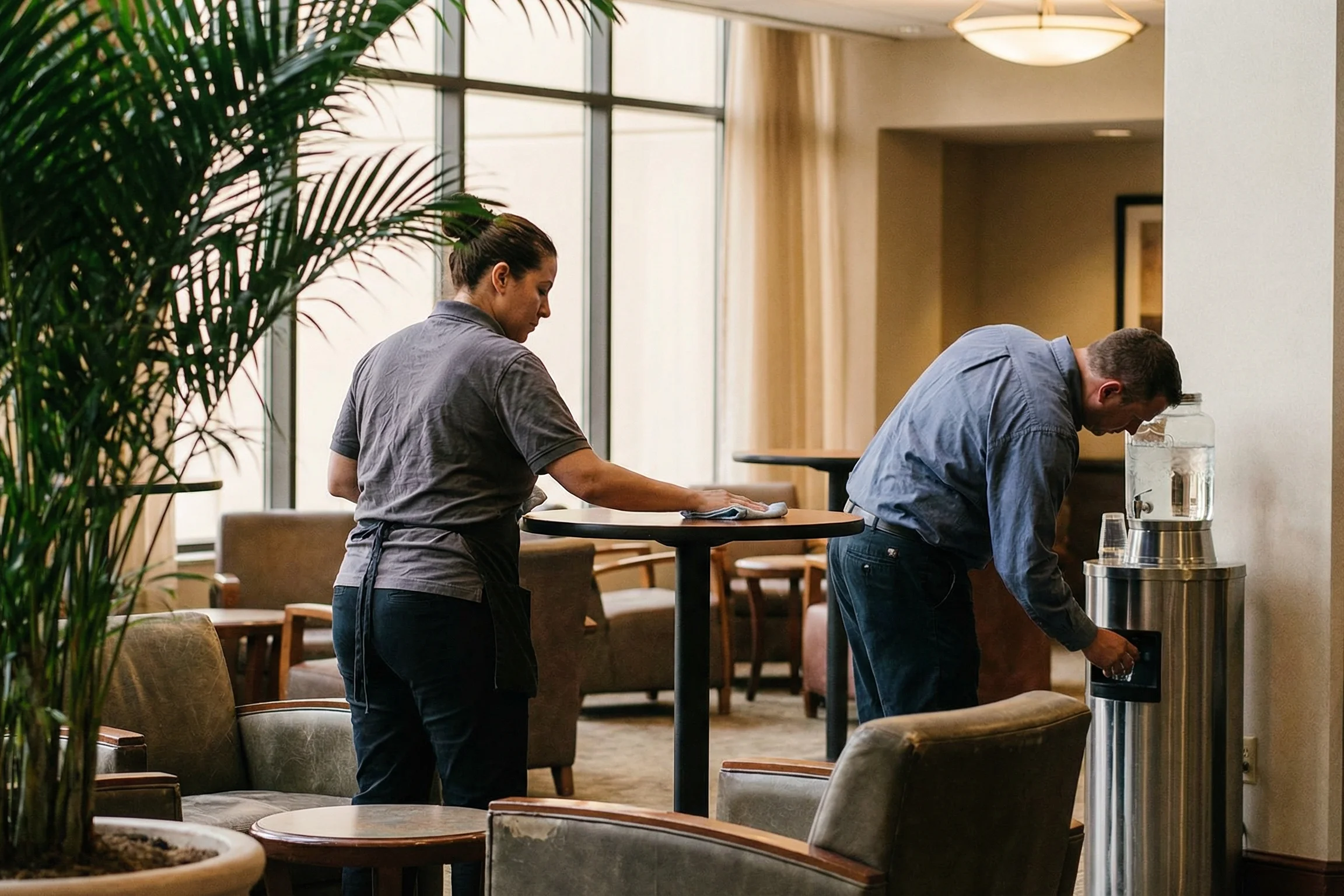
Event hospitality staffing shapes guest perception before the first session begins. Arrival windows are compressed, questions spike simultaneously, and badge or credential issues surface in clusters rather than evenly throughout the day. If coverage is thin during the first 30 to 60 minutes, recovery becomes visible and expensive.
Here is what typically breaks first. Registration lines stretch beyond the planned queue space. Guests begin asking directional questions while still in line. A conference event staff member steps away to help, which slows throughput further. Within minutes, supervisors are pulled into guest-facing troubleshooting instead of monitoring the overall flow.
Post-2023 arrival behavior has intensified this pressure. Attendees arrive closer to the keynote start times instead of spreading across early check-in windows. That creates sharper throughput spikes. Two under-assigned positions at registration can increase average wait time by six to ten minutes during peak compression. According to the U.S. Bureau of Labor Statistics, employment of meeting, convention, and event planners is projected to grow 5 percent from 2024 to 2034, a sign that event complexity and the operational demands on hospitality staff will only increase.
Event hospitality staffing directly impacts:
• Entry flow stability
• Registration processing speed
• Wayfinding clarity
• VIP routing control
• Escalation containment
In 2026, labor costs make reactive staffing adjustments expensive. Adding last-minute overtime to fix early congestion often costs more than properly layering shifts from the start. Understanding the hidden economics of understaffing shows how quickly a registration delay compounds into overtime fees, missed sessions, and sponsor dissatisfaction. The operational decision is simple: protect arrival first, stabilize mid-cycle, then taper coverage intelligently.
When event hospitality staffing is built around pressure windows instead of static headcount, guest flow remains controlled and supervisors retain oversight instead of firefighting.
What Do Hospitality Teams Handle and Prevent During Conferences and Festivals?
Event hospitality staffing acts as the experience buffer between guests and operations. These teams absorb friction before it escalates into visible breakdowns. When structured correctly, conference event staff protect timing, tone, and traffic flow across the venue.
In real time, hospitality teams handle:
• Badge troubleshooting and late check-ins
• Directional support between simultaneous sessions
• Accessibility guidance and seating adjustments
• VIP escort and green room coordination
• Lounge monitoring, restocking, and queue control
Now consider what they prevent. At a 20,000 square foot venue, one incorrect directional answer can send dozens of attendees back through the lobby. That creates cross-traffic. Cross-traffic slows registration. Registration delays compress session start times. Speakers become unsettled. Sponsors notice. The chain reaction happens quickly.
Festivals amplify the same pattern. Entry gates open at once. Hydration stations surge in warm weather. If event hospitality staffing is thin, guests begin asking security for assistance. Security then leaves perimeter control to answer general questions. What began as a staffing gap becomes a safety concern. The same principles that govern large-format festival staffing, supervisor-led zones, surge coverage, and clear escalation paths apply directly to how hospitality teams should be structured at conferences.
Strong deployment prevents:
• Line spillover into entrances
• Guests missing sessions due to confusion
• VIP congestion at shared entry points
• Supervisors are being pulled off oversight duties
In 2026, in environments where guest expectations are high and arrival patterns are less predictable, hospitality teams are not optional. They are flow regulators. When event hospitality staffing is structured to absorb friction at each zone, operations, production, and security can remain focused on their core responsibilities, preserving event stability.
CEO Excerpt
As CEO, I have seen firsthand that event hospitality staffing determines whether a conference feels seamless or strained within the first 30 minutes. When teams are structured around throughput, zone ownership, and peak arrival compression, you prevent bottlenecks before they happen and protect both guest experience and labour efficiency.
Which Roles Should Be Included in an Event Hospitality Staffing Plan?
Event hospitality staffing performs best when roles are clearly defined, and ownership is assigned by zone. Conferences penalize overlap because it slows throughput. Festivals penalize rigidity because demand shifts quickly. The solution is structured roles with controlled flexibility.
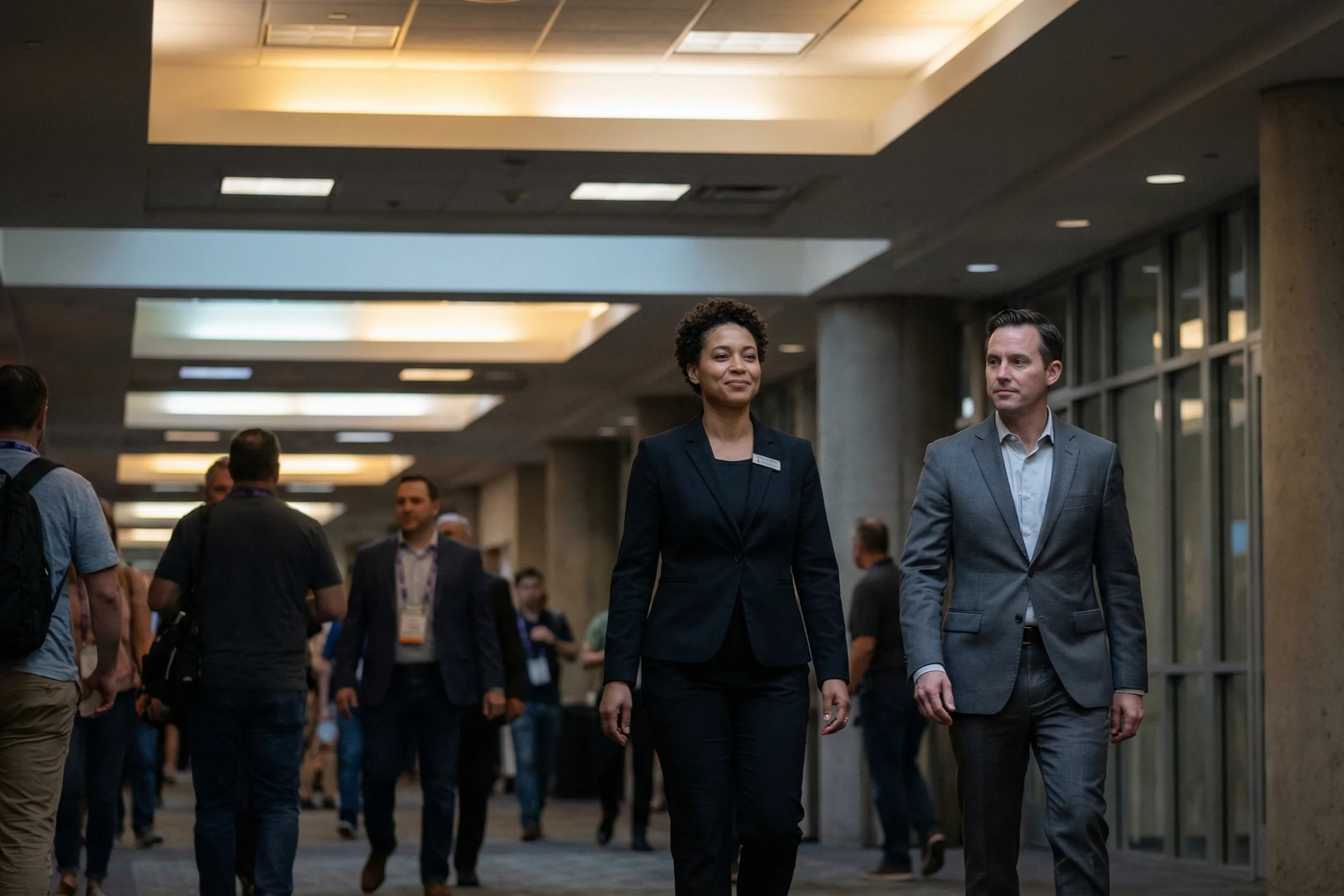
A strong event hospitality staffing plan includes five core role categories, each aligned to a specific pressure point.
1. Registration Staff
Primary Function: Protect arrival throughput
Responsibilities:
- Check-in processing
- Badge printing and troubleshooting
- On-site registration support
- Credential verification
Registration is the highest-pressure zone during compressed arrival windows. Conference event staff in this role must remain focused on processing, not answering repeated directional questions.
If registration staff is pulled away, throughput slows immediately.
2. Guest Services
Primary Function: Protect directional clarity and accessibility
Responsibilities:
- Wayfinding across session rooms
- Schedule guidance
- Accessibility support
- General information assistance
Guest services staff act as a buffer between attendees and registration. Their placement at hallway intersections and session corridors prevents repeated questions from slowing check-in.
In large venues, every high-traffic intersection should have visible coverage during peak transitions.
3. VIP Hospitality
Primary Function: Protect executive flow and brand perception
Responsibilities:
- Speaker escort
- Green room coordination
- VIP credential validation
- Controlled routing through public areas
VIP routes must never overlap with congested public lanes during peak windows. When conference event staff are assigned specifically to VIP hospitality, executive movement remains smooth and discreet.
In premium conferences, this role directly impacts brand perception.
4. Lounge And Refreshments Coverage
Primary Function: Protect the break flow and networking experience
Responsibilities:
- Beverage station monitoring
- Queue control
- Restocking coordination
- Space resets between sessions
Broken windows create secondary compression cycles. If lounge areas are undercovered, lines build quickly and delay session re-entry.
Event hospitality staffing must anticipate these spikes rather than react to them.
5. Floaters
Primary Function: Provide surge protection
Responsibilities:
- Reinforce registration during badge issues
- Support breakout release waves
- Stabilize hydration or amenity surges
- Cover short-term absences or rotations
A floater is not excess labor. It is buffer capacity.
Without floaters, supervisors are forced to leave oversight roles to solve local gaps. When event hospitality staffing includes pre-positioned floaters during known surge windows, micro-disruptions remain contained.
Role Clarity Prevents Floor-Wide Slowdowns
A complete event hospitality staffing model assigns the following:
- Defined responsibilities
- Named zone ownership
- Escalation pathways
- Temporary surge coverage
When roles are unclear, pressure in one area spreads across the venue. When conference event staff understand ownership boundaries, throughput stabilizes faster, and supervisors retain strategic control.
Defined roles are not administrative details. They are operational insurance against arrival compression and session turnover volatility.
How Many People Do You Need for Event Hospitality Staffing?
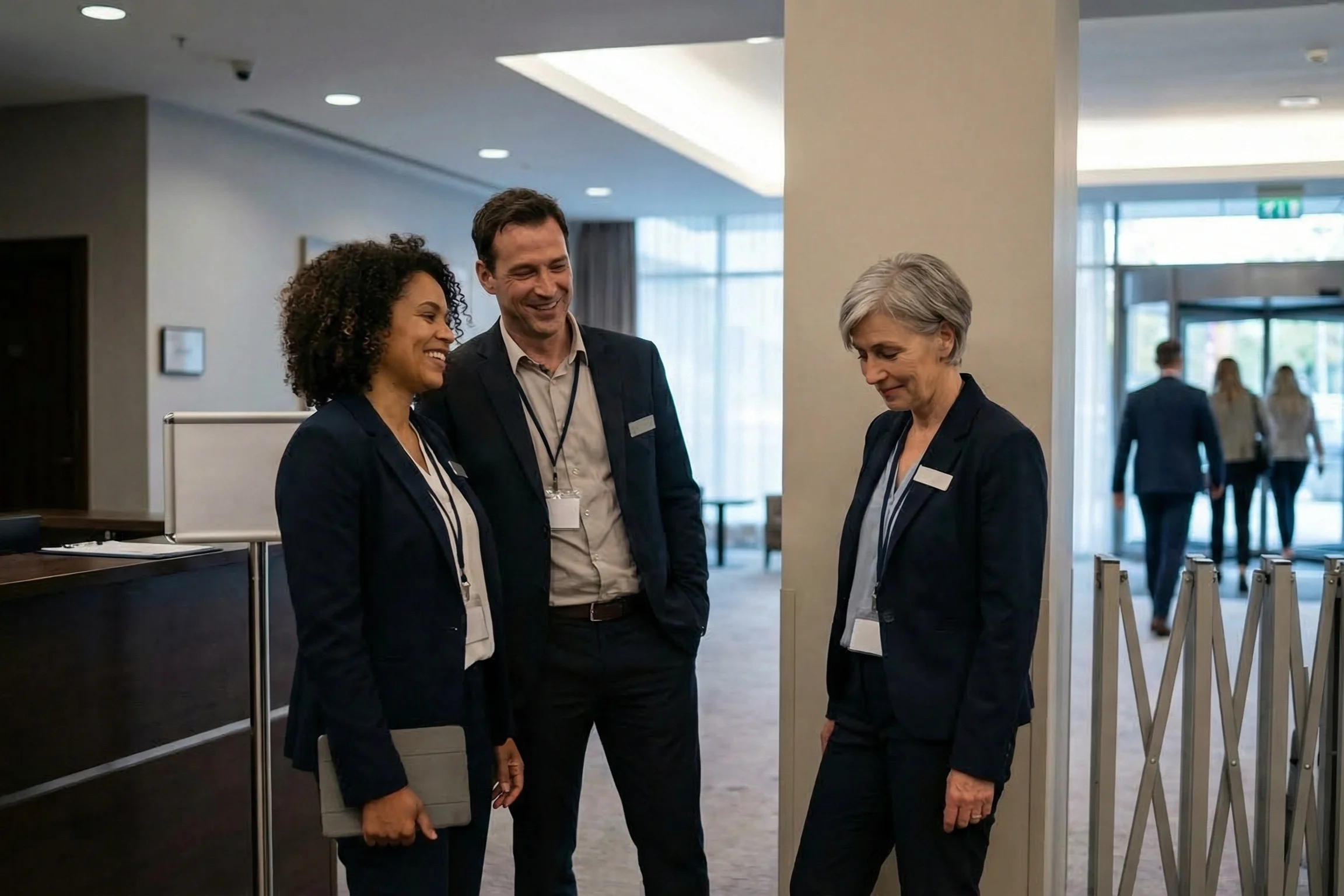
Event hospitality staffing should be sized around throughput pressure, zone count, and arrival compression. Attendance alone is not a reliable planning metric. Deployment density during peak windows determines whether lines stabilize or expand.
Conference event staff must be assigned based on processing capacity, not guesswork.
Baseline Staffing Ranges By Event Size
Use these starting benchmarks, then adjust for venue layout and timing intensity.
Small Conferences Under 300 Guests
- 6 to 10 hospitality staff
- Focus on protecting registration and one primary directional corridor
- At least one floater during the arrival window
Mid-Size Conferences: 300 To 1,000 Guests
- 12 to 20 staff
- Layered registration team
- Dedicated guest services anchors at hallway intersections
- 1 to 2 floaters pre-positioned during compression windows
Large Conferences Over 1,000 Guests
- 25 to 40 staff
- Multi-lane registration
- Zone leads assigned to high-traffic areas
- Dedicated VIP hospitality team
- 2 to 4 floaters during keynote release and break transitions
Festivals With A Single Entry Point
- 1 hospitality staff per 75 to 100 attendees as a baseline
- Add surge floaters during gate opening
- Increase ratio if hydration demand or weather exposure is high
These figures reflect arrival pressure modeling. They must increase when:
- There are multiple entry points
- The venue exceeds 20,000 square feet
- VIP volume is high
- Session turnovers occur within tight 10-minute windows
- Sponsor activations attract concentrated foot traffic
Throughput Example: Why Ratios Matter
Consider a mid-size conference with 800 attendees arriving within 45 minutes before a keynote.
To avoid visible queue expansion:
- Registration must process roughly 17 to 20 guests per minute
- At least 5 to 6 active check-in stations are required
- Floaters must be positioned to reinforce if the badge printers slow down
If conference event staff are reduced by two during that window, average wait time can increase by several minutes. Once wait time exceeds 10 minutes, guest perception shifts from organized to congested.
Event hospitality staffing must protect that first impression.
Balancing Cost And Coverage In 2026
Labor markets in 2026 make overstaffing expensive. However, understaffing during arrival is typically more costly because it leads to:
- Reactive overtime
- Supervisor diversion
- Sponsor dissatisfaction
- Session delays
According to the Center for Exhibition Industry Research Q4 2024 Index, trade show and exhibition performance has reached its strongest levels since the pandemic recovery. Higher attendance density means higher operational complexity.
The strategic objective is clear:
- Protect peak arrival aggressively
- Stabilize mid-cycle coverage
- Taper intelligently during low-flow periods
When event hospitality staffing is sized to throughput rather than attendance alone, guest flow becomes predictable, and labor investment becomes controlled rather than reactive.
How Should You Deploy Event Hospitality Staffing by Zones?
Event hospitality staffing should be mapped by zone ownership, not by shift list. When staff are assigned generically, small issues spread across the floor. When zones are defined and owned, pressure stays contained.
Start by dividing the venue into functional hospitality zones:
• Entry and Registration
• Session Rooms or Stage Areas
• Lounges and Networking Spaces
• VIP and Speaker Areas
• Amenity pinch points such as restrooms or hydration stations
Assign a senior conference event staff member or lead to each high-traffic zone. That person owns response time, reset speed, and escalation decisions within that area. Here is what happens when zones are not clearly assigned: a breakout session ends early, guests exit into the hallway looking for the next room, registration staff begin answering directional questions, check-in slows, lines grow, and a local gap becomes a floor-wide slowdown. Zone ownership prevents that chain reaction.
Floaters should not roam randomly. They should be pre-positioned during predictable surges. During the keynote release, two floaters might reinforce lounge and hydration zones for 20 minutes, then rotate back toward the entry before the next wave. This same zone discipline is essential in high-traffic trade show environments where burst density creates bottlenecks in minutes when roles are not clearly owned.
In 2026, environments where guest movement patterns are less predictable due to tighter scheduling and AI-driven agenda updates, zone clarity becomes even more important. When event hospitality staffing is deployed by zone with defined accountability, response times shorten and supervisors retain strategic oversight instead of reacting to preventable disruptions.
How Should You Schedule Shifts and Breaks for Hospitality Coverage?
Event hospitality staffing must be scheduled around pressure windows, not just total event hours. Guest flow is uneven. Coverage must reflect that reality. If you schedule evenly from morning to late afternoon, you will be overstaffed mid-cycle and exposed during arrival.
Peak compression typically occurs:
• 45 to 60 minutes before keynotes
• 10 minutes before and after session turnover
• During lunch release and re-entry
• At final event exit
A layered structure works better:
• Early surge team to stabilize registration and entry
• Core team to maintain mid-day continuity
• Short overlap team during lunch and release windows
Break modeling is equally important. Never allow more than 15 percent of frontline staff off the floor during active cycles. In union-regulated venues, break timing may be fixed, which requires staggered rotations planned in advance.
In 2026, human and AI hybrid scheduling tools can forecast attendance trends, but they cannot see badge printer failures, delayed buses, or sudden sponsor traffic spikes. An on-site lead must validate and adjust in real time. The CEIR Q4 2024 Index recorded a Total Index value of 95.6, marking the strongest trade show and exhibition performance since the onset of the pandemic, confirming that event volumes and operational complexity are rising, which makes precise shift layering more critical than ever.
By day two of a multi-day conference, fatigue appears first in tone and processing speed. Rotate high-interaction conference event staff briefly out of peak zones to protect service consistency. When event hospitality staffing is aligned with timing realities instead of static schedules, guest flow remains stable, and burnout risk declines across the program.
What Does a Real Event Hospitality Staffing Plan Look Like?
Event hospitality staffing becomes practical when mapped to real numbers, not theory. Let's examine a mid-size conference example: 800 attendees, a 20,000 square foot venue, a single main entry, six breakout rooms, one VIP green room, and two lounge areas.
Sample Staffing Plan:
• Registration Staff: 6
• Guest Services: 6
• VIP Hospitality: 3
• Lounge and Refreshments: 3
• Floaters: 2
• Total: 20
Six registration staff protect throughput during the 45-minute arrival compression window. Two floaters support that zone during peak, then redeploy to lounges during session breaks. Guest Services anchor hallways and directional intersections so registration remains focused on processing, not answering repeated questions. Three VIP staff ensure speakers are escorted efficiently and do not route through public congestion areas.
Lounge coverage prevents trash buildup and beverage line growth during break release. For events with executive or sponsor lounges, the service standards overlap significantly with VIP event staffing principles, where anticipatory service, discreet coordination, and polished tone are as important as headcount.
In this configuration, conference event staff are layered intentionally. Arrival stabilization comes first. As pressure shifts, floaters and designated leads redistribute coverage. This approach avoids reactive overtime and prevents supervisors from abandoning oversight roles. When event hospitality staffing is mapped to footprint, timing, and zone ownership, the floor stays controlled rather than chaotic.
How Do You Measure Whether Event Hospitality Staffing Was Sized Correctly?
Event hospitality staffing should be evaluated using operational data, not post-event impressions. Without measurement, the same deployment mistakes repeat at the next conference or festival.
Start with arrival tracking. Capture guest count in 15-minute intervals during the first hour. Compare that data to registration throughput. If lines extend more than 10 minutes beyond peak arrival, staffing was either undersized or poorly positioned. Over 53 percent of event organizers reported increased attendance in 2025, which means the assumption of stable or declining guest volume is no longer a safe planning baseline.
Track these performance indicators:
• Average registration wait time during peak
• Directional question volume per zone
• Lounge queue duration during breaks
• Escalations requiring supervisor involvement
• Break compliance adherence
• Conference event staff attendance rate
If supervisors are repeatedly pulled into guest-facing fixes, coverage gaps exist at the zone level. Review performance by daypart. Morning compression may require higher registration density, while afternoon adjustments may focus on lounge resets and hallway traffic control.
Warning signs that staffing was misaligned:
• Lines extend past the designed queue space
• Floaters remain fixed in one zone all day
• Breaks are skipped to maintain coverage
• Repeated directional confusion across sessions
HOW TO KNOW IF YOUR EVENT HOSPITALITY STAFFING WAS SIZED CORRECTLY: After the event, review six operational signals: average registration wait time during peak arrival (target under 10 minutes), directional question volume per zone (high volume signals a wayfinding or coverage gap), lounge queue duration during session breaks (should clear within 5 minutes), number of escalations requiring supervisor involvement, break compliance rate (no more than 15% of frontline staff off-floor during active cycles), and staff attendance rate. If supervisors were repeatedly pulled into guest-facing fixes, the coverage model had zone-level gaps , not just headcount shortfalls.
In 2026 environments with tighter schedules and cost pressure, measurement is not optional. It informs ratio refinement and shift layering for future programs. When event hospitality staffing is measured against throughput and escalation patterns, adjustments become intentional, protecting labor budgets and preserving a consistent guest experience across events.
3-Step Event Hospitality Staffing Audit
Before you lock staffing numbers for your next conference or festival, pressure-test your deployment model. Event hospitality staffing failures are rarely caused by effort. They are caused by unclear arrival modeling and undefined zone ownership.
Use this quick audit to validate your plan.
1. Map Arrival In 15-Minute Blocks
- Estimate total guest arrival by 15-minute intervals
- Calculate the required registration throughput per minute
- Confirm active check-in lanes match compression demand
If you cannot clearly state how many guests must be processed per minute during peak arrival, your staffing model is reactive.
Conference event staff must be sized to throughput, not attendance totals.
2. Assign A Named Zone Owner To Every High-Traffic Area
- Entry and registration
- Hallway intersections
- Session corridors
- Lounges and networking areas
- VIP and speaker zones
Each zone must have a responsible lead with defined escalation authority.
If multiple staff share a space without clear ownership, response time slows, and supervisors become the default fix.
Event hospitality staffing works when accountability is visible and structured.
3. Pre-Position Floaters For Predictable Surge Windows
- Reinforce registration before the keynote starts
- Support lounge areas during break release
- Anchor directional points during session turnover
- Protect exit flow at program close
Floaters should not roam. They should be strategically staged before compression builds.
If floaters are deployed only after congestion forms, your staffing model is reactive rather than preventative.
If any of these steps are unclear, your event hospitality staffing plan is vulnerable to visible bottlenecks and costly overtime corrections.
Structured arrival planning and zone ownership are the difference between controlled guest flow and floor-wide congestion.
Build Your Staffing Model Before Arrival Builds Pressure
Event hospitality staffing is not a last-step vendor decision. It is a flow control strategy that protects brand perception, sponsor satisfaction, and production stability.
Before you finalize headcount, review your arrival compression window, zone ownership plan, and shift layering model. Small deployment adjustments prevent visible bottlenecks and reactive labor costs.
If you want a structured review of your conference or festival staffing plan, request a staffing deployment consultation and align roles, ratios, and surge coverage before contracts are locked.
Plan Your Event Staffing with Confidence
Event hospitality staffing is the difference between controlled execution and visible disruption. The right staffing model doesn’t just fill roles it protects guest flow, reduces costs, and elevates brand perception.
If you want to:
- Eliminate long registration lines
- Improve guest experience from the first 30 minutes
- Avoid reactive overtime and staffing gaps
- Ensure smooth VIP and sponsor experiences
Get a tailored staffing deployment plan built around your event’s flow, not guesswork.
👉 Request your staffing strategy consultation today and align your roles, ratios, and zones before your event goes live.
Ready to elevate your next event?
Join thousands of event planners who trust EventStaff.com for reliable, professional staffing solutions.
Trusted by event professionals nationwide
1k+
Events Staffed
2 million+
Guests Served
97%
Positive reviews