

What if your biggest event cost isn’t staffing but the delays caused by poor staffing?
Event staffing cost savings don’t come from paying lower hourly rates. They come from preventing overtime, avoiding bottlenecks, and keeping your event timeline intact.
In one real case, a 45-minute delay caused by untrained staff led to a $12,000 overtime bill. After switching to a trained logistics team, that cost dropped to zero.
This guide breaks down how staffing decisions directly impact your event budget and how to control hidden costs before they escalate.
Executive Summary
Event staffing cost savings are realized by minimizing operational friction, preventing paid overtime, vendor extensions, and bottleneck-driven refunds. By investing in trained teams that secure flow and timeline integrity, organizers protect the budget from the compounding expense of operational failure.
Where Money Leaks First

If you’re budget-owning, these are the "first three" places staffing failures get expensive. Understaffing rarely causes immediate failure; it introduces drag.
- Entry flow: Small slowdowns by Ticket Checkers compound fast during peak arrivals.
- Vendor load-in: Unmanaged lanes create paid idle time and extensions.
- Supervisor attention: When leads get pulled into micro-issues, oversight collapses and problems multiply.
Keep those three stable and you usually avoid the nastiest surprises.
Typical Market Rates for Quality Staffing vs. Budget Staffing
To budget effectively, you need a baseline. While rates vary by region and volume, here are the typical hourly ranges you should expect for professional, insured, and W-2 compliant event talent compared to "warm body" budget options.
- General Event Staff (Ticket Scanners, Ushers, Greeters): $25 – $35 per hour
- Team Leads & Supervisors: $35 – $55 per hour
- Specialty Leads (VIP Hosts, Tech Check-in, Captains): $45 – $75 per hour
The Investment Gap: Why Paying More Saves Money There is often a "sticker shock" difference between a budget agency and a premier partner, but the math favors the investment. A trained, reliable team might cost $5/hour more per head than a generic agency. For a team of 10 staff working an 8-hour shift, that is a $400 difference in total spend.
That $400 insurance policy is what prevents the $12,000 overtime risk mentioned in the CEO excerpt above. When you pay the premium, you aren't just paying for a person; you are paying for the operational guarantee that the event finishes on time and on budget.
CEO EXCERPT
"We often see procurement teams focus on the hourly rate, but the real cost of staffing sits in the 'unseen' ledger, the paid overtime from a delayed load-out, the refund requests from a chaotic entry, and the sponsor churn from poor engagement. The cheapest staff is rarely the one with the lowest hourly wage; it’s the one that keeps your timeline intact."-CEO Event Staff
How Operational Efficiency Determines Final Budget Outcomes
Event staffing cost savings begin showing up before payroll is finalized. You’ll see it during the first arrival wave, while vendors are still loading in, and when supervisors decide whether to intervene or let a situation correct itself. Staffing controls time exposure, and time is the most volatile variable in any event budget.
Within the first 60 to 90 minutes, lost seconds compound. Overtime thresholds creep closer. Vendor overruns become more likely. Setup-to-showtime conversion time shrinks. This is where staffing decisions quietly reshape how staffing impacts event budget outcomes. Misallocation is the second leak. When trained staff spend their shifts answering basic wayfinding questions, senior labor absorbs work it shouldn’t. The invoice looks clean, but the operational costs do not.
The Multiplier Effect of Delay
In event economics, a 10-minute delay at the front door does not result in a 10-minute delay at the end of the night; it often results in an hour of overtime. When check-in stalls, the keynote starts late. When the keynote starts late, the room flip for the breakout sessions is delayed. Catering staff, AV technicians, and security personnel, who are often billing at union rates or strict hourly blocks mandated by labor regulations, are all forced into extended hours. A single staffing bottleneck at 8:00 AM can cost thousands of dollars by 6:00 PM.
Economic Reality Check
- Leakage: Staffing errors surface first as lost minutes, not line items.
- Compounding: One delayed entry point often triggers three downstream cost centers.
- Control: Budget predictability depends on flow control, not just total headcount.
What Increases Your Staffing Quote? (Cost Drivers)
Transparency builds trust. While the base hourly rates listed above cover the talent, specific logistical factors can influence your final quote. Understanding these drivers helps you self-qualify and budget accurately before you even request a proposal.
- Lead Time: Booking staff less than 7–14 days out often incurs "rush fees" to cover the expedited recruiting and onboarding required to secure quality talent.
- Holiday & Overtime Rates: Events falling on federal holidays or shifts exceeding 8–10 hours (depending on state labor laws) will trigger time-and-a-half or double-time billing.
- Uniform Requirements: Standard "all blacks" are usually included, but specific requests (e.g., tuxedos, branded polos, or thematic costumes) will appear as a separate line item or an increased hourly rate.
- Travel & Parking: If your venue is outside the metro transit zone or lacks crew parking, stipends for travel time or ride-shares may be added to ensure 100% attendance.
- Role Complexity: Roles requiring specific certifications (TABC, security licenses) or bilingual fluency command a higher market rate than general support roles.
The Hidden Costs of Poor Staffing That Never Appear on Budget Sheets

Event staffing cost savings disappear fastest in areas planners don’t actively model. Bottlenecks turn guest minutes into measurable loss. Common failure points include stalled entry compressing schedules, restroom queues bleeding into session start times, and F&B congestion pulling staff away from higher-value zones.
Vendor Friction and Loading Dock Economics
Vendor friction is another drain, especially for large Trade expos. When load-in lanes lack active management, crews wait. Waiting crews bill. Setup-to-showtime conversion slips, and departments move from execution to negotiation. If a lighting vendor is stuck on the dock because an untrained staff member didn't enforce the unloading safety schedule, that vendor charges for idle time. Worse, if the set-up isn't finished by the venue's hard stop, you face punitive rental extension fees.
ADA Flow and Compliance Risk
ADA flow breakdowns multiply risk. When accessible routes aren’t actively managed, staff get redeployed reactively, and compliance exposure rises. If an attendee with mobility challenges cannot navigate a crowded corridor because staff failed to maintain clear pathways, the operational cost spikes immediately. Senior supervisors must leave their posts to resolve the issue, often involving security or venue management. This pulls leadership away from the broader event, creating a vacuum where other issues can fester.
The Cost of Micro-Incidents
Micro-incidents complete the chain; a blocked corridor or a missing sign converts senior labor into reactive labor. Consider the "bathroom line escalation." If Ushers are not proactively managing flow to underutilized restrooms, long queues form at the main facilities. This delays attendees returning to sessions. Speakers face empty rooms, sponsors face empty expo halls, and the perceived value of the ticket drops. The cost isn't on an invoice, but it is deducted from the event's reputation and future revenue.
How Trained Event Staff Reduce Total Operational Costs
Event staffing cost savings don’t come from cheaper labor. They come from fewer escalations and faster throughput. Trained staff offset higher hourly rates quickly by doing the basics correctly under pressure.
Here’s what that looks like on a real floor:
- Moving guests correctly the first time: Questions don’t recycle, and wayfinding becomes intuitive.
- Preventing queue buildup: Staff actively manage lines during peak arrival windows, utilizing "snake" formations or redirecting to open lanes before guests grow frustrated.
- Reducing credential verification rework: Catching registration issues early stops the "problem attendee" from reaching the scanner and holding up the line for everyone else. This level of service elevates the guest experience, ensuring that trained team members redirect flow before bottlenecks form.
Incident frequency drops when staff recognize patterns early. Trained team members redirect flow before bottlenecks form. They resolve issues without escalation. Supervisors stay focused on oversight instead of firefighting. This is the financial impact of trained event staff in its most practical form.
Skill vs Cost Equation
- Ratio: One trained staffer often replaces 1.3 to 1.5 untrained equivalents.
- Supervision: Incident prevention saves supervisor time, not just guest frustration.
- Efficiency: Cost efficiency shows up as fewer "all-hands" moments
Staffing Ratios and Their Direct Impact on Event Budgets
Event staffing cost savings are protected by ratios, not raw totals. Entry points carry the highest risk because errors compound fastest there. A single missing position during peak arrival can slow throughput enough to trigger overtime across teams and create downstream congestion.
The "One Missing Person" Multiplier
In high-volume scenarios, being short one staff member does not reduce capacity linearly; it reduces it exponentially. If a four-lane entry point loses one scanner, the crowd does not just move 25% slower. Confusion spreads. Guests try to merge lanes, causing friction. Security checks bog down. The psychological stress on the remaining three staff members increases error rates. Suddenly, throughput drops by 50%. The cost of saving one hourly wage is obliterated by the cost of the resulting chaos.
High-density zones magnify misallocation. F&B areas, activations, and transit corridors do not self-correct. One missing staffer forces adjacent roles to compensate, pulling coverage from elsewhere. Multi-track events requiring specialized Conference Staff expose another vulnerability: understaffed rooms lose transition time. Speakers start late, attendees drift, and supervisors chase symptoms. Staffing ratios and cost control stay tied together in these environments.
Guest Experience as a Measurable Economic Outcome
Event staffing cost savings erode quickly when experience issues get treated as intangible. Guest dissatisfaction changes behavior, and behavior drives revenue. This is why workforce planning is vital.
When friction appears, you’ll see a predictable pattern: attendees disengage sooner, activation participation drops, and sponsors lose meaningful dwell time. That dwell-time cost compounds across multi-day programs, directly impacting perceived sponsor ROI. Sponsors pay for engagement, not just foot traffic. If staff are unable to manage crowds effectively, potential leads walk past booths because the aisle is too congested to stop.
Queue Abandonment and Data Loss
Queue abandonment is the cleanest signal. Guests don’t complain; they walk. Fewer badge scans mean lower conversion rates and reduced lead quality. If a registration line looks too long, a percentage of "walk-up" ticket buyers will simply leave. If a bar line is chaotic, F&B revenue plummets. Trained staff who manage these queues efficiently are directly protecting the event's revenue streams.
Experience Leakage
- Exposure: Lost minutes reduce brand exposure and sponsor confidence.
- NPS: Flow breakdowns lower Net Promoter Scores more than content quality.
- Revenue: Guest experience failures create long-tail revenue loss.
The ROI of Specialized Event Staffing Roles

Event staffing cost savings accelerate when roles are designed around time protection. You don’t need more bodies everywhere. You need the right coverage in the right failure zones. That’s the heart of cost-effective event staffing. Wayfinding as a Cost Saver Greeters do more than point fingers; they recover "lost minutes." By positioning staff at critical decision points, you prevent guests from wandering. This keeps the schedule tight and ensures attendees are in their seats when the session begins, protecting the value of the content.
Wayfinding as a Cost Saver
Wayfinding staff do more than point fingers; they recover "lost minutes." By positioning staff at critical decision points, you prevent guests from wandering. This keeps the schedule tight and ensures attendees are in their seats when the session begins, protecting the value of the content.
Room Monitors and Agenda Integrity
Room monitors protect agenda integrity. By managing door closures, seat filling, and AV checks, they ensure sessions end on time. This prevents the "drift" that pushes the entire day's schedule back, eventually leading to venue overtime charges.
Vendor-Flow Staff
Vendor-flow staff manage load-in. Vendor-flow roles protect setup-to-showtime conversion. One person managing access, conflicts, and sequencing often prevents several hours of extension labor later. It’s boring work, but it ensures your operations meet industry standards for efficiency.
Comparative Scenario: The Cost of Efficiency
To illustrate the true economics, consider two scenarios for a 2,000-person conference with a strict 5:00 PM venue hard stop.
Scenario A: "Budget" Staffing
- Staffing: Minimum wage, untrained generic staff.
- Entry: Slow scanning leads to a 20-minute delay in the opening keynote.
- Lunch: Poor crowd control results in slow service; lunch extends by 15 minutes.
- Load-Out: Exhibitors fight for dock space because no staff is managing the bays. Load-out runs 90 minutes over.
- Result: The savings on the hourly staff rate are wiped out by $5,000 in venue overtime fees and union labor extensions.
Scenario B: Strategic Event Staff Deployment
- Staffing: Trained professionals with specific role allocations.
- Entry: "Line-busting" staff pre-check badges, keeping flow continuous. Keynote starts on time.
- Lunch: Staff direct attendees to open buffet lines, maximizing throughput. Schedule holds.
- Load-Out: Dock staff assign slots to trucks. Load-out finishes 15 minutes early.
- Result: Zero overtime fees. Higher attendee NPS. Full sponsor satisfaction.
How Event Staff Engineers Cost Efficiency at Scale
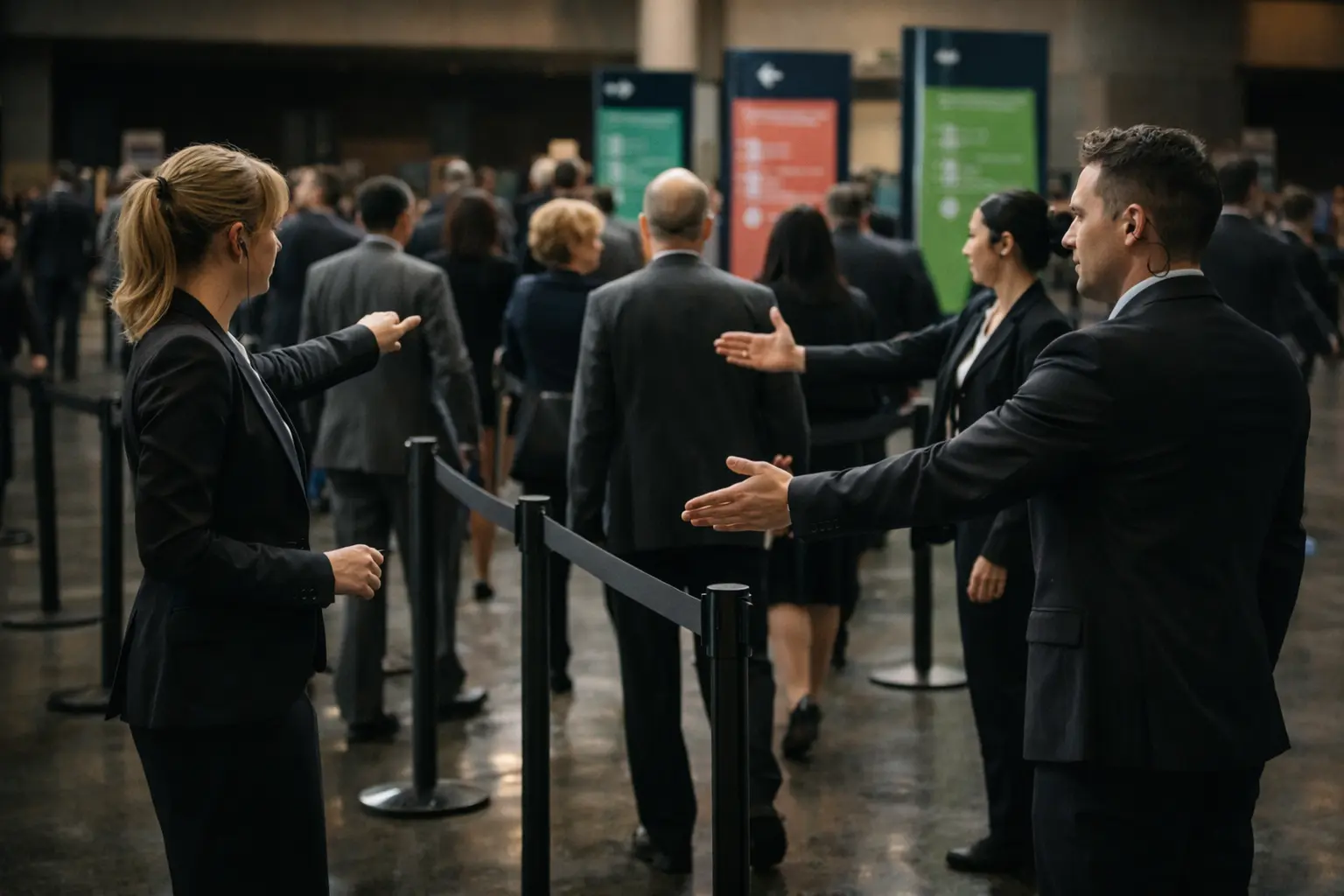
Event staffing cost savings come from systems that absorb pressure. Event Staff focuses on repeatable operational controls, not heroics. Core levers include bench depth to reduce surge overtime, supervisor-to-staff ratios that contain escalation, and pre-event mapping that removes waste before doors open.
The Value of Bench Depth and Real-Time Dispatch
Bench depth matters most when arrival timing shifts, weather hits, or program changes ripple through the floor. Backups prevent overtime from becoming the default fix. Furthermore, Event Staff utilizes real-time dispatch. Instead of static posts where staff might stand idle while another area is swamped, supervisors redeploy assets dynamically. This "zone defense" approach ensures you get maximum utility out of every labor hour paid. Standardized briefings reduce improvisation, ensuring every staff member knows the evacuation routes, VIP protocols, and schedule nuances before they step on the floor.
Event Staffing Cost-Efficiency Checklist for Budget Owners
Event staffing cost savings depend on pressure-testing assumptions before contracts are signed. This is where budgets stop being hopeful and start being controlled.
Budget owners should confirm:
- Entry Throughput: Do assumptions match arrival patterns? (e.g., 80% of guests arriving in a 30-minute window).
- Peak Window Coverage: Are critical zones fully covered during surges, not just "sort of" covered?
- ADA Coverage: Is accessible flow actively managed to prevent compliance delays?
- Specialty Roles: Are roles like Line Managers and Dock Marshals intentionally assigned?
Supervisor Ratios: Does the leadership structure reflect the complexity of the venue, not just the headcount?
Ready to Reduce Hidden Event Costs?
If your event budget is $5K+, the real risk isn’t staffing cost it’s operational failure.
Event Staff helps you:
- Prevent overtime before it starts
- Optimize staffing ratios for peak flow
- Eliminate bottlenecks across entry, F&B, and load-out
👉 Get a custom staffing plan designed to reduce costs and protect your timeline
Ready to elevate your next event?
Join thousands of event planners who trust EventStaff.com for reliable, professional staffing solutions.
Trusted by event professionals nationwide
1k+
Events Staffed
2 million+
Guests Served
97%
Positive reviews