
July 4th Event Staffing Checklist: A Complete Guide for Planners
Planning a July 4th event comes with staffing challenges that standard event models don't address: extreme heat, high alcohol consumption, outdoor logistics, and post-fireworks crowd surges. Even well-organized teams can struggle without the right strategy.
This checklist helps event planners, brand managers, and production teams build a staffing plan that is scalable and resilient, one built for real-world conditions rather than generic ratios. Instead of guessing at headcount and hoping the day goes smoothly, this guide walks through a repeatable framework you can apply to any outdoor, alcohol-heavy, high-attendance event. If you're staffing a broader mix of roles beyond July 4th, it's worth first getting familiar with event staff roles explained, which breaks down which positions actually belong on your roster.
You'll learn how to calculate accurate staffing numbers, structure your team for efficiency, manage heat-related risks, maintain alcohol compliance, and handle high-volume surges without operational breakdowns. If your goal is a seamless guest experience while maintaining full control behind the scenes, this checklist gives you a complete, ready-to-execute framework rather than a list of vague best practices.
Executive Summary
July 4th events require a specialized staffing approach that accounts for heat, alcohol demand, no-shows, and post-fireworks surges. Standard ratios are not enough to maintain performance under these conditions.
By building staffing buffers, structuring teams clearly, and planning for peak moments, event planners can ensure consistent service and operational control. A well-prepared staffing strategy turns high-risk variables into manageable systems.
Why July 4th Staffing Is Different
July 4th events combine high attendance, extended durations, alcohol-heavy service, and environmental stress in ways that standard event ratios don't account for. Independence Day carries risk well beyond the venue gates: from 2020 to 2024, 2,719 people were killed in motor vehicle crashes during the July 4th holiday period, and 38% of those drivers were legally drunk, a reminder of how much alcohol shapes the entire holiday, including what happens inside your event.
Key factors that make July 4th staffing more complex:
- Extended service hours that increase staff fatigue
- Outdoor environments that reduce efficiency over time
- High alcohol consumption requires tighter compliance and more bartenders
- Fireworks-related crowd surges that demand rapid response staffing
- Higher no-show rates compared to standard events
Event planners often underestimate how quickly service efficiency declines under holiday conditions. Heat fatigue, crowd density, and peak demand periods create pressure points that require proactive planning rather than reactive fixes once lines start forming. Without adjustments to standard ratios, these variables can lead to understaffing exactly when it matters most, during the two or three hours surrounding the fireworks show, when nearly every guest is trying to eat, drink, and leave at the same time.
Your staffing strategy should prioritize overstaffing with the intent to absorb no-shows and peak demand, clearly defined roles to prevent overlap, built-in rotation systems for heat, dedicated surge teams for post-fireworks movement, and stronger supervision layers for real-time decisions. A well-prepared plan ensures consistent guest experience across all service points, faster response during peak demand windows, reduced operational risk from fatigue or absenteeism, and better control over high-volume alcohol service.
For agency teams, this mirrors the zone-based thinking covered in event hospitality staffing for conferences and festivals, where throughput and zone ownership determine whether an event opens with control or congestion. The principle carries over directly to July 4th: it is not about increasing headcount alone but about structuring a workforce that can adapt in real time without compromising service quality.
How to Calculate July 4th Staffing Numbers
Standard event ratios are only a starting point. July 4th conditions, such as heat, alcohol demand, and unpredictable guest flow, require real adjustment. The table below shows how baseline ratios shift for holiday conditions:

Beyond ratios, build in a dedicated surge team, separate from your core staff, activated 15–30 minutes before fireworks end and positioned at bars, exits, and high-density zones. This prevents burnout and keeps service consistent. For events with festival-style gate operations, the staffing math in how to plan festival staffing applies directly, since it's built around the same active-post and relief-coverage logic used here.
Treat the buffer and the surge team as two separate calculations, not one combined number. The buffer exists to absorb people who don't show up; the surge team exists to handle people who do, in far greater concentration than the rest of the night. Conflating the two typically leaves an event short-staffed at the exact moment fireworks end, because the "extra" staff meant to cover a no-show are already deployed elsewhere.
Example: Staffing a 500-Guest Event
- 18–20 servers
- 8–10 bartenders
- 6–8 support staff
- 3–4 supervisors
- 6–8 surge team members
- 5–7 backup/on-call staff
Effective July 4th, staffing isn't about estimating; it's about planning for real-world conditions with buffers, role separation, and demand adjustments built in from the start.
CEO Excerpt
A successful July 4th event runs without visible disruption, even under peak pressure. Staff remain efficient, service stays consistent, and crowd movement is controlled from start to finish.- Daniel Meursing
Structuring Your Team for Efficiency
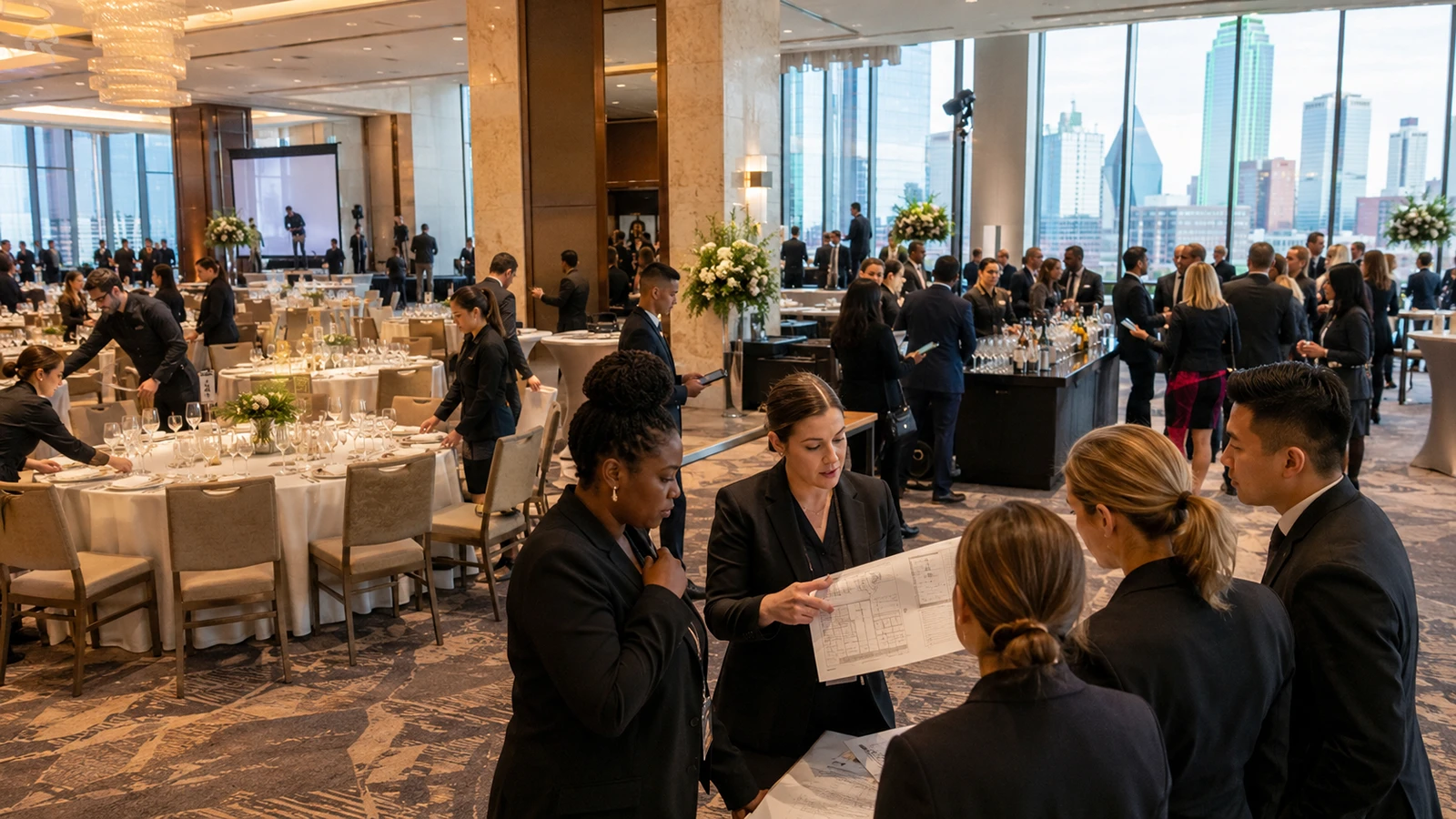
Once your staffing numbers are finalized, the next step is structuring your team so it can execute smoothly under pressure. A well-structured team prevents confusion and speeds up response during peak moments, because every person on the floor already knows exactly what they own and who to hand off to when something changes. Each staff member should have one clearly defined responsibility:
- Servers: focus only on guest service and order handling
- Bartenders: dedicated exclusively to drink preparation and service
- Barbacks: support bartenders with restocking and cleanup
- Support staff: manage clearing, resetting, and logistics
- Supervisors: oversee operations and handle escalations
Avoid dual responsibilities, especially at the bar. For more on matching roles to event type, see event staff roles explained.
Build your team into three functional layers:
- Core Team: handles standard guest service, food, and beverage flow throughout the event
- Rotation Team: rotates every 60–90 minutes to cover breaks and fatigue
- Floater Team: fills unexpected gaps from no-shows, delays, or surges, and supports supervisors with rapid problem-solving
Assign supervisors by zone (bar areas, dining/seating, entry and exit points, and high-traffic zones) rather than managing the event as a whole; this improves accountability and speeds up issue resolution. Each zone supervisor should be responsible for monitoring staff performance, managing guest flow, and making real-time decisions without needing to escalate every minor issue up the chain.
Keep your surge team fully separate from core operations, inactive during low-demand periods, and deployed only just before peak crowd movement, a distinction covered in more depth in crowd management vs. crowd control. This separation matters because pulling core staff into surge duty mid-shift almost always creates a second, smaller staffing gap right where you can least afford one: at the bar or the check-in table they just left.
Heat Management and Staff Performance
High temperatures directly impact staff energy, speed, and decision-making. Even overstaffed events can break down without a heat plan. This isn't hypothetical: CDC analysis found heat-related illness ED visit rates substantially increased across several U.S. regions during the warm-season months of 2023 compared to prior years, with working-age adults among the groups most affected. OSHA has responded with a proposed federal heat injury and illness prevention standard requiring scheduled rest breaks, hydration access, and shaded recovery areas for outdoor workers, protections a well-run July 4th plan should already include.
Build your heat strategy around these core elements:
- Rotation system: rotate staff every 60–90 minutes; stagger rotations to avoid service gaps; schedule breaks before fatigue becomes visible
- Hydration stations: staff-only, with water and electrolytes always available, plus mandatory hydration reminders from supervisors
- Cooling and recovery zones: shaded rest areas, air-conditioned access where possible, clearly marked and easy to reach,
- A dedicated heat supervisor: tracks fatigue levels, enforces hydration and rotation schedules, and adjusts deployment as needed
- Pre-event briefing: inform staff on rotation schedules, hydration expectations, and signs of heat exhaustion
Heat is a predictable challenge. Structured rotations, hydration systems, and active supervision keep your team efficient and reliable from start to finish. Unlike a crowd surge or a no-show, heat stress builds gradually and is easy to miss until a staff member is already struggling, which is exactly why it needs a named owner rather than a shared responsibility that nobody actively tracks.
Brief every staff member on heat protocols before the event begins: rotation schedules, hydration expectations, the visible signs of heat exhaustion, and clear instructions on when it's acceptable to step out without waiting for permission. When staff understand the system in advance, compliance improves, and small issues get caught before they become medical ones.
Alcohol Service Strategy and Compliance
Alcohol service is one of the highest-risk, highest-demand areas of any July 4th event. Without structure, bars become bottlenecks, and compliance risk rises fast. This connects to a broader national pattern: NHTSA data show Independence Day drunk-driving risk runs roughly 46% higher than on an average day, a reminder that on-site service controls matter as much as off-site safety messaging.
Key strategies:
- Optimize ratios: 1 bartender per 50–75 guests, 1 barback per 1–2 bartenders, with barbacks handling all restocking so bartenders never leave their station. A dedicated bar production crew handling setup, stock, and breakdown keeps this ratio intact.
- Decentralize bar stations: multiple bars distributed near high-traffic areas reduce walking distance and congestion
- Manage queues: clearly defined lines, staff directing guest flow, and clear access points for safety
- Enforce compliance: certified, responsibly trained bartenders; strict ID verification; clear refusal guidelines; and supervisor oversight at every station
- Plan the cut-off: gradually slow service before the peak crowd exits, set a clear last call, and coordinate cut-off timing with security in advance
A successful bar operation depends on structure, not just headcount. Optimized ratios, distributed service points, and enforced compliance let you handle high demand without compromising guest experience. The events that struggle most on July 4th are rarely understaffed at the front door; they're understaffed at the bar, where a single slow station can back up an entire section of the venue within twenty minutes of doors opening.
Treat alcohol service as its own mini-operation inside the larger event, with its own supervisor, its own escalation path, and its own real-time monitoring, rather than folding it into general hospitality oversight.
No-Show Contingency Planning
No-shows are one of the most disruptive July 4th challenges, holiday travel, longer hours, and heat fatigue all raise absenteeism risk compared to standard events. Build your protection in layers:
- 25–30% staffing buffer across all roles, prioritized in critical positions like bartenders and supervisors
- 10–15% on-call pool, pre-briefed and ready to deploy with clear arrival expectations
- Floaters kept unassigned until needed, deployable instantly to cover absences or surges
- A clear escalation plan: immediate notification to zone supervisors, rapid floater reassignment, and defined decision authority
- Pre-event confirmation: confirm attendance 24–48 hours out, reconfirm the morning of, and reissue shift reminders
No-show management is about preparation, not reaction. Staffing buffers, on-call teams, and real-time coverage absorb disruptions without touching the guest experience. The events that recover smoothly from a wave of no-shows are almost always the ones that treated the buffer as part of the core plan from day one, not as an emergency measure improvised the morning of the event.
Post-Fireworks Crowd Surge Management
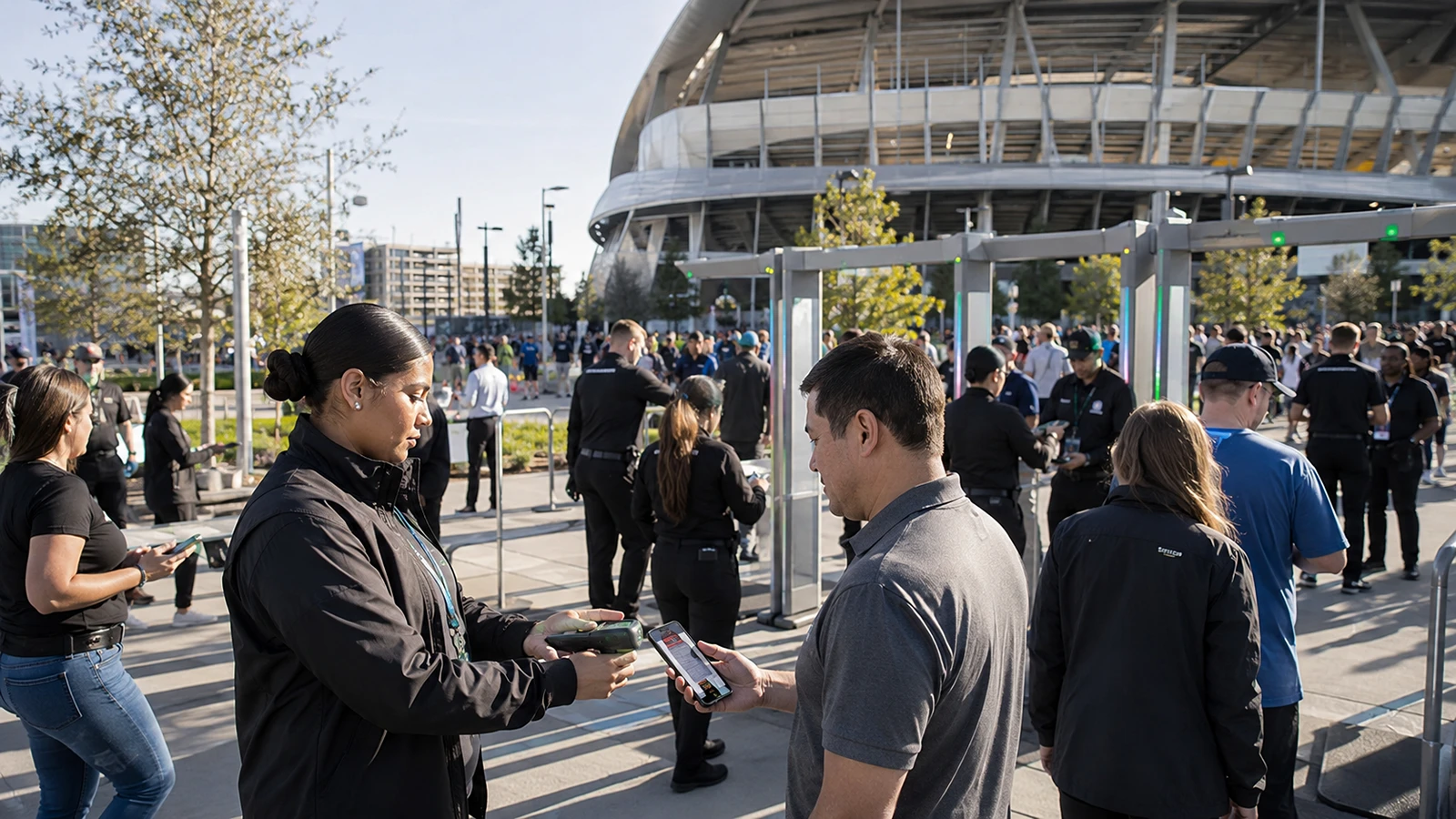
The minutes after fireworks are the most operationally intense phase of any July 4th event. Guest movement spikes rapidly, service demand peaks, and exits congest within minutes, a sharp, non-gradual shift that requires a pre-planned response, similar to the pressure points described in how crowd management works at stadium events.
Core surge tactics:
- Deploy a dedicated surge team 15–20 minutes before fireworks end, focused only on surge tasks and kept separate from core staff
- Position staff strategically at exits, gates, main walkways, intersections, and transportation zones, guiding guests actively rather than reacting passively, as outlined in building a crowd management plan for high-attendance events
- Coordinate exits and transportation with marked ride-share zones, parking direction, and clear signage
- Manage final service demand by keeping select bar stations open under surge staff control rather than reopening full operations
- Assign a surge supervisor to coordinate deployment, monitor density, and make real-time adjustments
Post-fireworks crowd management is a planned operation, not a reaction, a dedicated surge team and coordinated exits prevent chaos and maintain a safe, organized close. Treat the fifteen minutes before fireworks end as the true start of your closing operation, not the moment the last shell explodes, so your surge team is already in position when the crowd actually begins to move.
Communication and Day-Of Execution

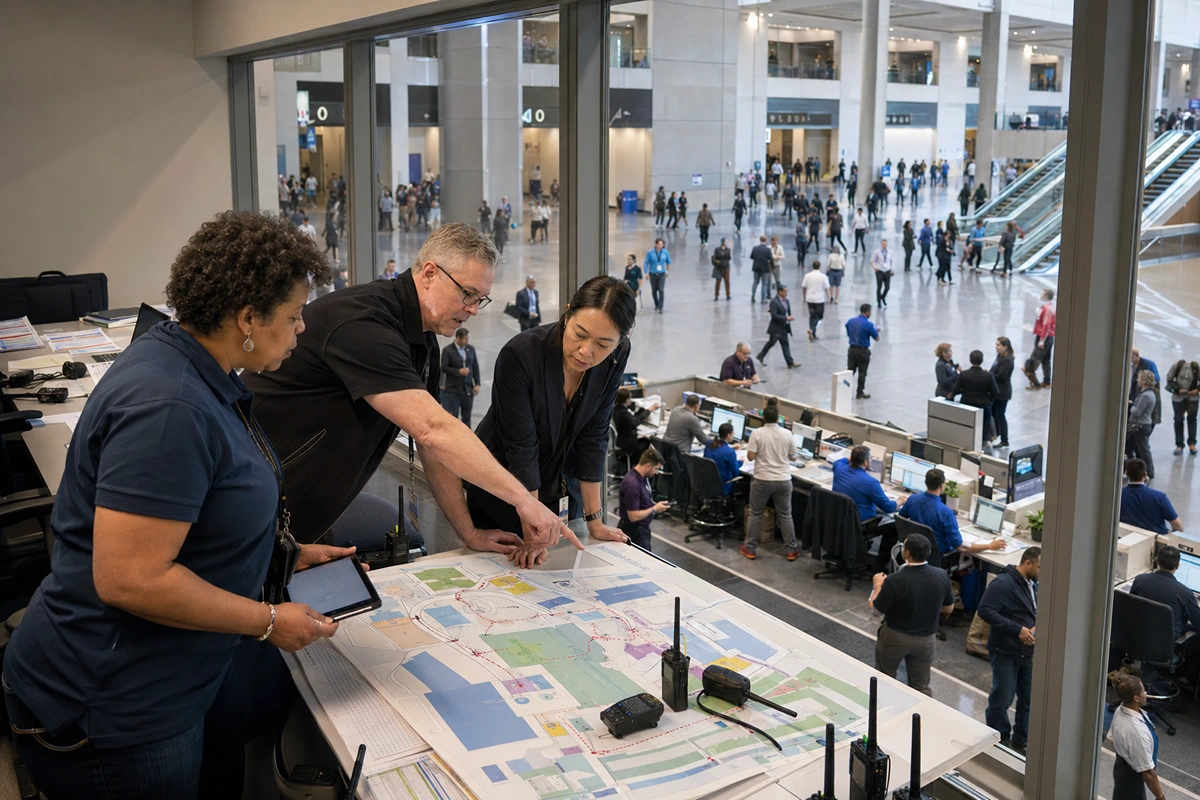
Even the best staffing plan fails without clear communication. Set up a primary communication channel (radios or phone groups), backup methods for technical issues, and a clear command structure with an event lead who holds final authority; zone supervisors; and team leads, so every staff member knows exactly who to escalate to.
Run a full pre-event briefing covering roles and zones, rotation schedules, surge activation timing, emergency procedures, and key contacts. During the event, supervisors should actively monitor for slowdowns, redistribute staff based on demand, and activate floaters when needed.
Final checklist before opening to guests:
- All staff present and checked in
- Roles and zones clearly assigned
- Communication systems fully functional
- Hydration stations and rest areas set up
- Bar stations and service areas ready
- Surge team and backup staff on standby
Strong communication and disciplined execution are what bring your staffing plan to life, they keep you adaptable and in control from open to close. A staffing plan with perfect ratios and a well-briefed surge team can still fall apart if a supervisor can't reach the operations lead when a bar station runs out of ice or an exit lane backs up, which is why the communication system deserves the same level of planning as headcount itself.
Plan Your July 4th Event Without Staffing Gaps
If you're managing a high-volume July 4th event, staffing isn’t something you can afford to estimate.
You need:
- The right ratios
- The right structure
- The right backup plan
👉 Work with a professional event staffing team that understands high-pressure holiday environments.
Whether you're planning a corporate event, brand activation, or large-scale celebration, the difference between smooth execution and operational chaos comes down to staffing precision.
Get a customized staffing plan tailored to your event size, location, and risk factors.
Ready to elevate your next event?
Join thousands of event planners who trust EventStaff.com for reliable, professional staffing solutions.
Trusted by event professionals nationwide
1k+
Events Staffed
2 million+
Guests Served
97%
Positive reviews