

CEO Excerpt
Trade show staffing companies are not headcount vendors. They are operational control partners who protect lead quality, supervision standards, and booth stability when traffic, fatigue, and pressure peaks.- CEO Event Staff
Trade show staffing companies build the operational system that keeps your booth controlled when traffic spikes, staff rotate, and schedules tighten.
If you are deciding whether to outsource, here is the clear answer: trade show staffing companies handle training, scheduling, supervision, and backup coverage so performance does not erode under pressure. A trade show staffing agency becomes essential when reliability directly affects demos, lead targets, and brand consistency.
If you are asking, what trade show staffing companies actually do, the direct answer is this: they recruit and vet the right people for specific booth roles, train them to represent your brand consistently, manage schedules and break rotations, supervise execution on site, and deploy backup coverage when reality deviates from the plan. A trade show staffing agency becomes essential when reliability and lead quality directly affect revenue outcomes.
Executive Summary
Trade show staffing companies manage sourcing, training, supervision, and backup coverage to keep booths stable and lead goals protected. A trade show staffing agency becomes essential when performance, consistency, and reliability directly impact revenue.
What Do Trade Show Staffing Companies Actually Do Behind the Scenes?

Trade show staffing companies turn headcount into controlled booth performance. They do this through structured sourcing, brand-aligned training, booth staffing management, defined trade show staff roles, and on-site supervision.
A professional trade show staffing agency is not filling shifts. It is building a system that protects engagement quality, lead integrity, and coverage stability.
1. Talent Sourcing and Vetting
Professional trade show staffing services evaluate more than availability. They assess:
- Brand alignment and communication style
- Comfort with structured lead qualification
- Stamina for long exhibit hours
- Experience with similar booth formats or industries
- Ability to follow supervision and escalation protocols
A product specialist and a brand ambassador are not interchangeable. One drives technical depth. The other drives engagement volume. If the wrong person anchors the wrong role, performance declines quickly.
Clear role alignment at the sourcing stage protects:
- Engagement quality
- Conversation control
- Demo throughput
- Qualification discipline
This is where strong trade show staffing companies begin protecting outcomes, before the exhibit hall even opens.
What this protects: engagement quality before the show even opens.
2. Brand-Aligned Training
Strong trade show staffing companies standardize how your booth communicates and qualifies, so outcomes are consistent across every shift. That typically includes:
- Approved talking points and objection handling
- A lead qualification rubric (who gets scanned, who gets routed, who gets scheduled)
- Handoff rules (when to pull in sales, when to book a demo, when to exit)
- Role clarity across trade show staff roles, so “engagement” does not dilute “qualification”
Without structured training, each staff member improvises. You still collect scans, but CRM integrity drops, sales acceptance declines, and your ROI story becomes harder to defend.
Without structured training, conversations vary by staff member. Qualification becomes inconsistent. CRM data weakens. With industry statistics showing the cost per lead at a trade show averages $112, qualification discipline becomes a direct financial variable. Two adjacent attendees should hear the same positioning and face the same qualification gate. That only happens with alignment before the floor opens.
What this protects: Brand consistency and lead integrity.
3. Scheduling and Booth Staffing Management
Booth staffing management goes beyond assigning shifts. It includes:
- Call-time coordination
- Credential confirmation
- Staggered break rotations
- Peak traffic planning
- Overlap coverage to prevent dead zones
AI tools can generate schedules. They cannot observe fatigue, traffic spikes, or disengagement posture. Human supervision ensures that coverage remains stable when pressure increases.
Effective trade show staffing companies monitor:
- Traffic density by zone
- Conversation duration
- Queue buildup at demo stations
- Energy levels across shifts
AI can build schedules. It cannot see fatigue building at 2:00 p.m. It cannot anticipate two people stepping away at once. The same principles that govern event flow psychology apply directly to trade show booths; crowd behavior is predictable when structure is in place.
What this protects: Coverage stability during traffic surges.
4. Defined Role-Specific Structure
Clear trade show staff roles prevent operational drift.
Common roles include:
- Brand ambassadors for engagement volume
- Booth hosts for traffic routing
- Lead qualifiers for data accuracy
- Product specialists for demo depth
- Floor support for booth readiness
- Supervisors for accountability and escalation
If everyone greets and no one qualifies, pipeline value drops. If specialists get trapped in casual conversations, demos stall. Defined roles protect flow and protect outcomes.
Professional trade show staffing services align roles to objectives, not headcount totals.
5. On-Site Supervision
Supervision is where a trade show staffing agency separates itself from temporary staffing vendors.
Supervisors manage:
- Late arrivals
- Messaging drift
- Traffic surges
- Break enforcement
- Real-time performance adjustments
At 10:07 a.m., if someone runs late, a supervisor shifts coverage quietly. Without that structure, internal staff scramble, demos start late, and visible instability sets the tone for the day.
Trade show staffing companies build contingency plans in advance:
- Backup personnel
- Defined escalation chains
- Replacement timelines
- Compliance awareness for venue rules
What this protects: Stability when reality deviates from the plan.
What do trade show staffing companies handle behind the scenes? They recruit, train, schedule, supervise, and back up trade show event staff to keep booths covered, consistent, and accountable. A trade show staffing agency manages operational control so performance does not erode when traffic peaks and fatigue builds. When structured correctly, trade show staffing companies do not add complexity. They remove risk.
What Problems Do Trade Show Staffing Companies Prevent on Show Day?
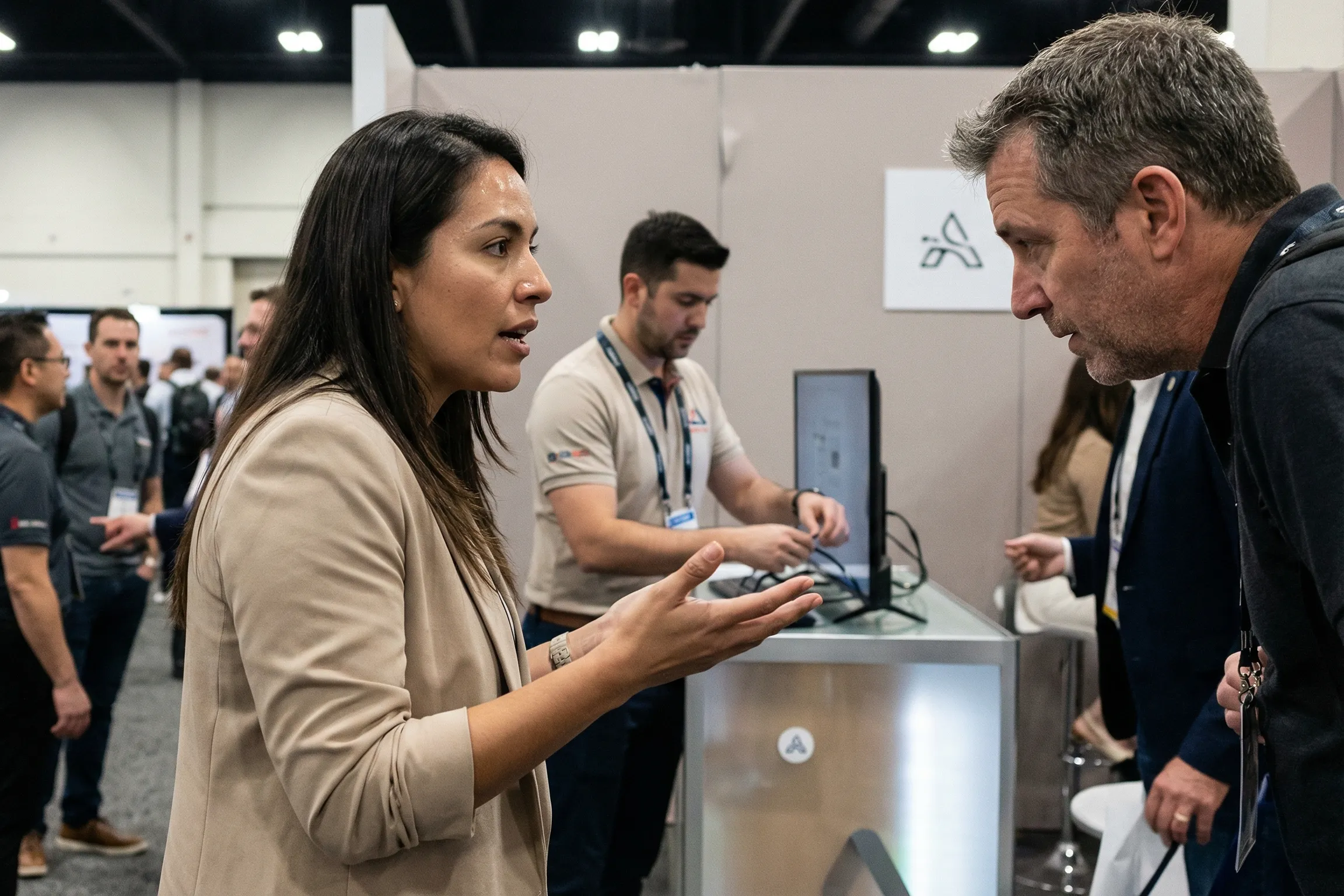
Trade show staffing companies exist to prevent predictable breakdowns. On a high-traffic show floor, small gaps compound quickly. A professional trade show staffing agency builds safeguards that keep those gaps from becoming visible failures.
Below are the most common show-day risks and how structured trade show staffing services prevent them.
1. The No-Show Chain Reaction
One uncovered position can trigger:
- Late demo starts
- Traffic congestion at entry points
- Sales reps abandoning scheduled meetings
- Rushed or incomplete lead capture
- Visible instability during peak hours
When doors open and one role is empty, internal staff compensate. That compensation pulls attention from qualification, routing, or demo delivery. By midday, the booth feels reactive rather than controlled.
Trade show staffing companies prevent this through:
- Pre-assigned backup coverage
- Clear replacement timelines
- Defined supervisor escalation protocols
- Staggered arrival confirmations
What this protects:
- Demo consistency
- Sales meeting integrity
- First-impression stability
2. Weak Lead Qualification
Without structured training and defined trade show staff roles:
- Everyone gets scanned
- Qualification criteria blur
- CRM quality declines
- Sales acceptance rates drop
- ROI reporting weakens
High traffic does not guarantee high-value pipeline. Trade show event staff must understand who qualifies, who routes to sales, and who exits gracefully.
Professional trade show staffing services enforce:
- Pre-defined qualification questions
- Clear ICP criteria
- Structured handoff triggers
- Consistent data capture standards
When qualification discipline holds, your post-show sales process remains intact.
What this protects:
- Lead integrity
- Sales confidence
- Revenue forecasting clarity
3. Break and Fatigue Gaps
Trade shows are endurance environments. Energy visibly drops without structure.
Without disciplined booth staffing management:
- Multiple staff step away at once
- Demo stations lose coverage
- Engagement posture weakens
- Traffic bottlenecks form
A trade show staffing agency manages staggered break rotations so no zone becomes uncovered. Supervisors monitor energy and rotate high-interaction roles strategically.
What this protects:
- Visible energy on the floor
- Engagement consistency
- Traffic flow stability
4. Messaging Drift
As the day progresses, unsupervised staff often begin improvising.
Common consequences include:
- Inconsistent positioning
- Overpromising features
- Misaligned pricing conversations
- Confusion during sales handoffs
Trade show staffing companies conduct real-time coaching and enforce approved talking points. Messaging discipline is not left to chance.
What this protects:
- Brand credibility
- Legal and compliance alignment
- Executive visibility at high-profile events
5. Compliance and Labor Missteps
Many venues enforce strict labor rules affecting:
- What staff can assemble or move
- Credential access requirements
- Union-related restrictions
- Access to restricted show-floor zones
Misunderstanding these constraints can cause delays or public corrections.
Professional trade show staffing companies account for:
- Credentialing timelines
- Venue-specific labor boundaries
- Escalation channels for compliance questions
What this protects:
- Operational continuity
- Avoidable fines or interventions
- Smooth coordination with show management
What problems do trade show staffing companies prevent? No-shows, inconsistent messaging, missed breaks, weak lead capture, and show-day instability that disrupts sales focus.
When Should You Hire a Trade Show Staffing Agency Instead of Using Internal Staff?
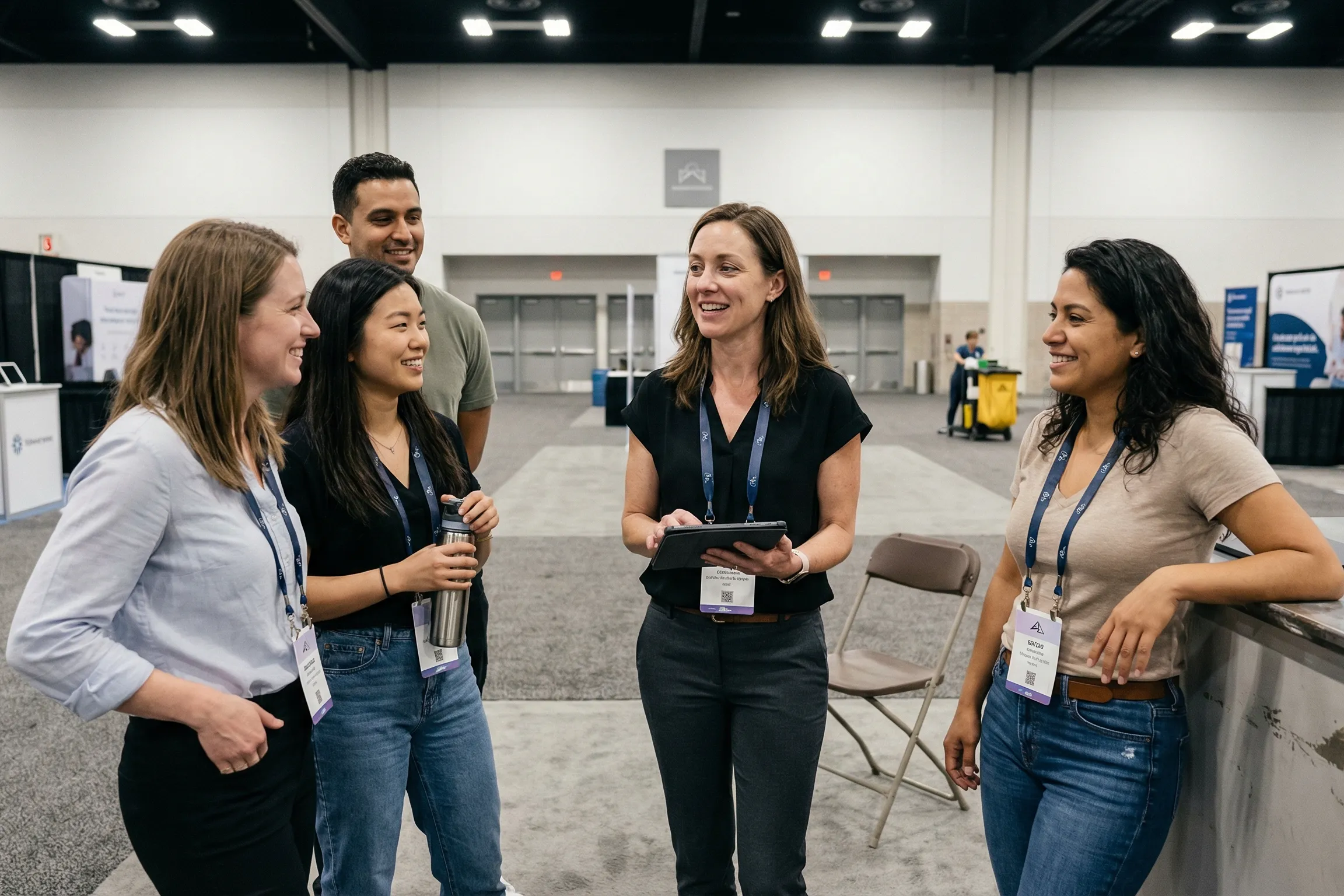
Hire a trade show staffing agency when booth performance depends on supervision, backups, and consistent execution that your internal team cannot maintain while also selling, hosting, or managing stakeholders.
Trade show staffing companies are most valuable when a single staffing gap could impact demos, lead targets, or brand consistency.
When Internal Staffing Works
Internal staffing can be reliable when:
- The booth is small and single-zone
- Traffic is predictable and manageable
- Messaging is straightforward
- Your team has time for pre-show training and rehearsal
- A dedicated supervisor is available and is not responsible for selling
- Coverage requirements allow consistent breaks without dead zones
If these conditions hold, internal staffing can remain stable.
When a Trade Show Staffing Agency Is Safer
Outsourcing becomes advisable when:
- One absence creates visible coverage gaps
- Multiple demo stations run simultaneously
- Lead targets are aggressive and time-sensitive
- The event spans multiple days, with fatigue compounding daily
- Your internal team must prioritize meetings and sales conversations
- Execution needs to be consistent across cities or multiple shows
Reliable exhibition staffing support adds depth, accountability, and replacement speed that internal teams rarely maintain while also managing core business priorities.
Trade show staffing companies reduce risk by ensuring that:
- Booth staffing management is controlled across every shift
- Trade show staff roles stay aligned to objectives
- Supervision and escalation are assigned, not shared
- Backups are planned, not improvised
Reliable exhibition staffing support provides coverage depth and accountability continuity. For teams managing budget alongside headcount, reviewing staffing cuts costs builds the financial case before committing to a staffing structure.
Comparison Overview
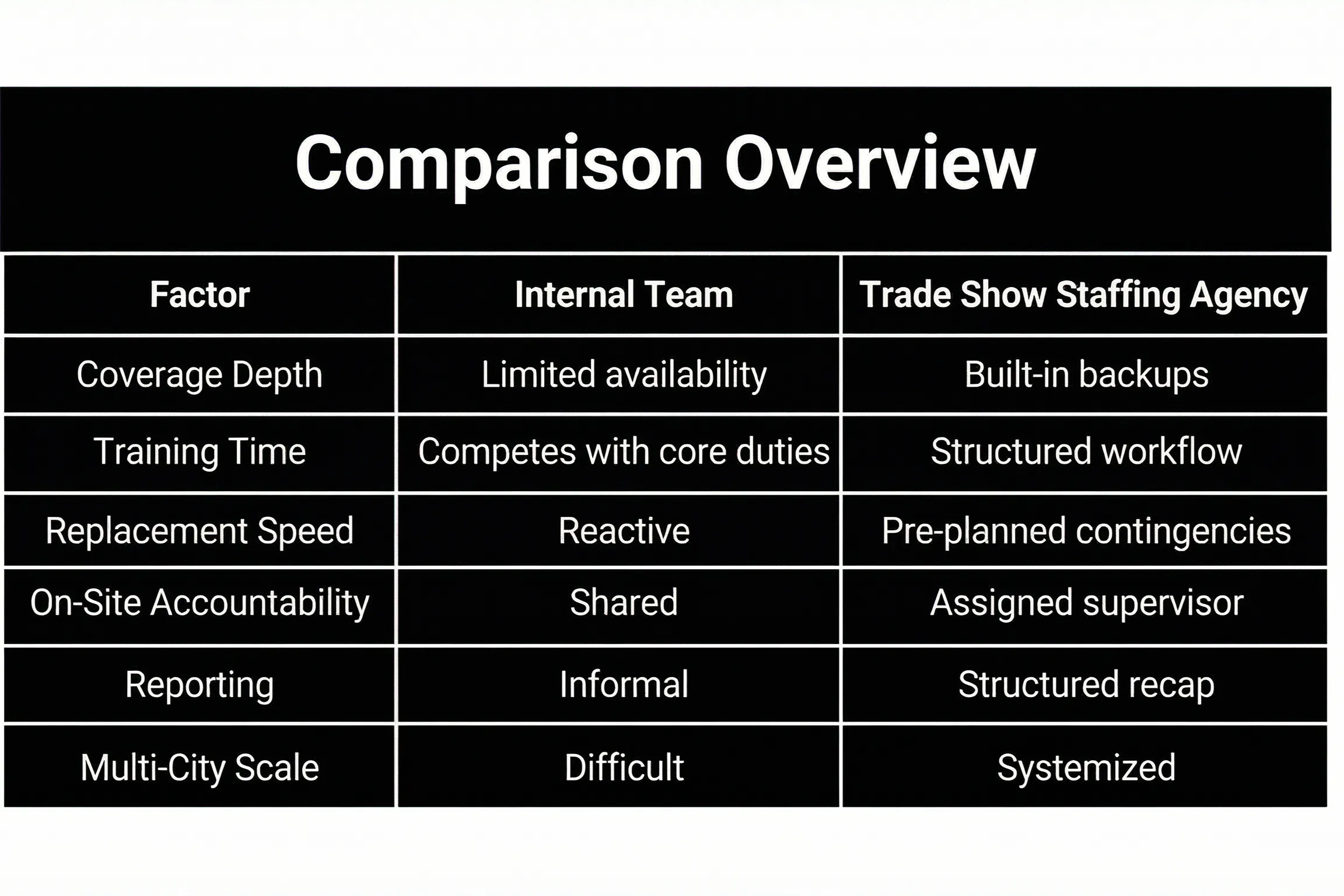
AI scheduling tools cannot enforce behavior or standards. Human supervision remains central.
When should you hire a trade show staffing agency? When booth performance depends on supervision, backups, and consistent execution, your internal team cannot fully manage.
What Trade Show Staff Roles Should You Staff and What Does Each Protect?
Defined trade show staff roles protect engagement, lead quality, traffic flow, and supervision so booths operate efficiently.
Misaligned staffing causes more performance loss than understaffing.
Core Trade Show Staff Roles

Without defined trade show staff roles:
• Traffic bottlenecks form
• Specialists become misallocated
• Qualification weakens
• Coverage gaps increase
Professional trade show staffing services align roles with outcomes rather than headcount.
How should you structure trade show staff roles? Add ambassadors for volume, qualifiers for lead quality, and supervisors to protect booth flow and standards.
How Do Trade Show Staffing Companies Run Show-Day Operations Minute to Minute?
Trade show staffing companies manage call-time, credentials, break rotations, live replacements, coaching, and daily reporting.
1. Call-Time and Credential Management
• Early arrival
• Position confirmation
• Messaging review
• Coverage adjustments for delays
If call time slips, the booth opens unstable. Stability early sets the rhythm for the day.
2. Break Rotations
Staggered breaks prevent:
• Dead zones
• Engagement drops
• Coverage imbalance
Without rotation discipline, performance decays mid-afternoon.
3. Live Monitoring
Supervisors observe:
• Engagement posture
• Conversation duration
• Qualification discipline
• Traffic flow
Corrections happen in real time, not in post-show reports.
4. Supervision Ratios
When one supervisor covers too many staff, quality softens:
• Scripts drift
• Handoffs weaken
• Break timing slips
Trade show staffing companies plan oversight capacity to protect standards.
5. End-of-Day Recap
Daily reviews include:
• Traffic pattern assessment
• Lead quality review
• Messaging adjustments
• Next-day refinements
Multi-day shows improve only if daily loops exist. The same reporting discipline applies to conference environments , a well-structured conference staffing structure shows how role accountability translates to consistent daily performance.
What do trade show staffing companies manage on show day? Call-time enforcement, break coverage, live adjustments, coaching, and daily reporting to keep booths stable.
When Is Hiring Trade Show Staffing Companies Essential?
Hire trade show staffing companies when booth complexity exceeds your team's supervision capacity.
The Two-Trigger Rule
If two or more apply, outsourcing is recommended:
• Multiple booth zones
• Long hours plus early load-in
• VIP or press visibility
• High lead targets
• Limited internal supervision
Post-2023 attendee behavior shows shorter engagement windows and sharper traffic spikes. Coordinated exhibition staffing support becomes necessary to manage flow under those conditions. Without supervision, booths drift.
When is hiring trade show staffing companies essential? When you cannot fully supervise the booth and one staffing gap risks lost demos or weaker leads.
How Do You Vet Trade Show Staffing Companies Before You Sign?
Evaluate trade show staffing companies based on training workflow, replacement timing, supervision structure, escalation plans, and reporting.
Ask:
• How are staff vetted between shows?
• What is the brand training process?
• What is the no-show replacement timeline?
• Who supervises on site?
• How are venue compliance and credentialing handled?
• What reporting is delivered daily and post-show?
If the answers remain vague, risk remains high. If someone says they “always have backups,” ask how quickly they deploy and who activates them. If supervision is mentioned, ask for names and roles. A credible trade show staffing agency demonstrates systems, not just availability.
Minimum Acceptable Standard
• Written replacement policy
• Defined training process
• Named supervisor for multi-staff booths
• Daily recap reporting
• Compliance awareness
How do you vet a staffing vendor? Ask about supervision, replacement timing, training process, compliance planning, and daily reporting.
Why Structure Wins the Trade Show Floor
Staffing cannot correct a weak offer. It can prevent avoidable operational breakdowns that reduce performance. If your booth requires supervision, multi-day endurance, or multi-zone coordination, reviewing your staffing structure before finalizing logistics is practical risk management. Trade shows reward control. Trade show staffing companies provide it. Ready to protect your next exhibit? Get a quote to build a specialized booth team that executes without excuses.
Ready to elevate your next event?
Join thousands of event planners who trust EventStaff.com for reliable, professional staffing solutions.
Trusted by event professionals nationwide
1k+
Events Staffed
2 million+
Guests Served
97%
Positive reviews