
| Staffing Category | High Risk (Understaffed) | Meets Standard (Baseline Flow) | Surge Ready (Optimized / Peak Flow) |
|---|---|---|---|
| Registration Staff |
< 1 per 150 attendees (Likely to cause long queues and delayed entry) |
1 per 150 attendees (Ideal for steady mid-day flow) |
1 per 75 attendees (Required for morning rush/first 60 mins) |
| Room Monitors |
< 1 per room (Risk of technical failure or unmanaged doors) |
1 per breakout room (Ensures basic coverage) |
1 per room + 1 floater per 4 rooms (Covers breaks, tech issues, and speaker needs) |
| Ushers |
< 1 per 250 seats (Slow seating; bottlenecks in aisles) |
1 per 250 seats (Standard density management) |
1 per 125 seats (Double) (Critical for General Session rapid seating) |
| Floor Support |
None at key points (High confusion; risk of congestion) |
1 per major intersection (Basic wayfinding coverage) |
1 per intersection + Elevator Banks (Prevents vertical transport gridlock) |
| Floaters |
< 1 per 15 staff (Breaks will leave key posts empty) |
1 per 10 active staff (Sustainable break rotation) |
1 per 8 active staff (High flexibility for emergencies) |

Conference staffing is the difference between a seamless event and a logistical breakdown. You can spend months planning the perfect agenda, but if your registration desk fails in the first 10 minutes, your entire event experience suffers.
This guide explains exactly how conference staffing works, including registration staff, ushers, and room monitors. You will learn the staffing ratios, roles, and operational systems required to move large attendee volumes without delays, confusion, or safety risks.
CEO Excerpt
"Conference staffing determines the stability of your event infrastructure. This guide provides the exact ratios and operational protocols for registration, ushers, and room monitors to eliminate bottlenecks and guarantee guest safety."- CEO Event Staff
How Many Staff Do You Need for a Conference?
The number of staff required depends on attendee volume, venue layout, and session density. However, proven benchmarks include:
- Registration Staff: 1 staff per 150 attendees
- Check-in Stations: 1 per 120 attendees/hour
- Room Monitors: 1 per session room
- Floaters: 10–15% of total staff
- Supervisors: 1 per 10–12 staff
For example, a 1,000-attendee conference typically requires:
- 6–8 registration staff during peak arrival
- 10+ room monitors for breakout sessions
- 15–20 floor and support staff
Understaffing peak arrival windows creates delays that impact the entire event schedule.
Executive Summary
Conference staffing determines the stability of your event infrastructure. This guide provides the exact ratios and operational protocols for registration, ushers, and room monitors to eliminate bottlenecks and guarantee guest safety, helping you plan a successful corporate event from day one.
Why Conferences Demand a Balanced Staffing Mix
You cannot solve operational friction with headcount alone. Adding more untrained bodies to a confused crowd only creates a denser, more confused crowd. Conference staffing requires a specific architecture of roles designed to counterbalance the physical pressure attendees place on a venue.
Guest Flow Complexity
Think of your attendee count as water pressure. When a general session ends, you dump 2,000 people into a hallway designed for 500. This is not a service issue; it is a physics issue. Without dedicated Crowd Management acting as human bollards to divert traffic, you get dangerous compression points. According to venue safety standards from the International Association of Venue Managers (IAVM), managing this density requires personnel whose sole responsibility is routing flow away from pinch points.
Multi-Room Schedule Challenges
Multi-room scheduling creates a distinct operational threat. If you have 12 concurrent breakout sessions, you need more than 12 monitors. You need a relief system. Labor laws mandate breaks, but your keynote speaker does not stop talking. A robust conference staffing plan includes floaters who rotate through rooms to ensure no door is ever unmanned.
Speaker and VIP Considerations
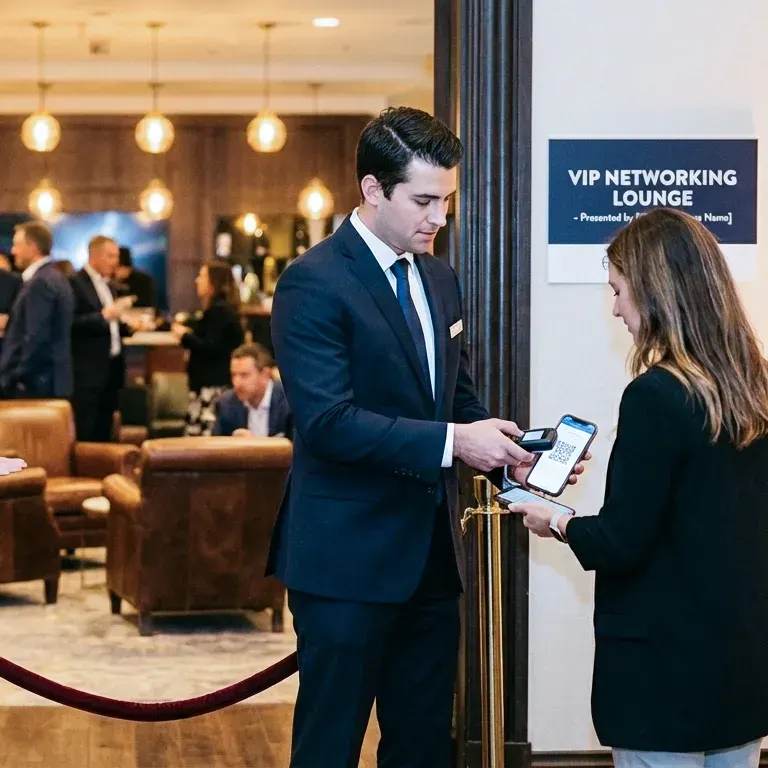
High-level speakers introduce volatility. A VIP who arrives late or forgets their credentials can freeze a standard registration line. You need specific Corporate events staff trained in executive protocol to intercept these issues before they affect the general public.
Success requires managing the physics of crowd movement (guest flow), the logistics of the schedule (multi-room), and the volatility of high-profile guests (VIPs) simultaneously. Without a balanced mix, a single bottleneck can cascade into a venue-wide failure.
Core Conference Staffing Roles
To build a conference staffing roster that functions under pressure, you must move beyond generic titles. Role specialization allows you to assign specific accountability for every square foot of the venue.
Registration Staff
These staff members control the entry velocity of your event. Conference registration staff are not just greeters; they are data technicians. Their primary metric is throughput. If a check-in interaction takes 45 seconds instead of 15, your lobby becomes a holding cell. They must be proficient in credential verification and capable of rapid troubleshooting when a badge printer jams. Using professional Check in Staff ensures that the first touchpoint is seamless.
Ushers
Event ushers for conferences serve a different function than theater ushers. Their job is density management. Their primary operational goal is ballroom flow routing, filling the front rows first to prevent the "empty front, packed back" dynamic that delays session starts. During a lockout (when a room hits capacity), Ushers act as the hard control point to turn guests away firmly but politely.
Room Monitors
This is the most critical technical role in the ecosystem. Room monitor duties have evolved into a hybrid of timekeeper, AV liaison, and crowd manager. A monitor tracks attendance for CEU credits, uses hand signals to alert AV techs of audio feedback, and ensures the room resets instantly for the next speaker. Specialized Conference Staff are essential here to maintain the educational integrity of the sessions.
Floor Support Staff
Floor support staff are the infrastructure of the event. They operate in the transition zones, hallways, lobbies, and escalator landings. While they answer wayfinding questions, their operational purpose is risk detection. They spot the coffee spill before a slip-and-fall occurs. Greeters and floor staff notice the elevator bank backing up and radio for a diversion.
Floaters & Runners
You will statistically lose 10% of your workforce capacity at any given moment to breaks or bathroom trips. Floaters plug these holes so that a security checkpoint or registration desk is never abandoned. Runners act as the logistics circulatory system, moving box lunches, batteries, and lanyards to where they are depleted.
Supervisors
Conference staffing breaks down when communication lines are too long. You need one supervisor for every 10–12 staff members. Supervisors handle the "micro-crises", the angry guest, the sick staffer, the schedule change, so the event planner remains focused on the macro run-of-show. Deploying Production Teams to oversee these zones creates a chain of command that protects the organizer.
Generalists create chaos; specialists create flow. Ensure every staff member, from registration to floor support, knows their specific "zone of accountability." A Room Monitor should never leave their door to direct traffic; that is the job of Floor Support.
Conference Staffing Ratios: Operational Health Rubric
Use this rubric to evaluate the readiness of your staffing plan. Aim for the "Surge Ready" column for high-stakes times (morning arrivals, keynote seating) and "Meets Standard" for steady-state operations.
.webp)
Entry Volume & Registration Desk Operations
For registration desk operations, you must calculate your "Arrival Curve." If 80% of your 1,000 attendees arrive between 8:00 AM and 9:00 AM, you have a throughput requirement of 800 people per hour. A single station handles roughly 120 people per hour at maximum efficiency. You would need roughly 7 stations to handle the surge without lines building up. Efficient conference staffing here is non-negotiable.
Room Count and Schedule Density
If you require concurrent session support across 10 rooms, you need 10 monitors plus 2–3 floaters. If all sessions end effectively at the same time, you need to increase your hallway staff. You do not staff for the session duration; you staff for the transition chaos.
ADA Routing Support
A specific subset of floor support staff must be dedicated to ADA routing support. Vertical transport is a major bottleneck. These staff members guard elevators to ensure they remain available for guests with accessibility needs, while politely directing able-bodied attendees to escalators or stairs.
Don't guess. Use the 1:150 ratio for entry and 1 monitor per room as your baseline, then adjust for surge windows. If you understaff the morning rush, you spend the rest of the day recovering from the delay.
How Registration Staff Maintain Smooth Conference Entry
The first ten minutes of the attendee journey define their perception of the brand. Conference registration staff are the architects of this experience.
Queue Shaping
We do not use straight lines. Conference staffing teams should deploy a snake queue (serpentine). This is a mathematical necessity. If one printer jams in a multi-line setup, that entire line stops, and anxiety spikes. In a snake queue, the line keeps moving to the next available agent. The perception of progress reduces guest frustration. Experienced Ticket Checkers are trained to manage these queues effectively.
Credential Troubleshooting
The "Help Desk" is a mandatory component of conference registration flow. You must empower staff to remove problem cases from the main line immediately. If a badge does not print in 10 seconds, the staffer escorts the guest to the Help Desk. This keeps the primary conference staffing throughput high and predictable.
A seamless registration process ensures that guests begin their experience positively. Using serpentine queues and a dedicated Help Desk prevents a single tech failure from stalling the entire event entry.
Managing Session Changeovers Without Gridlock
The most dangerous window in any conference is the changeover. This is when conference staffing pays for itself.
Door Timing
Room monitor duties include strict door control. They must physically hold the incoming crowd back until the outgoing crowd has cleared the room. This prevents the "collision effect" in the doorway. It requires staff with the confidence to hold a hand up to a rushing crowd of executives.
Corridor Routing
Event floor support staff duties shift during changeovers. They become traffic engineers. They stand in the center of the corridor to create virtual lanes, directing traffic to "stay to the right." This prevents the friction of cross-traffic and keeps the hallway velocity consistent.
Effective door timing and corridor routing prevent overcrowding. Staff must be proactive "traffic cops" during these 15-minute windows, not just passive observers.
Multi-Level Venue Flow Management
If your venue spans multiple floors, you have a vertical transport problem. Elevators are low-capacity bottlenecks.
Escalator and Elevator Support
You need staff positioned at the top and bottom of every escalator. Their only job is to keep people stepping off. If one person stops at the landing to check their phone, the pile-up behind them is immediate. Corporate event staff must be vocal and proactive here to push people away from the landing zone.
Zone Captain Assignments
In a multi-level conference staffing deployment, assign a Zone Captain to each floor. They monitor hallway density detection. If a floor becomes dangerously crowded, they radio the level below to hold traffic or redirect guests to a secondary staircase. Using Hostesses as zone captains can add a layer of polish while maintaining operational control.
Multi-level venues can easily turn chaotic if not managed properly. Assigning staff at key landings and using Zone Captains ensures guests are always moving and prevents dangerous density buildup.
Technology + Staff Integration
Your conference staffing team must be integrated with your event technology.
Scanning and Access Control
Conference entry operations fail when staff are not trained on the hardware. Staff must know how the scanner behaves in offline mode or low light. They need to know that a red light might mean "wrong session" and not just "scan error." This prevents false rejections at the door.
Communication Channels
Your conference help desk staff and floor teams should be on a unified communication channel. If a room is freezing, the monitor messages the channel, and a floater resolves it with the venue. The monitor never leaves the room. This is conference throughput optimization in practice. Integrating your team helps in creating a safety plan for events where communication is the first line of defense. The PCMA emphasizes that real-time communication is the single biggest factor in successful crisis management.
Integrating technology with conference staffing ensures quick access and real-time problem-solving without interrupting the event flow. Staff must be as proficient with the app as they are with the floor plan.
How EventStaff Builds Reliable Conference Staffing Teams
The "gig economy" model fails in the conference sector because it relies on random assignment. Conference staffing requires continuity.
Market-by-Market Rosters
At EventStaff, we curate local rosters. We know the best corporate conference staff for hire in every major hub. These are professionals who know the convention center layout better than the organizers do. They know where the freight elevators are and which restrooms have lines.
Briefings and Multi-Day Consistency
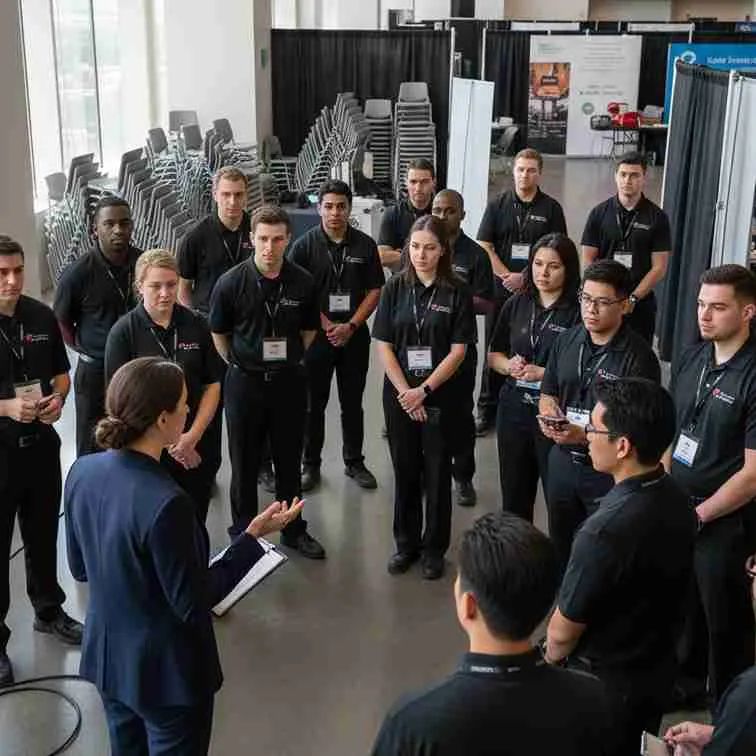
We operate on the "Pre-Shift Rally" model. Every morning, supervisors brief the team on VIPs, schedule changes, and safety protocols. We also prioritize multi-day badge management, keeping the same staff for the full 3-day run. By day two, the team is operating on autopilot because they know the flow. This consistency is exactly how hospitality staff elevate guest experience.
At Event Staff, we ensure every member is well-trained and familiar with the venue. By using local rosters and consistent teams, we eliminate the learning curve that plagues generic temporary staffing.
Real-World Example: Preventing a Registration Bottleneck
At a 2,000-attendee corporate conference, 75% of guests arrived within a 90-minute window. The initial setup included only 8 check-in stations, creating immediate congestion.
After restructuring:
- Stations increased to 14
- A serpentine queue was implemented
- A dedicated help desk removed problem cases
Result:
- Wait times dropped from 25 minutes to under 5 minutes
- Entry flow stabilized within 30 minutes
This demonstrates how proper conference staffing design directly impacts attendee experience.
Conference Staffing Checklist
Use this checklist to validate your conference staffing strategy.
- Ratio Check: Do you have 1 conference registration staff member for every 150 attendees?
- Breaks: Have you scheduled overlapping breaks so no position is ever empty?
- Tech Backup: Do you have 10% extra scanners and fully charged battery packs?
- Floaters: Do you have at least 2 dedicated floaters per floor?
- Briefing: Is there a hard start time for staff briefing 60 minutes before doors open?
- Uniforms: Is the visual identity clear (e.g., matching blazers) so staff are easily identified?
Check your ratios, confirm your floaters, and ensure backup tech is ready. These essentials will make your conference staffing plan run smoothly from start to finish.
Final Thoughts on Your Conference Staffing Plan
Your event is only as strong as its execution on the ground. Poor conference staffing leads to long lines, overcrowding, and frustrated attendees.
Work with a team that understands operational flow, not just staffing numbers. EventStaff provides trained conference staff who are experienced in high-volume, multi-room environments.
Get a customized staffing plan and quote today, and ensure your next conference runs without delays, bottlenecks, or guesswork.
Ready to elevate your next event?
Join thousands of event planners who trust EventStaff.com for reliable, professional staffing solutions.
Trusted by event professionals nationwide
1k+
Events Staffed
2 million+
Guests Served
97%
Positive reviews