

Choosing the best event organizer for brand activations means choosing a partner who can deliver real engagement, not just attractive setups. Brand activations work when staffing, audience flow, and interaction design support how people actually behave in live environments.
Brand activation event management focuses on execution that drives participation, recall, and action. This is why services for branded event activations must cover trained staff, on-site leadership, and real time problem solving, not only production and visuals.
This guide explains how to evaluate a brand activation agency, what brand activation services matter most, and how to select an organizer who can deliver consistent results for experiential brand activations and corporate event brand activation campaigns.
CEO Excerpt
“Successful brand activations are not built on concepts alone. They succeed when execution, staffing, and audience flow are engineered with precision. The brands that win are the ones that plan for real human behaviour, not ideal scenarios.” — CEO, EventStaff
Executive Summary
Choosing the best event organizer for brand activations requires a clear focus on execution, staffing, and audience engagement, not just creative concepts or production quality. Effective brand activation event management depends on how well agencies design guest flow, train brand ambassadors, and respond to real time challenges on-site.
What Does An Event Organizer For Brand Activations Actually Do?
A brand activation organizer turns marketing goals into live experiences that drive interaction, recall, and action. Brand activation event management goes beyond venue booking or vendor coordination. It focuses on how people move through the space, how staff engage them, and how every interaction reinforces the brand message.
Unlike traditional events, experiential brand activations rely on consistent, repeatable human interactions. This is why services for branded event activations must integrate planning, staffing, and on-site execution into a single delivery model. In 2024, global experiential marketing spending reached $128.35 billion, exceeding pre-pandemic levels and growing 10.5% year over year, which reflects how strongly brands now invest in live, experience-led engagement.
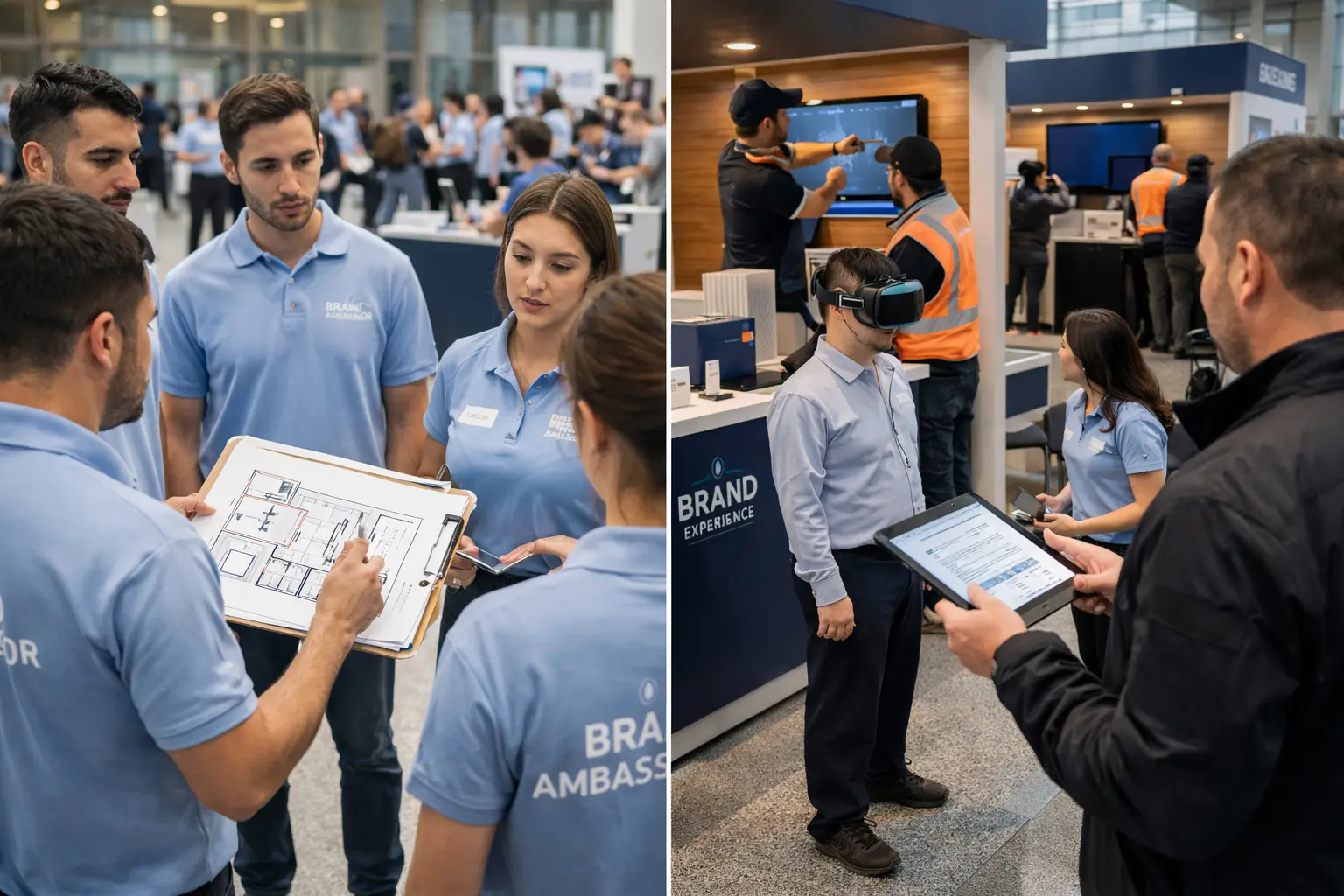
Traditional Event Planning vs Brand Activation Execution
Traditional event planning is built around schedules and logistics. Success is often measured by attendance, setup quality, and whether the event runs on time.
Brand activation event management is built around engagement and behaviour. Success is measured by how long people stay, how many participate, and whether they take action after the experience.
Key differences include:
- Focus on interaction rather than attendance
- Staffing trained for brand conversations, not only guest assistance
- Flow design to guide participation, not just movement
- Measurement based on engagement, not only footfall
Brand Activation Organizer Responsibilities: What Agencies Actually Handle
A professional brand activation agency manages multiple execution layers at the same time, often under changing conditions.
Core responsibilities include:
- Translating the creative concept into a physical, interactive experience
- Managing permits, compliance, and site readiness for public or semi public spaces
- Recruiting, training, and supervising brand ambassadors and team leads
- Designing guest flow to reduce bottlenecks and increase dwell time
- Handling on-site troubleshooting for staffing, technical, or logistics issues
- Tracking engagement data and post event performance metrics
When these elements work together, the activation delivers consistent brand experiences across all touchpoints. When they do not, even strong creative ideas fail to convert interest into meaningful engagement.
Key Insight
Brand activation organizers do more than plan events. They engineer experiences that guide human behaviour in live environments while protecting the brand at every touchpoint. This execution focus matters, as research shows that 77% of marketers rate events as their most effective channel, and 85% of consumers are more likely to purchase after attending a branded experience.
Services for Branded Event Activations: What Separates Strong Agencies from Basic Planners
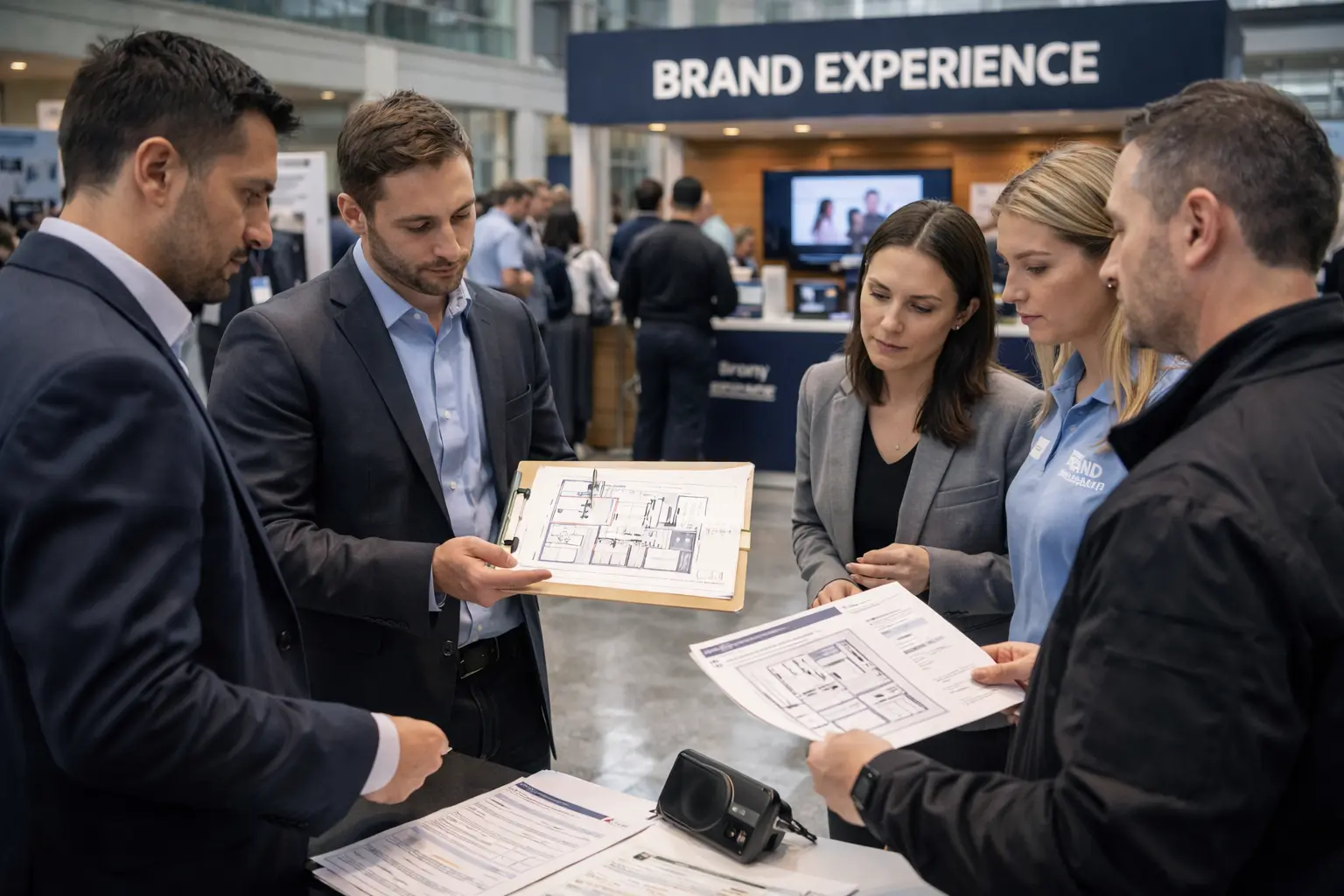
Not all agencies offering brand activation services deliver the same level of execution support. Some focus mainly on creative concepts and production, while others specialise in staffing, flow design, and on-site control. The best event organizer for brand activations provides integrated services that connect strategy, people, logistics, and measurement.
Understanding how professional staffing agencies deliver cost savings through operational efficiency reveals why training investments pay off immediately.
Strategy And Concept Support
Strong brand activation event management starts with aligning the activation to business goals, not just visual appeal.
This should include:
- Audience journey mapping from entry to exit
- Clear objectives such as awareness, product trial, lead capture, or UGC creation
- KPIs linked to engagement, not only impressions or footfall
Use case:
A consumer brand may prioritise sampling volume and social sharing, while a B2B brand may focus on longer dwell time and qualified leads. Strategy alignment ensures the experience supports the right outcome.
Event Production And Logistics
Execution quality depends on planning detail and site readiness.
This should include:
- Venue selection based on audience behaviour, not just traffic volume
- Permit handling and local compliance management
- Vendor coordination for fabrication, AV, power, and connectivity
- Detailed schedules, rehearsals, and contingency planning
Staffing And Training
Staffing is the main driver of engagement in experiential brand activations.
This should include:
- Trained brand ambassadors with product and messaging knowledge
- Product specialists where demonstrations or explanations are required
- Team leads and supervisors to manage performance on-site
- Briefings and refreshers to maintain message consistency
Well trained staff turn passive visitors into active participants. Poor staffing reduces interaction, even when the setup looks impressive.
On-Site Execution And Supervision
Live environments require constant coordination and fast decisions.
This should include:
- Set up and teardown management
- Crowd and flow control during peak periods
- Real time problem solving for staffing, technical, or vendor issues
- Quality checks to protect brand standards throughout the day
Measurement And Reporting
Without performance data, brand activations become brand theatre rather than measurable marketing. Event ROI typically ranges between 25% and 34%, and 59% of marketers believe experiential marketing delivers higher returns than traditional advertising. Tracking engagement and outcomes is what turns live experiences into accountable, high-impact campaigns.
This should include:
- Tracking interactions, dwell time, and participation rates
- Lead or data capture where relevant
- Post event insights with optimisation recommendations
If an agency cannot clearly explain how its brand activation services connect to engagement outcomes, it is likely delivering production without performance.
How To Choose The Best Event Organizer For Brand Activations
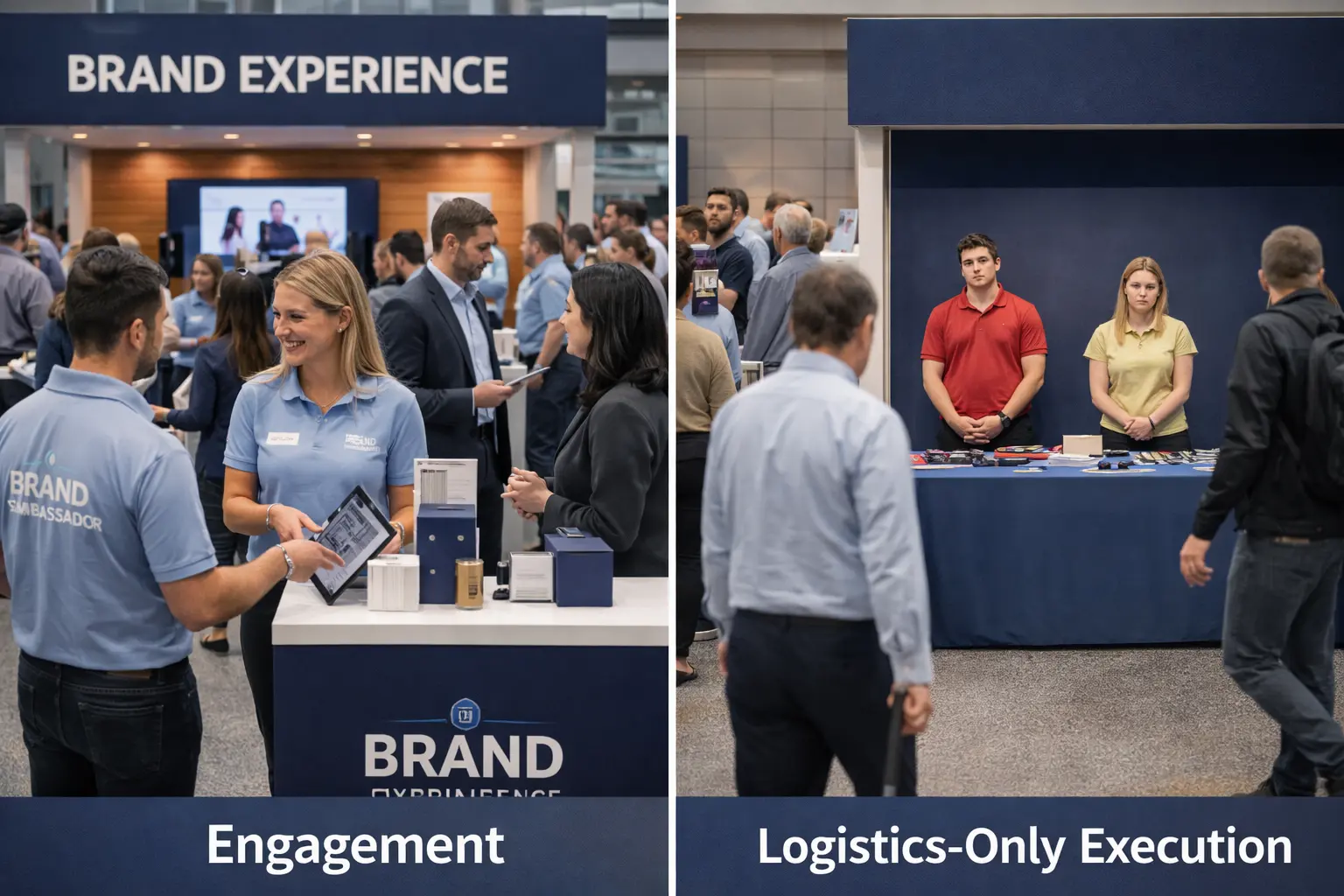
The best event organizer for brand activations is one that specializes in engagement-led execution, not just event logistics. When comparing agencies, prioritize partners who demonstrate strong staffing leadership, audience flow design, and real-time problem-solving experience in live environments.
A reliable brand activation partner should meet the following criteria:
- Proven experience in brand activation event management, not only corporate events
- Documented case studies showing engagement outcomes, not just creative concepts
- In-house or tightly managed brand ambassador teams with structured training
- Clear audience flow planning for peak and low traffic periods
- On-site supervisors with authority to make real-time decisions
- Defined engagement metrics such as interactions, dwell time, or lead quality
Many brands search for “tell me best event organizer for brand activations” and receive long agency lists. The real differentiator is not creative presentation, but operational control under live conditions. Strong organizers design for how people actually behave, not how campaigns look on paper.
Why This Matters
Many brands ask, “tell me best event organizer for brand activations” and receive long lists of agencies. The real difference is not who has the most creative deck, but who can consistently deliver engagement under live conditions. A great brand activation agency plans for human behaviour, not just ideal scenarios.
Example
An organizer who plans queue management, staff rotation, and crowd redirection will outperform one who assumes guests will naturally move through the experience as designed.
Quick Decision Tip
If an organizer cannot confidently walk you through what happens when:
- footfall spikes unexpectedly
- Staff do not show up
- The equipment fails mid-activation
- They are not the right partner for experiential brand activations.
Brand Activation Specialists Vs General Event Organizers
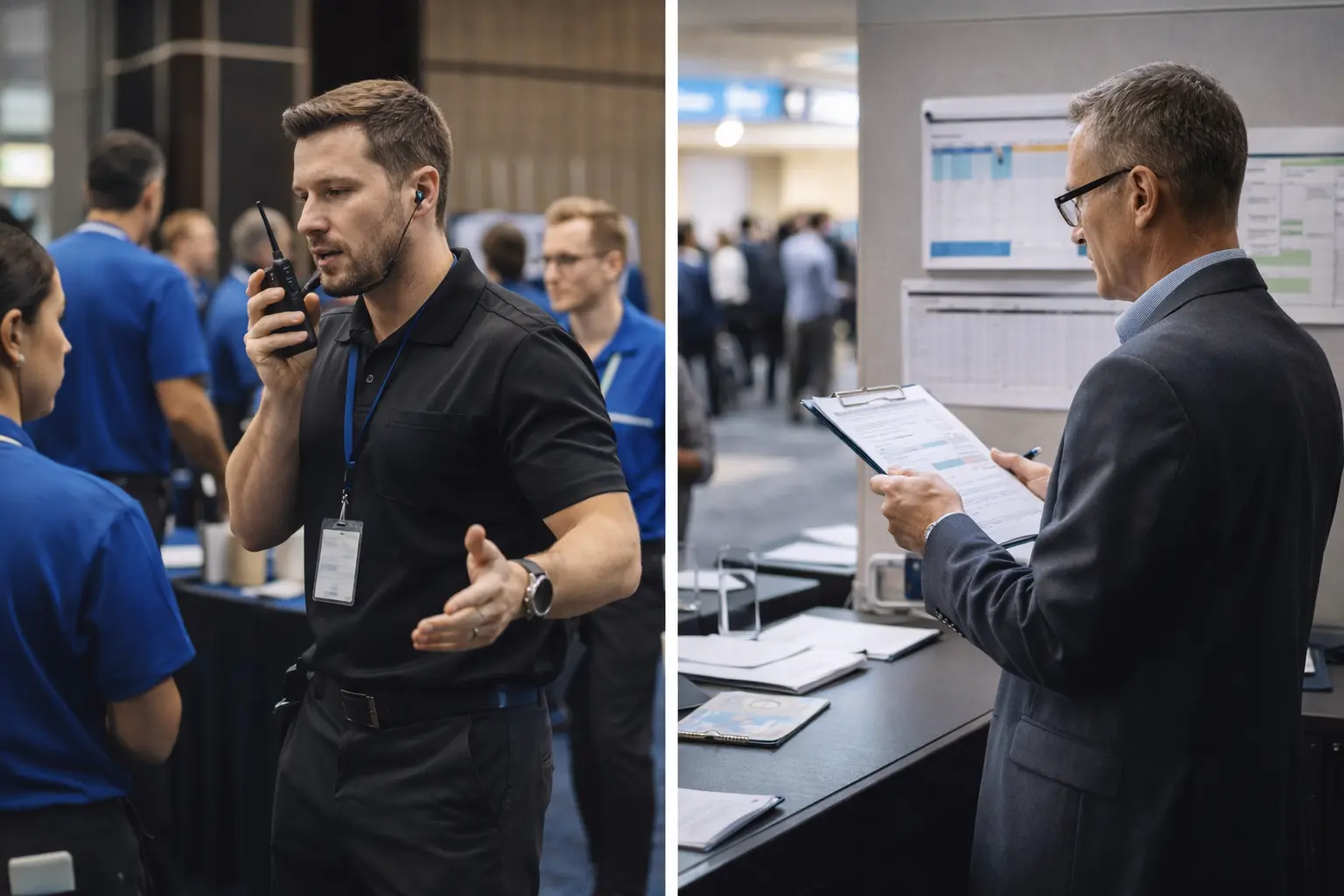
Not every event organizer is equipped to deliver experiential brand activations. While many agencies can manage timelines and vendor coordination, brand activation specialists are built for engagement design, staffing performance, and real time execution under changing conditions.
Brand activation event management involves unpredictable variables such as shifting footfall patterns, audience behaviour, weather, and technical dependencies. A specialist brand activation agency is structured to adapt quickly without compromising brand standards or safety.
Why Specialisation Matters
General event organizers often succeed in controlled environments such as conferences or formal corporate events. Brand activations operate in open, dynamic settings where interaction quality determines success.
Key differences include:
- Engagement and participation as primary goals, not just smooth operations
- Trained brand ambassadors and supervisors, not only basic event staff
- Audience flow design to maximise dwell time and reduce congestion
- Real time optimisation during slow periods or peak traffic
- Measurement based on interaction quality, not only attendance
Example Use Case
A mall based corporate event brand activation requires staff who can approach visitors confidently, supervisors who can reposition teams based on traffic, and rapid adjustments when queues build up. A general event organizer may deliver the setup perfectly but fail to drive interaction or manage crowd flow.
If an agency focuses more on décor, staging, and branding visuals than on people, flow, and engagement, it is unlikely to deliver strong experiential brand activations.
Questions To Ask An Event Organizer Before Hiring
Asking the right questions quickly reveals whether an agency truly understands brand activation event management or is simply offering general event planning with added branding. These questions help you evaluate execution depth, staffing capability, and on-site control before you commit.
Experience And Specialisation
- What percentage of your projects are experiential brand activations versus traditional events?
- Can you share case studies with engagement results, not only photos or concepts?
- Have you managed activations similar in size, location, or audience to ours?
- Do you have repeat clients for brand activation services in our industry?
Engagement And Flow Design
- How do you design for dwell time and interaction, not only footfall?
- What methods do you use to prevent bottlenecks during peak hours?
- How do you adjust the experience if engagement drops on-site?
- How do you test or rehearse guest flow before launch?
Staffing And On-Site Leadership
- Do you recruit and train your own brand ambassadors and team leads?
- What training do staff receive on product, messaging, and interaction style?
- Who supervises the team on-site and what authority do they have to act?
- What is your backup plan if staff cancel or underperform?
Execution And Risk Management
- How do you handle last minute layout, vendor, or technical changes?
- Who makes real time decisions if conditions change on event day?
- How do you manage safety, compliance, and permit requirements?
Measurement And Reporting
- What engagement metrics do you track during corporate event brand activation campaigns?
- What reporting will we receive after the activation?
- How do you use performance data to improve future activations?
Commercial Clarity
- What is included in your pricing and what is treated as an add-on?
- How are scope changes or cost overruns approved and documented?
Agencies that answer these questions clearly are more likely to deliver reliable services for branded event activations. Vague answers often signal limited operational control.
Corporate Event Brand Activation: What Changes At Enterprise Scale
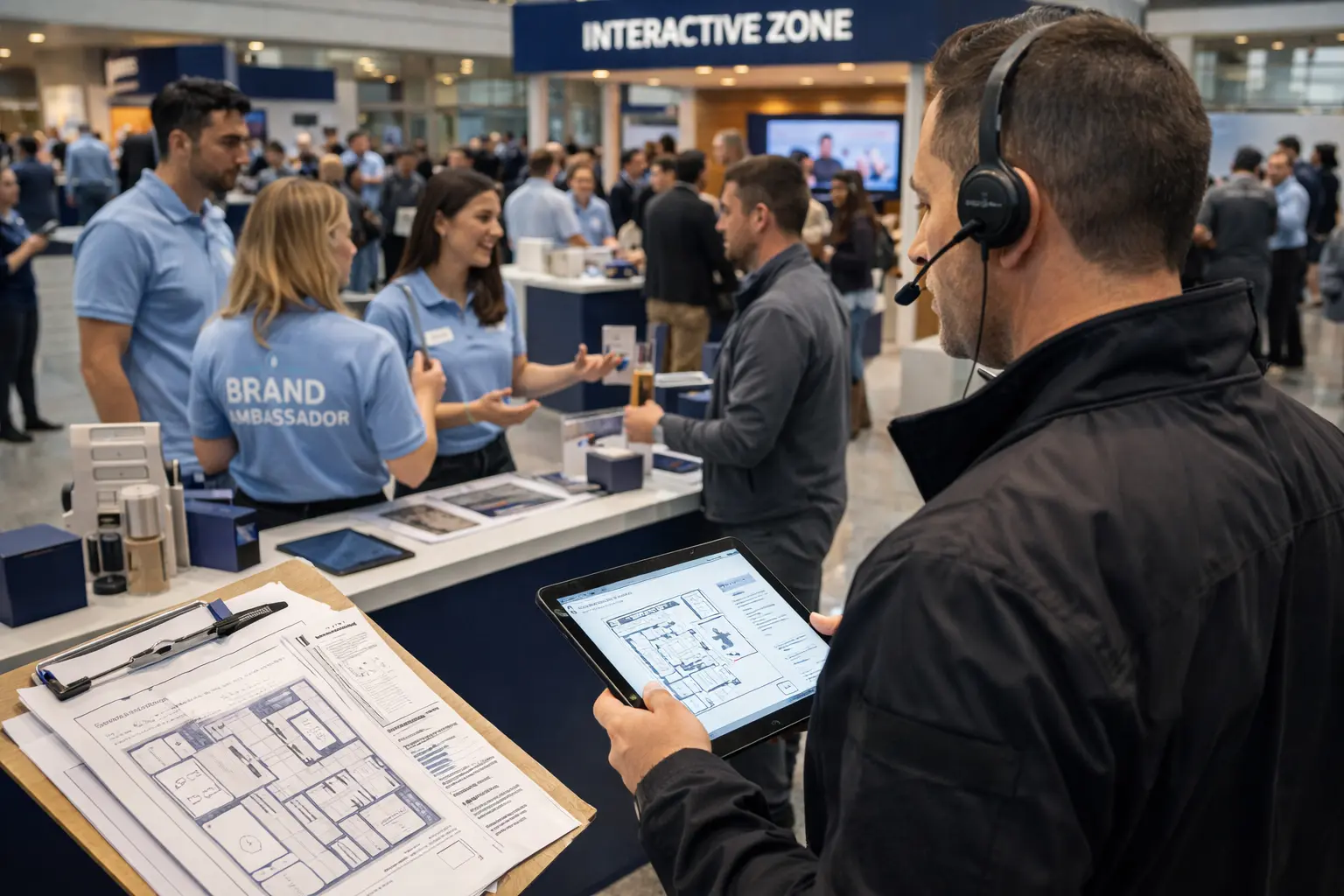
Corporate event brand activation involves higher visibility, stricter compliance, and greater operational risk than local or single day activations. As brand exposure increases, execution discipline becomes just as important as creative impact.
Enterprise campaigns often include multiple stakeholders, public audiences, and media presence. This means brand activation event management must follow structured processes that protect both brand reputation and legal compliance.
Why Enterprise Activations Carry Higher Risk
Large brands operate under tighter scrutiny and public expectations. Small execution gaps can escalate quickly and damage perception.
Common risk factors include:
- High social media exposure from attendees and media
- Legal and safety obligations in public or commercial spaces
- Procurement and compliance requirements from corporate teams
- Consistency expectations across multiple locations or dates
What Enterprise Level Organizers Must Deliver
To support corporate event brand activation programs, agencies must scale both people and processes.
Process And Documentation
- Standard operating procedures for setup, staffing, and safety
- Approval workflows for creative, messaging, and compliance
- Incident reporting and escalation protocols
Stakeholder Management
- Alignment between marketing, legal, procurement, venue, and staffing teams
- Clear communication channels that prevent last minute delays
Staffing At Volume
- Trained brand ambassadors deployed across locations or long schedules
- Local backup pools to prevent staffing gaps
- Experienced supervisors managing daily performance
Scalability And Replication
- Playbooks that ensure consistent execution across cities or venues
- Centralised training and briefing materials
Media And VIP Handling
- Staff trained on brand voice, privacy, and escalation procedures
- Clear protocols for press or senior leadership interactions
Example Use Case
A multi city product roadshow requires consistent staff training, local permit compliance, centralised reporting, and on-ground supervisors who can adjust layouts or staffing without affecting brand experience. Without strong operational systems, performance varies by location and results become unreliable.
For enterprise brands, a reliable brand activation agency behaves like an operations partner, not just a campaign vendor.
Common Mistakes Brands Make When Choosing An Organizer
Even experienced marketing teams can make avoidable mistakes when selecting an event organizer for brand activations. These errors often lead to low engagement, operational issues, or poor ROI, even when the creative idea is strong.
Choosing Based On Visuals Alone
Strong renderings and attractive decks do not guarantee effective execution or engagement.
Why this fails:
- Visuals do not reflect staffing quality or flow design
- Production success does not equal audience participation
What to do instead:
- Review case studies with engagement metrics and outcomes
- Ask how interaction was driven, not just how the space looked
Underestimating Staffing Impact
Brand ambassadors and team leads are the primary drivers of interaction in experiential brand activations.
Why this fails:
- Untrained staff struggle to start conversations or explain products
- Low energy reduces dwell time and participation
What to do instead:
- Ask for training plans, supervision structure, and staff profiles
- Confirm backup staffing and performance monitoring processes
Unclear On-Site Ownership
When decision making is slow or unclear, small problems grow quickly.
Why this fails:
- Vendors wait for approvals
- Staff lack direction during peak periods
What to do instead:
- Confirm who has authority on-site to adjust layouts, staffing, or flow
No Contingency Or Escalation Planning
Live environments always involve uncertainty.
Why this fails:
- Staff cancellations or equipment issues stop engagement
- Delays damage brand perception
What to do instead:
- Ask about spare equipment, backup staff, and emergency workflows
Measuring Attendance Instead Of Engagement
Footfall does not reflect activation performance.
Why this fails:
- High traffic does not guarantee meaningful interaction
- ROI cannot be justified to stakeholders
What to do instead:
- Define engagement metrics and reporting before the event
Overlooking Permits And Compliance
Public and semi public spaces require legal approvals and safety planning.
Why this fails:
- Activations risk shutdowns or fines
- Brand reputation may suffer
What to do instead:
- Ensure the agency manages all permits and compliance documentation
Avoiding these mistakes improves the chance of selecting an organizer who can deliver reliable services for branded event activations and protect brand performance on-site.
What A Great Brand Activation Organizer Delivers Onsite
The difference between a good brand activation and a great one often comes down to execution. On-site performance determines whether an activation drives engagement, creates memorable experiences, and reflects positively on your brand.
Key Onsite Deliverables
- Clear Briefing
Staff, team leads, and vendors should fully understand objectives, roles, and messaging before the activation begins. Miscommunication leads to inconsistent experiences.
- Confident, Trained Staff
Brand ambassadors and product specialists should engage attendees naturally, answer questions accurately, and guide interactions seamlessly.
- Visible Leadership
On-site supervisors and team leads ensure smooth coordination, make quick decisions, and handle any unexpected challenges efficiently.
- Smooth Flow Management
A well-designed activation anticipates crowd movement, prevents bottlenecks, and keeps visitors engaged from entry to exit.
- Fast Issue Resolution
Equipment failures, staffing gaps, or vendor delays are inevitable. A competent organizer resolves problems instantly without disrupting the experience.
- Consistent Brand Voice
Every interaction from signage to ambassador conversations reinforces the brand message and identity.
Example Use Case
At a tech product launch, attendees flowed through demo zones guided by trained ambassadors. Supervisors monitored queues in real time and redirected guests to prevent congestion. Any technical issue with demo stations was fixed within minutes, leaving visitors with a seamless and memorable experience.
Key Insight
A great organizer makes their work invisible to the audience. Attendees leave engaged and impressed, never noticing the complex logistics and problem-solving that made the activation successful.
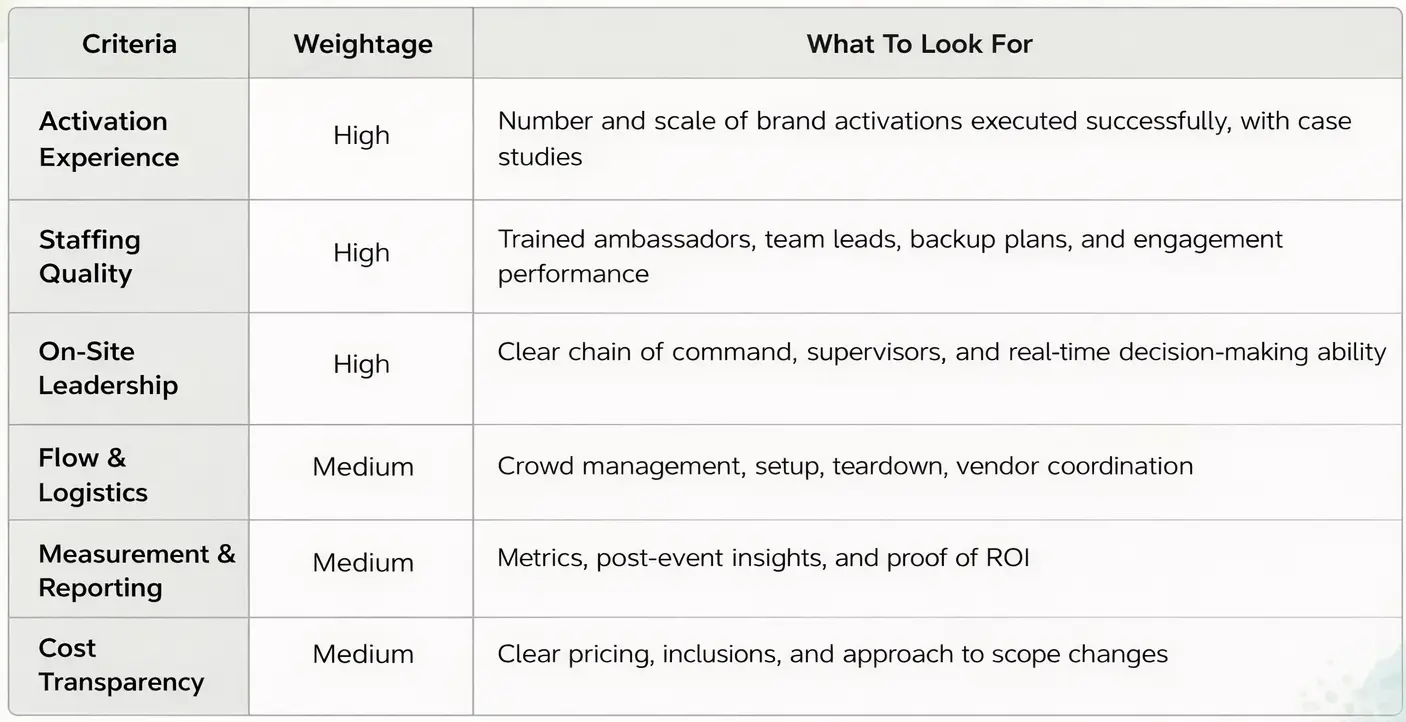
How To Compare Event Organizers (Simple Scoring Framework)
Choosing the right organizer becomes easier when you have a structured scoring system. This allows you to objectively evaluate multiple agencies based on the factors that truly impact brand activation success.
Closing Guidance on Services for Branded Event Activations
Strong brand activations succeed because execution is engineered, not improvised. The right partner plans for peak traffic, staffing rotations, compliance checks, and technical contingencies long before the first guest arrives. They supervise teams on-site, protect brand standards, and capture meaningful engagement data that proves campaign value. This is what professional services for branded event activations should deliver. Not just production and visuals, but operational leadership, trained staff, and measurable outcomes that support future marketing decisions. If you are planning an activation that involves public audiences, multiple days, or high brand visibility, prioritise partners who can demonstrate staffing depth, compliance readiness, and real-time execution control.When you are ready to evaluate options, you can request a detailed proposal or quote to assess how an agency structures staffing, supervision, and reporting, not just creative concepts.
Ready to elevate your next event?
Join thousands of event planners who trust EventStaff.com for reliable, professional staffing solutions.
Trusted by event professionals nationwide
1k+
Events Staffed
2 million+
Guests Served
97%
Positive reviews