

Street team marketing works when it feels like a real brand moment, executed consistently across neighborhoods, time blocks, and audience types. It fails when it gets treated like “hand out flyers and hope,” with no training standards, no operational control, and no measurement plan that leadership trusts. If you want street teams to drive pipeline, trial, sign-ups, foot traffic, or repeat purchase, you need a partner who can hire for the role, deploy with discipline, and report like it matters.
At Event Staff, street teams are built for outcomes: structured outreach, clean brand representation, and measurable performance across every shift. This guide explains what to look for when you hire, how strong activations are planned, and how serious teams measure impact without inflating the story.
CEO Excerpt
"Most brands do not lose with street teams because the idea is weak. They lose because the execution is unmanaged. A street team activation is a field operation: people, talk tracks, locations, timing, and proof. When those parts are not controlled, the result looks busy and still underperforms. Event Staff teams are designed to deliver consistency under pressure. That means hiring people who can approach strangers professionally, training them to qualify intent in seconds, and managing shifts so the message stays tight from the first interaction to the last. Measurement matters too. If you cannot explain what the activation produced, you cannot scale it confidently." - CEO, Event Staff
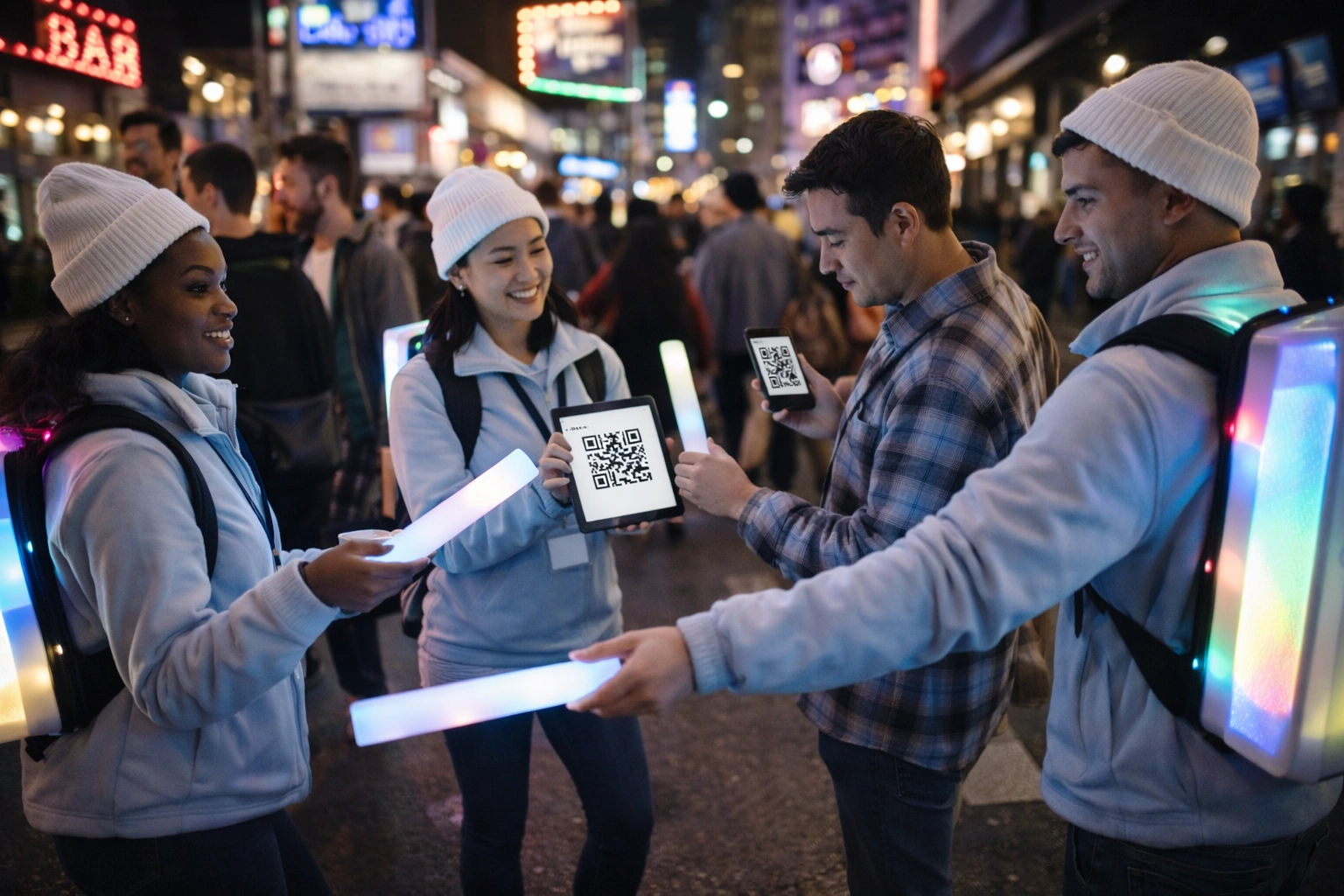
Why street team marketing is growing again
Budget is flowing back into live and experiential channels because brands are chasing something digital alone struggles to deliver: high-trust attention. PQ Media’s Global Experiential Marketing Forecast projects the global experiential marketing market at $128.35B in 2024, growing to $199.12B by 2028.
That macro trend matters for street team marketing because street teams are often the most scalable “micro-experience” you can deploy. You can place a brand in the path of the right audience, with a human who can tailor the message in real time, and you can do it without waiting for a major event to come around.
Consumer behavior supports it too. The EventTrack 2026 research highlights that experiences drive repeat purchase and content creation, which is the compounding effect most teams want but rarely operationalize.
What strong street team marketing looks like in practice
In a high-performing street team activation, the “street” is just the channel. The real work is role clarity and execution discipline. Street teams succeed when they can do three things at the same time:
- Create fast trust while staying on-message. They need to open conversations naturally, handle quick objections, and avoid drifting into off-brand claims. That requires training, not just energy.
- Move interactions toward a next step. Depending on your goals, that step might be a sample trial, a QR scan, an email/SMS opt-in, a store visit, or a booked demo. The team needs a defined conversion path that fits the setting.
- Generate data you can defend internally. Leadership does not want stories. They want numbers that connect to business impact, plus enough context to decide what to scale next.
The buyer-side takeaway: you are not hiring “people to promote.” You are hiring a partner to run a controlled field program with repeatable outcomes.
Hiring street teams: what you should demand from your partner
Hiring is not only about filling slots. It is about getting the right interpersonal profile for the environment you are deploying into, then holding a quality bar across every shift. The partner you choose should be able to explain, clearly, how they staff for specific activation conditions.
A street team hiring process should include:
- Role-specific casting, not generic staffing. A sampling-heavy activation needs confident, high-volume openers who can keep pace and still represent the product correctly. A lead-capture activation needs calm communicators who can qualify intent and ask for information without making it awkward.
- Training that reflects your conversion goal. If the objective is opt-ins, the team needs consent-forward language and a consistent “why” for the customer. If the objective is retail lift, they need location fluency and a credible reason to visit now.
- On-site supervision that protects consistency. You are not only managing attendance. You are managing message accuracy, positioning, line flow when crowds form, and real-time adjustments when a location underperforms.
If you want this to scale, insist that the vendor’s hiring plan connects directly to your activation objective, and that you meet the supervisor who will actually run the field.
Planning a street team activation that scales
Good planning reduces variance. Most street activations fail because the team has too much freedom and not enough structure. Planning should lock in where the team will be, what they will say, what they will hand out, and how they will prove performance.
Strong street team marketing planning usually includes:
- Audience and location logic you can defend. A partner should not pick locations because they are “busy.” They should pick them because the foot traffic matches your target profile, and because the moment is right for your offer. A commuter corridor requires a different approach than a nightlife district, even if both are crowded.
- A shift design that matches attention patterns. Time blocks matter. Lunch-hour outreach behaves differently than early evening. Your plan should treat timing as a variable, then structure staffing and messaging to match.
- Asset control and replenishment. If you are sampling, you need inventory discipline and pacing rules. If you are distributing collateral, you need version control so the team does not mix outdated materials with current ones.
- A talk track built for the environment. Your script should include an opener, a one-sentence value line, two proof points, and a conversion ask. It should also include what not to say, which is a brand safety issue.
This planning layer is where your vendor proves they understand field realities. The best street teams are prepared to handle weather shifts, competing noise, security constraints, and sudden crowd density without losing the brand thread.
Measurement: prove impact without inflating the story
Measurement is the difference between a one-off activation and a program. If you cannot prove what the street team produced, the best outcome you get is “it seemed busy.” That does not earn repeat budget.
There is a reason measurement is a universal pain point across live channels. Bizzabo’s 2025 benchmarking report notes 70% of surveyed organizers reported difficulty demonstrating ROI for in-person B2B conferences. That same report shows investment appetite remains strong, with 53% expecting budgets to grow and 66% planning to hold more events in 2025 (same source).
Street team marketing has the same measurement challenge and the same opportunity: if you build the measurement strategy into the activation design, you can defend the spend and scale confidently.
A credible measurement stack for street teams includes:
- Operational metrics that show execution quality. Interactions per hour per rep, conversion to next-step rate, time-to-engagement, and location performance by time block. These tell you whether the team performed, not just whether the neighborhood was busy.
- Conversion signals tied to digital behavior. QR scans, short-link visits, opt-ins, and offer redemptions. Outdoor research supports the idea that people do take action when the mechanism is simple; for example, an OAAA/Harris Poll release notes action-taking behaviors and includes QR-related response behavior .
- Context for attribution. You want to separate “we were present” from “we drove lift.” That means capturing time, location, and volume context so your marketing analytics team can compare against baselines.
- A human layer of insight. Short intercept questions, repeated objections, message resonance by audience type, and qualitative patterns. This is where street teams outperform static media, because they can report what the audience actually said.
Smartphone behavior makes this measurably easier than it used to be. Pew reports that 91% of U.S. adults own a smartphone . When the next step is mobile-native, street teams can convert interest into trackable action quickly.

How Event Staff structures street team marketing for repeatability
Repeatability comes from operational standards. A high-performing street team program is built like a system, not a one-day hustle. The core components should be visible in the deliverables you receive.
1) The staffing plan is built around behavior, not headcount.
We map what the team needs to do per hour, then staff to hit that behavior at a sustainable pace. That includes who opens conversations, who handles deeper questions, who manages replenishment, and who runs data capture quality control.
2) Training is designed to protect message accuracy under real conditions.
Training includes talk track practice, objection handling, product truth standards, and the exact conversion ask. It also includes what happens when crowds surge, when someone challenges the offer, or when the environment becomes noisy and fast.
3) Field supervision is treated as performance management.
Supervisors coach in real time, validate that the team is executing the script correctly, adjust positioning when a location underperforms, and protect data cleanliness so reporting is credible.
4) Reporting is built to support decisions.
Clients do not need a “nice recap.” They need to know which locations and time blocks performed, what messaging worked, what the audience actually asked, and what to change before the next run.
If you want the program to grow, those standards are the difference between “a fun activation” and a field channel you can invest in confidently.

Common failure points and how strong street teams prevent them
Street team activations tend to break in predictable ways. Knowing them helps you evaluate vendors and avoid expensive resets.
- Message drift across shifts. Without tight training and supervision, the pitch changes rep to rep, and your brand story becomes inconsistent. Strong programs solve this with a locked talk track, field coaching, and quick pre-shift refreshers.
- Data that cannot be trusted. Opt-ins get messy when reps rush, skip required fields, or fail to explain consent. Strong programs treat data capture as a skill and include QA rules, not just a form.
- Location choices based on “busy” instead of “right.” High foot traffic does not equal high intent. Strong programs tie locations to audience intent and offer fit, then test and iterate based on performance.
- Activation fatigue. If your offer and approach never change, the program stops surprising people. Strong programs build variation into messaging and execution while keeping brand standards intact.
These are operational problems, not marketing theory problems. The partner you hire should be able to explain exactly how they prevent each one.
What you should receive from your street team partner
If you want street team marketing to be a repeatable channel, the output cannot be vague. You should expect a defined set of deliverables that make the program measurable and scalable.
- Activation Plan. A documented objective, audience assumptions, location strategy, shift blocks, and what success looks like. It should also list constraints and how the team will adapt in the field.
- Staffing Blueprint. The role mix, supervisor coverage, and what each role is responsible for during the shift. It should explain how staffing supports your conversion goal, not just how many people will show up.
- Training Pack and Talk Track. Scripts, product truth standards, objection handling, and the exact ask. It should include QA rules so the message stays consistent under real crowd conditions.
- Measurement and Reporting Framework. What gets tracked, how it gets tracked, and how insights will be delivered. It should include both operational metrics and conversion signals you can connect to broader marketing reporting.
When these pieces are in place, street team marketing stops being “street.” It becomes a controlled acquisition and awareness channel you can scale.
Final Words
Street team marketing can be one of the most efficient ways to create high-trust attention and move people into a measurable next step. The channel is not the differentiator. Execution is. When hiring, planning, and measurement are treated as a system, street teams become repeatable, scalable, and defensible in front of leadership.
If you want Event Staff to design and run a street team activation built around hiring quality, controlled delivery, and clean reporting, start with our Street Teams service page and we’ll scope an activation plan aligned to the outcome your team is accountable for.
Ready to elevate your next event?
Join thousands of event planners who trust EventStaff.com for reliable, professional staffing solutions.
Trusted by event professionals nationwide
1k+
Events Staffed
2 million+
Guests Served
97%
Positive reviews