
What Types of Conventions Need Event Staff?
Executive Summary
Not every convention needs the same convention event staff. A conference might lean heavily on registration and session support, while a trade show demands floor managers and booth staff. A summit prioritizes VIP hospitality, and a consumer show requires extensive brand ambassador teams. Understanding which type of convention you're running is the first step to figuring out what convention staffing looks like for your specific event. This guide breaks down how staffing requirements change based on event format, attendance size, and attendee behavior, helping you build a team that actually works for your situation.
Why Different Types of Conventions Need Different Event Staff
Here's the thing: a lot of event planners assume bigger events just need more bodies. That's only half the story. The real driver of staffing needs isn't just how many people show up; it's what those people are doing when they get there.
A trade show with 5,000 attendees looks totally different operationally than a conference with 5,000 attendees. At a trade show, people are bouncing between booths, gathering product information, and connecting with exhibitors. That requires booth staff, lead capture teams, and floor managers who understand the exhibitor experience. At a conference with the same headcount, attendees are moving between breakout sessions and networking areas. You need registration staff, session monitors, and speaker support instead.
The biggest difference comes down to attendee behavior. The type of convention event staff you hire depends on what your audience actually does during the event. Are they hunting for products? Learning from speakers? Networking over cocktails? Building relationships with executives? Each scenario demands a completely different staffing strategy.
That's why convention staffing isn't one-size-fits-all. The four main convention types, trade shows, conferences, summits, and consumer shows, each have their own staffing personality. Get the format right, and your team supports the experience. Get it wrong, and you end up with bodies in the wrong places.
The Four Convention Types and What They Actually Are
Before you can figure out staffing, you need to know what you're actually running. Let me break down the four main types of conventions you'll encounter:
- Trade Shows (also called "trade shows and exhibitions" in professional contexts) are where companies showcase products and services to industry professionals. Think CES or a specialized manufacturing expo. The whole point is exhibitor-to-attendee interaction, lead generation, product discovery, and competitor research. These are professional, business-focused events, and attendees come with a clear agenda: find vendors, evaluate solutions, and make connections.
- Conferences center on education and content. You've got keynote speakers, breakout sessions, workshops, and networking events. Attendees are there to learn, hear from experts, and connect with peers around shared interests. A marketing conference, tech summit, or industry conference fits here. The schedule drives the experience; people move between sessions, and timing matters hugely.
- Summits are smaller, more executive-focused events. You're talking to decision-makers, C-level attendees, and VIP guests. The atmosphere is more intimate, and the emphasis shifts from volume to the quality of the experience. Think invitation-only leadership summit or high-level industry roundtable. Fewer people, higher expectations for hospitality and service.
- Consumer Shows and public expos open the doors to everyone. These are conventions, such as large gatherings of people with shared interests. These are open to the public and heavy on entertainment, product discovery, and brand engagement. Home improvement expos, auto shows, and food festivals are where families wander around, try samples, watch demonstrations, and get inspired. The energy is totally different because the crowd is the general public, not industry professionals.
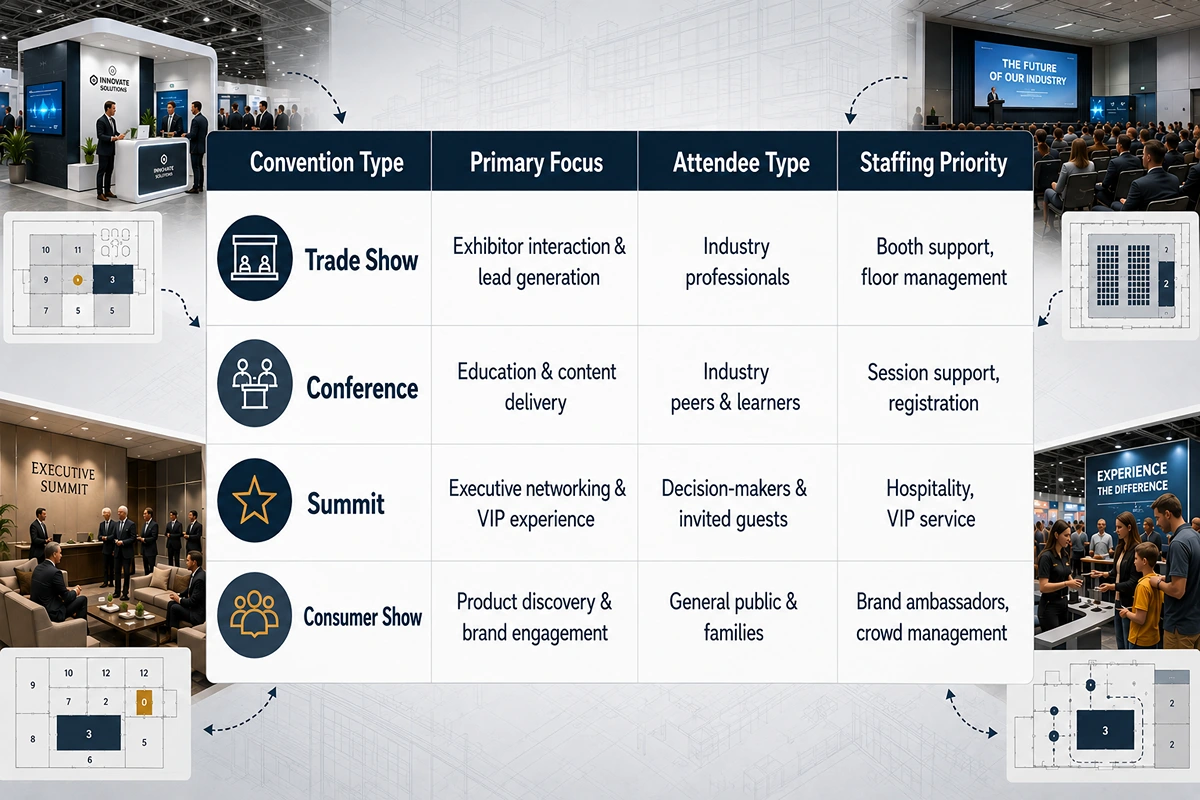
Each one needs a different convention event staff approach. The International Association of Exhibitions and Events has long recognized these distinctions as foundational to event operations planning.
CEO Excerpt
Different types of conventions create fundamentally different operational requirements. Trade shows demand exhibitor-focused support; conferences require session management; summits prioritize VIP hospitality; consumer shows need engagement-driven staff. - Daniel Muersing
Trade Shows Need Booth Support, Registration, and Floor Staff
Let's start with trade shows because they're probably the most complex from a staffing perspective.
At a trade show, exhibitors have paid good money to be there. Their success directly impacts your event's reputation, so your staff needs to make sure exhibitors can actually do their jobs. That means you need:
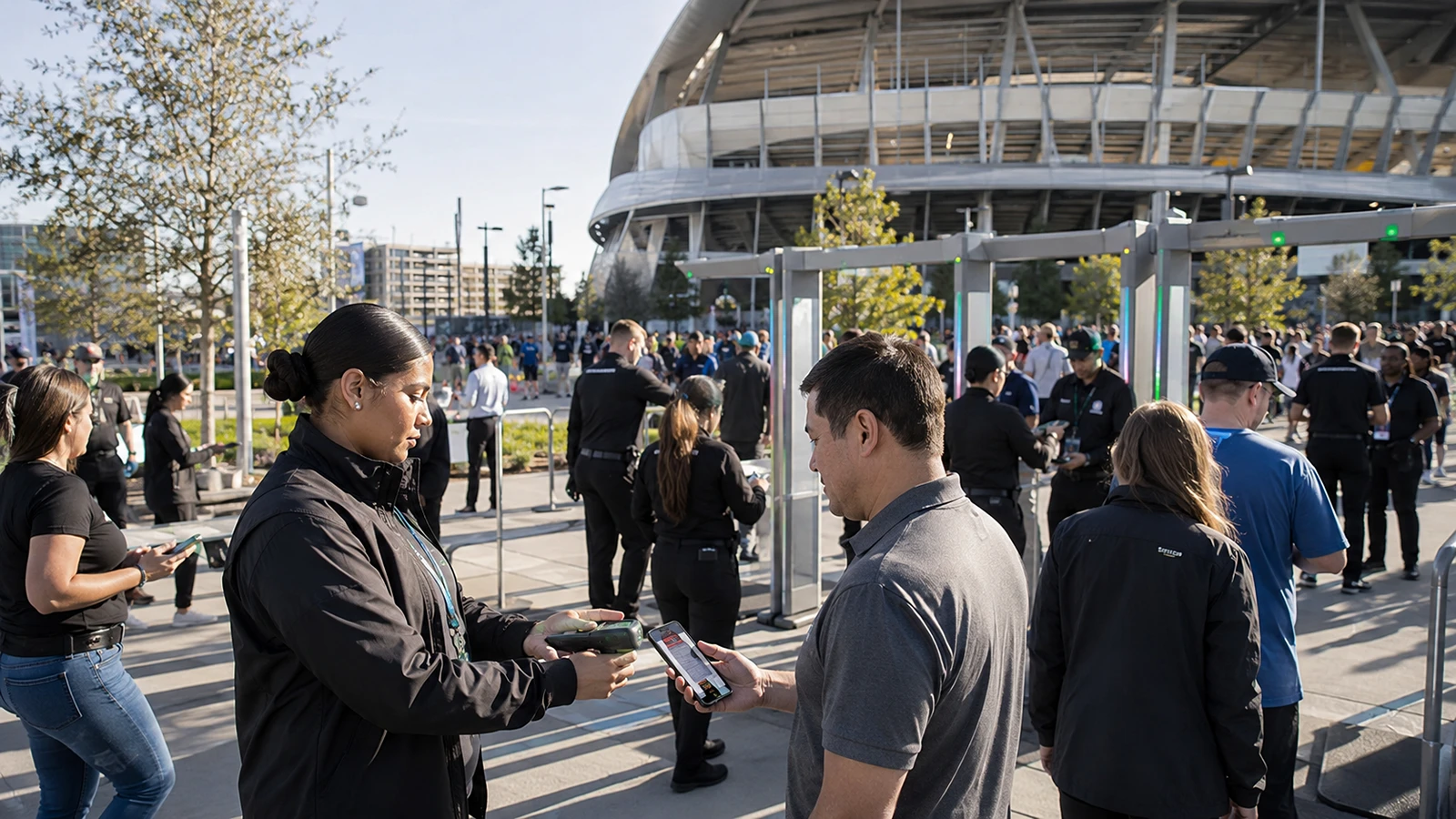
- Registration and check-in staff who can process attendees quickly without creating a bottleneck at the entrance. People hate waiting, and a sluggish registration line sets a bad tone immediately.
- Booth support staff who help exhibitors with setup, troubleshooting, and day-of logistics. These aren't just bodies; they need to understand the exhibitor experience and know how to solve problems on the fly.
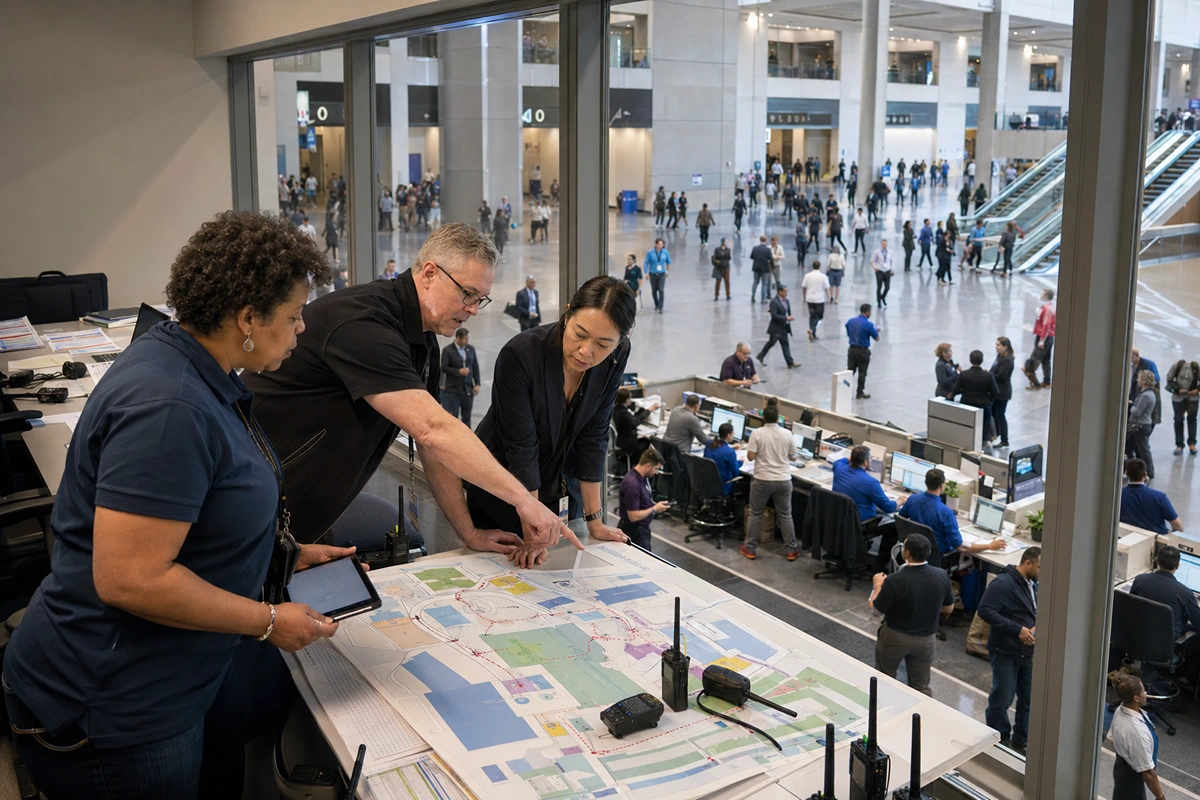
- Floor managers roam the space, answer questions, handle issues, and keep the event flowing. They're the eyes and ears on the ground. When an exhibitor has a problem or an attendee is lost, the floor manager fixes it.
- Lead capture or registration teams that help attendees scan badges or collect information. At bigger trade shows, this might be a separate role.
- Brand ambassadors or product demonstrators, if your exhibitors need extra support showcasing products or conducting live demos. Many planners find that starting as brand ambassadors at major expos requires dedicated training on product knowledge and engagement.
Trade shows are exhausting for staff because everyone's constantly moving, problems pop up everywhere, and the energy never really stops. The staffing complexity doesn't always match the attendance size. A well-organized 3,000-person trade show might actually need fewer staff than a chaotic 1,500-person show with complicated exhibitor needs. That's why understanding the anatomy of high-performing booth staffing can make or break your event's success.
Conferences Require Session Support and Attendee Management
Conferences flip the script. Instead of roaming attendees moving between booths, you've got people flowing between defined sessions. Everything revolves around the schedule.
Convention staffing for conferences typically includes:
- Registration and guest services teams that get people checked in and oriented. Conferences often have attendee bags, lanyards, materials, and schedules to hand out. It's more structured than a trade show, but it still requires organized, detail-oriented staff.
- Session monitors or room staff who sit outside breakout rooms manage capacity, hand out materials, and sometimes track attendance. This staff needs to be present and professional because they're literally at the entrance to the content. The specifics of conference staffing mix with registration, ushers, and monitors matter significantly to session flow.
- Speaker support staff who handle speaker logistics, AV coordination, session timing, and speaker comfort. A speaker arriving 10 minutes before their session and needing help finding the green room isn't uncommon. Your staff smooths those moments.
- Wayfinding and guest services staff who point people to sessions, help with directions, and answer general questions. Larger conferences can have confusing layouts, and attendees get lost easily.
The beauty of a conference event's staff is that it's more predictable than a trade show. Sessions happen on a schedule. You know roughly when sessions are changing. You can plan staff breaks around the flow. But the tradeoff is that everything has to be timed precisely. Miss the setup window for a breakout session, and attendees show up to a chaotic room.
Summits Require VIP and Executive-Focused Staffing
Summits are a totally different animal. You're working with a smaller headcount, maybe 200 to 500 people, but expectations are way higher. These attendees are executives and decision-makers who notice everything: temperature, noise levels, and how smoothly things run.
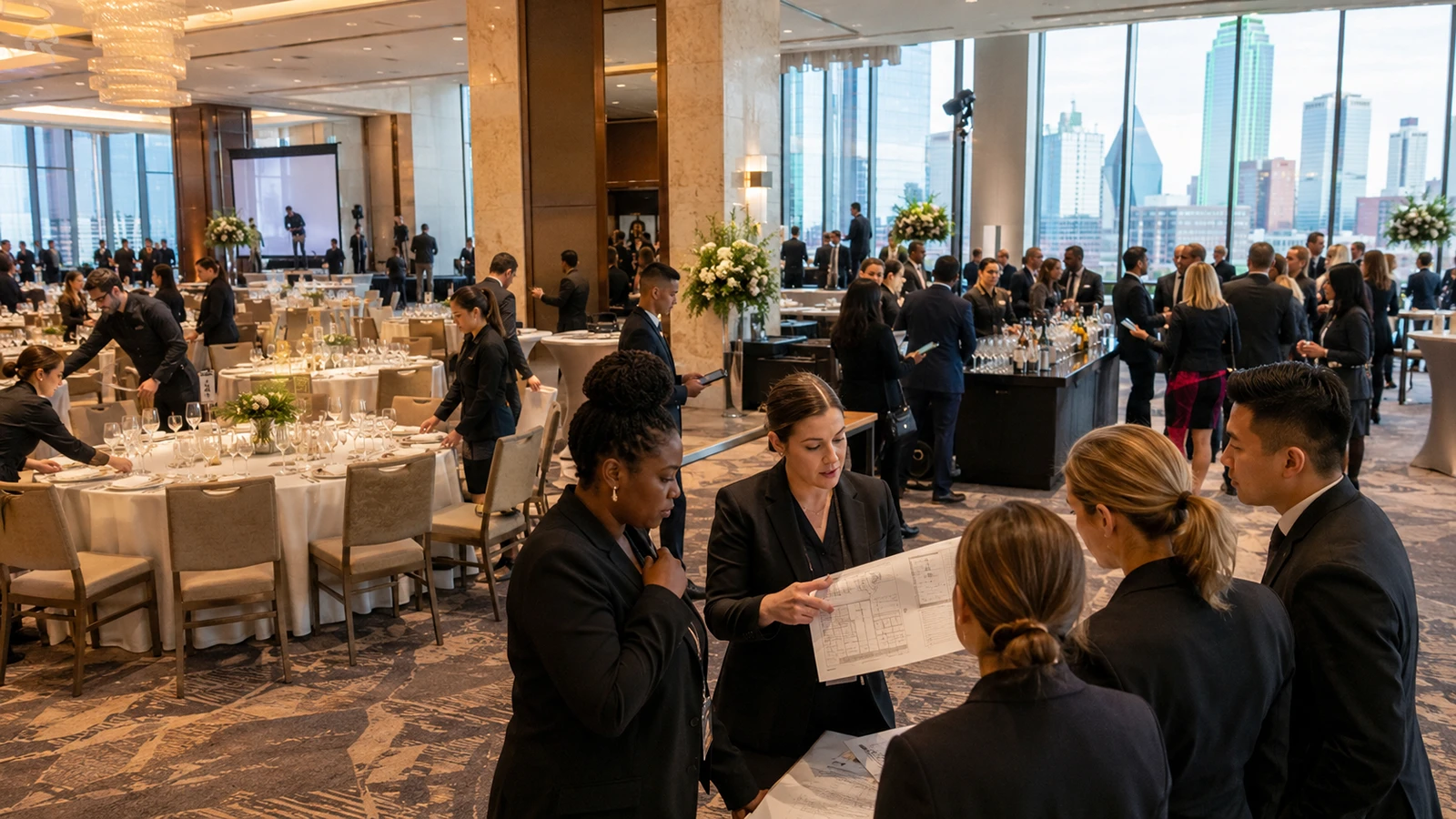
Your staff can't just be warm bodies; they need to be polished, attentive, and genuinely hospitable. Understanding VIP event staffing for sponsor lounges can elevate the entire executive experience.
You'll typically need:
VIP hosts or concierge staff who greet attendees, anticipate needs before they're asked, and create a high-end hotel experience. Registration staff are trained to make first impressions count. Registration here is a welcome ritual, not a transaction. Hospitality staff manage beverage service, food stations, and comfort (a cold coffee is noticed and remembered). Session facilitators, if your summit includes roundtables. Access control staff if attendance is by invitation only.
The staffing budget for summits per attendee is usually higher than that for trade shows or conferences, even if the total headcount is smaller. You're paying for skill, attentiveness, and polish.
Consumer Shows and Expos Require the Most Attendee-Facing Staff
Consumer shows are the wild card. The general public includes families, hobbyists, casual browsers, and serious buyers. You've got kids running around, people asking dozens of questions, and a constant need for engagement.
These events require the most consumer show staffing because attendees want interaction, not just information. They want to touch products, watch demonstrations, talk to people, and feel the energy.
You'll typically need:
- Brand ambassadors and product demonstrators who can explain products, run live demos, and make the experience exciting. These aren't just smart people they need personality and energy.
- Crowd management and guest services staff who keep lines flowing, answer general questions, and help attendees navigate the space.
- Registration and entry staff who welcome people, hand out maps or programs, and set the tone for the experience.
- Sampling or giveaway teams if brands are distributing products. Someone has to manage the line and hand things out.
- Set up and support staff who keep the space looking good throughout the day. Consumer shows are high-traffic, and things get messy fast.
Consumers show a need for more bodies overall because you're supporting a much more interactive experience. The attendee-to-staff ratio is usually higher. A 5,000-person consumer show staffing plan might need 50+ staff. A 5,000-person trade show might need 30.
How Convention Size Changes Staffing Needs and Budgets
Okay, attendance size matters, but probably not the way you think.
A small 300-person summit might need just 8–10 staff. A medium 1,000-person conference might need 15–20. A large 5,000-person trade show could need 40–60, depending on complexity.
But here's where it gets interesting: a 500-person consumer show might actually need more staff than a 500-person trade show because consumer show attendees want more interaction and engagement. The type of convention changes the math.
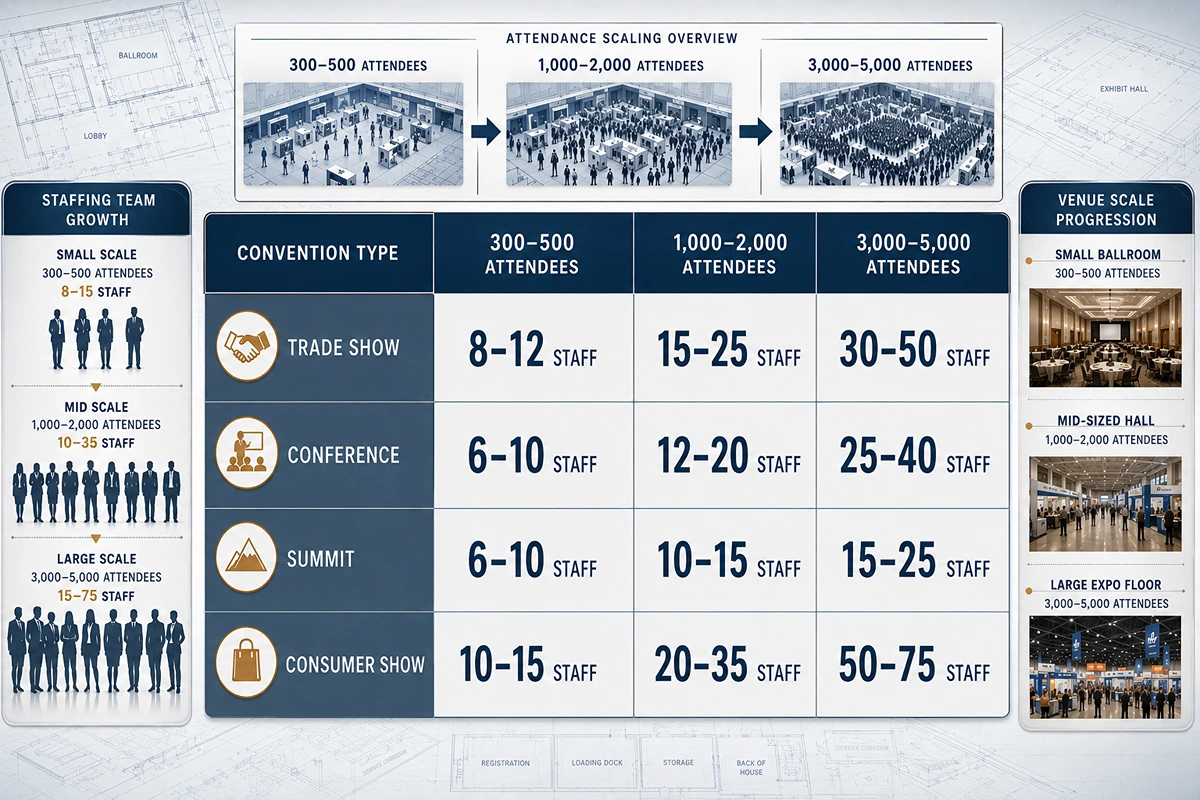
These aren't hard rules. A chaotic, poorly-planned 1,000-person trade show might need as many staff as a smooth 3,000-person conference. Complexity, venue layout, and exhibitor/attendee density all affect the numbers.
The staffing budget gets heavier as attendance grows, but the per-person cost often drops. When you're calculating average costs to hire event staff for conventions, economies of scale become obvious. A 300-person summit might spend $3,000–5,000 on convention staffing. A 3,000-person summit might spend $20,000–35,0 00, but that's $7–12 per attendee instead of $10–17.
Choosing the Right Event Staff for Your Convention
Here's the practical question: how do you actually figure out what convention event staff you need?
Start by asking yourself three things:
- First, what's the primary goal of your event? Are attendees there to find vendors (trade show), learn something (conference), network with peers (summit), or discover new products (consumer show)? That one answer drives your entire staffing strategy.
- Second, what's the attendee experience you're trying to create? High-touch hospitality? Efficient logistics? Exciting engagement? That determines the skill level and personality you need in your staff.
- Third, how complex are your venue and logistics? A sprawling convention center needs more floor managers than a compact hotel ballroom. Multiple breakout rooms need more session support. The physical space shapes your staffing blueprint.
From there, you can build an event staffing plan that actually fits your convention. Don't just hire a number. Hire for roles. Hire for the experience. Hire for your specific event staff needs based on your specific event type.
Understanding which event staff roles you actually need is foundational to making the right hiring decision.
The Real Convention Staffing Strategy Starts with Understanding Your Event Type
Here's what we've covered: not every convention event staff strategy looks the same. A trade show needs exhibitor-focused floor support. A conference needs session and speaker coordination. A summit needs VIP hospitality. A consumer show needs engagement and brand ambassadors.
Ready to staff your convention the right way?
We handle convention event staffing for trade shows, conferences, summits, and consumer shows across the country. Whether you need floor managers, booth support, registration teams, or VIP hospitality staff, we've got the expertise to match your specific event type and attendee experience goals. [Contact Us] to discuss your staffing plan; no guessing, just a clear strategy built around your
Ready to elevate your next event?
Join thousands of event planners who trust EventStaff.com for reliable, professional staffing solutions.
Trusted by event professionals nationwide
1k+
Events Staffed
2 million+
Guests Served
97%
Positive reviews