
Popup Staff vs. Booth Staff: Which Staffing Model Actually Drives Better Brand Activation Results?
Choosing between pop-up staff and booth staff is one of the most important decisions in brand activation staffing. It directly impacts whether your campaign generates awareness at scale or converts attention into qualified leads.
Many event planners and brand managers assume that staffing is an execution detail. In reality, it is a strategic lever. The staffing model you choose determines how your audience experiences the activation, how interactions are handled, and what outcomes you can realistically achieve.
Executive Summary
Popup staff drive high-volume reach and brand awareness through mobile, fast-paced engagement, while booth staff deliver deeper conversations built for lead qualification and conversion. Choosing the wrong model or treating both roles as interchangeable leads to predictable underperformance: strong traffic with weak conversion or a well-built booth with no footfall. The right approach aligns staffing to your specific goal, audience behavior, and product complexity, often combining both roles in a structured hybrid model for full-funnel results.
Why This Decision Impacts Activation Performance
In live environments, audience attention is limited, and behavior is unpredictable. Your staffing approach needs to match both your campaign objective and how attendees move through the space.
- If your goal is brand awareness, you need a model that maximizes reach and visibility
- If your goal is lead generation, you need a model that supports deeper conversations and qualification
- If your goal includes both, your staffing structure must support a clear journey from first interaction to conversion
This is where the difference between popup staff and booth staff becomes critical.
What Most Brands Get Wrong About Event Staffing
A common mistake in event staffing for brand activations is treating popup staff and booth staff as interchangeable roles. They are not.
- Popup staff are designed for high-volume engagement and crowd interaction
- Booth staff are designed for in-depth conversations and lead capture
When the wrong model is used, performance issues appear quickly:
- High traffic but low conversion rates
- Strong booth setup but limited footfall
- Engaged visitors but no structured follow-up
These are not execution failures. They are misaligned staffing decisions, and they show up in the same patterns we broke down in 10 mistakes event hosts make when staffing festivals in major U.S. cities.
What You Will Learn In This Guide
This guide answers a key question many planners and marketers ask:
Should you use popup staff, booth staff, or a combination of both for your brand activation?
You will learn:
- The exact difference between popup staff vs booth staff
- When to use each model based on your activation goals
- How to structure a staffing plan that supports both reach and conversion
- Common mistakes that reduce activation ROI and how to avoid them
By the end, you will have a clear framework to choose the right event staffing model based on your campaign objectives, audience behavior, and expected outcomes.
What Popup Staff Do In Brand Activation Staffing
Popup staff are designed for reach, speed, and high-volume engagement. In brand activation staffing, their primary role is to create visibility, initiate quick interactions, and bring people into your activation funnel.
How Popup Staff Operate In Live Event Environments
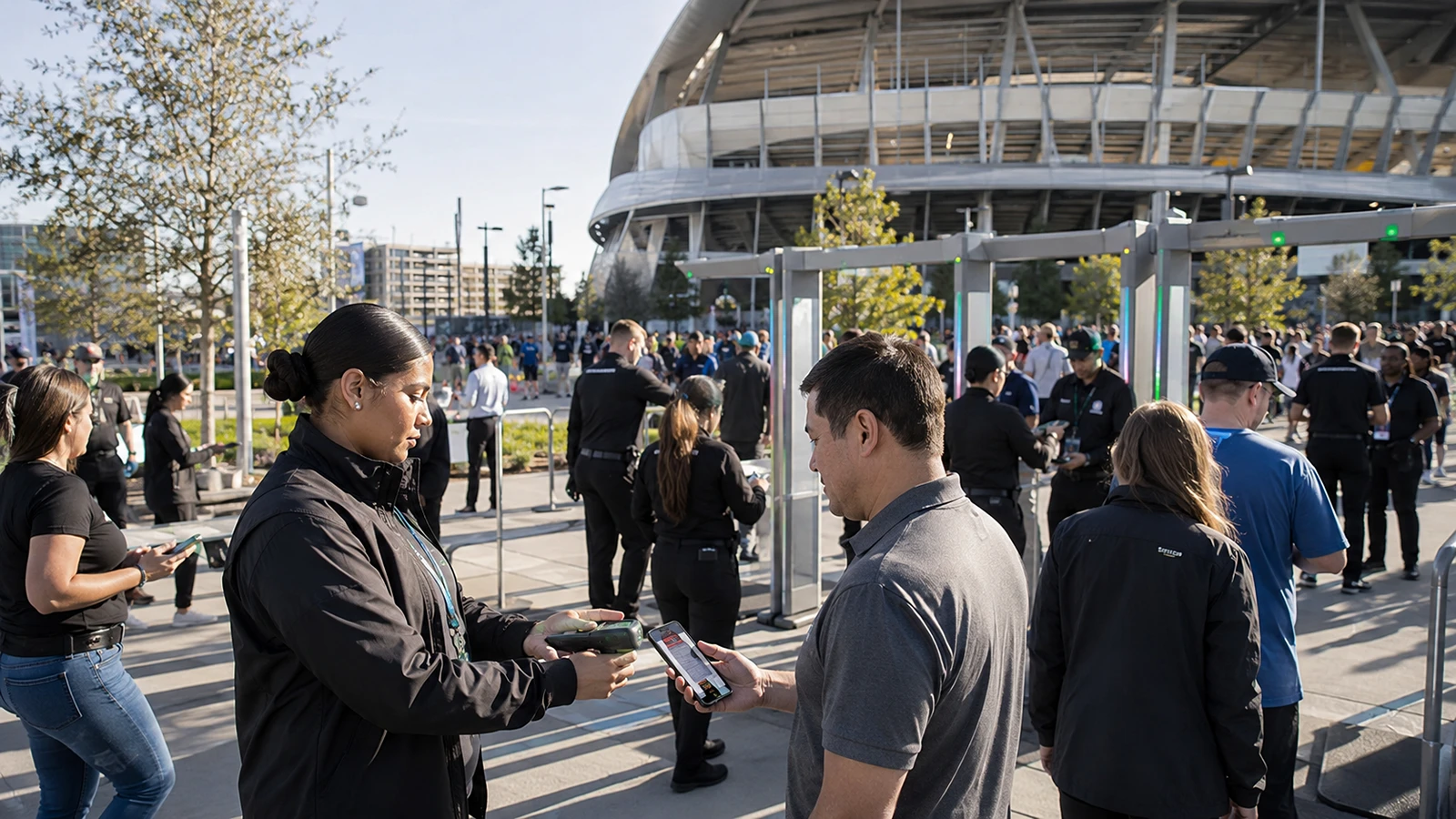
Popup staff are mobile. They move through high-traffic areas instead of staying in one place. Their job is to intercept attention and turn passive attendees into active participants.
Typical responsibilities include:
- Approaching attendees in crowded environments
- Distributing samples, flyers, or promotional materials
- Delivering short brand messages or hooks
- Directing interested visitors toward a booth or central activation area
Because of this movement-based approach, popup staff can handle a significantly higher number of interactions compared to booth staff.
Typical performance range:
- 80 to 150 interactions per staff member per day in high-footfall environments
- Short interaction time, usually under 30 to 60 seconds per person
This makes them the most effective model for campaigns focused on brand awareness and audience reach, the same principle that shapes how brand activation agencies operate in dense metro markets like San Francisco.
Where Popup Staff Perform Best
Popup staff are most effective in environments where attendees are constantly moving and not committed to a single experience.
Common use cases include:
- Music festivals and large public events
- Mall activations and street campaigns
- Multi-brand exhibitions with heavy foot traffic
- Product sampling campaigns
Example use case: A beverage brand launching a new product at a festival uses popup staff to distribute samples and create buzz. Their goal is not deep explanation but maximum exposure and recall.
Strengths Of Popup Staff In Event Staffing
Popup staff are valuable when your activation depends on visibility and scale.
Key advantages:
- High interaction volume in a short time
- Ability to cover large physical areas
- Strong crowd engagement and energy generation
- Effective for first impressions and brand recall
This isn't just anecdotal. Cvent's 2026 experiential marketing research found that 90 percent of marketers believe experiential engagement increases audience engagement, and global experiential spend surpassed $128 billion in 2024 as more brands leaned on high-volume, in-person interaction to build recall.
Limitations Of Popup Staff
Popup staff are not designed for depth. Their structure limits how much time they can spend with each attendee.
Key limitations:
- Limited ability to handle detailed product questions
- No structured lead qualification process
- Lower conversion rates compared to booth-based engagement
- Conversations are short and often transactional
If your activation requires explanation, consultation, or lead capture, relying only on popup staff will reduce overall effectiveness.
When Popup Staff Are The Right Choice
Choose popup staff when your primary objective is:
- Brand awareness and visibility
- High reach across large audiences
- Sampling and first-touch engagement
- Driving traffic toward another activation point
In brand activation staffing, popup staff are the top-of-funnel engine. They create attention and feed interest into the next stage of the experience, similar to how brand ambassadors are deployed around heavy foot-traffic moments like NYFW's experiential brand ambassador programs.
CEO Excerpt
Pop-up staff and booth staff aren't interchangeable; one is built for reach, the other for conversion. This guide breaks down when to use each, how to combine them, and how to structure a staffing plan that actually moves your brand activation ROI. - Daniel Meursing
What Booth Staff Do In Brand Activation Staffing
Booth staff are designed for depth, qualification, and conversion. In brand activation staffing, their role is to turn interest into meaningful conversations and measurable outcomes such as leads, sign-ups, or sales intent.
How Booth Staff Operate In Live Event Environments
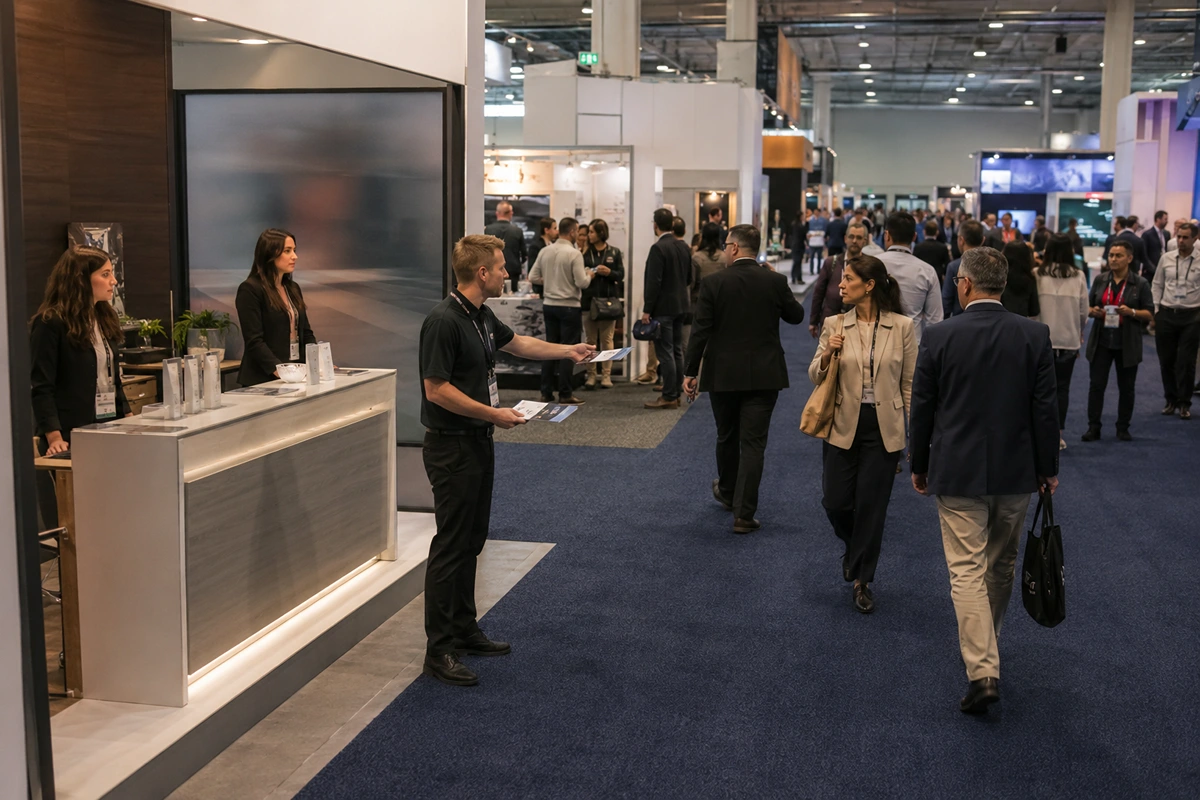
Booth staff work from a fixed location, usually within a branded setup such as a booth, demo zone, or experience area. Unlike popup staff, they do not chase attention. They manage and convert it.
Typical responsibilities include:
- Greeting and qualifying visitors who approach the booth
- Explaining products, services, or brand value in detail
- Conducting demos or guided walkthroughs
- Answering questions and handling objections
- Capturing lead information using structured processes
Because booth staff focus on longer interactions, their total volume is lower, but the quality of each interaction is significantly higher.
Typical performance range:
- 30 to 50 in-depth conversations per staff member per day
- 3 to 5 times higher lead qualification rates compared to high-volume engagement models
This makes them essential for campaigns focused on lead generation, product education, and conversion, the same principles we outlined in how to staff a booth at Las Vegas Convention Center and how to staff a MAGIC Las Vegas booth for real buyers.
Where Booth Staff Perform Best
Booth staff are most effective in environments where attendees are willing to stop, engage, and explore.
Common use cases include:
- Trade shows and industry exhibitions
- Product demo activations
- Corporate or invite-only brand events
- Experience zones within larger events
Example use case: A SaaS company at a trade show uses booth staff to demonstrate its platform, answer technical questions, and identify high-intent prospects for follow-up by the sales team.
Strengths Of Booth Staff In Event Staffing
Booth staff add value when your activation depends on quality interactions and measurable outcomes.
Key advantages:
- Ability to deliver detailed product explanations
- Structured lead capture and qualification
- Higher conversion rates per interaction
- Better alignment with sales and follow-up teams
The data backs this up. Cvent's trade show statistics report found that 81 percent of trade show attendees hold buying authority and 72 percent are more likely to buy from an exhibitor they meet in person, which is exactly the kind of high-intent audience that structured booth engagement is built to convert.
Limitations Of Booth Staff
Booth staff are not built for scale. Their fixed position and longer conversations limit how many people they can engage.
Key limitations:
- Lower total interaction volume
- Dependence on footfall reaching the booth
- Higher cost per interaction
- Limited ability to attract passing traffic without support
If your activation relies heavily on visibility and crowd engagement, booth staff alone may not generate enough reach.
When Booth Staff Are The Right Choice
Choose booth staff when your primary objective is:
- Lead generation and qualification
- Product education or demonstration
- High-intent conversations with prospects
- Driving measurable outcomes from event participation
In brand activation staffing, booth staff operate as the conversion layer. They transform attention into actionable business results.
Popup Staff Vs Booth Staff: Key Differences In Brand Activation Staffing

Understanding the difference between popup staff vs booth staff is essential for building an effective event staffing strategy. These roles are not interchangeable. They are designed to perform different functions within a brand activation.
Core Operational Differences
The most important distinction is how each role operates within the event environment.
Popup staff:
- Mobile and movement-based
- Initiate interactions across the venue
- Focus on short, high-frequency engagement
- Drive traffic toward a central activation point
Booth staff:
- Fixed and location-based
- Engage visitors who approach the booth
- Focus on longer, in-depth conversations
- Capture and qualify leads
This operational difference directly impacts how each role contributes to your activation goals.
Interaction Style And Performance Metrics
Popup staff and booth staff are measured differently because their objectives are different.
Popup staff metrics:
- Number of interactions per hour
- Samples or materials distributed
- Traffic directed to the booth or activation zone
- Brand recall and visibility indicators
Booth staff metrics:
- Number of qualified conversations
- Leads captured and categorized
- Demo completions or sign-ups
- Conversion rate and follow-up potential
A mismatch between role and KPI is one of the most common reasons brand activations underperform.
Briefing And Training Requirements
Effective event staffing requires role-specific training and briefing. Using the same brief for both roles leads to confusion and reduced performance.
Popup staff briefing should include:
- Movement zones and coverage areas
- Opening lines and engagement hooks
- Sampling or distribution guidelines
- Clear direction on when to redirect visitors
Booth staff briefing should include:
- Product and service knowledge
- Conversation flow and qualification questions
- Lead capture tools and processes
- Escalation or closing criteria
When briefing aligns with role expectations, execution becomes consistent and measurable, which is also why staffing costs vary so widely across regions, a factor we cover in what to budget for premium event staffing in major markets.
Common Mistakes In Brand Activation Staffing
Many brands make predictable mistakes when choosing between popup staff vs booth staff.
- Using popup staff for lead generation campaigns that require depth
- Relying only on booth staff in high-traffic environments with low stopping intent
- Expecting one team to handle both awareness and conversion without structure
- Failing to define clear KPIs for each role
These mistakes lead to:
- High engagement but low conversion
- Strong booth setup with limited traffic
- Missed opportunities for qualified leads
Quick Comparison Table
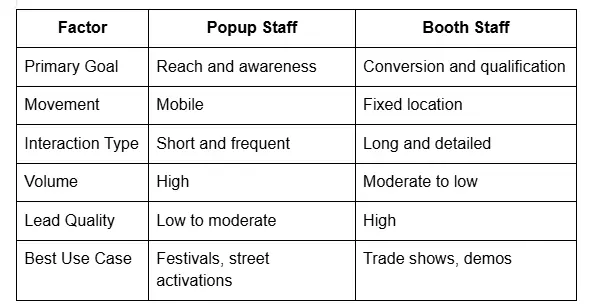
Key Takeaway
Popup staff and booth staff serve different stages of the customer journey within a brand activation.
- Popup staff generate attention and initial interest
- Booth staff convert that interest into measurable outcomes
Choosing the right model, or combining both strategically, is what determines whether your event staffing delivers real ROI.
How To Choose Between Popup Staff Vs Booth Staff For Your Brand Activation
Choosing the right model in popup staff vs booth staff is not a preference decision. It is a strategic choice based on your activation goals, audience behavior, and expected outcomes.
Use the framework below to align your brand activation staffing with real performance results.
1. Define Your Primary Activation Goal
Start with clarity on what success looks like for your event.
- If your goal is brand awareness, visibility, and reach, popup staff are the right fit
- If your goal is lead generation, sign-ups, or conversions, booth staff are essential
- If your goal includes both, you need a structured combination of both roles
Practical insight: Campaigns that try to achieve awareness and conversion using only one staffing model often underperform on both fronts, a pattern we've also seen play out in conference and festival settings, which is why hospitality staffing strategies for conferences and festivals usually call for a blended team from the start.
2. Assess Product Or Service Complexity
The more complex your offering, the more you need depth in interaction.
- Simple messaging such as sampling or brand recall works well with popup staff
- Products that require explanation, demos, or comparison need booth staff
- High-value or B2B offerings almost always require in-depth conversations
Example: A fintech product or SaaS platform requires booth staff to explain features, pricing, and use cases, while popup staff can only create initial interest.
3. Understand Audience Behavior At The Event
How your audience moves through the event determines how much time you can realistically capture.
- Passing traffic environments such as festivals or malls favor popup staff
- Intent-driven environments such as trade shows favor booth staff
- Mixed environments require a combination of both
Key question: Are attendees browsing casually, or are they actively looking for solutions?
4. Map The Customer Journey Within The Activation
High-performing brand activations follow a simple journey:
- Attention
- Interest
- Engagement
- Conversion
Popup staff support the early stages. Booth staff handle the later stages.
If your staffing model does not support this flow, you will see drop-offs between engagement and conversion.
5. Align Staffing With Measurable KPIs
Each role should have clearly defined performance metrics.
Popup staff KPIs:
- Interactions per hour
- Samples distributed
- Traffic directed to booth
- Engagement rate
Booth staff KPIs:
- Qualified leads captured
- Demo completions
- Conversion rate
- Follow-up readiness
When KPIs are aligned with role function, performance becomes easier to track and optimize.
Simple Decision Matrix
Use this quick reference to choose the right staffing model:
- Awareness + high footfall = Popup staff
- Conversion + high intent audience = Booth staff
- Awareness + conversion combined = Hybrid model
Key Takeaway
The decision between popup staff vs booth staff should always be driven by:
- Your activation objective
- Your audience behavior
- Your product complexity
When these factors are aligned with your event staffing strategy, your brand activation is far more likely to deliver both reach and measurable results.
Using Popup Staff And Booth Staff Together For Maximum ROI
For many brands, the best answer to popup staff vs booth staff is not choosing one over the other. It is combining both roles into a structured brand activation staffing model that supports the full customer journey.
When executed correctly, this hybrid approach increases both reach and conversion without compromising either.
The Hybrid Model: From Attention To Conversion
A high-performing activation follows a simple flow:
- Attract attention
- Create interest
- Drive engagement
- Convert and capture leads
Popup staff and booth staff each play a defined role in this journey.
- Popup staff generate attention and initial interest across the venue
- Booth staff handle engagement, qualification, and conversion at a fixed point
This creates a connected system where awareness feeds directly into measurable outcomes.
How To Structure The Handoff Between Teams
The transition from popup staff to booth staff is the most critical point in the entire activation.
To ensure a smooth handoff:
- Define clear triggers for redirection such as interest signals or relevant questions
- Train popup staff to introduce the booth as the next step, not a separate experience
- Ensure booth staff are prepared to continue the conversation without restarting
- Use simple context cues such as "interested in demo" or "asked about pricing"
A strong handoff improves visitor experience and increases the likelihood of conversion.
Avoiding Role Overlap And Performance Loss
One of the most common issues in hybrid event staffing is role confusion.
To maintain efficiency:
Popup staff should focus on:
- High-energy engagement
- Quick messaging
- Traffic generation
Booth staff should focus on:
- Detailed conversations
- Product education
- Lead capture and qualification
When roles are clearly separated, both teams perform at a higher level.
Real-World Use Case
At a large exhibition, a consumer tech brand used popup staff to engage attendees in walkways and demo teaser features. Interested visitors were directed to a booth where trained staff conducted full product demonstrations and captured leads.
Result:
- Increased booth traffic by over 40 percent
- Higher average conversation time at the booth
- Improved lead quality and follow-up conversion rates
This demonstrates how combining both staffing models can significantly improve activation ROI.
Why The Hybrid Model Works
The hybrid model aligns staffing with how people naturally engage at events.
- Not all attendees are ready for a deep conversation immediately
- Not all interested visitors will find your booth without guidance
- Not all interactions should be treated the same
By using both popup staff and booth staff strategically, you create a seamless path from discovery to decision.
Key Takeaway
In brand activation staffing, combining popup staff and booth staff allows you to:
- Maximize reach without losing conversion opportunities
- Capture both casual interest and high-intent engagement
- Build a structured and scalable activation model
For campaigns that require both visibility and results, a hybrid staffing approach is often the most effective choice.
Conclusion: Choosing The Right Brand Activation Staffing Model
The decision between popup staff vs booth staff is not about preference, cost, or convenience. It is about choosing the right brand activation staffing model that aligns with your campaign goals and audience behavior.
When the staffing model is misaligned, results suffer in predictable ways:
- High footfall but low lead quality
- Strong engagement but no measurable outcomes
- Well-designed booths with limited traffic
These are not execution issues. They are structural gaps in event staffing strategy.
What High-Performing Activations Do Differently
Successful brand activations follow a clear approach:
- They define whether the goal is awareness, conversion, or both
- They match staffing roles to each stage of the customer journey
- They assign clear KPIs to popup staff and booth staff
- They design a seamless flow from first interaction to lead capture
This level of planning ensures that every interaction contributes to a measurable outcome.
Final Decision Framework
To choose the right model, ask:
- Do you need reach at scale or qualified conversations?
- Is your audience passing through or actively engaging?
- Does your offering require quick messaging or detailed explanation?
Your answers will clearly indicate whether you need popup staff, booth staff, or a combination of both.
Ready To Plan Your Next Activation?
If you want your next campaign to deliver both visibility and results, your staffing strategy needs to be intentional.
- Align your team structure with your activation goals
- Use popup staff to drive awareness and traffic
- Use booth staff to convert interest into leads
- Combine both roles when your campaign requires full-funnel performance
A well-structured event staffing strategy does more than support execution. It determines whether your brand activation delivers real ROI.
Need help planning your brand activation staffing? Work with a team that understands how to structure popup staff and booth staff for measurable impact, from first interaction to final conversion.
Ready to elevate your next event?
Join thousands of event planners who trust EventStaff.com for reliable, professional staffing solutions.
Trusted by event professionals nationwide
1k+
Events Staffed
2 million+
Guests Served
97%
Positive reviews