

A brand activation agency in San Francisco turns a live marketing concept into an executable campaign with clear responsibilities, measurable outcomes and a realistic operating plan. Depending on the activation, that may include location planning, permit coordination, production, staffing strategy, on-site supervision and campaign reporting.
San Francisco adds several local considerations. Public-space permissions vary by location, venue labor rules can affect load-in, and audience movement differs considerably between districts such as Union Square, SoMa and the Embarcadero. Agencies therefore need to plan around the actual site rather than applying the same activation model across the city.
This guide explains what a brand activation agency does in San Francisco, how its role differs from that of a staffing partner, what determines headcount and cost, and how brands can evaluate an agency before committing campaign budget.
CEO Excerpt
"In San Francisco, a brand activation isn't just about the creative concept; it's about surviving the logistics. We don’t just staff for the 'happy path' where the permits arrive early, and the sun shines. We staff for the reality of fog, strict union rules, and 45-minute load-in windows. That operational grit is what separates a pretty event from a profitable one."- CEO Event Staff
Executive Summary
A brand activation agency in San Francisco exists to control execution in a market where permits, labor rules, weather, and foot traffic routinely disrupt plans. Rather than focusing on creative alone, these agencies design adaptable experiences, build conversion-focused staffing models, and manage on-site decision-making so activations produce measurable results instead of just visibility.
What Is a Brand Activation Agency?
A brand activation agency turns a live marketing idea into an experience that encourages people to take a measurable action. Event Marketer notes staffing quality has a direct influence on activation performance because the people representing the brand shape how guests engage, participate, and respond.
In San Francisco, that role extends beyond creative planning. Public-space approvals, venue access rules, changing weather, limited load-in windows, and uneven foot traffic can all affect how an activation performs. A concept that works in Union Square may need a different staffing model, layout, or engagement approach near the Embarcadero or Moscone Center.
A brand activation agency typically helps coordinate:
- Campaign format and location planning, based on the audience, desired action, available space, and expected dwell time.
- Permits and venue requirements, including the approvals, access restrictions, and production rules that apply to the selected site.
- Staffing strategy and supervision, covering headcount, role allocation, training, breaks, replacements, and on-site decision-making.
- Live execution, including queue buildup, stock shortages, equipment issues, weather changes, and unexpected shifts in attendance.
- Lead capture and reporting, so interactions, demonstrations, samples, scans, and qualified leads can be measured after the campaign.
As Campaign US highlights, the human element remains central to brand recall. The strongest agencies therefore define who owns each responsibility before production begins, especially when they are working alongside a separate staffing partner, venue team, or production vendor. Clear ownership prevents gaps in training, scheduling, access, supervision, and reporting once the activation is live.
For a deeper dive on how large teams are managed during these complex rollouts, read our analysis on large-scale staffing case studies.
Comparison: How Activations Fit Into the Marketing Mix
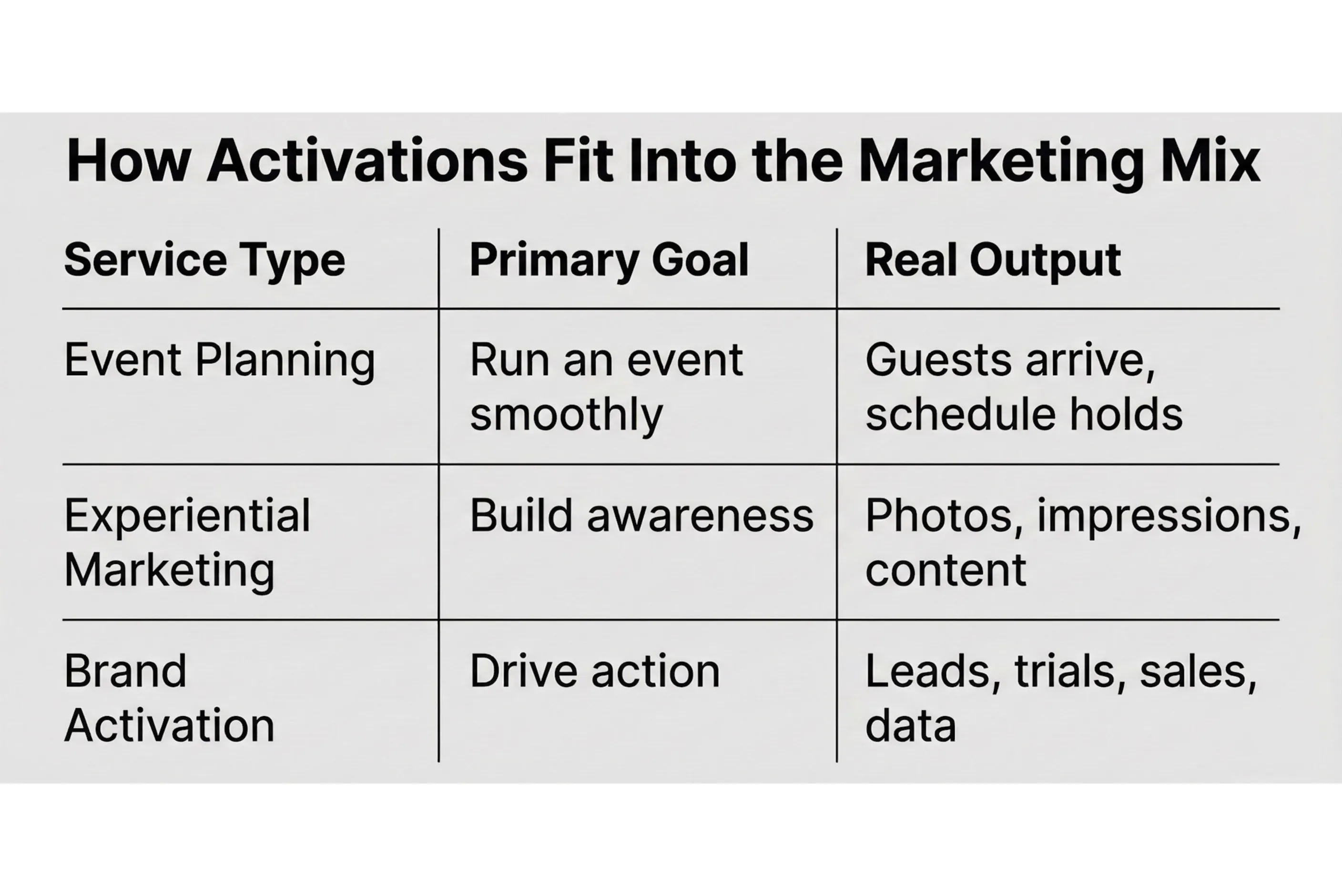
What this really means for you
If your goal includes any form of conversion, a brand activation agency isn’t a nice-to-have. It’s how you protect the timeline, budget, and outcomes in a city that doesn’t forgive loose execution.
What Does a Brand Activation Agency Do in San Francisco?
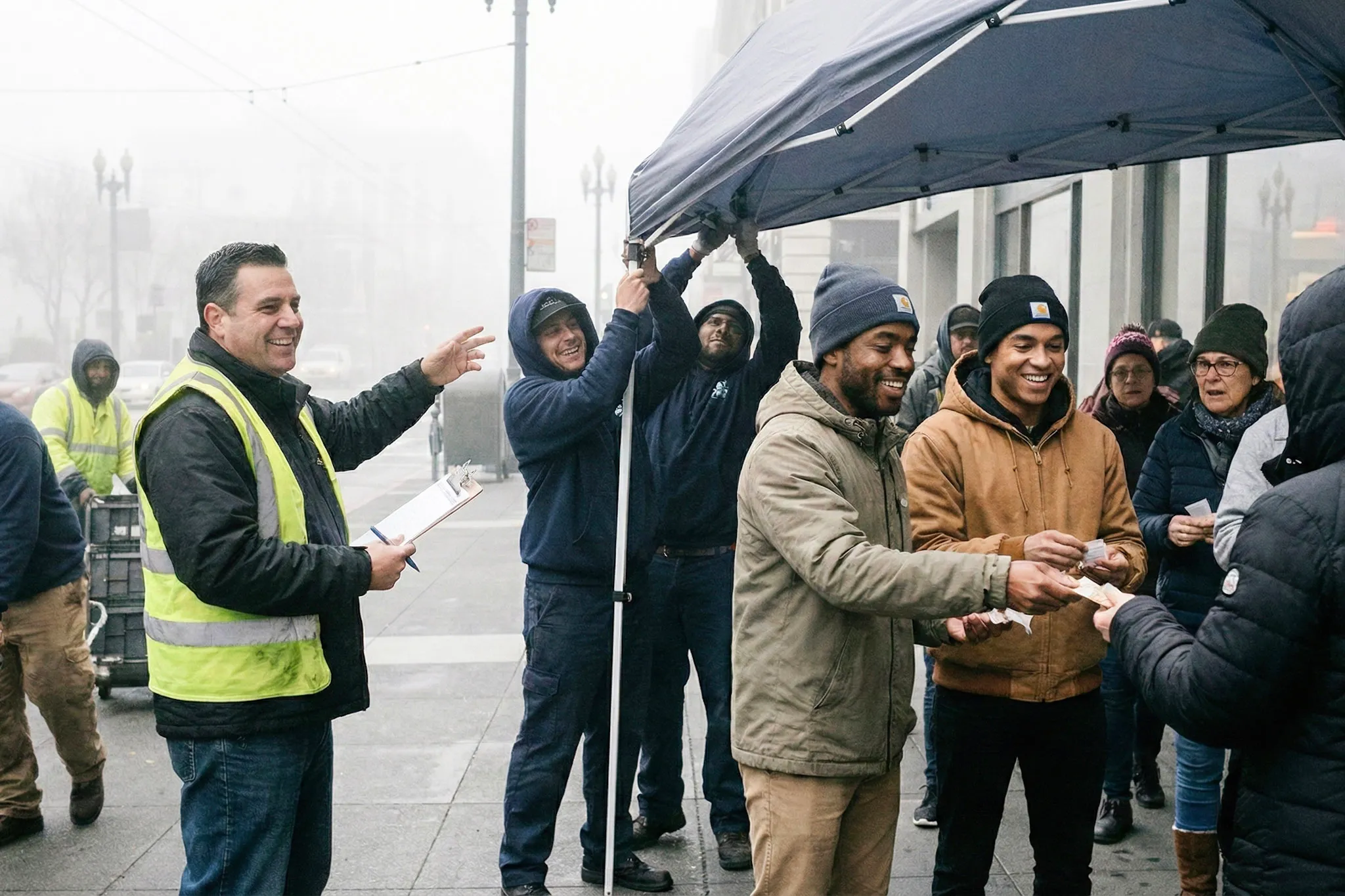
At a high level, most brand activation agencies focus on structure and coordination, not the day-to-day behavior of staff on the ground. Here is the operational split: agencies typically own the infrastructure, while staffing partners own the human execution.
A brand activation agency in San Francisco typically handles the full activation lifecycle, not just the visible parts:
- Concept and format development are tied to how people actually move, stop, and engage, because passive booths don’t survive SF foot traffic.
- Location selection and permits are often the longest critical path items and the most underestimated. Lead time varies by location and agency, but 45–60+ days is common for parks or amplified sound.
- Staffing models and supervision decide not just who’s on site, but who’s in charge when something goes sideways. If you skip supervision, conversion drops first.
- On-site execution and escalation, including weather pivots, crowd surges, or staffing gaps.
- Lead capture and reporting, because impressions without data don’t survive budget reviews. These outcomes become clearer when brands apply structured approaches to measuring brand activation success.
When it comes to staffing, agencies either provide teams directly or manage vetted local staffing partners. The difference matters. Someone still owns training, replacements, and performance.
What this really means for you
If an agency can’t explain who supplies staff, who supervises them, and how no-shows are handled, you’re carrying more operational risk than you think.
Brand Activation Services in San Francisco That Actually Drive Results
When brands ask what services a brand activation agency in San Francisco provides, the better question is which responsibilities must be owned for the campaign to perform once it goes live. Most activations do not fail because the concept lacks creativity. They struggle because production, staffing, permits, training, and measurement were planned separately.
The clearest way to evaluate an agency is by ownership. Some responsibilities usually sit with the activation agency, while others require a specialist staffing partner with local recruitment, training, and on-site management capabilities.
Ownership Snapshot
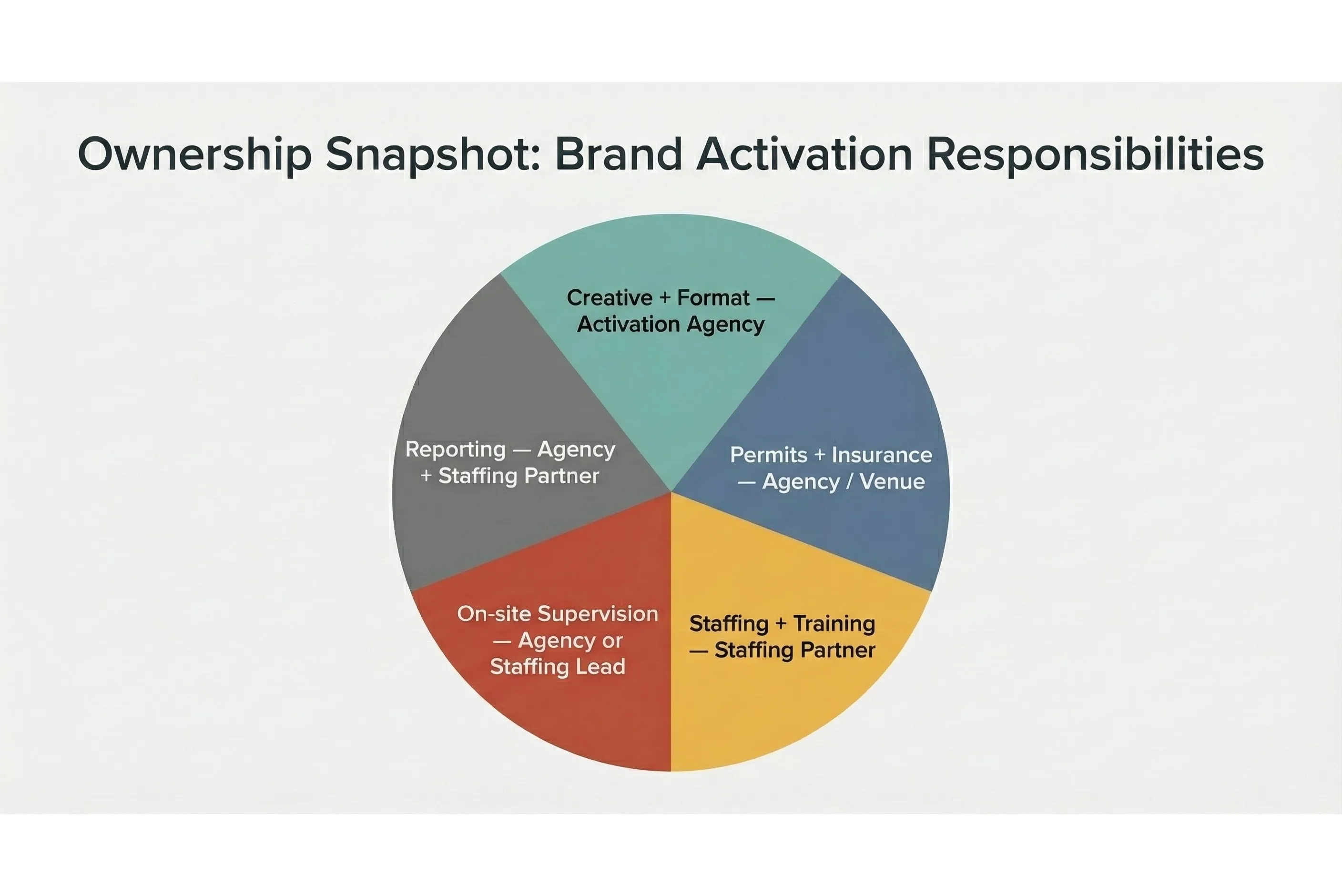
Creative & Strategy
Creative strategy determines how the audience moves through the activation and what action they are expected to take. In San Francisco, where foot traffic and dwell time can vary sharply by neighborhood, agencies need to design interactions that make sense for the location rather than relying on a generic event format.
That includes the opening message, demonstration sequence, product trial, lead-capture step, and final handoff. Staff should know what to say first, how to qualify interest, and when to move someone toward the next action. Passive displays may attract attention, but trained staff are usually responsible for turning that attention into participation.
Production & Logistics
Production and logistics cover the physical requirements that keep the activation operating throughout the day. A seasoned brand activation agency should plan around venue access, load-in timing, power availability, connectivity, equipment placement, storage, replenishment, and breakdown.
Contingency planning is equally important. Offline lead-capture options, backup power, weather protection, spare equipment, and product-storage plans reduce the risk of one technical issue stopping the experience. These decisions should be confirmed before staff arrive, so the on-site team can focus on guests rather than solving production problems.
Permits & Compliance
Permitting and production approvals normally sit with the activation agency, venue, or production partner. The exact requirements depend on the location, campaign activity, product being distributed, sound levels, equipment, and use of public space.
Food or beverage sampling may require health-related approvals, while sidewalk, park, or street activity can involve separate city processes. Staffing partners should receive the final site rules before training begins, including access instructions, prohibited activities, safety expectations, and escalation contacts. Missing approvals can delay opening and leave scheduled staff unable to begin work.
Staffing & Training
The staffing plan should define the number of brand ambassadors, demo staff, team leads, and supervisors required for each part of the activation. Headcount should reflect expected attendance, interaction length, operating hours, break coverage, product volume, and the number of separate engagement zones.
Training should cover more than brand talking points. Staff need to understand the audience, campaign objective, qualifying questions, demonstration process, lead-capture system, guest eligibility, and escalation procedure. The qualities required for each position will depend on the campaign, which is why agencies should evaluate relevant experiential brand ambassador attributes rather than filling every role with the same profile.
Measurement & ROI
Measurement begins before the activation opens. The agency should define which interactions will be recorded, who is responsible for collecting the data, and how performance will be reviewed during the campaign rather than waiting until the final report.
QR scans, samples distributed, demonstrations completed, qualified conversations, leads captured, and hourly throughput can all provide useful information. Staff prompt the desired actions, while supervisors monitor participation and identify where engagement is slowing. The agency can then combine those results with campaign costs to assess performance and improve future activations.
What this really means for you
If “services” sounds vague in a proposal, the gaps will show up on site. Usually during your busiest hour.
Types of Brand Activation Events San Francisco Agencies Run
A brand activation agency in San Francisco doesn’t just run events. They select formats based on how the city behaves.
- Pop-ups work well in neighborhoods like Hayes Valley or the Marina because of weekend pedestrian density, whereas pure commuter corridors often lack dwell time.
- Product launches need flow control when press and demos collide.
- Sampling activations succeed only when health compliance and replenishment are airtight.
- Street teams live or die by throughput math: touches per hour per staffer.
- Mobile activations face parking and staging constraints that can erase half a day if mishandled.
Conference activations bring another layer. Union rules at Moscone Center. Venue labor calls. Approved staffing lists. Miss one requirement, and your crew watches someone else plug in your own booth.
By 2026, attention windows are shorter. Micro-engagement spikes matter more than long conversations. Agencies design around that reality.
What this really means for you
The “best” activation type is the one that survives SF constraints and still hits your goal. Format choice is an operational decision, not a creative one.
Staffing for Brand Activation Event Management: Who You Actually Need
Staffing problems rarely appear as one obvious failure. They show up as slower demonstrations, unattended guests, growing queues, missed lead-capture opportunities, delayed breaks, and supervisors being pulled into frontline roles. By the time the issue becomes visible to the client, the team is usually already operating below capacity.
A brand activation agency should therefore build the staffing plan around the guest journey, not around a convenient headcount. Each role needs a defined purpose, clear performance expectations, and enough coverage to remain effective throughout the activation.
A brand activation agency builds teams intentionally:

Staffing Ratios (Reality-Based)
Staffing ratios should be treated as a starting point, not a fixed rule. The correct headcount depends on the number of engagement zones, expected traffic, interaction length, break coverage, setup duties, and whether staff are also responsible for demonstrations or lead capture.
- Small pop-up: A compact activation may need two to four brand ambassadors and one team lead. This can work when the footprint is simple, the interaction is brief, and there are no separate registration, demonstration, or queue-management requirements.
- Medium activation: A campaign with several engagement points may require six to twelve staff and one dedicated supervisor. The team may include brand ambassadors, demo staff, lead-capture staff, and support coverage for breaks or replenishment.
- Large footprint: A multi-zone or high-volume activation may require twelve to twenty-five or more staff, supported by team leads, supervisors, and shift rotation. Larger teams usually need clearer role separation so frontline staff are not pulled away from guests to manage stock, breaks, technology, or operational issues.
Throughput Logic
Headcount should be calculated from the amount of time each interaction requires. If the campaign expects 100 interactions per hour and the average conversation takes three minutes, one ambassador has a theoretical maximum of 20 interactions per hour.
Actual capacity will be lower once questions, lead capture, product resets, handoffs, and short pauses are included. Planning around the theoretical maximum creates bottlenecks during peak periods.
A more realistic calculation should consider:
- Average interaction time
- Expected interactions per hour
- Number of active stations
- Time required for data capture
- Product or equipment reset time
- Break and absence coverage
- Guest arrivals during peak periods
Higher labor costs may encourage brands to reduce headcount, but cutting every role equally usually weakens the activation. A better approach is to protect guest-facing positions, separate support work from engagement work, and assign supervisors who can move coverage as demand changes.
What this really means for you
If no one on-site has authority to adjust staffing, breaks, or flow, you’ll feel it during peak traffic, when it’s too late to fix.
How Much Do Brand Activation Agency Services Cost in San Francisco
Costs for a brand activation agency in San Francisco vary based on the scale of the campaign, the location, the number of staff required, the production setup, and how early planning begins. Staffing is often one of the largest controllable costs, but it is only one part of the full activation budget.
The main cost drivers include:
- Location pressure: Public spaces, premium venues, and high-traffic districts may involve additional permit, access, insurance, or staffing requirements. A campaign near Union Square or the Embarcadero may also need more support for guest flow, setup, and local logistics.
- Longer activations: Multi-day campaigns require shift rotations, break coverage, additional supervision, and more detailed fatigue planning. Extending hours can also increase overtime risk and replacement requirements.
- Custom fabrication: Purpose-built structures, signage, counters, displays, lighting, and branded environments increase upfront production costs. They may improve the guest experience, but they also add transportation, storage, installation, and breakdown expenses.
- Last-minute activations: Short lead times reduce the available staffing pool, limit production options, and leave less time for permits, training, and contingency planning. Rush recruitment, expedited shipping, and late venue changes can all increase the final cost.
The proposal should separate agency management, staffing, training, supervision, production, permits, technology, and reporting wherever possible. This makes it easier to identify which costs are fixed and where the scope can be adjusted without weakening the campaign.
Brands should also confirm whether staffing rates include recruitment, screening, payroll, insurance, paid training, breaks, parking, travel, replacements, and on-site management. A low hourly rate may become significantly more expensive once these items are added separately.
Early planning gives the agency more control over the budget. Decisions about location, campaign duration, interaction format, staffing depth, and production requirements can be made before expensive changes become necessary. A strong agency should explain these trade-offs clearly and show how each budget decision affects capacity, guest experience, and measurement.
Predictable ROI in San Francisco comes from realistic planning, defined ownership, and enough staffing to support the activation during peak periods. Cutting headcount without adjusting the guest journey usually creates slower interactions, longer queues, and fewer completed demonstrations or leads.
For a detailed breakdown of current market rates, see our brand ambassador agency fees cost guide 2025.
What this really means for you
Predictable costs come from early decisions. Not from squeezing vendors after the plan is locked.
What Makes a Great Brand Activation Agency in San Francisco
A strong San Francisco agency should be able to explain how the campaign will operate, not simply how it will look. Creative ideas matter, but the buyer also needs confidence that the agency can coordinate locations, staffing, production, training, measurement, and event-day decisions.
The strongest agencies answer operational questions directly. They identify dependencies early, distinguish confirmed information from assumptions, and make it clear who owns each part of the activation.
Local Planning Knowledge
Local knowledge should go beyond listing familiar neighborhoods. The agency should understand how the location affects the format, audience, operating schedule, production plan, and staffing model.
Ask how its approach would change between:
- A conference activation near Moscone Center
- A retail campaign around Union Square
- A commuter-focused activation near the Embarcadero
- A neighborhood pop-up in Hayes Valley
- A corporate experience in SoMa
A credible answer should discuss audience behavior, access, dwell time, venue restrictions, weather exposure, and surrounding pedestrian movement.
Clear Ownership of Responsibilities
The agency should provide a responsibility matrix showing what sits with:
- The brand
- The activation agency
- The staffing partner
- The venue
- The production vendor
- Any technology or measurement supplier
This is particularly important when staffing is outsourced. The brand should know who recruits the team, approves staff profiles, conducts training, manages replacements, supervises the event, and reports performance.
A Staffing Model Based on the Experience
A good agency does not start with a generic package of ambassadors. It maps the guest journey and assigns roles according to the work required at each stage.
The staffing plan should explain:
- How guests enter the experience
- Who initiates engagement
- Who handles demonstrations
- Who captures data
- Who manages queues
- Who replenishes materials
- Who covers breaks
- Who handles escalation
- Who represents the client on site
Headcount should be supported by expected volume, interaction time, and station capacity rather than an unexplained estimate.
Practical Training
Training should prepare the team to perform the activation, not simply repeat a brand script. Staff need to understand the campaign objective, audience, qualifying questions, product information, guest journey, technology, escalation process, and reporting requirements.
Ask to see the proposed training format and timeline. A strong agency should be able to explain what staff learn before arrival, what is reinforced during the on-site briefing, and how performance is corrected during the campaign.
On-Site Supervision
The agency should identify who has authority on site and how that person communicates with the brand, venue, production team, and staffing provider.
A supervisor should be responsible for:
- Attendance and replacements
- Break scheduling
- Role deployment
- Guest-flow changes
- Stock and collateral
- Staff performance
- Incident escalation
- Hourly results
- Client updates
A vague promise that “someone from the agency will be available” is not the same as assigning a named operational lead.
Measurement That Connects to the Campaign Objective
Good reporting begins with the campaign objective. An awareness activation, product trial, appointment campaign, and lead-generation program should not all be judged by the same metrics.
The agency should define:
- Which actions count as meaningful engagement
- How interactions will be recorded
- How duplicate or incomplete leads will be handled
- Which results will be tracked hourly
- What supervisors can change during the activation
- How costs will be compared with outcomes
- What the final report will include
Reporting should help the brand decide what to repeat, change, or stop in the next campaign.
Vetting Checklist
Before appointing an agency, ask for:
- Relevant San Francisco campaign examples
- A proposed responsibility matrix
- A preliminary staffing model
- A realistic production timeline
- A permit and approval plan
- The training approach
- Named on-site supervision
- Backup and replacement procedures
- Sample performance reporting
- Transparent pricing assumptions
- Current insurance and compliance documentation
- References from campaigns with similar requirements
Red Flags
Be cautious when an agency:
- Leads entirely with creative ideas but avoids operational detail
- Cannot explain how headcount was calculated
- Treats every frontline role as interchangeable
- Provides no named on-site supervisor
- Gives vague answers about permits or venue requirements
- Has no replacement or contingency process
- Promises results without defining how they will be measured
- Provides a single total price with no clear scope
- Cannot show experience with a comparable format, audience, or location
The right agency should make the campaign easier to evaluate before it begins. You should understand what will happen, who owns each responsibility, what the major risks are, and how performance will be measured before the budget is committed.
The “awkward silence” test
Ask, “Who’s the one person accountable if staffing, permits, and reporting all get messy at once?” Then stop talking. If you get a clean name and a clean process, good sign. If you get a committee, you’re buying ambiguity.
Example Brand Activation Packages (How Services Are Bundled)
Most proposals look bundled. The trick is spotting what’s actually included vs assumed. Packages are useful because they force decisions. They also expose what’s not included… which is where budgets get weird.
Below are three common bundles you’ll see for brand activation event services San Francisco teams run all the time. Use these to compare proposals apples-to-apples.
_1_11zon.webp)
What’s bundled vs line-itemed, and why it matters
Most agencies bundle the parts that are predictable. Staffing blocks. Basic rentals. On-site lead. They line-item the things that spike: fabrication, union labor, last-minute changes, multi-day storage, and content capture.
And honestly? That’s not evil. It’s reality. The problem is when the proposal hides that reality under vague wording like “production support.” Production support could mean “we’ll text the vendor,” or it could mean “we’re managing load-in like hawks.” Big difference.
Your budget isn’t blown by “extras”; it’s blown by missing ownership
The cost creep usually comes from gaps: storage wasn’t assigned, load-in wasn’t coordinated, and content wasn’t planned, so now you’re paying rush rates. When you review packages, don’t just compare pricing. Compare who owns what.
Common Mistakes Brands Make Running Activations in San Francisco
San Francisco activations often underperform because the operating plan does not match the location, audience, or pace of the experience. A campaign can look complete on paper and still lose momentum once guest flow, staffing pressure, venue access, or weather conditions begin affecting execution.
The most common mistakes usually appear when brands try to manage the activation internally or appoint partners without clearly defining who owns staffing, supervision, production, and measurement.
1. Choosing the Wrong Location for the Audience
High foot traffic does not automatically create valuable engagement. A tourist-heavy area may produce strong impression numbers but very few qualified conversations, demonstrations, sign-ups, or sales opportunities.
Location decisions should be based on audience relevance, likely dwell time, surrounding activity, and the action the campaign requires. A quick sampling activation may benefit from steady pedestrian movement, while a detailed product demonstration needs a site where people are willing and able to stop.
The right location also affects staffing. A high-volume site may need more outreach staff and faster scripts, while a lower-volume but more relevant audience may justify longer conversations and more specialized demo staff.
2. Understaffing the Activation
Brands often reduce headcount to protect the budget without adjusting the experience itself. The result is usually longer queues, rushed conversations, incomplete demonstrations, missed leads, and frontline staff being pulled into setup, replenishment, or troubleshooting.
Understaffing becomes more visible during peak periods. A team that appears sufficient during the first quiet hour may struggle once several guests arrive at the same time, staff begin taking breaks, or product resets slow the next interaction.
Headcount should be based on expected hourly volume, interaction time, number of active stations, break coverage, and support duties. Staffing to the daily average rarely works when traffic arrives in short, concentrated periods.
3. Running Without a Dedicated Supervisor
A supervisor protects the performance of the activation while frontline staff remain focused on guests. Without one, small issues quickly begin competing for attention.
Breaks overlap. Demonstrations fall behind. Stock is not replenished. Staff receive conflicting instructions. Entrances become crowded. A client request reaches several people before anyone takes responsibility.
A dedicated supervisor should monitor attendance, role coverage, guest flow, team performance, stock, technology, and hourly results. They should also have the authority to move staff, adjust breaks, escalate production issues, and communicate changes to the client or agency.
4. Treating Lead Capture as a Passive Step
A QR code, tablet, or sign-up form does not create leads on its own. Staff need to explain why the action matters, identify the right moment to ask, and guide the guest through the process without making the interaction feel forced.
Lead capture should be built into the engagement script. The team should know:
- Which guests qualify
- What information must be collected
- When the request should be introduced
- How consent is handled
- What to do if the system fails
- How incomplete or duplicate records are reviewed
Without that process, the activation may generate plenty of conversations but very little usable data.
5. Building the Plan Around Average Traffic
Average attendance figures can hide the moments when the activation is under the most pressure. A campaign may appear properly staffed across an eight-hour day but still fail during a 45-minute lunch rush or the period immediately after a conference session ends.
Staffing plans should identify likely peaks and place additional coverage where demand changes quickly. That may mean staggered shifts, floating staff, shorter breaks during high-volume periods, or a supervisor who can move people between engagement zones.
The goal is not to overstaff every hour. It is to protect the parts of the schedule where queues, delays, and missed interactions are most likely.
6. Ignoring Weather and Product-Handling Risks
Outdoor campaigns in San Francisco need a practical response to wind, fog, moisture, and temperature changes. These conditions can affect signage, uniforms, electrical equipment, product quality, guest comfort, and the amount of time people are willing to stop.
The contingency plan should cover tents or shelter where permitted, equipment protection, staff clothing, signage stability, product storage, and location changes within the footprint.
Sampling campaigns may also require specific product handling procedures so items remain safe, presentable, and available throughout the activation. These plans should be confirmed before staff arrive rather than improvised once conditions change.
Fast Fixes That Improve Outcomes
- Choose locations based on audience intent, not density alone. Review who uses the area, why they are there, and how much time they are likely to give the experience.
- Add supervision before the team becomes difficult to manage. One dedicated lead can protect frontline productivity by handling breaks, changes, stock, and escalation.
- Treat lead capture as an active, scripted moment. Staff should understand the value exchange and know exactly when and how to introduce it.
- Build staffing around peak periods rather than daily averages. Use hourly projections, interaction time, and station capacity to identify where extra coverage is required.
- Pre-plan weather and operational contingencies. Confirm how signage, equipment, samples, uniforms, and guest flow will be handled if conditions change.
The first hour of an activation often reveals whether the operating plan is strong enough. Staff begin testing the script, queues show where capacity is limited, and supervisors can see whether roles, handoffs, and replenishment procedures are working as intended.
Early friction should be treated as useful operational information, not something to ignore until the campaign ends. If guests are waiting too long, staff are unclear about responsibilities, or lead capture is being skipped, the supervisor should be able to adjust coverage, clarify instructions, and report the issue immediately.
Performance rarely improves on its own when the team starts without clear ownership. Structured staffing, active supervision, realistic capacity planning, and defined escalation procedures give the activation a better chance of recovering quickly and maintaining consistent results throughout the day.
The “first hour” tells the truth
If the first hour feels clunky, confused, unclear in roles, and without rhythm, it usually doesn’t magically fix itself by lunch. The best teams look smooth early because they’ve rehearsed the boring parts.
Final Thoughts on Running Successful Activations in San Francisco
Hiring a brand activation agency, San Francisco brands' trust comes down to one thing: who controls execution when conditions change.Predictable outcomes are not achieved by relying on creativity alone or by assuming foot traffic guarantees results. They come from structured staffing, operational oversight, and proactive problem-solving that accounts for permits, weather, union rules, and fluctuating pedestrian behavior.Brands that prioritize operational discipline see higher engagement rates, smoother activations, and defensible ROI. For those planning a San Francisco activation, securing an agency that can manage both staffing and execution is the key to turning live moments into measurable outcomes, protecting budgets, and maintaining control under pressure.
Ready to elevate your next event?
Join thousands of event planners who trust EventStaff.com for reliable, professional staffing solutions.
Trusted by event professionals nationwide
1k+
Events Staffed
2 million+
Guests Served
97%
Positive reviews