
Introduction: How Many Ticket Checkers Do You Need for an Event?
Planning entry operations is one of the most critical parts of event execution. A common question event planners ask is, "How many ticket checkers do I need for an event?" The answer is not a fixed ratio. It depends on attendance, entry time, and how quickly each guest can be processed at the gate.
Using the wrong staffing estimate leads to long queues, delayed entry, and a poor first impression for attendees, the kind of avoidable missteps we break down in 10 Mistakes Event Hosts Make When Staffing Festivals in Major U.S. Cities. For stadium events and large-scale activations, even a small miscalculation can create bottlenecks that impact the entire experience.
What You'll Learn in This Guide
This guide explains how to calculate the right number of ticket checkers using a proven throughput-based approach. You will learn:
- How to determine the correct ticket checker ratio for events
- How scanning technology affects staffing requirements
- How to calculate staffing for different event sizes
- When to adjust for VIP access and peak arrival times
By the end, you will have a clear, practical method to plan event staffing for entry gates with confidence and accuracy.
Executive Summary
This guide explains how to calculate the exact number of ticket checkers needed for any event using a throughput-based model. It covers key variables such as attendance, entry window, and scanning technology, along with real-world adjustments. The article also highlights staffing differences by event size and the need for separate VIP entry planning. By following this approach, event planners can reduce queues, optimize staffing costs, and improve overall event flow.
Why Ticket Checker Ratios Fail in Event Staffing
Many event planners still rely on a simple ratio, such as attendees divided by entry gates, to estimate staffing. While this approach seems practical, it does not reflect how entry operations actually work in live environments.
The real issue is that ticket checker requirements are driven by throughput, not static ratios. Every event has different variables that affect how quickly guests can be processed at the gate.
The Problem with Using Fixed Ratios
Relying on a generic ticket checker ratio for events often leads to:
- Understaffed entry points during peak arrival times
- Long queues that exceed acceptable wait times
- Uneven gate distribution and congestion
- Increased pressure on supervisors and frontline staff
These issues are especially common in stadium event staffing, where large volumes of attendees arrive within a short time window, a challenge we've seen play out firsthand while staffing Houston's FIFA Fan Zones.
What Actually Determines Staffing Needs
To accurately calculate how many ticket checkers you need, you must consider the following:
- Total attendance
- Entry window duration
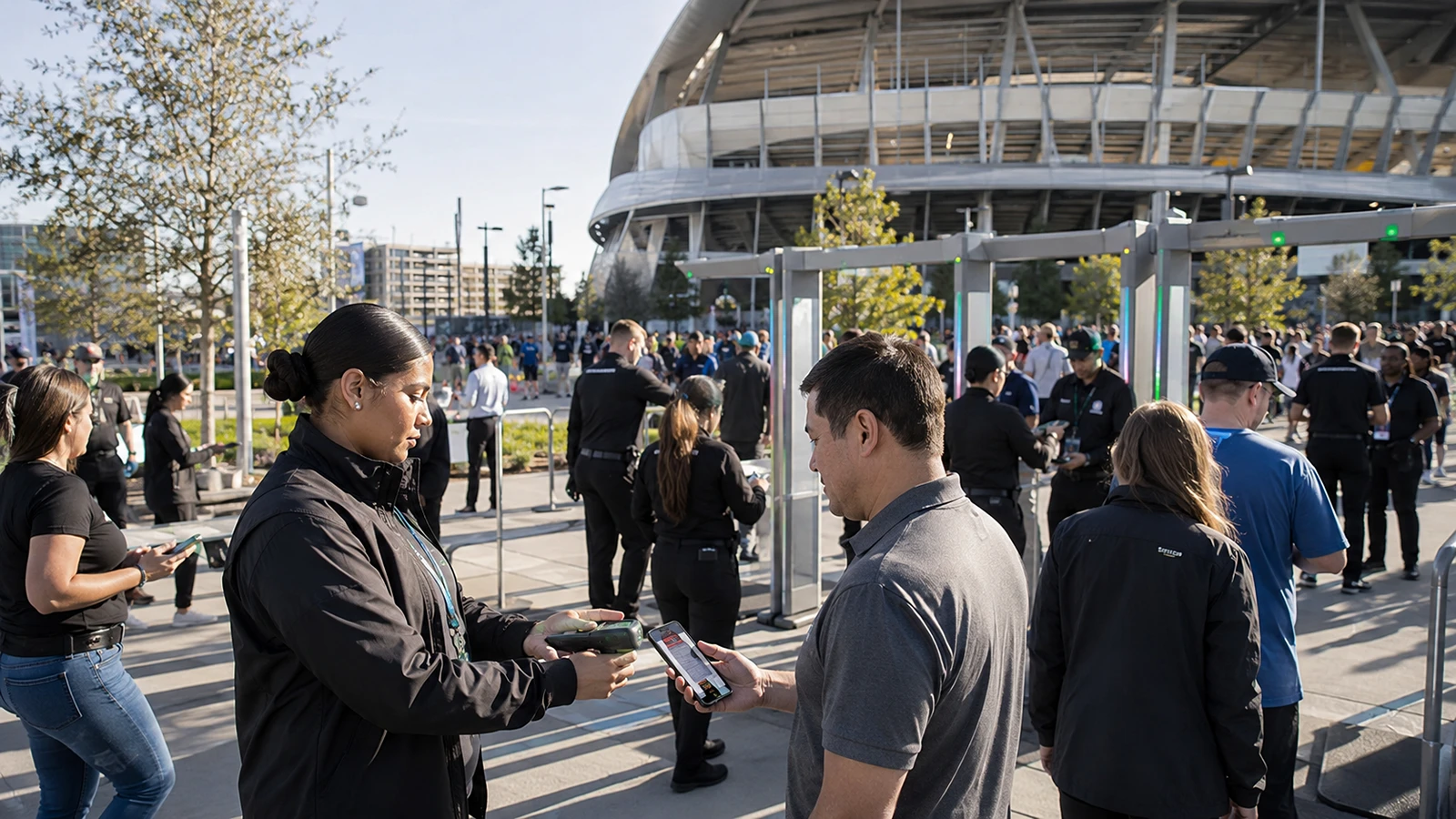
- Scanning method used, such as manual checks or mobile barcode scanning
- Guest arrival patterns, including early surges or late spikes
Each of these factors directly impacts event entry throughput, which is the number of attendees a single checker can process per hour.
The Impact of Poor Entry Planning
When staffing is miscalculated, the consequences are immediate:
- Entry queues exceed 10 minutes
- Guest satisfaction drops early in the event
- Staff are forced into reactive problem-solving instead of controlled operations
This isn't just anecdotal. Consumer research shows that roughly 39% of people will abandon a line or switch to a competitor rather than keep waiting once frustration sets in, according to Waitwhile's 2025 State of Waiting in Line report, a dynamic that translates directly to lost engagement and negative sentiment at ticketed events. For professional event planners and brand teams, this creates reputational risk and affects overall event performance.
The Smarter Approach
Instead of relying on outdated ratios, leading event teams use a throughput-based staffing model. This method calculates staffing needs based on real processing capacity at entry points, ensuring smoother flow and better guest experience, and it works hand in hand with the broader run-of-show planning that keeps every phase of a large event on schedule.
In the next section, you will learn exactly how to calculate the number of ticket checkers required using a simple, reliable formula.
CEO Excerpt
Accurate entry staffing is the difference between a smooth event launch and immediate operational failure. This guide replaces guesswork with a proven, scalable method based on real throughput. Plan smarter, reduce costs, and protect the guest experience from the first touchpoint. - Daniel Muersing
How to Calculate the Number of Ticket Checkers for Your Event
To answer the question of how many ticket checkers you need for an event, you need a method based on real entry flow, not assumptions. The most reliable approach is a throughput-based calculation, which aligns staffing with how quickly guests can actually be processed.
The Ticket Checker Calculation Formula
Use this formula to determine your staffing requirement:
Total Attendees ÷ Adjusted Throughput per Checker ÷ Entry Window (hours) = Number of Ticket Checkers
This formula ensures your event staffing for entry gates is based on capacity, timing, and real-world conditions.
Step 1: Define Total Attendance
- Start with your confirmed or expected number of attendees.
- Example: 10,000 guests
- This is the total volume your team must process at entry.
Step 2: Define Your Entry Window
- Determine how long before peak time guests will arrive.
- Example: 30 minutes = 0.5 hours
- Shorter entry windows require more staff to avoid congestion.
Step 3: Estimate Throughput per Checker
Throughput depends on your scanning method:
- Manual ticket checking: 250 to 300 guests per hour
- Mobile barcode scanning: 400 to 500 guests per hour
- QR code systems: 550 to 650 guests per hour
This is your baseline processing speed per staff member.
Step 4: Adjust for Real-World Conditions
Live events rarely operate at full efficiency. You should reduce throughput to account for:
- Group arrivals
- Ticket issues or delays
- Staff variability
Recommended adjustment: reduce throughput by 20 percent. Example: 450 becomes 360 guests per hour. This gives a more realistic event entry throughput figure.
Step 5: Apply the Formula
Now calculate your staffing requirement:
10,000 attendees ÷ 360 ÷ 0.5 hours = 55.5
Round up to ensure coverage:
56 ticket checkers required
Step 6: Add an Operational Buffer
Always include a buffer of 10 to 15 percent to handle:
- Late arrival surges
- Equipment issues
- Staff rotation and breaks
Final staffing range: 62 to 65 ticket checkers
Key Takeaway
If you are planning stadium event staffing or large-scale activations, this method gives you a clear and defensible answer to how many ticket checkers you need.
It replaces guesswork with a structured approach that improves entry flow, reduces queues, and protects the guest experience.
How Scanning Technology Impacts Ticket Checker Requirements
The type of ticket scanning system you use has a direct impact on how many ticket checkers you need for an event. Faster systems increase event entry throughput, which reduces staffing requirements and improves guest flow at entry points.
For event planners, this is one of the most important decisions in event staffing for entry gates, as it affects both operational efficiency and cost. It's a similar calculation to the one we outline in how Las Vegas conventions lose attendees before the first session, where slow check-in technology at the door quietly costs organizers turnout.
Ticket Checker Throughput by Scanning Method
Different technologies process guests at different speeds. Below is a realistic comparison of throughput rates:

These differences significantly affect your ticket checker ratio for events. The shift toward faster entry isn't just theoretical; mobile ticketing adoption grew 53% year-over-year across global sports leagues in 2025, according to Ticketmaster's 2025 Nexus State of Ticketing report, a trend that is directly lowering the staffing loads venues need at the gate.
Why Technology Matters for Event Staffing
Using faster scanning technology allows you to:
- Reduce the number of ticket checkers required
- Minimize queue times at entry gates
- Improve the overall guest experience
- Lower staffing costs without compromising efficiency
For stadium event staffing, where large volumes must be processed quickly, the impact is even more pronounced.
Example: Staffing Impact by Technology
Consider a 10,000-attendee event with a 30-minute entry window:
Manual Checking:
- Throughput: 300 per hour
- Staff required: 56 checkers
Mobile Barcode Scanning:
- Throughput: 450 per hour
- Staff required: 33 checkers
Result:
- Reduction of 23 staff members
- Lower operational costs
- Faster and smoother entry flow
Key Takeaway
If you are evaluating how many staff you need for an event, scanning technology should be part of your calculation, not an afterthought. Investing in faster systems can reduce staffing needs by 20 to 40 percent while improving operational control.
Ticket Checker Requirements by Event Size
Once you understand the calculation method, the next step is applying it to different event scales. Whether you are planning a mid-size activation or a large stadium event, the same throughput-based approach will determine how many ticket checkers you need.
Below are practical scenarios to help you estimate event staffing for entry gates based on event size.
5,000-Attendee Event
This is typical for brand activations, concerts, or regional sports events, the same audience mix we cover in what a brand activation agency actually does in San Francisco.
Assumptions:
- Entry window: 45 minutes (0.75 hours)
- Mobile barcode scanning
- Adjusted throughput: 360 guests per hour
Calculation:
5,000 ÷ 360 ÷ 0.75 = 18.5
Staffing Requirement:
- Base: 19 ticket checkers
- With buffer: 22 ticket checkers
Insight: Even at this scale, underestimating staffing can quickly lead to congestion during peak arrival periods.
10,000-Attendee Event
This represents large concerts, festivals, or multi-brand experiences.
Assumptions:
- Entry window: 30 minutes (0.5 hours)
- Mobile scanning
- Adjusted throughput: 360 guests per hour
Calculation:
10,000 ÷ 360 ÷ 0.5 = 55.5
Staffing Requirement:
- Base: 56 ticket checkers
- With buffer: 62 to 65 ticket checkers
Insight: Short entry windows significantly increase staffing needs, even when using efficient scanning systems.
20,000-Attendee Stadium Event
Large-scale events require precise planning and strong operational control.
Assumptions:
- Entry window: 60 minutes (1 hour)
- QR code scanning
- Adjusted throughput: 500 guests per hour
Calculation:
20,000 ÷ 500 ÷ 1 = 40
Staffing Requirement:
- Base: 40 ticket checkers
- With buffer: 45 to 48 ticket checkers
Insight: Higher-capacity scanning systems reduce staffing pressure, but coordination across multiple gates becomes critical.
Key Takeaway
There is no single ticket checker ratio for events that works across all scenarios. Staffing must scale based on:
- Total attendance
- Entry window duration
- Scanning technology
- Crowd arrival patterns
Using this structured approach ensures your stadium event staffing plan is accurate, efficient, and prepared for real-world conditions.
Why VIP Entry Requires Separate Ticket Checker Staffing
When planning event staffing for entry gates, VIP access is often underestimated. Many teams assume VIP guests can be processed using the same staff as general admission. In practice, this creates delays across all entry points.
To accurately determine how many ticket checkers you need for an event, VIP entry must be calculated separately.
How VIP Processing Differs from General Admission
VIP guests typically require additional verification steps beyond standard ticket scanning. These may include:
- Identity or name verification
- Credential or wristband distribution
- Access level confirmation
- Guest list checks
As a result, VIP processing is significantly slower.
Average processing time:
- General admission: 15 to 20 seconds per guest
- VIP entry: 3 to 4 minutes per guest
This creates a major difference in event entry throughput.
The Impact on Staffing Requirements
Because VIP processing is slower, fewer guests can be handled per checker per hour. If you combine VIP and general admission:
- General entry lines slow down
- VIP queues still build up
- Staff are forced to switch between processes
- Entry flow becomes inconsistent
Events that do not separate VIP staffing often experience 30 to 40 percent longer entry times.
Best Practice for VIP Staffing
To maintain efficiency across all entry points:
- Assign dedicated VIP ticket checkers
- Calculate VIP throughput separately from general admission
- Avoid reallocating general staff to VIP during peak periods
- Provide additional training for VIP handling and guest interaction
This approach ensures both VIP guests and general attendees experience smooth entry, and it's part of the same budgeting conversation we walk through in what to budget for premium event staffing in major markets.
When Separate VIP Staffing Is Essential
You should always plan separate VIP staffing when:
- The event exceeds 1,000 attendees
- VIP access includes multiple tiers or credentials
- Additional services such as gifting or accreditation are involved
For stadium event staffing and premium brand events, this is a standard operational requirement.
Key Takeaway
If you are calculating ticket checker requirements for events, VIP entry cannot be treated as a minor variation. It requires its own staffing model, based on slower processing times and higher service expectations.
Real-World Example: What Happens When Staffing Is Off
At a recent 12,000-attendee stadium event, entry staffing was calculated using a standard ratio instead of throughput.
On paper, staffing looked sufficient.
In reality:
- 70% of attendees arrived within 25 minutes
- Entry queues exceeded 20 minutes
- Supervisors were forced to step in as checkers
- VIP entry delays impacted sponsor experience
After switching to a throughput-based model for the next event:
- Entry time dropped to under 8 minutes
- Staffing was reduced by 15%
- Guest satisfaction scores improved significantly
The difference wasn’t more staff. It was smarter planning.
Signs Your Event Is Understaffed at Entry Gates
Even with careful planning, issues with event staffing for entry gates can appear quickly once doors open. Recognizing these signs early allows you to respond before guest experience is significantly impacted.
If you are unsure whether you have the right number of ticket checkers, these indicators will help you assess your situation in real time.
1. Entry Queues Exceed 10 Minutes
One of the clearest signs of understaffing is extended wait times.
- Guests waiting longer than 10 minutes begin to show frustration
- Perceived event quality drops before the experience even starts
- Negative feedback often originates from entry delays
The pattern shows up well beyond live events, too: broader queue research finds that a large share of people abandon a line entirely once the wait crosses the 10-minute mark, according to QueueHub's 2024 queue management data. For stadium event staffing, maintaining efficient flow at the gate is critical to overall event success.
2. Uneven Distribution Across Gates
If some entry points are overloaded while others remain underused, it signals a staffing or planning issue.
Common causes include:
- Poor staff allocation
- Lack of real-time coordination
- Ineffective crowd direction
This reduces overall event entry throughput, even if total staff numbers appear sufficient.
3. Staff Clustering or Bottlenecks
When ticket checkers begin grouping together or slowing down:
- Processing speed drops
- Guests hesitate or become confused
- Lines stop moving consistently
This often indicates that staff are overwhelmed or unclear on process flow.
4. Supervisors Stepping Into Operational Roles
Supervisors should manage flow, not replace frontline staff.
If supervisors are:
- Checking tickets
- Managing queues directly
- Handling guest issues continuously
It suggests that your ticket checker ratio for events is too low and lacks buffer.
5. Sudden Surges Create Immediate Delays
Events rarely have perfectly even arrival patterns. If your team cannot absorb surges:
- Queues build rapidly
- Recovery becomes difficult without additional staff
- Entry delays extend beyond peak periods
This is a clear sign that your staffing model did not account for real-world variability, one of the recurring mistakes we cover in 10 Mistakes Event Hosts Make When Staffing Festivals in Major U.S. Cities.
Key Takeaway
You do not need post-event analysis to know if your staffing was insufficient. The first 15 to 30 minutes of entry will reveal whether your ticket checker requirements were accurate.
Monitoring these signals allows you to adjust operations quickly and protect the guest experience.
Final Takeaway: Plan Ticket Checker Staffing with Accuracy
If you are still asking how many ticket checkers do I need for an event, the answer comes down to using the right method. Fixed ratios do not account for real entry conditions and often lead to delays, overcrowding, and a poor guest experience.
A throughput-based approach ensures your event staffing for entry gates is accurate, scalable, and aligned with real-world performance.
What to Remember
To calculate the right ticket checker requirements for events, focus on:
- Total number of attendees
- Entry window duration
- Scanning technology used
- Adjusted throughput per checker
- Buffer for real-time conditions
Using the formula:
Attendees ÷ Throughput ÷ Time = Ticket Checkers Required
This gives you a clear and defensible staffing plan for both small and stadium event staffing scenarios, and it pairs naturally with the hospitality staffing strategies that keep the rest of the guest journey running just as smoothly.
Why This Matters for Event Success
Accurate entry staffing helps you:
- Reduce queue times and congestion
- Improve guest satisfaction from arrival
- Maintain operational control during peak periods
- Optimize staffing costs without compromising service
For event planners, brand managers, and agencies, this directly impacts how your event is perceived and remembered.
Plan Entry Staffing with Confidence
Getting ticket checker staffing right is the difference between a smooth event launch and immediate operational chaos.
If you're planning a large-scale event, festival, or stadium activation, don’t rely on guesswork.
Work with experienced event staffing teams who understand real entry flow dynamics.
👉 Get a customized staffing plan based on your event size, entry window, and technology setup.
👉 Reduce queues, optimize costs, and deliver a seamless guest experience from the first touchpoint.
Ready to elevate your next event?
Join thousands of event planners who trust EventStaff.com for reliable, professional staffing solutions.
Trusted by event professionals nationwide
1k+
Events Staffed
2 million+
Guests Served
97%
Positive reviews