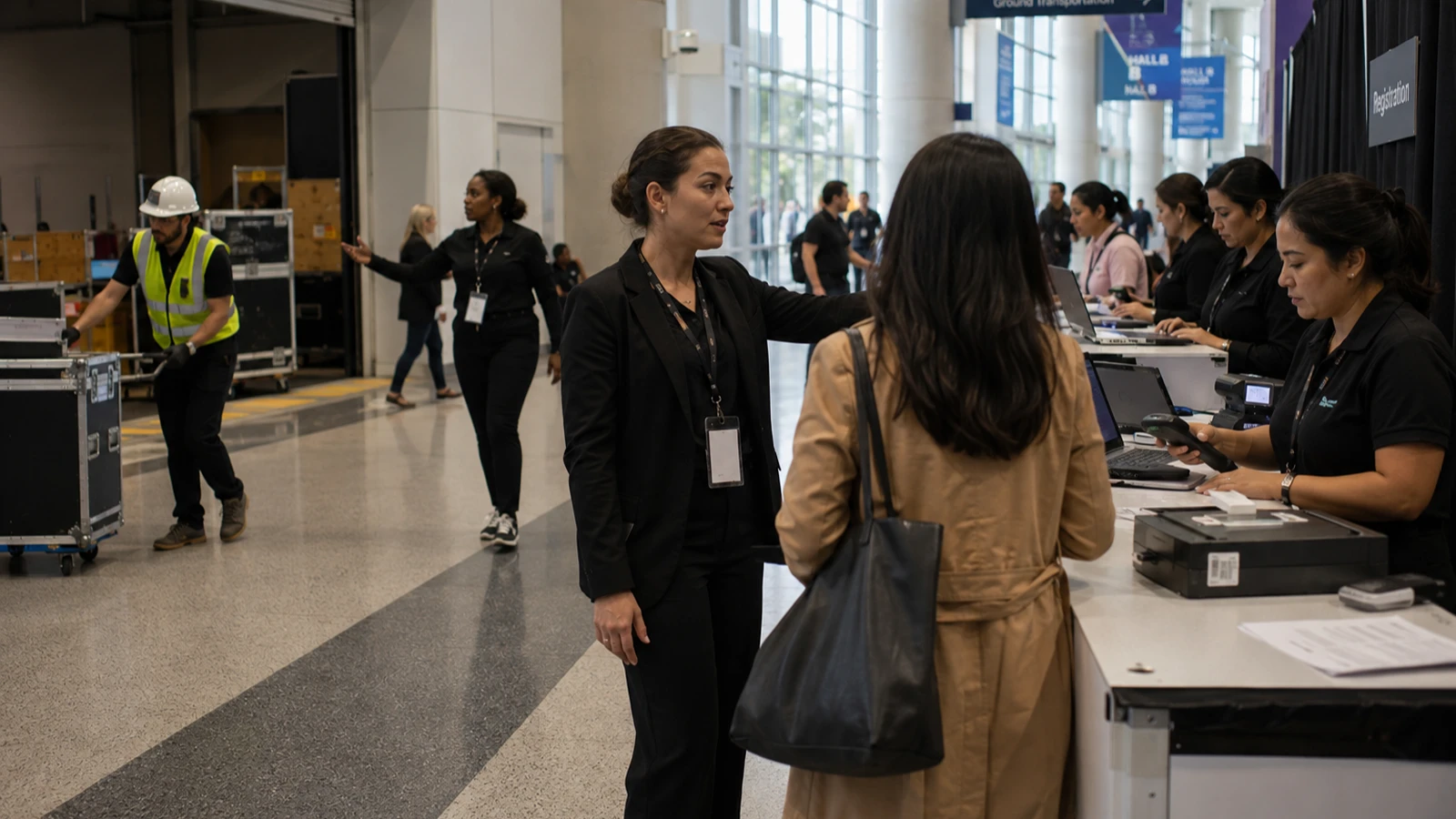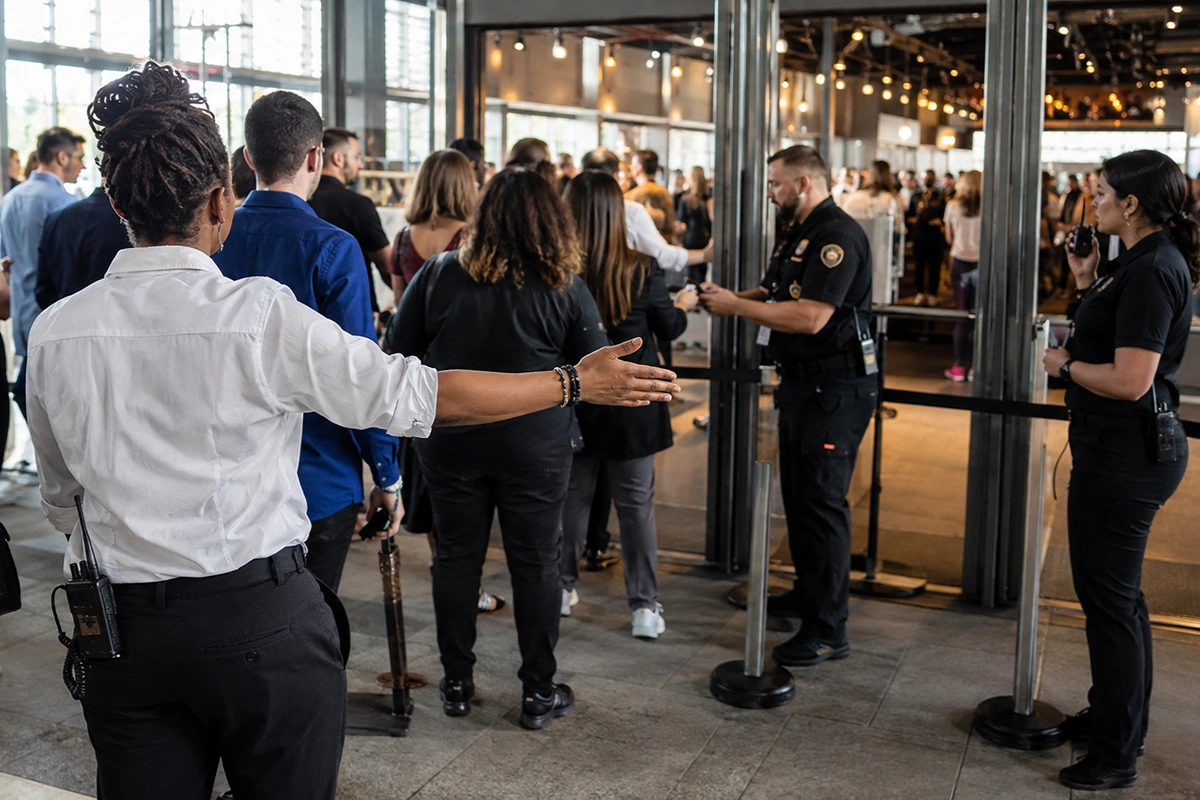

NeoCon exhibitors do not only need a booth that looks active. They need a booth where the right visitors are greeted, qualified, scanned, routed, and handed off before the next wave of aisle traffic moves past.
That is where Trade Show Staffing in Chicago becomes a lead-generation decision. At a show like NeoCon, booth staff help exhibitors turn walk-up interest into organized conversations, better lead data, smoother demo flow, and fewer missed opportunities across long show days.
This blog focuses on staffing for NeoCon exhibitors and booth traffic management, especially for brands that need to support product discovery, scheduled appointments, sales conversations, and visitor movement at the same time.
Quick Answer
Trade Show Staffing in Chicago helps NeoCon exhibitors manage booth traffic by separating greeting, lead qualification, demo flow, appointment check-ins, badge scanning, and sales handoffs. The right booth team keeps visitors moving while helping qualified prospects reach the correct sales or product expert before interest fades.
CEO Excerpt
“Trade show staffing should help exhibitors protect the value of every booth conversation. At a show like NeoCon, visitor traffic moves quickly, and sales teams need support before the handoff happens. The right booth staff help qualify interest, keep the booth organized, and make post-show follow-up stronger.”- Daniel Meursing, CEO, Eventstaff
Why NeoCon Booth Traffic Behaves Differently
NeoCon is built around serious product discovery. The official NeoCon exhibitor page says the show features more than 400 leading and emerging brands introducing thousands of products and solutions across workplace, healthcare, education, hospitality, retail, residential, public space, and government markets through NeoCon exhibitor information.
That audience mix changes how booth staffing should work. Visitors may include architects, designers, dealers, workplace strategists, facility leaders, procurement teams, media, students, consultants, and end users. Some are gathering broad ideas. Others are comparing vendors for real projects, looking for specification details, checking finishes, or arriving for a scheduled meeting with a product lead.
For exhibitors, the challenge is mixed-intent traffic. A casual browser and a high-value buyer can arrive within the same minute, and both may look interested from the booth edge. If the booth has no qualification layer, sales reps can spend equal time with both while stronger prospects wait, walk away, or get scanned without enough follow-up context.
This is why trade show staffing for lead generation events needs to be treated as a booth operating system. Booth staff are not there to simply add presence at the aisle. They help identify the visitor’s intent, ask the right first question, route the person to the right next step, and protect the sales team from being pulled into every low-fit conversation.
For NeoCon exhibitors, that matters because product interest can look deceptively simple. A visitor may stop because a finish, furniture system, material, or visual display catches their eye. The staffing question is whether that interest becomes a qualified conversation, a useful scan, a scheduled follow-up, or just another person who passed through the booth without a clear next step.
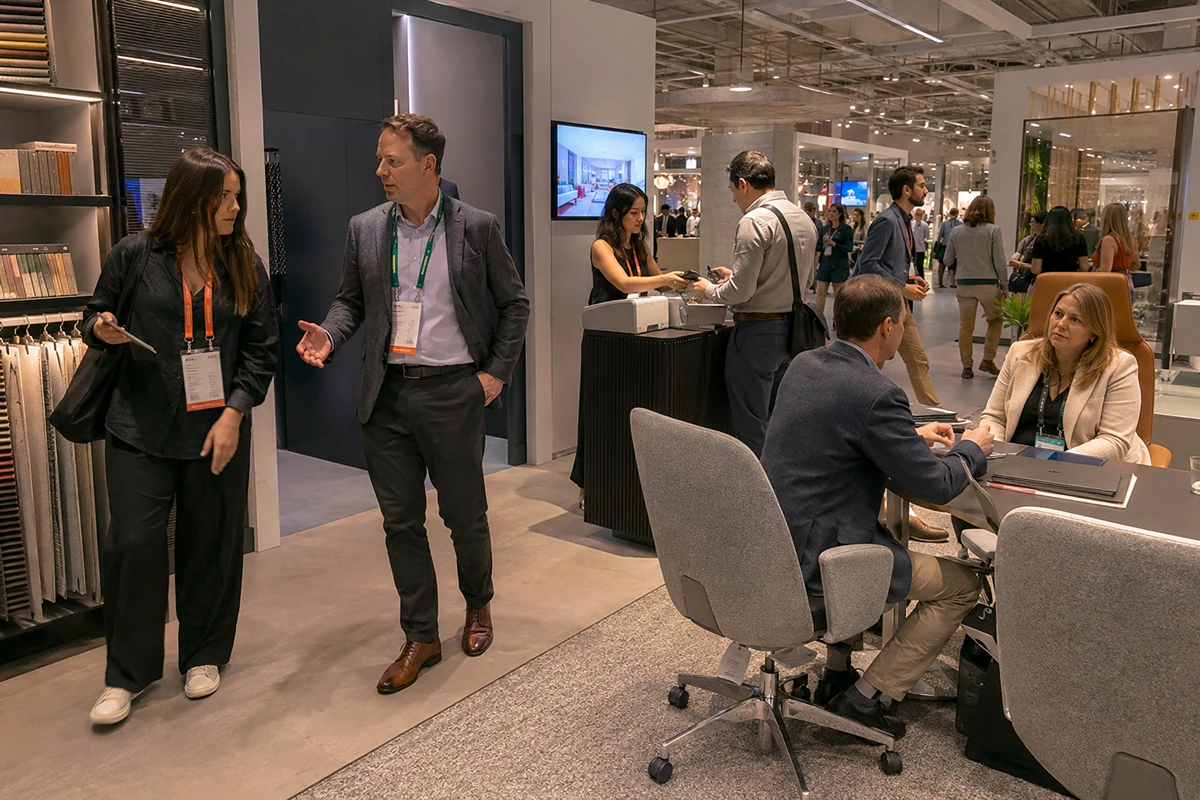
The Booth Traffic Problem Starts Before the Sales Conversation
Most lead loss starts before a salesperson ever speaks to the visitor. It begins at the booth edge, where the visitor is deciding whether to enter, ask a question, scan a code, take a photo, touch a sample, or keep moving.
At NeoCon, visitors often move between floors, showrooms, product displays, CEU sessions, appointments, and exhibitor meetings. Many are working through a tight agenda. If the first staff interaction feels unclear, slow, or too sales-heavy, the visitor may leave before the exhibitor knows whether they were a serious prospect.
The practical staffing implication is that exhibitors need a front layer and a sales layer. The front layer manages approach, qualification, scanning, routing, and early questions. The sales layer handles deeper product conversations, technical discussion, relationship development, and high-value prospects.
When the same person tries to greet, qualify, scan, explain, demo, and hand off every visitor, the booth loses control. The person at the front becomes too busy to greet new arrivals. The sales rep becomes trapped in a low-priority conversation. The badge scan happens without notes. The qualified visitor waits too long and moves on.
A stronger approach separates the visitor path:
- Greeting identifies interest and opens the conversation. This role keeps the booth approachable and prevents visitors from standing near the edge without being acknowledged. A good greeter can quickly determine whether the visitor wants a product overview, a sample, a meeting, or a sales conversation.
- Qualification sorts casual interest from real opportunity. Staff should ask short, useful questions about role, company, project type, market sector, buying timeline, or specification need. The goal is to understand the visitor’s purpose without making the interaction feel stiff.
- Routing connects the visitor to the right person. A workplace designer, dealer, healthcare planner, purchasing contact, or corporate real estate leader may each need a different conversation. Booth staff protect the visitor experience by sending people to the right specialist quickly.
- Lead capture preserves context. Post-show follow-up often depends on someone reviewing many scans after the floor closes. If the only record is a badge scan, the follow-up team may not know whether the visitor cared about workplace seating, healthcare materials, dealer pricing, or a future project. Booth staff should capture one useful note at the moment of interest.
- Handoff protects momentum. Sales reps should not have to restart every conversation from the beginning. A short handoff such as “architect, healthcare project, interested in finishes, wants samples” gives the sales team a better starting point.
This is the core reason staffing for NeoCon exhibitors and booth traffic management matters. Booth staff make the visitor path clearer before the sales conversation begins, which helps exhibitors protect both traffic flow and lead quality.
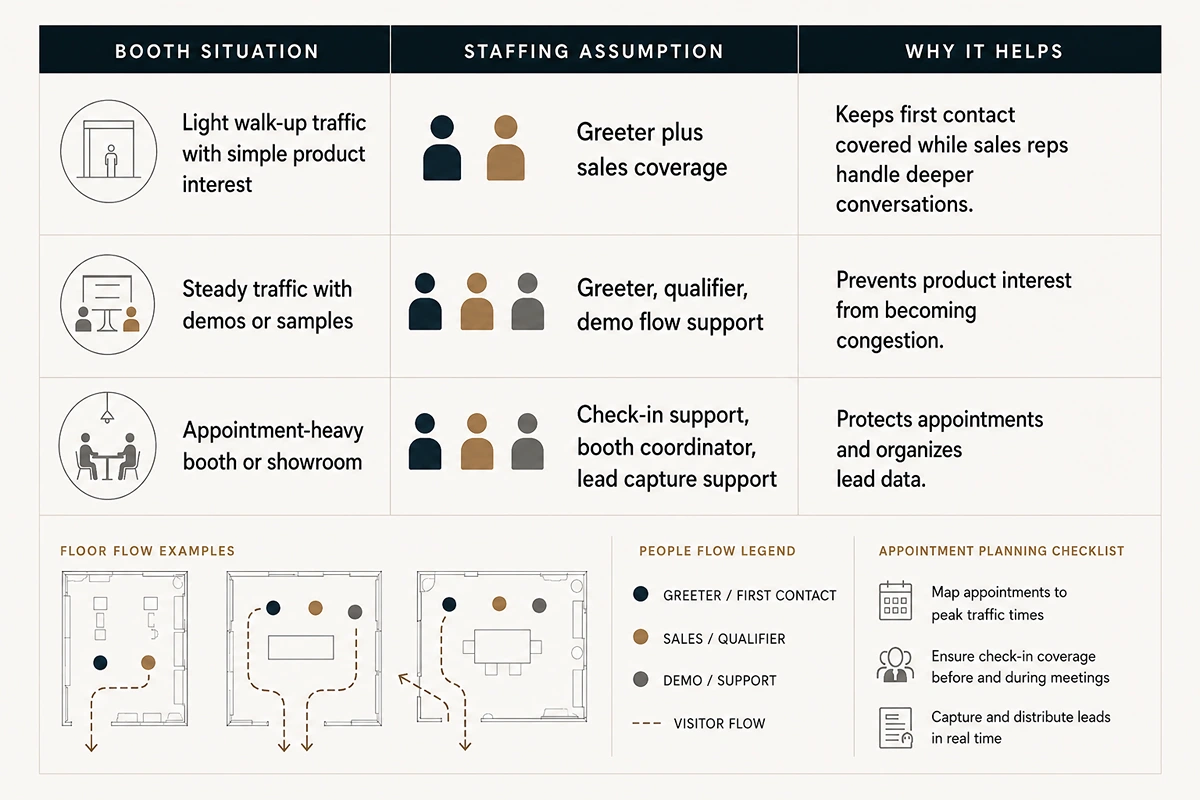
NeoCon Booth Traffic-to-Lead Staffing Matrix
A useful booth staffing plan should connect each visitor moment to a clear staff role. The matrix below gives exhibitors a practical way to think about booth traffic, lead quality, and exhibitor support.

For planning purposes, most exhibitors should separate greeting from qualification when traffic arrives in waves or when product demos attract multiple visitors at once. A practical benchmark is to assign one front-of-booth greeter for steady walk-up traffic, then add qualification or demo support when the sales team is handling more than one serious conversation at a time.
The matrix also helps exhibitors avoid generic headcount planning. The question is not simply how many staff are available. The better question is which visitor moments need ownership. A small booth with heavy demo interest may need more flow support than a larger booth with mostly scheduled meetings. An appointment-heavy showroom may need check-in and coordination more than a traditional greeter.
This is also where booth layout matters. Open booths need staff who can intercept and guide traffic without blocking movement. Booths with sample tables need staff near the product area. Booths with private meeting zones need someone to protect appointment flow. The staffing plan should follow the way visitors physically move through the space.
Lead Generation Needs a Qualification Layer
A booth can feel busy all day and still produce weak follow-up if the team does not qualify visitors properly. A crowded booth can create the impression of success, but traffic only becomes valuable when the exhibitor understands who visited, what they cared about, and what should happen next.
That is why trade show staffing for lead generation events should include short, repeatable qualification questions. These questions do not need to be aggressive or overly scripted. They need to help staff separate immediate opportunity from general interest.
At NeoCon, useful booth questions may include:
- Are you evaluating products for a current project, future project, or general research? This separates immediate opportunities from long-range interest without making the visitor feel interrogated. It also helps the follow-up team prioritize who should receive a fast response after the show.
- Which market are you focused on: workplace, healthcare, education, hospitality, retail, public space, or residential? NeoCon’s category spread makes this question practical because it helps route the visitor to the right product lead or sales contact.
- Are you looking for technical details, pricing direction, samples, or a meeting with a specialist? This gives booth staff a quick way to understand the next best step. Some visitors need a deep product conversation, while others simply need information captured for later.
- Should we connect you with someone now or capture details for follow-up? This prevents sales reps from being pulled into every conversation while still giving the visitor a useful option.
The staffing value is in consistency. If every team member asks different questions, the lead data becomes uneven. If no one asks questions, badge scans may pile up without enough context. A trained booth staffer can ask one or two useful questions, scan the badge, add a short note, and route the visitor without slowing the booth.
For exhibitors, this protects sales energy. Sales reps can focus on serious prospects, technical conversations, key accounts, and scheduled meetings while booth staff keep the top of the funnel moving.
Product Demos Create Traffic Clusters
NeoCon exhibitors often attract visitors through visual and tactile product interest: finishes, furniture systems, lighting, surfaces, textiles, seating, workplace products, acoustic solutions, technology, and sample displays. A strong product moment can pull several people into the booth at once.
That attention is valuable, but it creates a physical booth-management problem. Visitors may gather near a demo point, block sightlines, interrupt active conversations, or create a small crowd that makes other visitors hesitate to enter. If no one owns that area, the product display can generate interest while also reducing lead capture.
A better booth plan assigns demo flow support. This person does not replace the product specialist. Their role is to manage the area around the product moment so the specialist can stay focused on deeper questions.
Demo flow support can invite waiting visitors into the right position without crowding the sales conversation. They can capture quick interest from visitors who cannot stay. They can direct technical questions to the right person instead of letting multiple people interrupt one specialist. They can also watch the aisle edge and reset the flow when visitors begin to spill into shared space.
This matters because traffic clusters are often where leads get lost. The most interested visitor may not be the loudest person in the group. A designer may quietly examine a finish and leave because no one greeted them. A dealer may ask one question and move on because the product expert is tied up. A staff member assigned to demo flow can identify those moments and create a path for capture or handoff.
For staffing for NeoCon exhibitors and booth traffic management, product demos should be treated as traffic magnets. If the booth has a magnet, someone needs to manage what happens around it.
Large Convention Exhibitors Need Support Beyond the Booth Counter
NeoCon is hosted at THE MART, which describes the show as a leading platform and major event for the commercial design industry, serving design professionals and end users through THE MART’s NeoCon event page. That venue context matters because many exhibitors are managing more than one simple booth interaction.
Some exhibitors balance showroom traffic, temporary displays, meetings, demos, product launches, appointment schedules, and follow-up priorities. A booth team that looks strong at 10 a.m. can feel thin by mid-afternoon if breaks, overlapping conversations, and appointment arrivals are not planned.
That is where exhibitor support staffing for large conventions becomes valuable. Support staff help keep the booth functioning while the core sales team focuses on relationship-building and product conversations.
For planning purposes, exhibitors can think about support needs in three bands:
The NeoCon 2026 exhibitor checklist points exhibitors toward staff registration, company profile setup, hotel planning, move-in/out details, deliveries, construction, and booth services through the NeoCon exhibitor checklist. That supports the larger planning point: booth staffing should be integrated into pre-show preparation, not added after the booth design, travel, and materials are already set.
Staffing should be discussed while the booth team is still mapping zones. Where do walk-ups enter? Where do scheduled meetings wait? Where do demos happen? Where are samples handled? Where should casual visitors be scanned without blocking high-value conversations? These questions decide whether booth staff are placed effectively or simply added to the floor as extra bodies.

Staffing Roles That Matter for NeoCon Exhibitors
The strongest booth staffing plan depends on the exhibitor’s traffic pattern, product category, and sales goals. For most NeoCon exhibitors, the relevant roles include booth staff, greeters, lead qualifiers, appointment support, demo flow support, and a booth coordinator or staff lead.
Booth Staff and Greeters
Booth staff and greeters own the first moment of contact. They help visitors understand whether the booth is relevant, who to speak with, and where to go next.
For NeoCon, this role needs more product awareness than a generic greeting position. Staff should know the exhibitor’s categories, priority products, buyer types, and basic qualifying questions before the show opens. If they only know where to stand, they cannot meaningfully protect the sales team’s time.
Lead Qualifiers
Lead qualifiers protect sales time. Their job is to identify whether a visitor is a designer, buyer, dealer, end user, media contact, student, or general browser, then route the conversation accordingly.
This role is especially useful when visitor volume rises. Without qualification, the sales team may spend too much time on low-intent conversations while stronger prospects wait. A lead qualifier creates a first filter without making the booth feel restrictive.
Appointment and Check-In Support
Appointment support helps scheduled meetings start on time. This role can confirm names, notify the correct rep, manage waiting visitors, and keep appointment flow from colliding with walk-up traffic.
For appointment-heavy booths, this role protects the highest-value conversations of the day. A scheduled buyer should not stand near the booth edge while the team tries to find the right person.
Demo Flow Support
Demo flow support manages visitor movement around products, samples, and visual displays. This role helps visitors engage without crowding the booth or interrupting active conversations.
When demos are central to the booth, this role can make the difference between controlled attention and unmanaged congestion. It also helps ensure visitors who show interest are captured before they leave.
Booth Coordinator or Staff Lead
A booth coordinator keeps the staffing plan aligned during the day. This person can manage breaks, answer staff questions, handle changes, and help decide when visitors need to be routed differently.
For multi-day shows, a staff lead also helps maintain consistency as energy drops and schedules shift. The booth may need different staff placement after lunch than it needed during the morning rush.
What Exhibitors Usually Miss Before Show Week
Many booth issues are created before the first visitor arrives. The problem is usually a staffing plan that does not match the way visitors actually move through the booth.
They expect sales reps to handle every first touch.
Sales reps are valuable, but using them as greeters can weaken lead quality. If reps are pulled into every casual question, they have less time for qualified prospects. The staffing implication is to place trained booth staff at the front so reps can focus on higher-value conversations.
This also changes the visitor experience. A booth staffer can greet lightly, ask one practical question, and route the visitor without making every interaction feel like a sales pitch. That makes the booth easier to enter and easier to manage.
They scan badges without capturing context.
A scan is useful, but a scan without notes can become weak follow-up. At a show like NeoCon, visitors may ask about specific materials, use cases, categories, or future projects. Booth staff should capture short notes that explain why the lead matters.
The fix is simple but often missed. Staff should be trained on what counts as a useful note before the floor opens. “Healthcare project,” “dealer inquiry,” “needs samples,” or “interested in acoustic panels” can make post-show follow-up far stronger than a scan alone.
They do not assign ownership for demo traffic.
Product demos and sample areas naturally attract clusters. Without demo flow support, staff may miss visitors who are interested but do not want to interrupt. The exhibitor may see a crowded booth and assume it is working, while qualified visitors quietly leave.
Assigning ownership helps keep the area active and organized. One person can watch who is waiting, who needs a scan, who has a technical question, and who should be routed to a product specialist.
They forget break coverage.
Multi-day conventions create fatigue. If the booth has no break plan, coverage becomes uneven and staff may leave key areas exposed. This is especially risky when a booth relies on one person to greet, scan, qualify, and support demos.
A practical fix is to schedule coverage before the show and assign one lead to monitor gaps. Breaks should not remove the only person who knows how to qualify visitors or handle appointments.
They brief staff on logistics but not buyer types.
Knowing where to stand is not enough. Booth staff should understand which visitors matter most, what questions to ask, and when to hand off to sales. That makes the booth more useful as a lead-generation system.
A good briefing should include buyer categories, priority products, top qualifying questions, handoff rules, lead note expectations, and the names or roles of sales reps who own different conversations.
How to Apply This at the Next Chicago Trade Show
Chicago is built for major meetings and conventions, with Choose Chicago positioning the city for conventions, meetings, and events across top venues and event spaces through Chicago meeting and convention planning (https://www.choosechicago.com/meeting-planners/). For exhibitors, the NeoCon lesson can apply beyond one show.
A practical planning timeline looks like this:
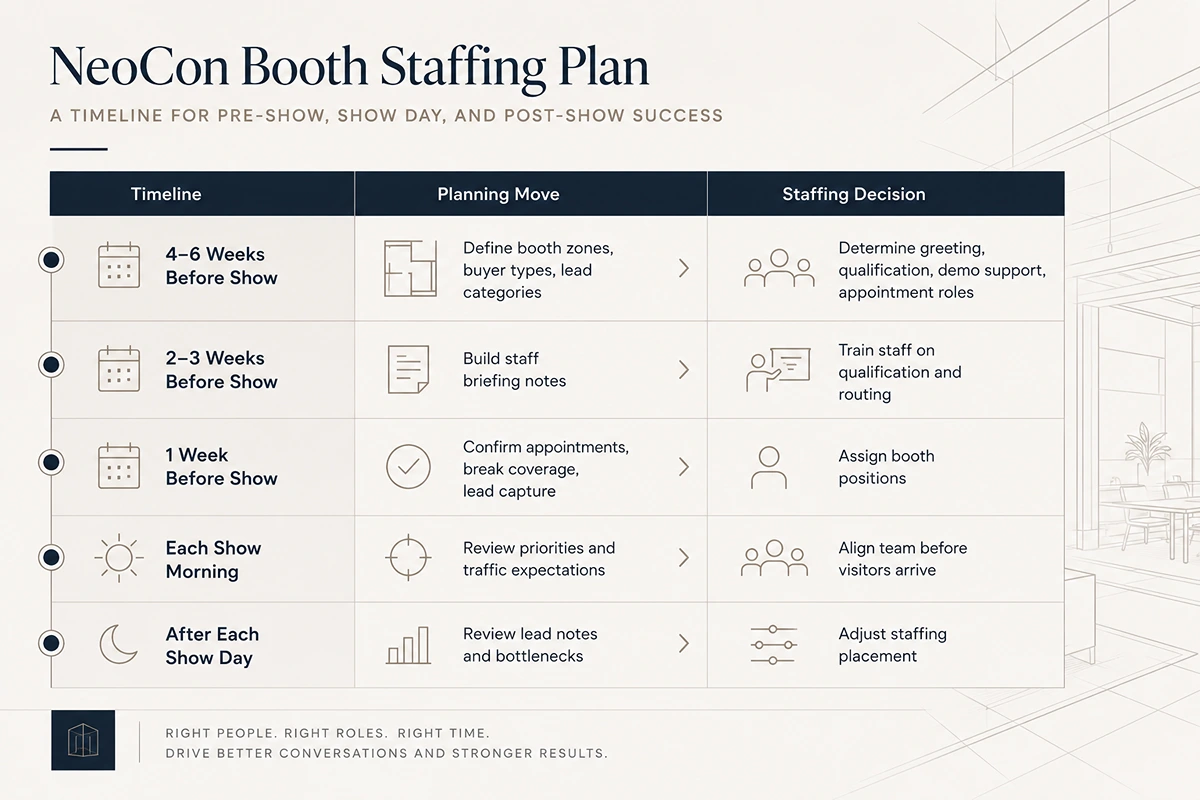
This timeline matters because staffing decisions become weaker when they are made after the booth is already built. If the team waits until show week, they may know how many people they need, but not what each person should own.
The better approach is to map the booth as a set of visitor moments. First contact, product interest, lead qualification, appointment arrival, sales handoff, and follow-up capture each need an owner. Some booths can combine roles. Others need separation. The decision should come from traffic behavior, not guesswork.
Common Mistakes to Avoid
Hiring booth staff without giving them a qualification script.
A friendly booth staffer can help the booth feel active, but lead generation needs more structure. Staff should know two or three qualifying questions, which visitor categories matter most, and when to hand off a prospect. Without that, they may greet well but fail to protect sales time.
The script should not sound robotic. It should give staff enough direction to understand whether the visitor is a designer, dealer, buyer, media contact, student, or general browser. That small layer of structure makes every scan and handoff more useful.
Putting the strongest sales rep at the booth edge.
The booth edge is important, but it is often better handled by trained booth staff who can greet, qualify, and route. Senior sales reps should be available for serious conversations, technical questions, and priority prospects.
This helps protect expert time. If the strongest rep is answering every basic product question, they may be unavailable when a decision-maker, major account, or scheduled appointment arrives.
Treating demo interest as a sales conversation every time.
Some visitors want a quick look, a sample, a photo, or a follow-up. Others need a deeper product discussion. Demo flow support helps identify which path fits.
That prevents the booth from becoming crowded around conversations that could be handled more efficiently. It also keeps staff from over-serving low-intent visitors while high-intent visitors wait.
Waiting until the show opens to define handoff rules.
Handoffs should be decided before the first visitor arrives. Staff need to know who handles dealers, designers, end users, media, and current clients. If every handoff is improvised, qualified leads can lose momentum.
A good handoff rule is specific. For example, dealer inquiries go to one rep, healthcare project conversations go to another, and media requests go to a designated contact. That level of clarity makes booth traffic easier to manage.
Forgetting that multi-day shows change by hour.
Morning traffic, lunch periods, appointment windows, and afternoon fatigue can all change booth needs. A staffing plan should allow for role rotation, breaks, and small adjustments across the day.
A booth that works at 9:30 a.m. may need a different setup by 2 p.m. The staff lead should watch for bottlenecks and move support where the visitor journey is starting to slow.
Why Eventstaff Fits This Need
Eventstaff supports exhibitors with booth staff who can be briefed around the actual visitor journey, not just the booth location. For NeoCon-style shows, that means staff can be assigned to greeting, lead qualification, demo flow, appointment support, booth coordination, and visitor routing.
That role clarity matters because exhibitors often need their sales team focused on serious prospects. When booth staff manage the first layer of traffic, sales reps can spend more time with qualified buyers, scheduled appointments, and product-specific conversations.
For Trade Show Staffing in Chicago, Eventstaff’s value sits in preparation and placement. The right staff are matched to the booth’s traffic pattern, buyer profile, and lead-generation goal so the exhibitor gains more control over what happens during peak show periods.
This is especially useful for exhibitors who know they will have different visitor types. A booth team can be briefed on which questions to ask, which guests to prioritize, how to record lead notes, and when to bring in the right sales contact. That makes staffing part of the exhibitor’s sales process rather than a separate operational task.
Bottom Line
Trade Show Staffing in Chicago helps NeoCon exhibitors manage booth traffic by turning visitor movement into a clearer lead-generation process. The strongest staffing plans separate greeting, qualification, demo flow, appointment check-in, lead capture, and sales handoff instead of expecting the sales team to absorb every task.
For staffing for NeoCon exhibitors and booth traffic management, the key is to plan by booth moment, not just staff count. For trade show staffing for lead generation events, the goal is to qualify and route visitors before the sales team loses time. For exhibitor support staffing for large conventions, the staffing plan should protect appointments, demo areas, break coverage, and post-show follow-up data.
A busy booth is only useful when the right visitors are captured, routed, and remembered. Trade show staff help make that happen.
Ready to elevate your next event?
Join thousands of event planners who trust EventStaff.com for reliable, professional staffing solutions.
Trusted by event professionals nationwide
1k+
Events Staffed
2 million+
Guests Served
97%
Positive reviews