
Introduction: Why Promotional Staff Mistakes Can Impact Brand Campaign Results
Brand activations rarely fail because of poor ideas. They fail because of execution gaps, and the biggest one is staffing.
Even with strong foot traffic and creative concepts, campaigns underperform when the team on the ground cannot engage, educate, or convert visitors effectively. In fact, experiential campaigns can deliver 3:1 to 5:1 ROI, but only when staffing is aligned with strategy.
So, what are the most common promotional staff mistakes that reduce campaign performance? And more importantly, how can you avoid them?
In this guide, we break down five critical staffing mistakes that impact engagement, conversions, and ROI, along with practical fixes used by high-performing brand activation teams.
What Are The Most Common Promotional Staff Mistakes In Brand Campaigns?
The most common promotional staff mistakes that reduce campaign ROI include:
- Assigning the wrong roles to campaign objectives
- Skipping structured brand immersion training
- Limiting staffing to peak hours only
- Operating without real-time supervision
- Failing to capture post-event data
Each of these mistakes directly impacts how customers experience your brand and whether that experience converts into measurable results.
Executive Summary
Promotional staff plays a critical role in brand campaign success, yet common planning mistakes often reduce performance. This guide outlines five key staffing errors that impact engagement, conversions, and ROI. It provides practical strategies to improve team selection, training, coverage, and measurement. By optimizing staffing decisions, brands can deliver more consistent and effective activations.
The Five Promotional Staff Mistakes That Happen Before Day One
Most brand campaigns do not fail because of poor execution on the event floor. They underperform because of decisions made during the planning stage, especially around staffing.
Before exploring each mistake in detail, here is a quick overview of the five most common issues and how they impact campaign outcomes:
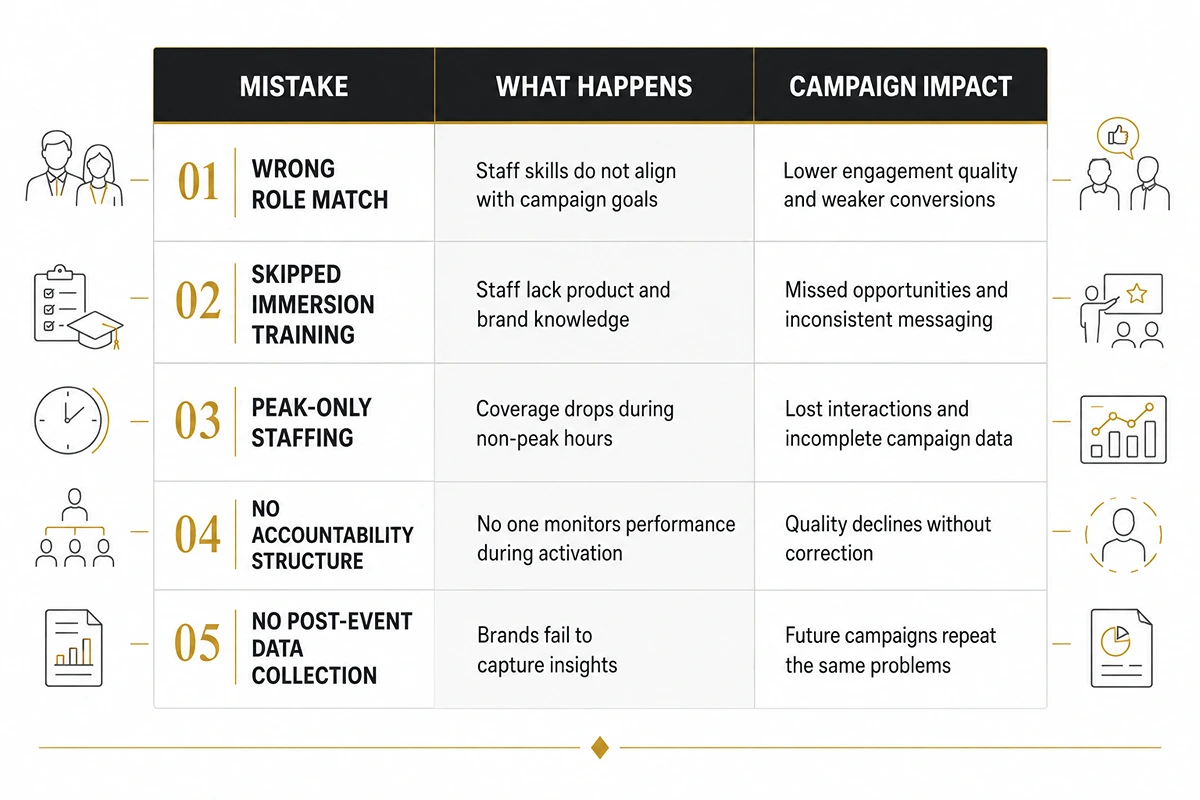
Each mistake may seem small on its own, but together they create a significant gap between expected and actual campaign performance. A well-designed booth cannot compensate for a team that cannot explain the product, and high foot traffic does not guarantee conversions without trained brand ambassadors. Understanding these issues early allows brands to build a stronger activation strategy from the beginning.
Mistake #1: Choosing The Wrong Staff Role For The Campaign Goal
One of the most critical promotional staff mistakes brand campaigns make is assigning the wrong type of staff to the wrong objective. A brand activation is not just about attracting attention; it is about guiding the visitor through an experience that aligns with the campaign goal. When staff roles are not clearly defined, conversations become inconsistent and results suffer.
Why Role Mismatch Reduces Campaign Performance
When staff are not aligned with campaign goals, conversations remain surface-level, customer questions go unanswered, engagement does not convert into action, and brand perception becomes inconsistent. Assigning general promotional staff to a technical product demo, for example, can limit the depth of interaction. Visitors may show interest, but without proper explanation, they leave without taking the next step.
Understanding The Right Staffing Roles
- Promotional Staff are best suited for driving foot traffic, distributing samples, and creating initial engagement. Their primary focus is awareness and interaction volume.
- Brand Ambassadors are best suited for product education, lead generation, and customer engagement. Their primary focus is quality conversations and conversions.
- Product Demonstrators are best suited for explaining product functionality, running guided demos, and answering technical questions. Their primary focus is product understanding and interest.
How To Choose The Right Team For Your Campaign
Before hiring staff, brands should define the campaign objective, the target audience profile, the type of interaction required, and the desired outcome from each conversation. As a simple framework: prioritize promotional staff if the goal is visibility, brand ambassadors if the goal is education, and product specialists if the goal is demonstration.
For a retail product launch inside a shopping mall, promotional staff can attract visitors and create awareness, brand ambassadors can explain product benefits and collect leads, and product demonstrators can showcase usage and answer detailed questions. A mixed staffing model ensures every stage of the customer journey is supported. It's the same market-specific logic we walked through in what a brand activation agency does in San Francisco.
Key takeaway: Role clarity is the foundation of a successful activation. When staff responsibilities align with campaign goals, conversations become more meaningful and results become measurable. However, even the right team will underperform if they are not properly prepared, which leads to the next mistake.
Mistake #2: Skipping Brand Immersion Training
Another major promotional staff mistake is assuming that a quick briefing is enough to prepare the team. While logistics may be clear, brand understanding is often shallow, which directly affects customer interactions. If staff cannot clearly explain the product, communicate the brand message, or handle customer questions, the activation loses its effectiveness.
Why Lack Of Training Hurts Engagement And Conversions
When brand immersion is skipped, staff rely on generic talking points, messaging becomes inconsistent across the team, customer questions are not handled confidently, and opportunities to convert interest into action are missed. Visitors expect knowledgeable representatives, and if they do not receive clear answers, they disengage quickly. The stakes are measurable well beyond a single event floor, too. Organizations with strong, structured training programs report being 17% more productive and 21% more profitable than those that skip it, a gap that shows up quickly in short, high-pressure activation settings.
What Effective Brand Immersion Training Should Include
- Product knowledge: key features, benefits, target customer problems, and competitive differences, so staff can tailor conversations instead of repeating scripted lines
- Brand messaging: alignment on brand voice, positioning, and campaign objectives to build trust and strengthen perception
- Objection handling: preparation for common questions like "How is this different?" or "Why should I choose this product?"
- Live roleplay and practice: opening conversations, explaining value, handling difficult scenarios, and transitioning to lead capture
How To Brief Promotional Staff Before An Activation
A strong briefing process should happen before event day and include a structured training session lasting several hours, clear documentation, defined roles and expectations, and practice opportunities for real interaction scenarios. Relying only on a short day-of-event briefing often results in surface-level understanding and inconsistent delivery. In a product demo activation, a trained brand ambassador can explain features and guide the visitor toward a decision, while an untrained staff member may only describe the product at a high level, and that difference directly impacts conversion outcomes.
Key takeaway: Training transforms staff from event support into brand representatives. Even with the right training, results can still drop if staffing coverage is inconsistent, which leads to the next mistake.
Mistake #3: Using Peak-Only Staffing Models
A common promotional staff mistake is reducing team size outside of expected busy hours. While this may seem like an efficient way to manage costs, it often leads to missed engagement opportunities and inconsistent customer experiences. It is one of the same coverage gaps that shows up repeatedly in our review of 10 mistakes event hosts make when staffing festivals in major U.S. cities.
Why Peak-Only Staffing Reduces Campaign Results
Brand activations do not operate in perfectly predictable traffic patterns. Customer flow varies based on timing, location, competing activities, and audience behavior. When staffing is concentrated only during high-traffic periods, visitors during slower hours receive limited or no engagement, demonstrations may not be consistently available, lead collection becomes inconsistent, and customer experience varies throughout the day. Not all valuable interactions happen during busy periods, either. During lower traffic times, visitors often spend more time at the activation, and staff can focus on quality engagement instead of volume, which is ideal for capturing qualified leads.
Better Approach: Flexible And Continuous Coverage
Instead of removing staff completely, maintain a minimum number of staff throughout the activation, increase team size during expected peak periods, assign flexible roles so staff can shift based on traffic, and ensure key functions like demos and lead capture are always covered. In a retail activation running for six hours, early hours may attract curious shoppers with time to engage, mid-event may see higher traffic and shorter interactions, and later hours may include highly interested visitors ready to convert. Reducing staff in early or late hours can result in missed opportunities across the customer journey. Coverage gaps also make it harder to plan a realistic budget, which is why we broke down what to budget for premium event staffing in major markets as a companion piece to this guide.
Key takeaway: Consistent coverage supports consistent results. However, even with proper coverage, performance can decline without active management, which leads to the next mistake.
Mistake #4: Running An Activation Without An Accountability Structure
Even the most experienced teams can lose consistency during a live event. One of the most overlooked promotional staff mistakes is failing to implement a clear accountability system to monitor and guide performance in real time. A brand activation is a dynamic environment where crowd flows change, energy levels shift, and team focus can drop over time. Without structured oversight, small issues can quickly affect the overall campaign outcome.
Why Lack Of Accountability Impacts Campaign Performance
When there is no supervision or performance tracking, staff engagement levels become inconsistent, lead collection may slow down, team members may drift from assigned roles, and customer experience varies across time periods. These issues are rarely visible in the moment but become clear when reviewing campaign results. The value of structured oversight extends beyond a single event day, too. Organizations with structured onboarding and supervision processes see new-hire retention improve by as much as 82%, underscoring how much early, consistent management shapes performance.
What An Effective Accountability Structure Looks Like
A well-managed activation assigns one supervisor for every 8 to 10 staff members, conducts regular check-ins throughout the activation, provides real-time feedback and direction, and sets clear expectations for engagement and lead capture. Supervisors are responsible for maintaining consistency, not just managing schedules.
What Supervisors Should Monitor
- Interaction volume: Are staff actively engaging visitors?
- Conversation quality: Are conversations aligned with campaign objectives?
- Visitor flow and behavior: Where are visitors spending time, and where are they dropping off?
- Staff positioning: Are team members in the right locations and roles?
By monitoring these factors, supervisors can make immediate adjustments that improve performance during the activation. This kind of real-time oversight is especially critical at larger, multi-day activations, a scenario covered in more depth in our event hospitality staffing strategies for conferences and festivals. If one station has high traffic but low engagement, a supervisor can reposition staff immediately, rather than only identifying the issue after the event, when it is too late to correct.
Key takeaway: Accountability turns planning into consistent execution. However, even a well-managed activation loses long-term value if insights are not captured, which leads to the final mistake.
Mistake #5: Ignoring Post-Event Data Collection
The final and often overlooked promotional staff mistake is failing to capture insights after the activation ends. While the event may feel complete once the booth is packed and the team leaves, the most valuable learning opportunity begins at that point. Without structured data collection, brands lose the ability to understand what worked, what failed, and how to improve future campaigns.
Why Post-Event Data Is Critical For Campaign ROI
Every activation generates real customer interactions that provide direct insight into customer preferences, messaging effectiveness, product perception, and objections. When this information is not recorded, brands rely on assumptions instead of real feedback. This gap matters more than most brands assume: 92% of marketers now say they plan to strengthen post-event follow-up specifically to capture data and improve ROI, which starts with what staff records on the floor.
What Data Promotional Staff Should Capture
A simple, structured approach can provide valuable insight without adding complexity: total customer interactions, number of qualified leads generated, conversion actions completed, common customer questions and objections, and direct customer feedback or quotes.
How To Implement A Simple Post-Event Process
Provide a standard reporting format for staff, allocate time at the end of each shift for data capture, encourage teams to record real observations rather than assumptions, and review insights shortly after the event. This process can take less than 10 minutes per team member but delivers long-term value. In a product launch activation, staff may notice customers repeatedly asking about pricing or compatibility. If captured, this insight can improve messaging in future campaigns; if ignored, the same objection will continue to reduce conversions.
Key takeaway: Post-event data turns individual activations into a learning system. Without this step, even successful activations cannot scale or improve over time.
CEO Excerpt
Many brand activations fail not because of poor concepts but due to avoidable staffing mistakes. Learn the five key promotional staff mistakes that impact campaign results and how to fix them to improve ROI. - Daniel Muersing
How To Improve Brand Activation ROI Through Better Staffing Decisions
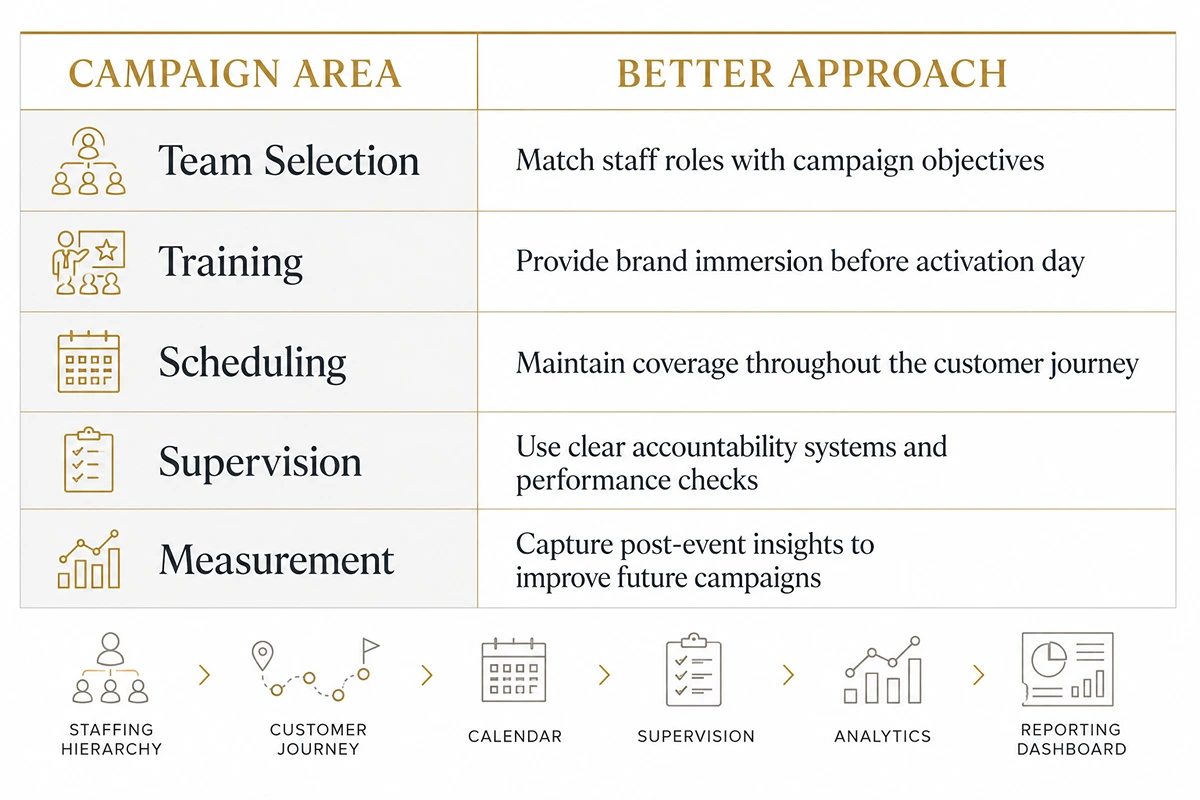
Strong campaign performance comes from aligning every staffing decision with the overall objective. Brands that avoid these common mistakes and implement structured processes can create more consistent and measurable outcomes.
The Bottom Line: Treat Staffing As A Campaign Variable, Not A Cost
Brand activations succeed when every element works together, and staffing plays a central role in that success. The most common promotional staff mistakes brand campaigns make include choosing the wrong staff roles, skipping brand immersion training, limiting staffing to peak hours, operating without accountability, and ignoring post-event data. Each of these mistakes is preventable with the right planning approach.
Brands that treat staffing as a strategic investment rather than a simple operational task can improve campaign consistency, increase conversion opportunities, and build stronger customer connections. If you're weighing staffing models against your next launch, our guide on what to budget for premium event staffing in major markets is a useful next read.
For brands looking to elevate their next activation, EventStaff provides trained promotional teams, experienced brand ambassadors, and structured staffing solutions designed to align with your campaign goals and deliver measurable results.
If your next campaign needs to deliver measurable results, staffing cannot be an afterthought.
EventStaff helps brands deploy trained promotional teams, brand ambassadors, and product specialists aligned with your campaign goals, not just event logistics.
👉 Request a staffing plan today and see how the right team can improve engagement, conversions, and ROI from day one.
Ready to elevate your next event?
Join thousands of event planners who trust EventStaff.com for reliable, professional staffing solutions.
Trusted by event professionals nationwide
1k+
Events Staffed
2 million+
Guests Served
97%
Positive reviews