
Proven Trade Show Staff Training: 60-Minute System to Qualify Leads and Close More Deals
Planning a successful booth isn’t just about design or foot traffic, it’s about execution. And that starts with trade show staff training.
Most exhibitors assume their team knows how to handle conversations. In reality, untrained booth staff spend too much time on casual browsers and miss real buyers.
So how do you train trade show booth staff to qualify leads quickly and confidently?
This guide breaks down a proven trade show staff training system you can run in just 60 minutes. You’ll learn how to structure conversations, filter high-value prospects, and turn booth traffic into real pipeline opportunities.
Executive Summary
A well-structured trade show staff training program can dramatically improve lead quality and conversion rates without increasing booth traffic. By training your team to qualify prospects in under 60 seconds using a simple 3-question framework, you eliminate wasted conversations and focus only on real buyers. This 60-minute system combines positioning, qualification, and role-play to drive consistent execution on the floor. The result: fewer leads, higher intent, and 3–5x more revenue opportunities from the same event.
.webp)
How Do You Train Trade Show Staff to Qualify Leads?
Effective trade show booth staff training focuses on one goal: helping your team identify qualified buyers fast.
Instead of memorizing scripts or product details, your staff should learn:
- How to ask the right questions
- How to identify buying intent
- How to exit low-value conversations quickly
The most effective training programs prioritize qualification over pitching, because qualified leads drive revenue—not conversations.
The 60-Minute Trade Show Staff Training Structure
Your trade show booth staff training should run exactly 60 minutes, 1–2 days before the show (not day-of).
Breakdown:
- Step 1: Opening Context (8 minutes) - Why they're here and what success looks like
- Step 2: Product Briefing (15 minutes) - Your three core differentiators only
- Step 3: Qualification Framework (10 minutes) - The three questions, explained
- Step 4: Booth Etiquette (5 minutes) - Greeting protocol and conversation depth
- Step 5: Role-Play Practice (20 minutes) - Real-world scenarios and feedback
- Step 6: Materials Review (2 minutes) - Reference sheets they'll use on the floor
Timing matters: Train 1–2 days before, not day-of. Staff who train earlier internalise better. Staff who train the morning of the show forget half by afternoon.
Step 1: Opening Context (8 minutes)
Tell staff why they're there. Make it relevant to them.
Say this:
- "Your job isn't to sell-it's to identify who can buy."
- "Every conversation in the first 60 seconds should answer: Is this person qualified?"
- "If you qualify leads, our sales team closes deals. That's success."
Cover booth goals (X qualified leads, not X total leads), what "qualified" means for your business, and why it matters to them (clear job definition = better performance, faster conversations, less time wasted).
Step 2: Product Briefing (15 minutes)
Don't teach product details. Teach positioning.
Cover only:
- Your three core differentiators - What makes you different from competitors
- Example: "We solve this faster, at lower cost, with less disruption."
- Your ideal customer profile - What types of companies benefit most
- Example: "Best for mid-market SaaS scaling beyond 100 employees."
- Five common objections and honest answers - Not defensive, not dismissive
- Example: "We're more expensive upfront but save you $X in the first year."
Do NOT cover detailed feature lists, pricing variations, complex use cases, or technical specifications. These create decision paralysis.
Write down questions that go deeper and answer them after role-play.
CEO Excerpt
At most trade shows, the first person who speaks loses control of the conversation. The teams that win are the ones trained to ask before they pitch and qualify in under a minute. - Daniel Muersing
Master the 3-Question Qualification Framework
This is the single most important thing to train. Your staff ask every prospect exactly three questions in order, and nothing else.
This framework mirrors industry-standard lead qualification methodology, adapted for the speed required in booth environments.
Question 1: "What problem are you trying to solve?"
- Why: Establishes fit immediately
- Time: ~15 seconds
- Good answer: "We need better visibility into operations" (specific problem, solvable)
- Red flag: "Just looking around" (browser, not buyer)
- Action: Specific problem → Q2. Vague answer → polite close, save 4 minutes.
Question 2: "When do you need to solve it?"
- Why: Establishes timeline (urgent vs. someday matters)
- Time: ~10 seconds
- Good answer: "Within Q2" or "In the next 6 months" (defined timeline)
- Red flag: "Whenever" or "Not sure" (no urgency = low priority prospect)
- Action: 3–6 month timeline → Q3. Distant/vague → still capture, mark lower priority.
Question 3: "Are you involved in making this decision?"
- Why: Confirms authority (is this a real buyer or a referral?)
- Time: ~10 seconds
- Good answer: "Yes, I own procurement" or "I'm influencing the decision" (real decision-maker)
- Red flag: "I'll pass this to my boss" (wrong person, time wasted)
- Action: Yes → deep conversation, detailed notes. No → take contact info, exit gracefully.
Total time: 60 seconds. After these three questions, your team knows: Is this qualified? What's the timeline? Who's the buyer?
This framework filters out 70% of low-value conversations and gives your sales team context for every real lead. No more wasted follow-up on browsers.
Run 20-Minute Role-Play Practice
This is where training becomes execution. Skip role-play, and the staff will sound awkward on the floor.
Setup (2 minutes): Partner staff in pairs (or play the prospect yourself). One person is the booth staff; one is the prospect. Make it realistic—the prospect asks real objections: "How much does it cost?" "How long does setup take?" "Do you work with companies like mine?"
Round 1: The Full Conversation (5 minutes)
- Staff member runs the full interaction: greeting → three questions → transition
- Prospect asks real objections and questions
- Staff uses the cheat sheet if needed (normalize this-it's on the floor)
Debrief Round 1 (3 minutes): What went well? What felt awkward? Did they ask all three questions in order? Did they handle objections?
Round 2: Different Scenario (5 minutes)
- Prospect role changes-this time they're a browser, not a buyer
- Staff practices qualifying them out (polite close is an important skill)
- Prospect throws tough questions: "Why should we use you instead of [Competitor]?"
Debrief Round 2 (2 minutes): Did they recognize the browser and stay brief? How did they handle the competitive question? Confidence level?
Staff who practice will be confident. Staff who skip practice will be hesitant and miss the flow.
Prepare Your Team Materials
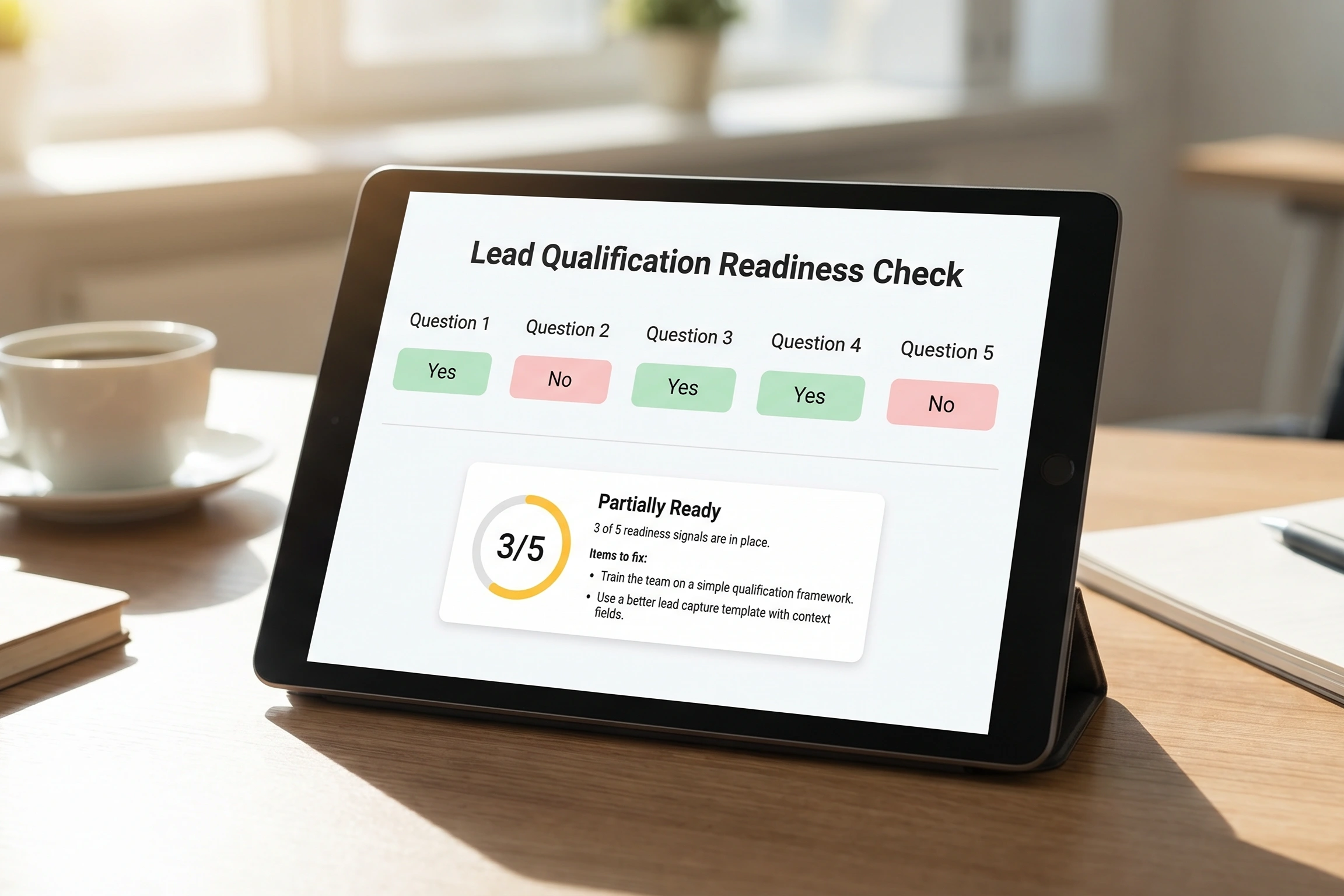
Print and laminate these before the show:
1. One-Page Cheat Sheet
- Your three core differentiators
- The three qualifying questions
- Five most common objections + your honest answers
- Who to escalate to for deeper technical help
2. Lead Capture Template
- Company name, contact name, title
- What problem are they solving
- Timeline
- Budget authority
- Next step
Clear lead capture makes follow-up immediate and informed.
3. FAQ Reference Card
- Questions you know will come up
- Honest, concise answers
- Pricing guidelines (if applicable)
- How to say "I don't know" professionally
Measure Execution on Show Day
Don't assume they "got it." Observe.
On the floor, watch for:
- Do they greet within 10 seconds? (Yes/No)
- Do they ask the three questions in order? (Yes/No)
- Do they recognize qualified vs. unqualified prospects? (Pattern recognition)
- Are they taking useful notes on leads? (Check capture quality)
- Are they maintaining energy? (Or exhausted by Hour 4?)
After the show, review:
- Lead quality: How many qualified vs. unqualified?
- Follow-up conversion: What % of captured leads became meetings?
- Staff feedback: What questions came up most? What confused them?
Well-trained teams generate 70%+ qualified leads. Untrained teams often produce 20–30%. The difference is measurable.
The Measurable Impact
You invest $20,000–$50,000 in booth space and logistics. Without training, staff capture high-volume lead lists (200+ names), but 70% are browsers, not buyers.
Without Training:
- 200 names captured
- 40 actual prospects
- 8 convert to sales
With 60-Minute Training:
- 80 names captured (60% fewer)
- 72 actual prospects (80% quality rate)
- 18 convert to sales
The trained team captures fewer leads but 3–5x more qualified leads. More importantly, your sales team isn't wasting time on 160 low-value follow-ups. Instead, they focus on 72 real opportunities.
This matters because 80% of trade show leads are never followed up on, costing exhibitors millions annually. The difference between success and waste is staff preparation.
Research shows that trained staff convert leads at a 2:1 rate compared to untrained staff, and 85% of exhibitor success depends on booth staff performance. Yet only 26% of exhibitors conduct staff training for all or most of their events. Get professional booth staff trained and ready for your next event.
A single 60-minute training session with role-play delivers 10–20x ROI on the training investment itself. The difference isn't effort or chaos management. It's structure.
Your next trade show doesn't need better booth traffic. It needs staff trained to qualify.
According to industry research from the Center for Exhibition Industry Research (CEIR), nearly 79% of trade show leads are never followed up effectively, often due to poor qualification at the booth level.
That means most exhibitors aren’t failing because of traffic; they’re failing because of unstructured booth staff training.
Teams that implement structured trade show sales training frameworks see significantly higher conversion rates because every interaction is intentional.
Mini Case Study:
At a recent SaaS trade show, one exhibitor implemented this exact booth staff training framework across a team of six.
Instead of collecting 200+ unqualified leads, they captured just 90 contacts, but over 70 were decision-makers with active projects
Within 30 days, their sales team converted 22% of those leads into meetings, more than double their previous event performance.
Ready to turn your booth traffic into a qualified pipeline and not waste conversations?
Get a free consultation and see how our trade show staff training and exhibition staffing solutions help you:
- Qualify leads in under 60 seconds
- Increase conversion rates by 3–5x
- Eliminate low-value follow-ups
Book your consultation today and start building a high-performing booth team.
Ready to elevate your next event?
Join thousands of event planners who trust EventStaff.com for reliable, professional staffing solutions.
Trusted by event professionals nationwide
1k+
Events Staffed
2 million+
Guests Served
97%
Positive reviews