
Planning a Chicago event usually starts with one broad assumption: you need staffing support. The harder question comes next. When should you hire event staff in Chicago, and what type of staff does the event actually need? A trade show at McCormick Place, a corporate reception in the Loop, a branded pop-up near Navy Pier, and a high-traffic public program in a city-managed venue all create different staffing demands.
That matters because Chicago is not a one-format event market. It is a convention city, a business-events city, a hospitality city, and a destination city at the same time. According to Choose Chicago’s McCormick Place overview, the convention center draws millions of attendees each year and anchors a major share of the city’s meeting economy. In practical terms, that means event staffing choices in Chicago should be made by format, flow, and audience expectation, not by guesswork. In this guide, we break down what kinds of event staff in Chicago different events usually need and how to think about the right staffing mix before the event gets too close.
CEO Excerpt
“Chicago events reward strong planning, but they also reward the right people on the floor. We have seen the difference repeatedly. The right team can keep arrivals moving, support a busy booth, protect the guest experience, and give the client room to focus on the event itself. At Eventstaff, our view is simple: staffing should reflect the event format, the audience, and the pressure points that matter most on site.” - CEO, Eventstaff
Why Chicago Events Need More Specific Staffing Decisions
Chicago supports a wide range of event formats, and that is exactly why staffing decisions need to be more precise here. A convention floor, a corporate networking event, a private hospitality-driven function, a seasonal public activation, and a neighborhood-facing outreach campaign do not operate the same way. The city’s event infrastructure is broad, and so is the range of environments where brands and organizers need on-site support.
You can see that in the venues themselves. McCormick Place positions itself as the largest convention center in North America, while Navy Pier operates as one of the city’s most recognized public-facing destinations for events, attractions, and seasonal programming. On top of that, the Chicago Park District manages a large network of parks and public spaces that host community and large-scale public events across the city. When a market has this much variety, staffing cannot be handled as a generic final-step decision.
That is why the stronger question is not simply whether you need Chicago event staff. It is which type of staff will make the event work better.

What Type of Event Staff in Chicago Do Trade Shows Usually Need?
Trade shows are one of the clearest use cases for specialized staffing in Chicago. The city has strong convention relevance, and exhibitors are often working in high-volume, competitive environments where attention is limited and visitor decisions happen quickly.
Booth staff for first-contact engagement
At a trade show, the booth needs to feel active before the strongest prospects arrive. Booth staff help start the first layer of interaction. They greet, draw people in, answer basic questions, and make the booth easier to approach. That matters on crowded floors, where passive booths often lose opportunities before a sales conversation even begins.
Registration and check-in staff for attendee flow
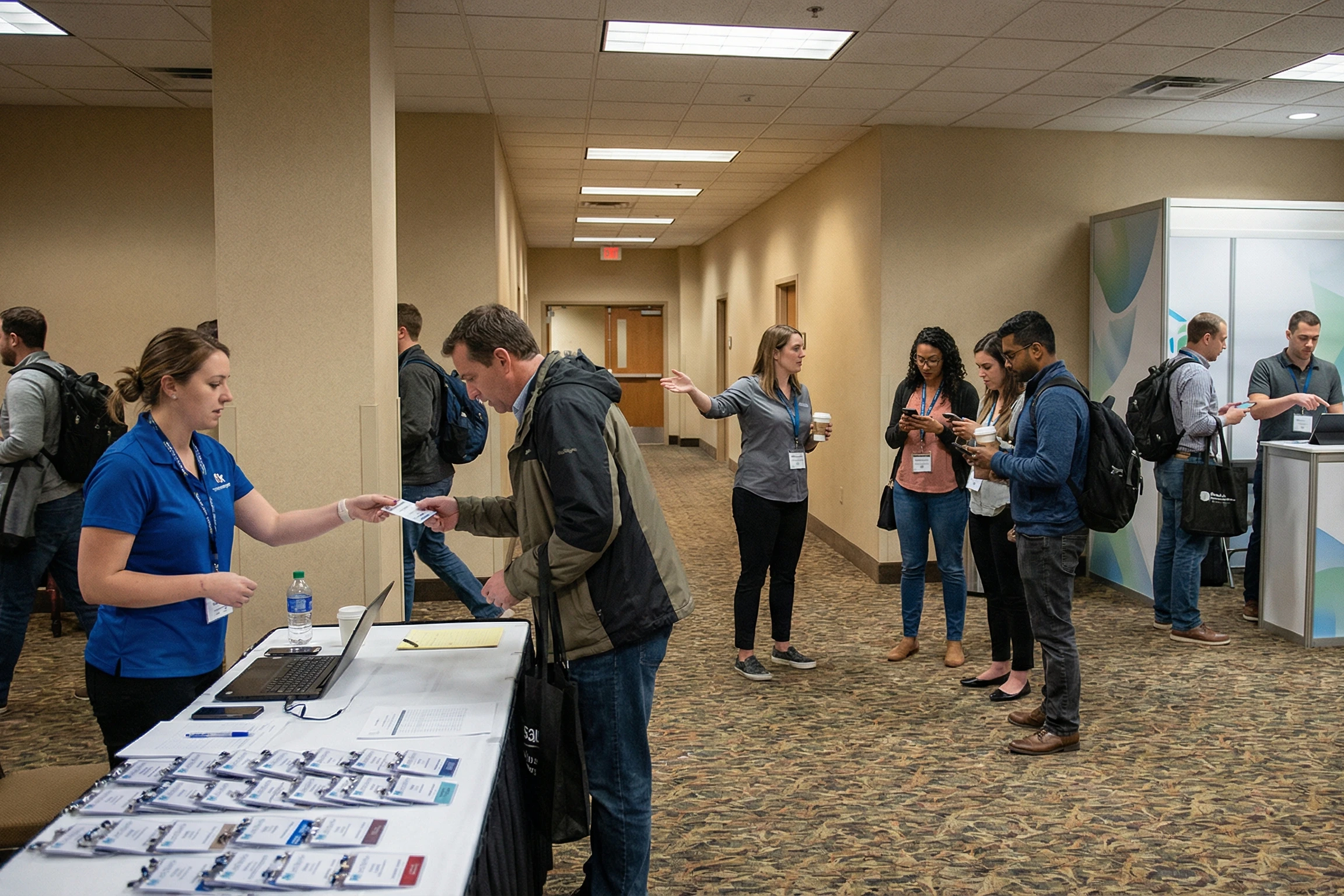
Some trade show environments also need registration-facing support. This is especially important when the event includes side programming, hosted guest lists, exhibitor hospitality, or branded check-in moments. In those situations, the staffing requirement is less about energy and more about speed, calm, and consistency under pressure.
Promotional support for visibility
Some exhibitors also need staff who can create movement around the stand. That may involve traffic-building, light outreach, sample distribution, or guiding visitors toward the booth. For many trade show staff Chicago needs, the strongest setup is layered. One team invites. Another team qualifies. Another helps the event footprint stay organized while traffic rises and falls throughout the day.

What Type of Event Staff in Chicago Do Corporate Events Usually Need?
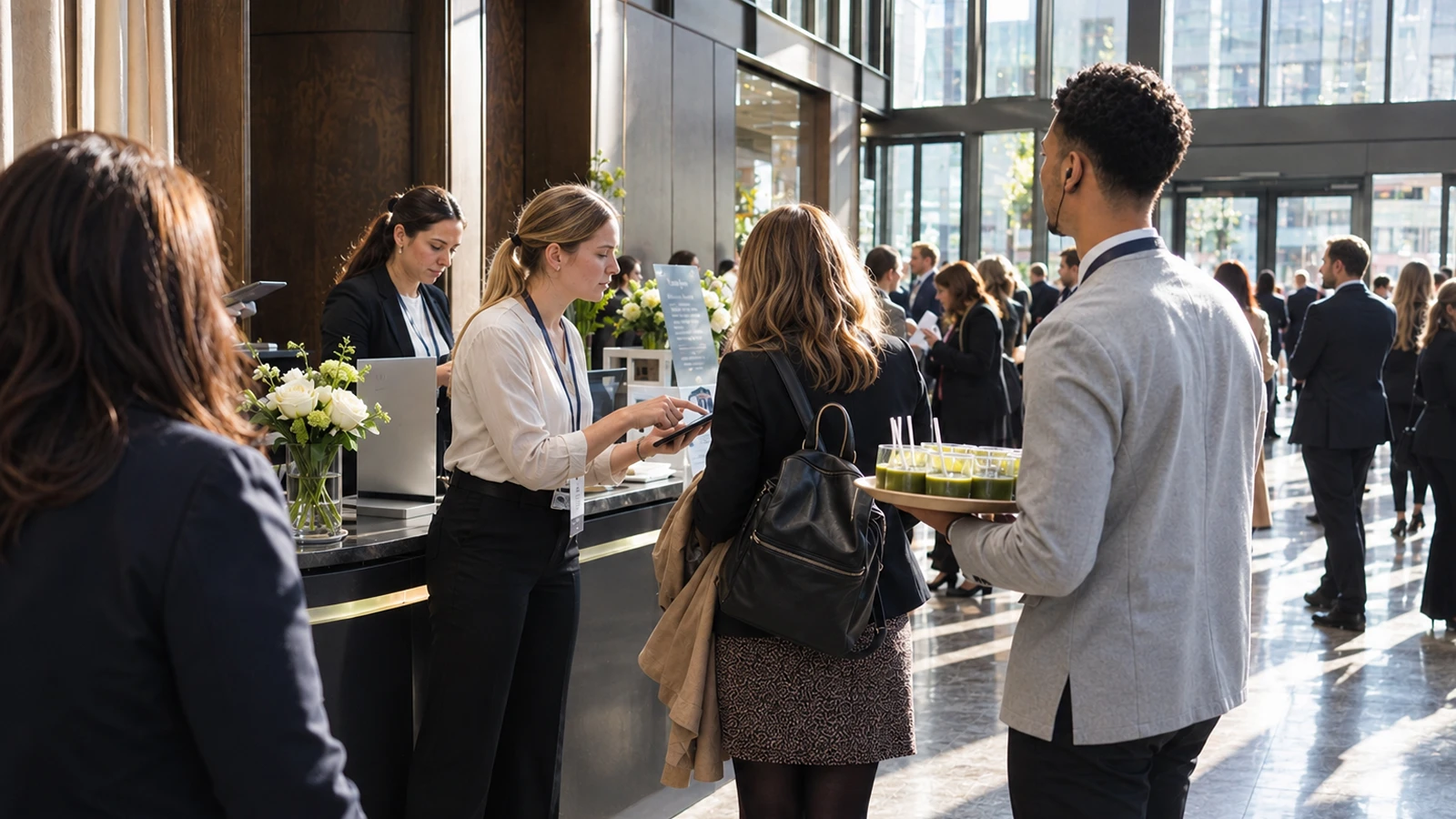
Corporate events in Chicago often require a more polished and controlled staffing style. The audience expectations are different, the timing discipline is tighter, and the margin for front-of-house errors is smaller. This is especially true in downtown business environments, major hotel venues, and client-facing event settings tied to the city’s central business districts and meeting infrastructure, which World Business Chicago continues to position as a major draw for business investment and corporate activity.
Greeters and check-in teams for smooth arrivals
For corporate events, first impressions usually begin at arrival. Greeters and check-in staff help avoid slow lines, guest confusion, and unclear entry points. If the event includes decision-makers, clients, media, or senior leadership, even small front-end delays can shape the tone of the event more than planners expect.
Front-of-house support for guest experience
Some events need staff who can hold the guest-facing environment together without becoming overly visible. That might include directing arrivals, helping transitions between spaces, managing guest questions, and supporting a premium feel as the event moves from check-in to networking to seated or programmed segments.
Staff who fit premium business environments
Not every staffing role is about logistics alone. Some are there to protect the tone of the room. That means the best corporate event staff Chicago plans usually involve staff who can be polished, clear, and helpful without making the environment feel overmanaged. In business-facing settings, that balance matters.

What Type of Event Staff in Chicago Do Brand Activations and Pop-Ups Usually Need?
Brand activations and pop-ups usually need more visible audience engagement than a trade show or corporate event. The staffing plan has to support attention, interaction, and brand momentum in real time.
Promo staff for live engagement
Promo staff are useful when the event depends on public-facing interaction. That could mean product awareness, light product explanation, sampling, line engagement, or encouraging guests to take a first step toward the brand. In activations, these staff help close the gap between seeing and participating.
Experiential staff for guided interaction
If the event includes product demonstrations, immersive moments, structured guest movement, or multi-step participation, experiential staff are often a better fit. They help the event feel guided without feeling stiff. That matters when the interaction itself is the campaign.
Popup staff for short-term branded spaces
Pop-up events often compress a lot of operational complexity into a small footprint. Guest entry, product support, transitions, line control, and pacing all matter more because the space is limited and the event is often temporary. Popup staff help the environment stay active and manageable at the same time.
Street teams for public-facing outreach
Some campaigns are less about the event footprint and more about audience reach. That is where street teams can become the stronger option. In high-footfall areas, public-facing zones, and destination-heavy parts of the city, the brand may need staff who can carry visibility outward rather than waiting for the audience to walk in.

What Type of Event Staff in Chicago Do Large Public Events Usually Need?
Large public events bring a different kind of operational pressure. The issue is often not only guest engagement. It is movement, clarity, volume, and keeping the event understandable from the attendee point of view.
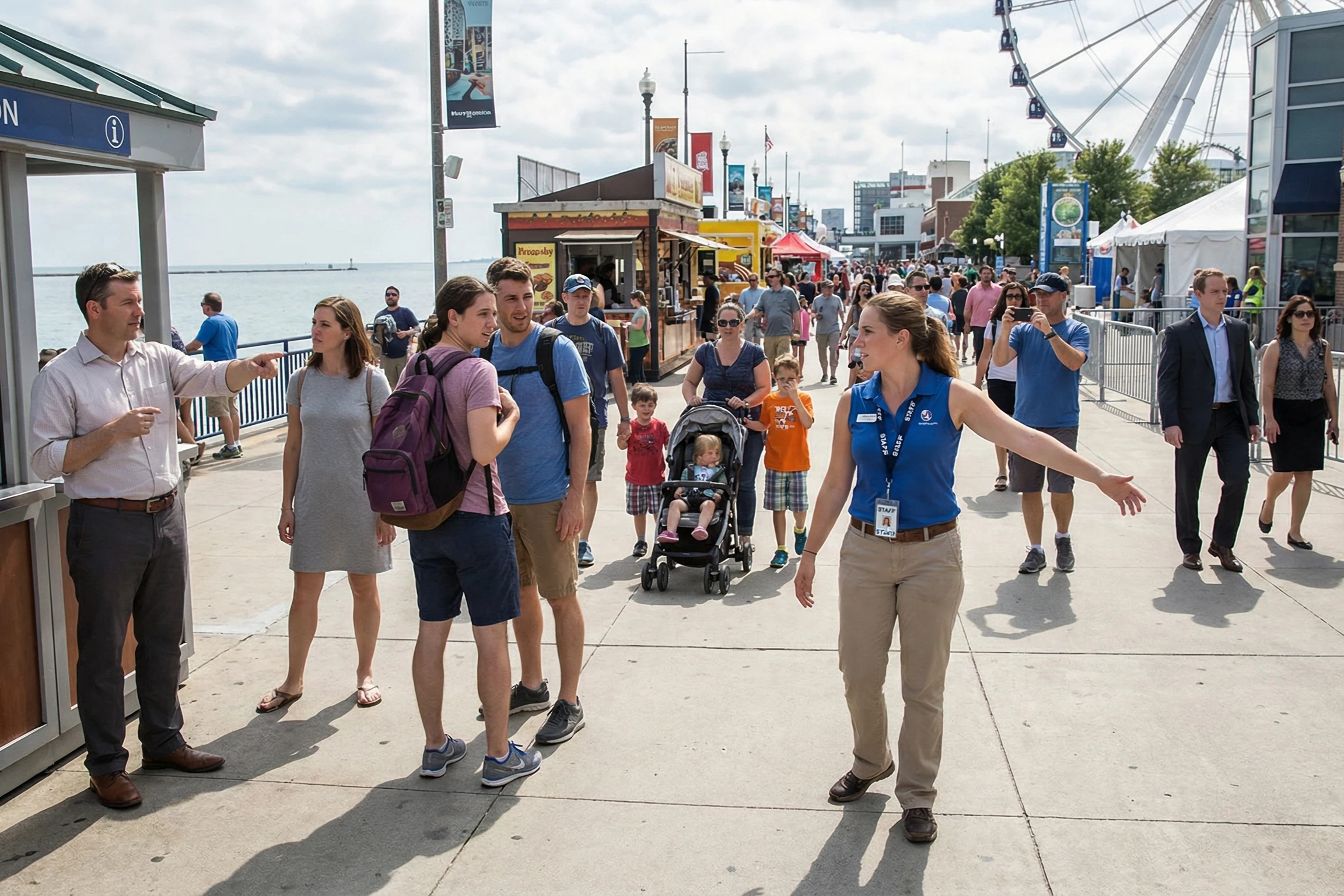
Chicago has several environments where that becomes especially important. Public destinations like Navy Pier and major city-managed spaces under the Chicago Park District can attract broad audiences with very different levels of familiarity, patience, and event readiness. In those settings, staffing decisions affect how easy the event feels to attend.
Guest-flow support for peak arrival periods
Many large events feel manageable until arrivals compress into a short window. That is when guest-flow support becomes important. Staff help keep lines readable, answer quick questions, and reduce the kind of confusion that expands quickly once a crowd forms.
Directional staff for crowd movement
If the event has multiple access points, zones, entry procedures, or transitions, directional staffing matters. Guests should not have to guess where to go next. Clear, calm human direction improves movement and reduces friction across the footprint.
Front-facing teams for high-volume interaction
Some large events still need strong guest-facing presence. That may include welcome teams, information support, activation help, or branded interaction points that keep the event from feeling distant or disorganized.
Multi-role staffing for layered formats
For bigger events, one staffing type is often not enough. The strongest plan usually combines check-in support, guest-flow coverage, directional help, and any brand-facing or public-facing interaction the event requires. The larger the event, the more important that layered approach becomes.
How to Match Event Staff in Chicago to the Real Goal of the Event
One of the smartest planning decisions is to stop thinking only in titles and start thinking in outcomes.
If the priority is lead capture, the staff need to support first-touch interaction and move the right people toward more qualified conversations.
If the priority is guest flow, registration and front-of-house support matter more than broad promotional energy.
If the priority is brand visibility, then promo staff, experiential staff, or outreach-focused teams may add more value than a generic staffing setup.
If the priority is premium guest experience, the staffing choice should emphasize polish, calm execution, and consistency.
If the priority is handling volume, role clarity and coverage placement usually matter more than adding headcount without a plan.
That is the real value of choosing the right event staff in Chicago. You are not just filling shifts. You are staffing toward the actual purpose of the event.

Mistakes People Make When Booking Event Staff in Chicago
The first mistake is booking too generally. Saying “we need event staff” may be true, but it does not help define what success looks like on site.
The second mistake is assuming one staff type can solve every problem. Check-in, booth support, guest flow, promo engagement, and public-facing outreach are related, but they are not the same.
The third mistake is underestimating how quickly event conditions can change in a city like Chicago. Convention environments, business events, lakefront destinations, and public spaces all have moments where timing matters more than total event length.
The fourth mistake is waiting too long to define the staffing plan. Once the event is close, teams often hire reactively instead of intentionally, and the result is usually a weaker staffing mix.
How Eventstaff Supports Different Chicago Event Formats
At Eventstaff, the stronger way to staff Chicago events is to start with the event format and work outward from there. A trade show needs a different front-end rhythm from a corporate reception. A pop-up needs different pacing from a large public event. A guest-facing hospitality environment needs different staffing from a high-volume convention footprint.
That is why the best staffing plan usually begins with a few simple questions. Where are the pressure points? Where does the audience need help? Where does the brand need a human presence? Where do lines, transitions, or first impressions matter most? Once those answers are clear, the staffing mix becomes more precise, and the event usually runs more smoothly because of it.
Final Words
Choosing the right event staff in Chicago is not about checking a box before the event starts. It is about matching the team to the event format, the audience, and the moments where execution can either hold steady or slip. Trade shows need one kind of support. Corporate events need another. Brand activations, pop-ups, and large public events each have their own staffing logic.
That is why the strongest staffing decisions are specific. When the staffing mix reflects the real shape of the event, the guest experience improves, the brand shows up more clearly, and the team running the event has more control from start to finish.
Ready to elevate your next event?
Join thousands of event planners who trust EventStaff.com for reliable, professional staffing solutions.
Trusted by event professionals nationwide
1k+
Events Staffed
2 million+
Guests Served
97%
Positive reviews