

The Corporate Event Planning Checklist Built Around Real Deadlines
You have eight workstreams moving at once, and one long to-do list will bury the details. The venue wants signed rooms and access windows. AV wants the agenda before it can price the show. Catering wants to meet deadlines. Finance wants purchase orders. Registration is still moving. Staffing cannot wait until the final RSVP number. This corporate event planning checklist shows what each owner owes at each window, so the planner is not chasing every answer in the same week.
Executive Summary
Corporate event planning checklist readers usually know the date, budget, and venue, but not what each owner owes next. This blog turns the checklist into a week-by-week grid across venue, program, vendors, staffing, registration, AV, budget, and compliance. It also shows how real conference timelines, vendor deadlines, final counts, and staffing ratios change the plan before doors open.
Eight Workstreams Are Too Many for One Long To-Do List
A corporate event planning checklist should read like a control board for the event, not a diary of tasks. At a 1,000-person summit, the AV lead, registration owner, venue contact, budget owner, staffing partner, and program lead are all working at the same time. The problem starts when one owner’s delay quietly blocks another owner’s next move.
The Bureau of Labor Statistics describes meeting, convention, and event planners as arranging “all aspects” of events and professional gatherings, and its current outlook projects 5% growth for the occupation from 2024 to 2034. That fits the reality of corporate event planning: the work spreads across logistics, people, vendors, money, communications, and risk rather than sitting inside one neat lane.
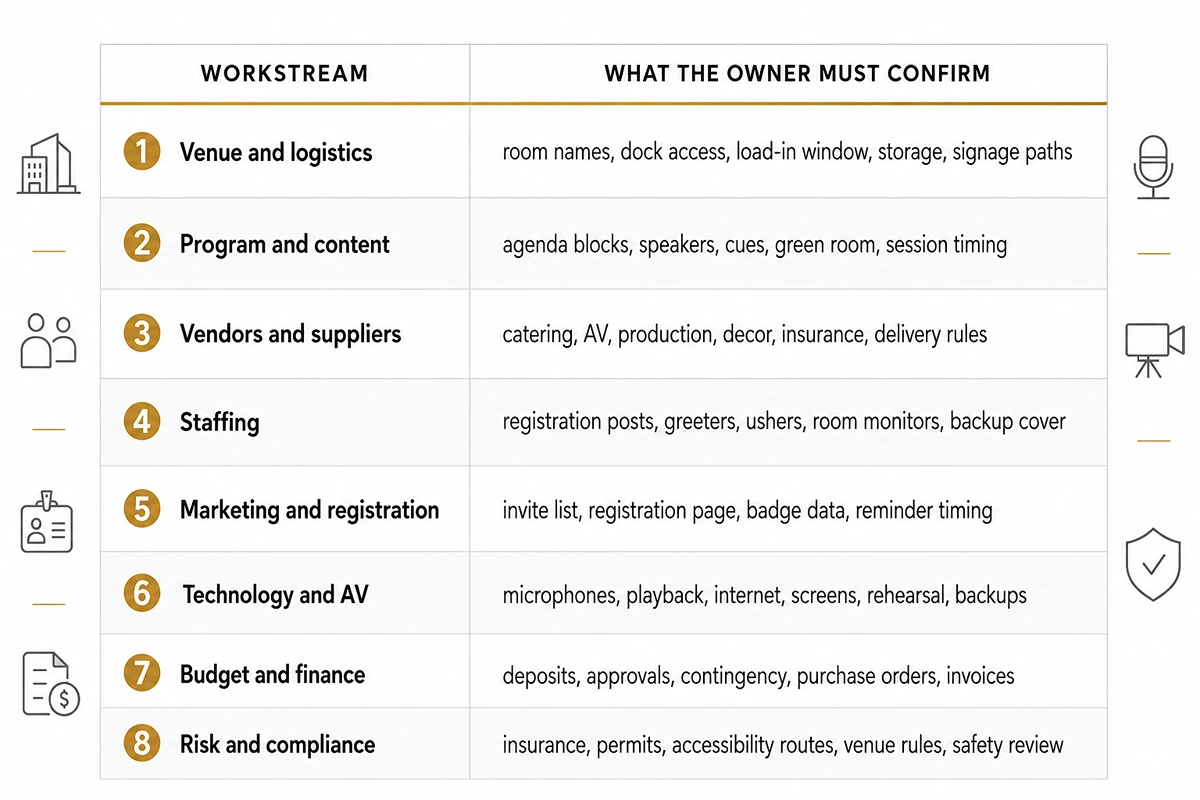
At a leadership all-hands, one missing owner can create a chain reaction. If the green room is not assigned, the CEO escort gets improvised. If AV does not receive the final keynote timing, rehearsal runs on guesswork. If staffing only hears “700 attendees,” no one knows whether the pressure is at check-in, elevator banks, breakout doors, or lunch. That is why the checklist starts with workstreams before it starts with dates.
For corporate events, the planner should pass over the attendance forecast, room list, arrival pattern, guest movement points, and any sponsor or showcase areas that need people on the floor.
A Phase Framework Does Not Tell You What Is Due Thursday
Phase frameworks are useful for naming the shape of the project. They are less useful when the planner has a catering count due in four days and a speaker deck still missing. Cadmium’s event planning resource lists the 5 C’s as Concept, Coordination, Control, Culmination, and Closeout. Also, it lays out seven stages covering goals, scope, budget, vendors, marketing, logistics, program schedule, and evaluation. Treat that as planning language, not an official standard.
For a working corporate event planning checklist, turn the phases into deadline windows:
- 12+ weeks out: objective, budget shape, date, venue, attendance range.
- 12 to 8 weeks out: vendor shortlists, registration setup, AV audit, staffing range.
- 8 to 4 weeks out: signed scopes, service levels, speaker deadlines, floor plan drafts.
- 4 weeks to doors: final counts, briefing packs, run of show, rehearsal, risk review.
- Event day: load-in, briefing, doors, live delivery, teardown, venue sign-off.
- Week after: invoice checks, feedback, attendance data, internal debrief, next-event notes.
A live example makes the timing problem easier to see. Adobe Summit’s FAQ says the in-person agenda spans three days and includes keynotes, Sneaks, strategy keynotes, and more than 200 sessions and hands-on labs. It also notes that Adobe tries to avoid sessions ending exactly when labs begin so attendees can get between rooms. That is the kind of tiny timing detail a corporate planner should steal for a smaller multi-room summit. (Adobe Summit)
For corporate events, that timing detail changes staffing. If 600 people leave a keynote and head toward coffee, badges, sponsor booths, and breakout rooms inside the same short window, staffing posts should sit at the decision points, not wherever the floor looked empty during setup.
The Date Is Not Yours Until the Contract Is Signed
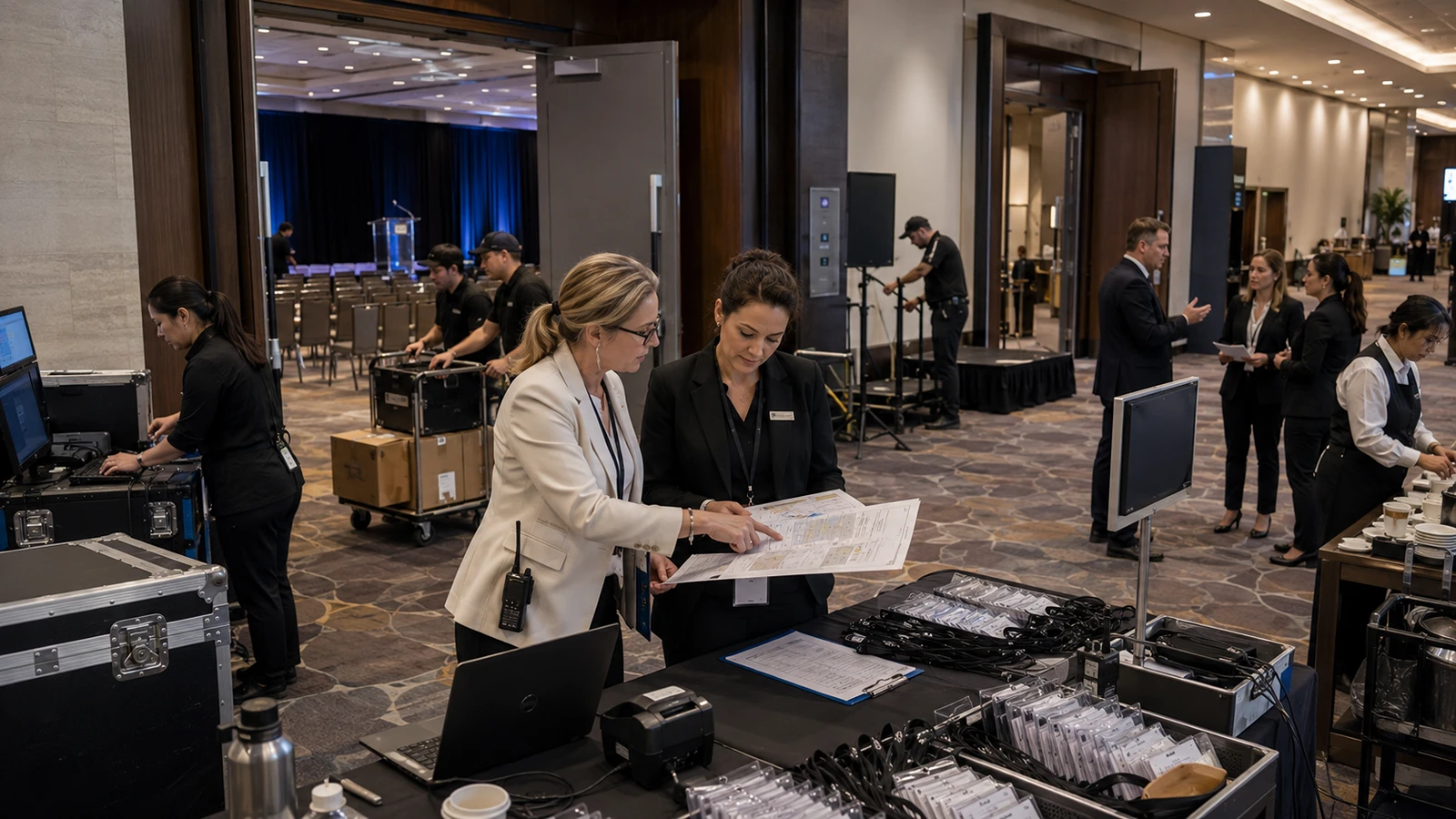
Twelve weeks out, the checklist should chase anything another company can delay, price, deny, or give to someone else. The venue date, room block, dock time, freight elevator, AV capacity, catering availability, registration platform, and staffing range all sit on calendars outside the planner’s control.
Use this as the 12-week “do not leave it floating” list:
- Venue: signed contract, exact rooms, access times, load-in and load-out windows, storage, furniture included, freight route, union or house rules if they apply.
- Program: event objective, rough agenda, speaker longlist, executive moments, sponsor presence, rooms that may need overflow.
- Vendors: AV, catering, production, decor, registration platform, insurance requirements, first price ranges.
- Staffing: low, expected, and high attendance forecast; registration model; room count; public entry points; VIP paths; sponsor or showcase zones.
- Budget: contingency line, deposit dates, approval owner, hard cutoffs for late changes.
Salesforce’s Dreamforce 2026 registration page shows why early outside commitments matter at scale: a full conference pass is tied to September 15–17, 2026, and the page also points attendees toward hotel options and conference access. A corporate event will not carry the same footprint. Still, the same planning truth applies: date, venue, hotel, pass, and agenda logistics move early because other people can take the inventory.
The staffing row should begin as a range here. The brief gives planning ranges of 30–45 event-day staff per 1,000 attendees and 1 setup worker per 250–300 sq ft, with 10–15% added where overhead work is involved. Those are planning ranges, not EventStaff commitments, and format changes the number.
For corporate events, this is the moment to ask: Is the event single-room or multi-room? Does registration hit all at once? Are executives moving through public areas? Are sponsors or demos pulling guests into side zones? Those answers shape the first crew range.
NOTE: A corporate event planning checklist should show what each workstream owes before the timeline gets tight. At 12 weeks out, chase the items attached to someone else’s calendar: venue contracts, load-in windows, AV capacity, catering availability, registration setup, staffing ranges, insurance, and permit checks.
CEO Excerpt
I’d tell any corporate event planner to stop waiting for the final RSVP count before talking about staff. The floor plan, arrival pattern, room count, and lunch flow usually reveal the staffing pressure much earlier. Final headcount tightens the number, but it should not be the first time anyone is looking at crew. - Daniel Muersing
Vendor Promises Need Names, Times and Backup Plans
Eight weeks out is the paper trail window. Verbal confidence is no longer enough. “The caterer is good,” “AV knows the room,” and “the venue said access is fine” are all too soft for a corporate event with leadership, sponsors, clients, or employees walking into a timed program.
Ask sharper questions now.
For the venue:
- Which door do vendors use?
- Who opens dock access?
- What room is storage, and when is it available?
- What other event is loading in or out the same day?
- Who signs off the room before doors?
For catering:
- What is the final count deadline?
- How many service staff arrive?
- Where does food stage before service?
- Who answers dietary questions on site?
- What happens if lunch service starts ten minutes late?
For AV and production:
- Which sessions need playback?
- How many wireless microphones are in the room?
- Who owns speaker clickers?
- Where does the confidence monitor sit?
- What time is tech rehearsal in the actual room?
For staffing:
- Which posts stay fixed?
- Which posts float?
- Which posts require radios?
- Who owns break cover?
- Who can approve a staff move during the event?
Adobe Summit’s public session information gives a useful comparison point. Adobe has described Summit as having more than 200 sessions and hands-on labs across 13 tracks, which shows how quickly room assignments, timing, and attendee movement can become operational problems, not just agenda content.
Fun site test for the reader: open the registration page as a first-time attendee and try to find arrival time, parking, badge pickup, agenda changes, accessibility contact, and room location in under two minutes. Anything hard to find online becomes a question at the registration desk.
For corporate events, EventStaff should receive function-level roles here: registration desk, issue desk, executive arrival, breakout door cover, sponsor zone, room monitor, production runner, or crowd flow post. “We need staff” is not enough to build a shift plan.
Four Weeks Out Is When Estimates Become Real Numbers
Four weeks out, soft numbers start turning into vendor instructions. Catering does not want “probably 800.” Badge printing does not want “a few more.” Staffing cannot place people against “some breakout rooms.” AV cannot rehearse against an agenda that still says “panel TBD.”
Run a final-number sweep instead of another generic checklist.
- Numbers tied to attendance
Catering count, badge stock, registration staff, greeters, ushers, lunch lines, shuttle count, overflow rooms, sponsor traffic, and post-keynote movement.
- Numbers tied to floor area
Setup crew, load-in time, furniture moves, signage placement, storage, room resets, production runners, and teardown cover.
- Numbers tied to the program
Microphones, speaker escorts, green room coverage, room monitors, cue sheets, slide deadlines, rehearsals, and breakout transitions.
The brief’s planning logic is useful here: guest-facing staffing and catering move with attendance, while setup crew usually moves with square footage. If attendance rises but the floor plan stays the same, do not scale every row blindly. If the team adds rooms, staging, overhead items, or a showcase zone, both attendance-driven and space-driven rows may change.
A better week-four example is the catering guarantee. Hotel and venue event terms often require the client to give an exact attendance number by the deadline listed in the banquet event order. Atrium Hospitality’s BEO terms say the client must provide the exact event attendance by the time indicated on the BEO, and Law Insider’s sample food-and-beverage guarantee language gives an example of a final guaranteed attendee count due by noon five business days before the event. Use this as the practical lesson: once the guarantee is submitted, the number stops being a guess and becomes a purchasing, staffing, prep, and billing instruction.
Try the “one attendee morning” exercise. Put one guest on paper at 8:30 AM. They park, enter, find registration, get a badge, ask about Wi-Fi, grab coffee, find the keynote, leave the keynote, choose a breakout, and reach lunch. Every stop creates a signage, staffing, AV, catering, or venue question. The corporate event planning checklist should answer those before the staff briefing.
For corporate events, week four is when the range becomes posts: registration desk, badge issue desk, entry greeters, breakout ushers, room monitors, sponsor-area staff, production runners, and crowd movement cover.
Event Day Exposes the Checklist You Actually Built
Event day should turn the corporate event planning checklist into visible floor decisions: which dock opens first, who briefs staff, where the issue desk sits, which doors need greeters, and how problems move to the event lead. A flat list gets hard to use once vendors, speakers, guests, and staff are all moving at the same time.
Use the day in four blocks:
- Before load-in: the dock lead has the delivery order, driver contacts, freight route, backup unload spot, and venue contact. Storage is marked before boxes arrive.
- Before doors: staff briefing covers posts, radios, break cover, guest questions, escalation, and who can move people. Registration has an issue lane, not only a main line.
- During the event: runners handle urgent room items without pulling registration staff. Crowd staff watches coffee lines, elevator banks, sponsor traffic, and breakout doors.
- After guests leave: teardown starts after guest areas are clear. The venue walkthrough records damage, left items, overtime, storage, and invoice notes while details are still fresh.
A better event-day example is onsite check-in. Accelevents’ badging playbook recommends walking the attendee path, timing a small arrival sequence, and keeping the help lane clear. PheedLoop’s check-in guide also suggests a dedicated staff-assisted lane for VIPs, walk-ins, or attendees who cannot find themselves in self-service. That is exactly the kind of detail this section should capture before doors open: the main line is for normal check-in, the issue lane is for the messy cases, and staff knows who can fix badge stock, printer issues, or name mismatches.
Try the five-guest test before doors. Send five people through check-in as different attendee types: pre-registered guest, VIP, walk-in, wrong company name, and badge reprint. If all five end up in the same line, the desk is not ready. If staff does not know who handles each case, the first guest wave will expose it.
For corporate events, EventStaff should staff the day in blocks: setup support, first-wave registration, guest direction, room movement, sponsor or showcase cover, crowd control near breaks, and teardown. One generic “event staff” line will not catch those shifts.
The Staffing Number Should Not Wait for Final RSVPs
A corporate event planning checklist should not say “book staff” and leave the planner guessing. Staffing should start as a range early, then tighten once the floor plan, agenda, and attendance forecast become clearer.
Use the range like this:
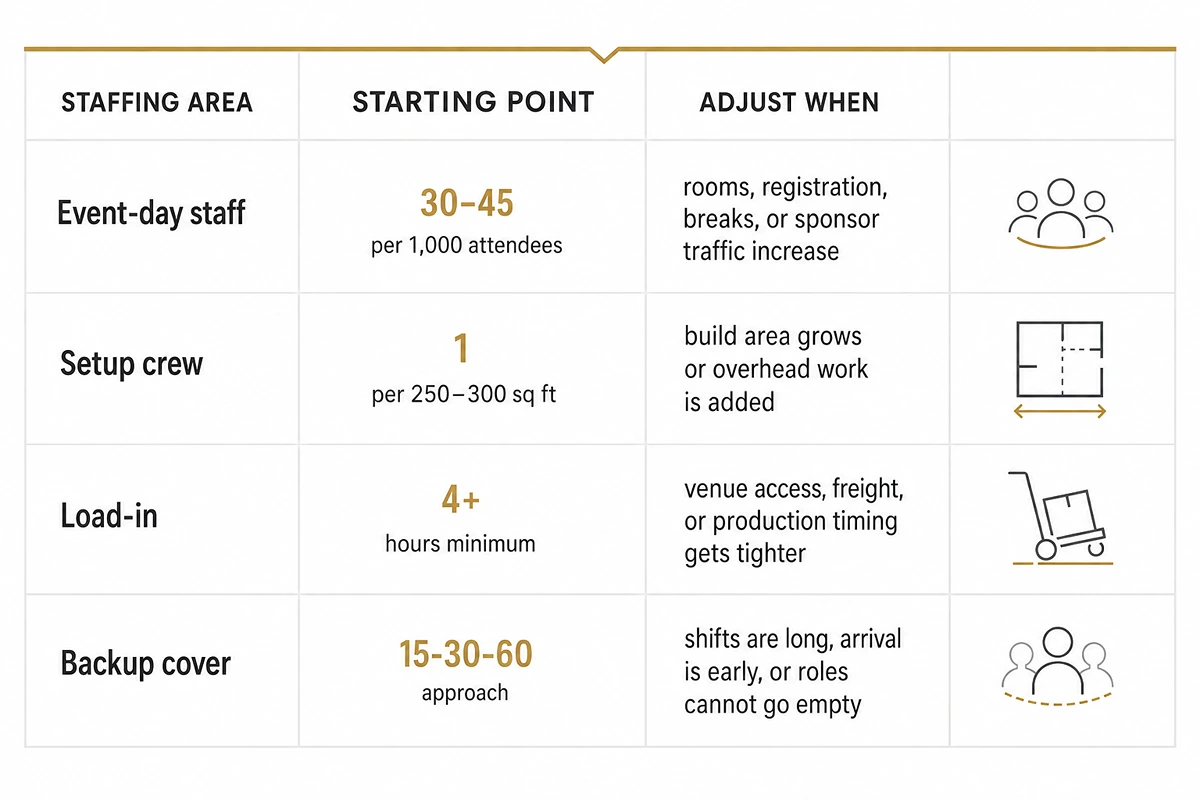
These are planning ranges, not fixed rules or EventStaff guarantees. A seated town hall with one entrance may sit near the lower end. A corporate conference with badge issues, breakout rooms, lunch movement, and sponsor traffic will usually need more people. The brief makes the useful distinction clear: guest-facing staff usually move with attendance, while setup crew usually moves with floor area.
A better use case here is a lunch-service squeeze, not another multi-track conference example. Cvent’s banquet staffing guide notes that meal service staffing often uses server-to-attendee ratios, and that service style can change the number. For a corporate event planner, the lesson is practical: if 900 people leave a keynote and lunch starts in the same hallway, the staffing question is not only “How many event staff?” It is also “Who keeps the lunch line from blocking the breakout doors?”
Use this quick staffing check:
- One main room: fewer room posts, heavier registration cover early.
- Multiple rooms: add door monitors and floaters between sessions.
- Sponsor area: add staff during breaks, not during keynotes.
- Tight lunch flow: place people before the line bends into hallways.
- VIP movement: assign named escorts instead of borrowing greeters.
- Long event day: protect break cover so fixed posts do not empty.
For corporate events, EventStaff can turn that range into actual posts: registration lead, issue desk, greeters, room monitors, sponsor-zone staff, lunch-flow cover, production runners, and backup staff. Working out your crew numbers? Talk to us.
A Crew Plan Should Show Who Moves and Who Stays Put
The staffing handoff should answer one practical question: who goes where when the room starts moving? A crew plan is not a list of job titles. It should show fixed posts, moving roles, backup cover, and the moments when staff shift positions.
For a corporate event, the cleanest handoff is:
- Floor plan: entrances, registration, breakout rooms, sponsor area, lunch route, VIP path
- Run of show: arrival wave, keynote start, breaks, lunch, room turns, teardown
- Attendance forecast: expected count, high estimate, and first-hour arrival pressure
- Problem posts: badge issue desk, hallway pinch point, sponsor crowding, elevator bank, VIP movement
A better use case here is an executive town hall with a product demo room. Registration is only busy for the first hour. After the keynote begins, two registration staff can move to the demo room entrance, one greeter can shift to lunch routing, and the issue desk lead can stay fixed for late arrivals and badge problems. The crew plan should show those moves before the briefing, not rely on someone figuring it out live.
EventStaff’s role stays specific: turn the checklist into posts, shifts, and movement points for corporate events. The brief’s scope includes conference and registration staff, production and run-of-show crew, booth staff or brand ambassadors where there is a showcase area, and crowd management at larger scale. Catering, AV, licensed security, and vendor rows stay with those suppliers.
Use the credential once, near the end: 500+ events staffed, 2M+ attendees, 25+ years in large-scale event staffing.
The Checklist Should Leave You With One Clear Next Move
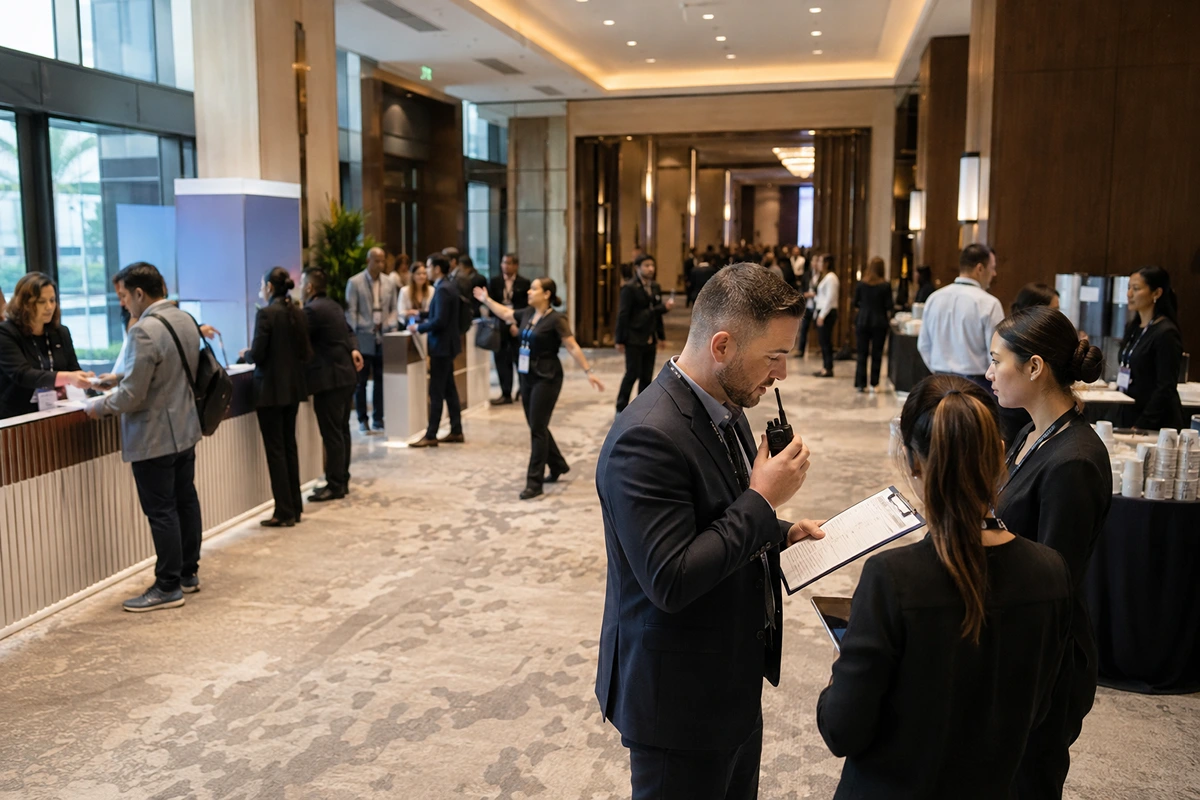
A good corporate event planning checklist should make the event feel less scattered by the time the reader reaches the end. You have already mapped the eight workstreams, turned broad planning phases into real deadlines, locked the outside commitments first, put vendor promises in writing, converted estimates into final numbers, and checked how the day will run once guests are in the building.
The decision now is simple: look at the checklist and find the rows that depend on people. Registration pressure, crowded breaks, sponsor traffic, room changes, VIP movement, lunch lines, and tight load-in windows should not sit in the plan as vague notes. They should turn into named posts, shift times, backup cover, and a crew briefing.
If your checklist is showing those pressure points, bring EventStaff in before the final week turns them into floor problems. For corporate events that need registration staff, greeters, ushers, room monitors, production support, crowd management, or sponsor-area coverage, staff your corporate event with a crew plan built around the actual day.
Ready to elevate your next event?
Join thousands of event planners who trust EventStaff.com for reliable, professional staffing solutions.
Trusted by event professionals nationwide
1k+
Events Staffed
2 million+
Guests Served
97%
Positive reviews