
EXECUTIVE SUMMARY
Choosing the right retail activation format starts with a clear goal awareness, trial, conversion, or lead capture since each requires a different setup and staffing approach. This guide breaks down retail brand activation ideas and retail store activation ideas based on real execution needs across store types. Most activations fail due to operational gaps like poor pacing, inconsistent messaging, and weak handoffs, not bad concepts. The focus is on building activations that stay consistent, handle real shopper volume, and drive measurable results.
Retail activation ideas only work when they are built for how shoppers actually behave in-store
.webp)
Most brands focus on the concept. But in reality, foot traffic and conversion are driven by execution, how quickly a shopper understands the activation, how easily they can participate, and how smoothly they move to the next step.
If you are trying to figure out:
- How to increase foot traffic in retail stores
- Which retail brand activation ideas actually convert
- Or why some retail store activation ideas fail under real volume
The answer usually comes down to three things: clarity, speed, and structure.
This guide breaks down retail activation ideas by goal, store type, and execution model so you can choose formats that not only attract attention but also consistently convert it into measurable results. If you want to understand how branded event activations influence buying decisions at a deeper level, that piece is a strong complement to what you'll find here.
CEO Excerpt
"Retail activations succeed through strong execution, not just big ideas. Brands that drive foot traffic and conversions focus on clear messaging, structured setups, and well-defined staff roles. When the experience is simple, and someone owns pacing, results become consistent and reliable." — CEO Event Staff
Why Most Retail Activations Fail Under Real Store Conditions
Research by Retail Dive and Forrester indicates that average in-store conversion rates range between 25% and 45%, depending on the sector, meaning 55% to 75% of shoppers leave without purchasing, highlighting significant untapped potential.
The most common breakdown points:
- Long wait times are reducing participation
- Inconsistent staff messaging
- No clear transition from demo to purchase
In high-traffic environments, even a 30–60 second delay per interaction can reduce total daily conversions significantly. Shopify has reported that 60% of shoppers abandon purchases due to long wait times, a friction point that well-structured retail activations are specifically designed to eliminate.
This is why the highest-performing retail activation ideas are not the most complex; they are the ones designed for speed, clarity, and repeatability at scale. Understanding how broader workforce planning shapes event outcomes applies directly to the in-store context: the structure you build before doors open determines how the floor performs when volume picks up.
Retail activation ideas and what makes them work in real stores
Retail activation ideas work when they give shoppers a fast reason to stop, a quick proof moment, and one obvious next step. In-store, the formats that perform best are usually the easiest to understand from a distance and the easiest to complete without waiting.
Three factors drive most strong retail activations:
Fast hook — The shopper should understand the offer in 5 to 10 seconds.
Quick proof — The product benefit should be experienced, not overexplained.
Clear next step — Buy, sign up, book, or test further — but only one primary action.
The most common failure points are operational, not creative: long lines with no pacing plan, too many choices or offers on one footprint, different staff explaining the activation in different ways, demo paths that take too long to reset, and lead capture that interrupts momentum.
A simple test: if a shopper cannot tell what the activation is, why it matters, and how long it takes within a few seconds, the format is too heavy for the floor.
Retail brand activation ideas based on your goal
Retail brand activation ideas should be chosen based on the goal because awareness, trial, and conversion require different formats. Use your primary objective to narrow the format first.
CHOOSE YOUR ACTIVATION FORMAT BY GOAL

If the goal is awareness
Awareness activations need high visibility, low time commitment, and fast participation. What matters most: visible setup, short participation time, clear message from a distance, and enough staff to keep the experience moving.
If the goal is trial
Trial works best when the shopper can experience the product benefit quickly and with guidance. According to EventTrack 2025, 66% of consumers are more likely to purchase a product after interacting with a brand at an event, a statistic that underscores why a well-briefed brand ambassador is often the difference between a shopper who lingers and one who walks past.
If the goal is conversion
Conversion-focused activations need a frictionless purchase path and assisted decision support. What matters most: one offer, one CTA, nearby product access, and a clean handoff from engagement to purchase.
If the goal is lead capture
Lead capture works when the shopper gets a clear reason to share information and the process feels fast. Always have an offline fallback if tech fails.
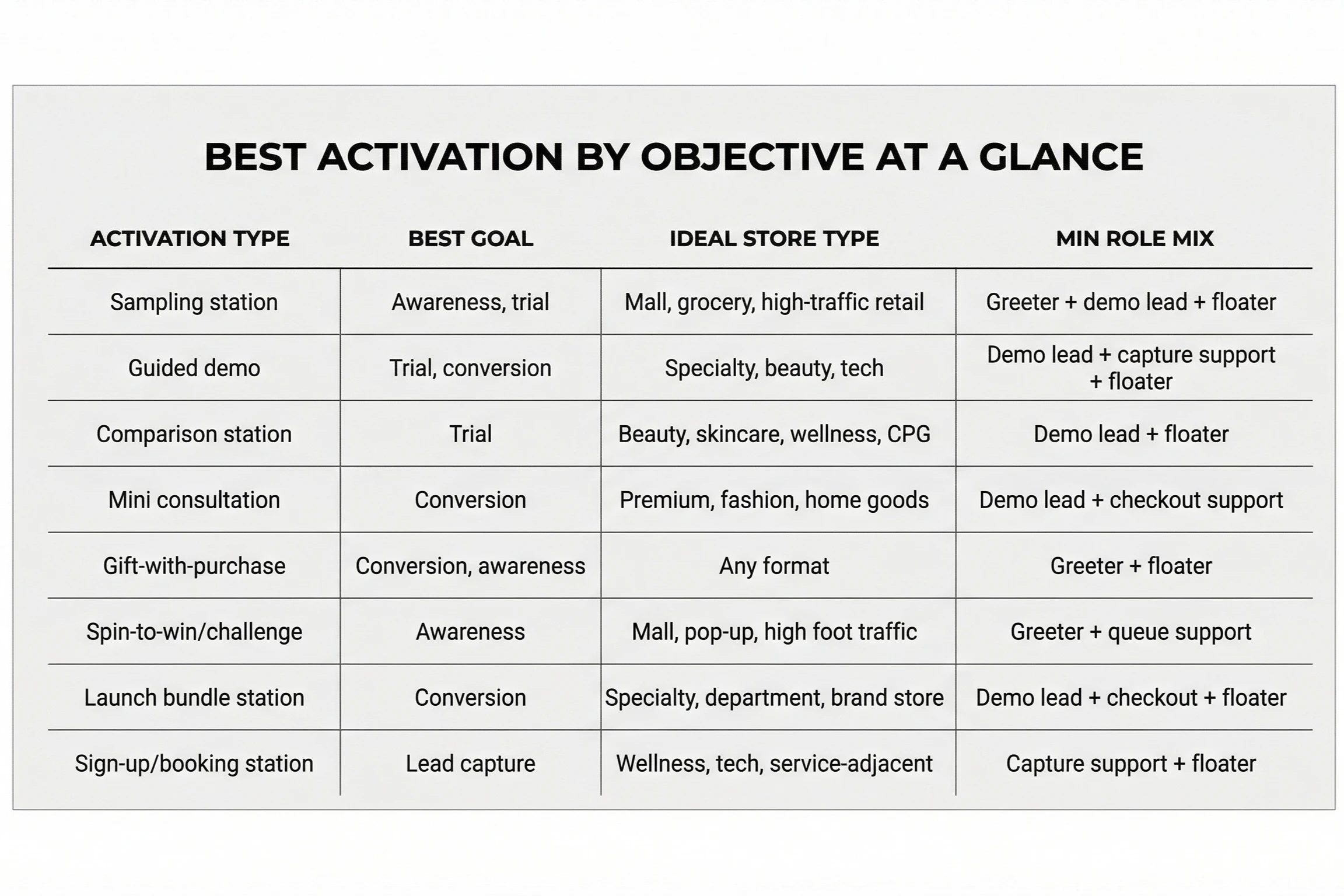
Best activation by objective comparison table
Retail store activation ideas that increase foot traffic
Retail store activation ideas increase foot traffic when the "why now" is obvious and the experience is easy to understand from a distance.
- "Try it in 2 minutes" demo station near the entry: The commitment feels small. The message is clear, the time is short, and the shopper can test before deciding.
- Limited-time micro-gift with purchase: Instant fulfillment matters. If the shopper has to redeem later, the impact weakens. Free samples and special offers rank among the top three reasons consumers engage with brands at events, according to EventTrack 2025.
- Partner day with a complementary brand: Creates energy without a large build. Beauty + skincare tools, beverage + snack pairings, fitness + recovery items. Nearly a third of brands currently invest in brand or field activation events as part of their experiential marketing strategy, and partner formats are one of the most efficient ways to deliver that energy without a large build cost.
- Quick challenge or spin-to-win: Keep participation under 20 seconds and tie the reward to a product moment.
- Photo moment with a participation reward: Works better when the reward is instant, and the queue stays short.
For activations that need to reach well beyond the store itself, the principles behind how hospitality staff elevate the guest experience translate directly to retail. The same attention to pacing and shopper flow that makes a large event work applies to a single-store footprint.
What breaks first and how to prevent it
Most retail activations do not fall apart because the concept is wrong. They fall apart in the first 90 minutes when volume picks up, and the setup was not built for it.
WHAT BREAKS FIRST ON A RETAIL ACTIVATION FLOOR AND THE FIX

Retail activation ideas for product launches and new collections
For launches, retail activation ideas should focus on guided proof and confident decision-making, not just visual spectacle.
- Guided demo with a one-sentence benefit: Start with the clearest promise. Show what the product does, then let the shopper try it.
- Comparison station (before vs after): One visual difference can do more than several talking points.
- Mini consultation station: Ask one qualifying question, then guide the shopper to the most relevant item.
- Bundle moment with a recommended set: Offer a simple "best place to start" combination instead of every option.
Launches often underperform because brands focus on the look of the moment rather than the speed of belief. The principles behind building a high-performing trade show booth staffing team apply here too: the role structure you build for a launch directly determines whether that speed holds up when the footprint gets busy. McKinsey's 2024 retail research found that hyper-personalization drives conversion rate increases of 5–15% a finding that reinforces why every interaction on launch day needs to feel individually relevant, not scripted in the generic sense.
Retail brand activation ideas for malls and high-traffic environments
In high-traffic retail, the goal is throughput. A mall activation can attract a lot of attention, but if pacing breaks, the experience becomes hard to manage very quickly.
Global experiential marketing spend reached $128.35 billion in 2024, surpassing pre-pandemic levels, which tells you that the competition for shopper attention in high-traffic environments is only increasing. The brands that win are the ones whose floor operations can absorb volume without degrading the experience.
Flow protection rules for high-traffic settings:
- The queue must expand without blocking walkways.
- One staff member should own pacing and line control full-time.
- Signage should answer the top three questions before the shopper reaches staff.
- Long explanations happen in a second lane, not in the main queue.
- Staff should know when to cut a longer interaction short and redirect.
For activations at major venues, the approach covered in what event staff do at corporate events and festivals gives useful context on how to separate role functions when multiple zones are running simultaneously.
Retail store activation ideas for smaller stores with limited space
In smaller stores, retail store activation ideas work best when they reduce crowding and keep interactions compact.
- Appointment windows or timed micro-sessions
- Mini demo bar with one hero product
- Assisted selling moment near checkout
- Staff-led "pick the right one" consult in under 60 seconds
Keep a clean exit path at all times, store extra supplies out of sight, and avoid oversized props or installations.
Retail activation ideas, staffing plan that protects the experience
Retail activation ideas need a simple staffing structure because flow breaks before interest does. When shoppers wait too long or meet inconsistent talk tracks, conversion drops fast.
HOW A SHOPPER MOVES THROUGH A WELL-STAFFED RETAIL ACTIVATION
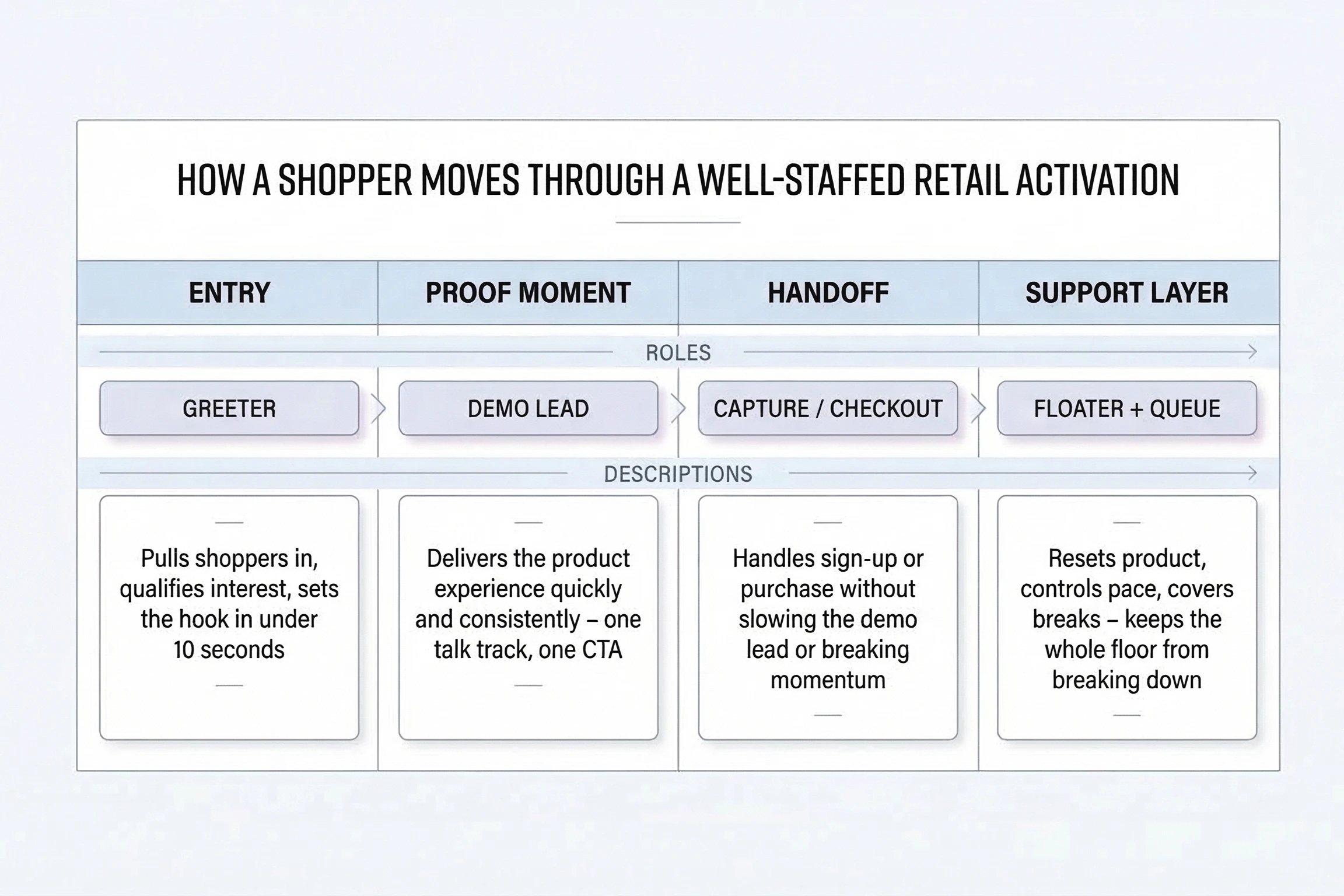
Important: The floater is the most under-resourced role in most activations. When the front of house gets busy, the floater gets pulled into demos, resets, stops, supplies drain, and the queue builds. Protect this role during peak windows.
Recommended staffing mix by activation type
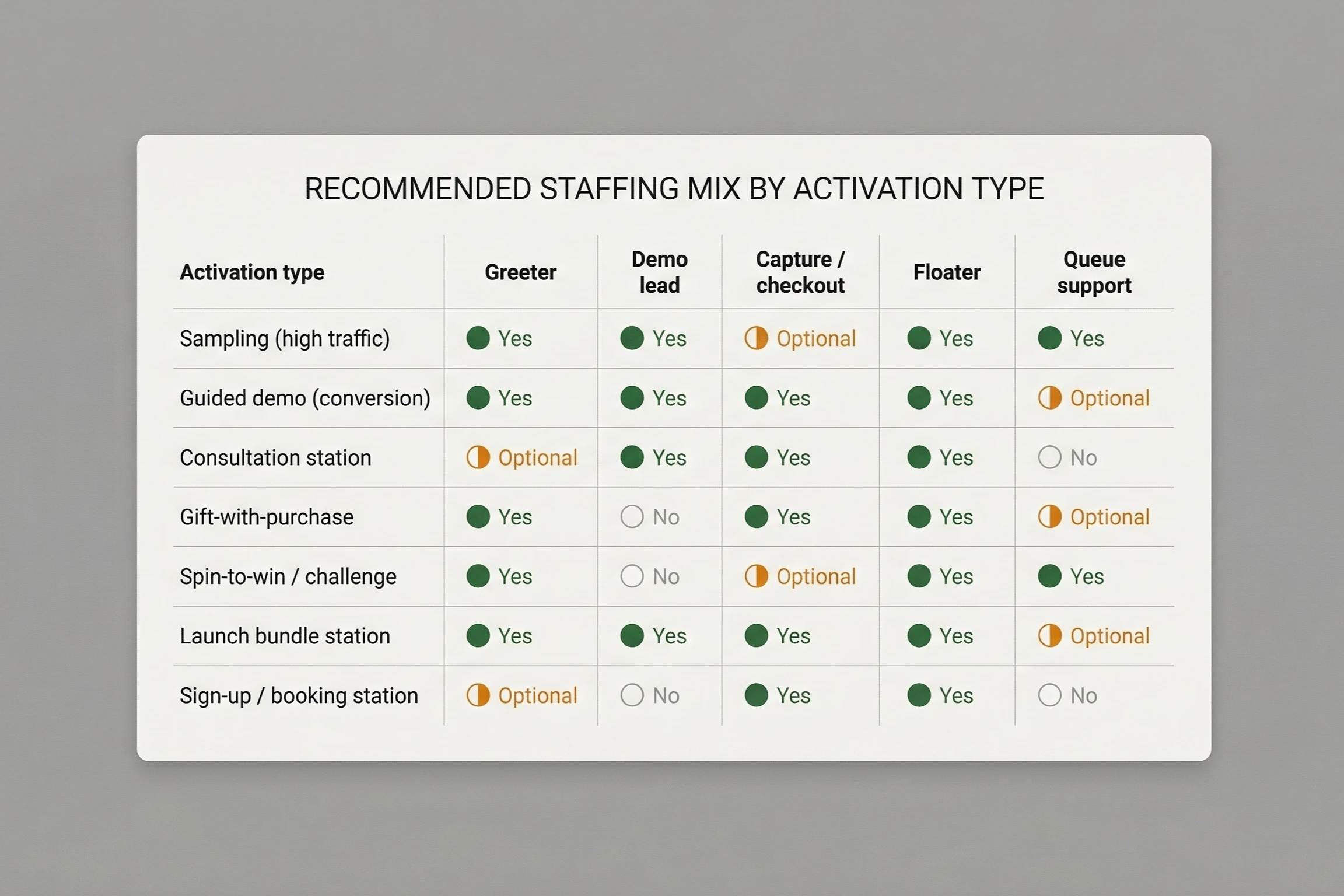
Add queue support any time you expect sustained volume above 30 interactions per hour. Add a supervisor for activations running more than 6 staff or spanning multiple zones.
Retail brand activation ideas checklist for planning and permissions
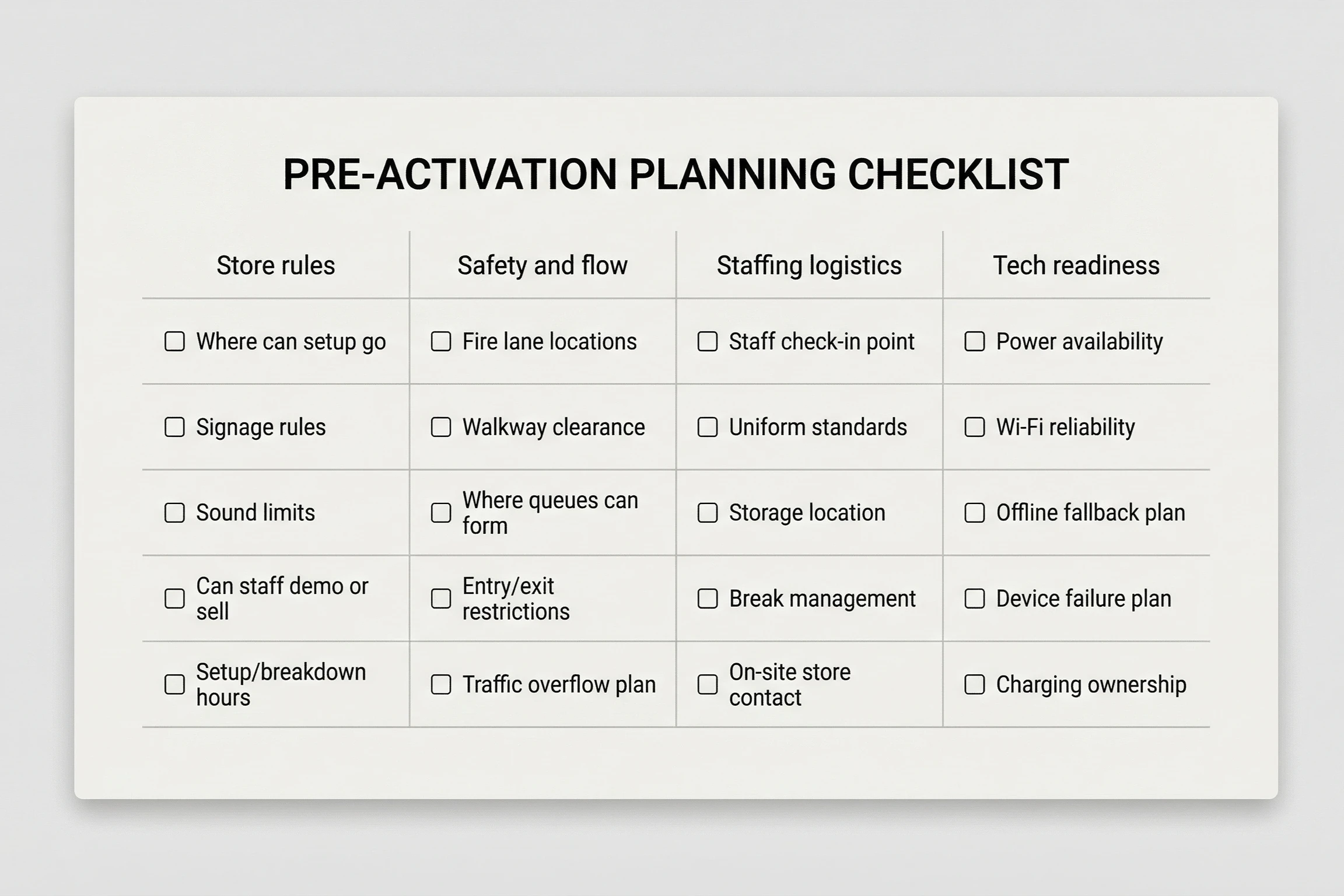
Most problems come from permissions and constraints. Use this checklist before finalizing the activation design.
PRE-ACTIVATION PLANNING CHECKLIST
Retail store activation ideas measurement that is simple and useful
Measure with a small number of metrics tied directly to the goal. If the measurement process slows the interaction, the team is collecting too much.
.webp)
SIMPLE MEASUREMENT MODEL MATCH METRICS TO YOUR GOAL
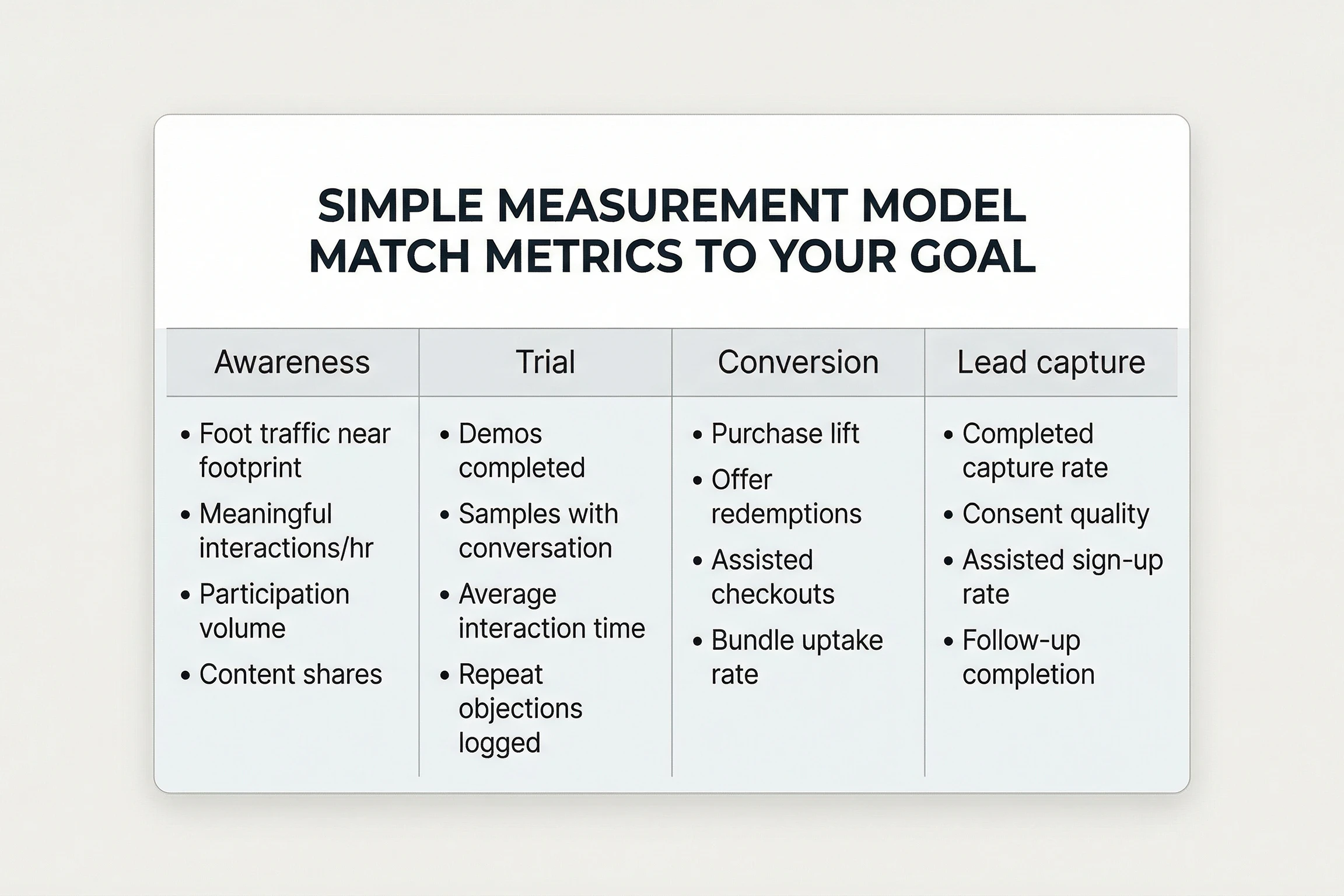
Track by hour, not just by day. Separate peak and off-peak results. Keep forms short. Log the top objections for post-event learning.
Retail activation ideas mini examples that show what works

These examples show how simple concepts win when execution is built for real shopper behavior.
Example 1 · High-Traffic Mall Sampling
Goal: Maximize participation without blocking foot traffic
Challenge: Queue overflow disrupted store flow by late morning
Fix: Assigned one staff member exclusively to pacing and queue control
Result:
- Queue remained stable throughout peak hours
- Participation volume increased without congestion
Key Insight: A short sampling lane, one-line message, and a dedicated pacing role allow high-volume participation without breaking store flow.
Example 2 · Product Launch Demo Station
Goal: Drive consistent demos and conversions
Challenge: Staff messaging varied across shifts
Fix: Standardized a 2-minute demo script built around one core benefit
Result:
- Conversion rates stabilized by early afternoon
- Shopper confusion reduced significantly
Key Insight: Consistency in talk track drives more conversions than creative variation across staff. Research from Billion Dollar Boy (December 2024) found that 73% of marketers plan to increase investment in brand ambassador programs over the next 12 months, largely because a well-briefed ambassador at the demo station is among the highest-return assets a brand can deploy.
Example 3 · Small-Store Consultation Format
Goal: Improve close rate without crowding the store
Challenge: Too many product options slowed decision-making
Fix: Introduced one qualifying question to guide shoppers to a single recommendation
Result:
- Faster decisions at the point of interaction
- Noticeable improvement in close rate
Key Insight: In small retail environments, reducing choice complexity increases conversion speed and improves shopper confidence. The lesson is not that every activation needs more complexity. Simple concepts perform better when the team plans for pace, consistency, and flow.
Ready to Pressure-Test Your Activation Floor Plan?
Most retail activation ideas look strong in planning, but break when real shopper volume hits. The difference is not the concept; it is how well the experience holds up under pressure. Activations typically fail when demo times drift, talk tracks become inconsistent, the floater role disappears, and no one owns pacing. When roles are clearly defined and execution is structured, the same concept delivers far stronger results with less chaos.If you are planning a high-traffic rollout, product launch, or multi-location campaign, now is the time to pressure-test your floor plan, staffing model, and execution flow. Get a tailored staffing plan and quote to ensure your activation runs smoothly, converts consistently, and scales without breaking your in-store experience.
Ready to elevate your next event?
Join thousands of event planners who trust EventStaff.com for reliable, professional staffing solutions.
Trusted by event professionals nationwide
1k+
Events Staffed
2 million+
Guests Served
97%
Positive reviews