

Choosing between convention centers in Las Vegas is one of the most important early decisions event planners make. The venue you select shapes how attendees arrive, how easily they move between sessions, and how smoothly your event operates from registration through closing remarks.
Large convention centers in Las Vegas operate more like campuses than traditional conference venues. Multiple exhibit halls, long corridors, skybridges, and separate buildings can make attendee movement far more complex than planners expect. At large events, thousands of guests may move between spaces at the same time, which means layout and flow directly affect registration speed, session timing, and overall guest experience.
The scale of the Las Vegas meetings market highlights why venue selection matters. The Las Vegas Convention Center campus alone spans more than 4.6 million square feet, and the broader destination offers nearly 15 million square feet of meeting and exhibition space supported by over 150,000 hotel rooms. With venues of this size, even small planning decisions can influence crowd movement and staffing requirements.
At this scale, operational details quickly become visible problems if they are not planned carefully. For example:
- A poorly placed registration desk can create lobby-wide lines before the first session begins
- Tight session transition windows can lead to hallway congestion and delayed schedules
- Expo booths without queue planning can block aisles and reduce exhibitor visibility
For planners evaluating convention centers in Las Vegas, the real decision is not only about venue size or rental cost. The more important question is how well the venue supports attendee movement, staffing logistics, and program timing across the entire event schedule.
This guide goes through all of it. Venue comparisons, flow planning, when to bring in conference staffing support, and when conference production companies become necessary rather than optional.
Executive Summary
Convention centers in Las Vegas vary significantly in layout, scale, and operational complexity. This guide helps planners choose the right venue by focusing on attendee flow, staffing needs, and event type. It also explains when production teams become essential for execution. By understanding these factors early, planners can avoid delays, reduce congestion, and deliver a seamless event experience.
How many convention centers are in Las Vegas?
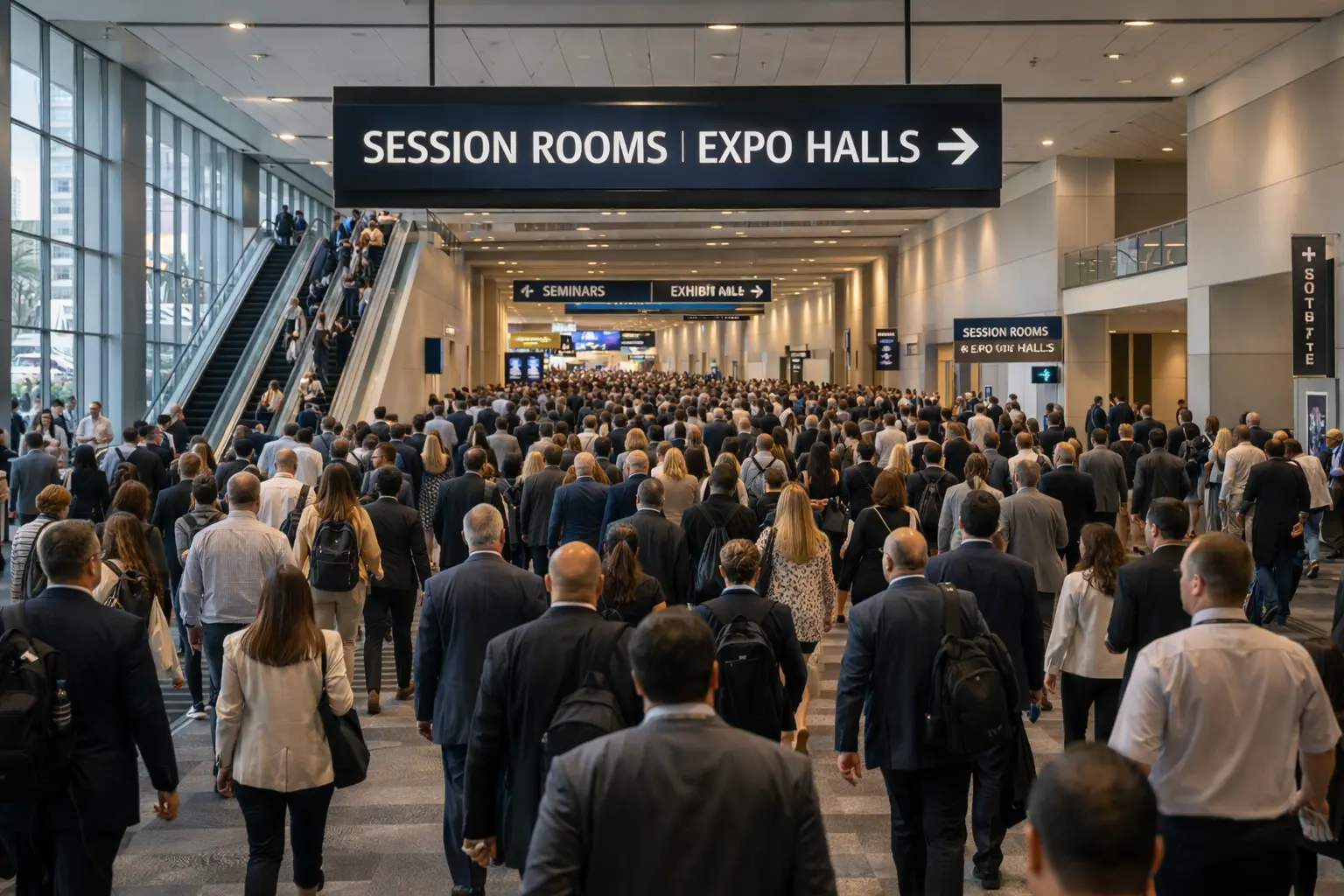
Event planners often begin their venue search by asking a simple question: how many convention centers in Las Vegas should be considered for large conferences or trade shows?
Las Vegas has three primary convention centers designed specifically for high-capacity events, exhibitions, and multi-day conferences. These facilities are built to handle large attendee volumes, complex logistics, and extensive exhibit halls.
All three are located within roughly a four-mile corridor along the Las Vegas Strip, which is one reason the city remains one of the largest convention destinations in the world.
The Three Major Convention Centers in Las Vegas
The main convention centers in Las Vegas include:
- Las Vegas Convention Center (LVCC)
- Venetian Expo
- Mandalay Bay Convention Center
Together, these venues provide more than six million square feet of exhibit space, allowing the city to host some of the largest trade shows and corporate conventions in the United States.
Additional Convention Venues Planners May Consider
While the three facilities above are the primary convention centers in Las Vegas, some planners also evaluate large conference venues located within major resorts. These include:
- Caesars Forum
- Wynn Convention Center
- MGM Grand Conference Center
These venues can work well for corporate meetings, industry conferences, and mid-size conventions that do not require the largest exhibit halls.
Why Most Planners Start With the Three Major Convention Centers
For events that require large exhibit floors, multiple breakout rooms, and infrastructure designed for thousands of attendees, the three primary convention centers in Las Vegas remain the most common starting point.
These venues provide:
- Large exhibit halls suitable for trade shows and expos
- Multiple meeting rooms for breakout sessions
- Integrated logistics support for exhibitors and production teams
- Capacity for large keynote sessions and multi-track conferences
Understanding how many convention centers in Las Vegas are designed for large-scale events helps planners narrow their venue search and focus on locations that can realistically support their program structure and attendee volume.
CEO Excerpt
"I've worked events at nearly every major convention center in Las Vegas, and the planners who struggle most aren't the ones with the smallest budgets; they're the ones who chose the venue before they understood their crowd. The venue decision is really a staffing and flow decision, and if you get the flow wrong, you spend the whole event reacting." - Daniel Meursing, CEO of Event Staff
What Event Planners Should Know About Convention Centers in Las Vegas Before Booking
Here's something that doesn't get said enough: large Vegas venues don't really operate like conference facilities. They operate like campuses.
Halls connect through long corridors. Multiple lobby areas. Skybridges. Sometimes entirely separate buildings. When thousands of people try to move between zones at the same time, even a moderately awkward design decision from fifteen years ago becomes a very visible problem today.
The venue differences that matter most to planners usually show up in three areas.
Walking Distance and Layout Complexity
This one sounds obvious until you're on-site and realize the keynote hall and the first round of breakout rooms are a seven-minute walk apart, and you built five-minute transitions into the agenda.
Things to look at before you commit:
- Distance between keynote halls and breakout rooms
- Whether the expo floor sits next to the conference space or in a completely separate building
- Corridor width and where traffic is going to merge
If any walking route exceeds five minutes, build buffer time into the agenda. Nonnegotiable.
Entry Points and Arrival Flow
The arrival experience sets the tone before a single session starts. And if you're funneling 2,000 people through one main entrance into one registration area, you're going to need more staff and a much better queue plan than you probably budgeted for.
Ask the venue:
- Are arrivals distributed across multiple entrances, or is everything concentrated in one lobby?
- Where do registration desks land relative to the entry points?
- Is there actual space for overflow lines, or does a slow morning back up into the drop-off zone?
Congestion Points During Peak Periods
The three moments that create the most pressure at large convention centers in Las Vegas are predictable every time: morning registration and badge pickup, breaks between sessions, and the lunch migration from conference spaces to the expo floor.
Those surges hit hardest at corridor intersections, escalators, elevator banks, entrances to keynote halls, and anywhere food service is set up. Plan for the peaks, not the average. Map the path from curb to seat and figure out exactly where you're going to need wayfinding staff, signage, or active crowd management.
How to Choose Between Convention Centers in Las Vegas Based on Event Type

The most useful framing here is: which moments in your event are highest risk operationally, and which venue layout creates the least friction at those moments?
Square footage and rental cost matter. But they don't tell you where your registration line is going to stall or how long it takes 500 people to clear a keynote hall and get to their next session.
Multi-Track Conferences With Breakout Sessions
The pressure point is transitions. If attendees can't move between sessions quickly, hallways fill up, starts get delayed, and the whole schedule starts sliding.
Look for venues with breakout rooms clustered near keynote spaces, short walking routes between session areas, clear corridor layouts that don't require navigation decisions every fifty feet, and actual space for staffed decision points at major intersections.
If transitions require long hallway walks or escalator travel, increase your session transition windows to ten to fifteen minutes. Venues with compact meeting room clusters genuinely reduce staffing needs because people can figure out where they're going without help.
Trade Shows and Expo-Focused Events
The pressure moves to the expo floor. Operational load is about exhibit hall size and ceiling height, loading dock capacity, freight elevator access, aisle width, and how close registration sits to the exhibit entrances.
High-interest booths create long queues that will spill into the aisles if there's no queue staging area built into the layout. Events with heavy exhibitor engagement benefit from dedicated trade expo staffing to monitor aisle flow, redirect traffic, and keep walkways clear.
VIP Programming and Sponsor Experiences
Events that include sponsor lounges, private receptions, or executive programming require venues that allow planners to separate VIP traffic from general attendee flow. For a deeper operational breakdown of how these environments are managed, see our guide to VIP event staffing.
When comparing convention centers in Las Vegas for VIP-focused events, evaluate whether the venue supports:
- Private access routes for sponsor or executive guests
- Dedicated holding areas for VIP arrivals
- Controlled entry points for invitation-only spaces
- Proximity between sponsor zones and main programming areas
Without these features, planners often need to build additional staffing layers to manage guest movement and maintain controlled access.
Mixed-Format Conferences With Expo Components
These create the most complex movement patterns because you're managing two completely different traffic systems simultaneously. Conference attendees are moving on to the next session schedule. Expo visitors moving freely. They collide constantly if the venue isn't set up to absorb it.
Look for flexible zoning between conference and expo areas, clear sightlines between major program spaces, overflow room near high-traffic sponsor booths, and lobby space that can absorb the surge when a keynote releases.
Mixed-format events almost always need dedicated on-site staffing teams for wayfinding, session room coverage, registration and credential support, and expo floor flow management.
Planning a Las Vegas Convention? Is Your Guest Flow Strategy Ready?
How to Plan Guest Flow at Convention Centers in Las Vegas. Managing guest flow at large Las Vegas convention centers requires designing tiered registration entries and mapping interior routes to build adequate schedule buffers for travel time. To prevent critical bottlenecks, planners must also stagger session release times and proactively manage high-interest expo queues using stanchions, floor markings, and dedicated floater staff.
Guest flow planning is one of those things that feels like an operational detail until it isn't. At venues where a single lobby can exceed 100,000 square feet, "we'll figure it out on-site" is how you end up with registration lines stretching out the door at 8:45am.
Entry and Arrival Planning
- Clearly marked entry lanes with signage visible from at least 50 feet out
- Separate badge pickup from exception handling, create a credential resolution desk for badge issues, lost registrations, and walk-ins
- Have an overflow queue plan ready before you need it
- Staff both outside and inside the entrance from the moment the doors open
Inside Movement Between Program Areas
- Staffed decision points at every major corridor intersection
- Walking routes mapped in advance, not guessed at
- Walking time estimated between keynote halls, breakout rooms, and expo spaces
- Schedule buffers added wherever travel time exceeds five minutes
How Venue Choice Affects Staffing and Schedule Risk
Venue layout is a staffing question. That's the reframe that actually helps planners make better decisions.
Each major Las Vegas convention venue operates differently. Entry points, corridor design, badge pickup locations, loading schedules , these vary significantly from one property to the next, and those differences directly affect how many staff you need and how much schedule padding is realistic.
Many operational considerations become clearer when reviewing how event logistics affect staffing coordination, transportation planning, and arrival timing across large venues.
Why Venue Layout Changes Staffing Needs
Layouts that require more active staffing support tend to share a few characteristics: long corridor merges where multiple traffic streams meet, limited entry points that compress arrivals into a single lobby, multi-building campuses connected by bridges or tunnels, large expo halls with multiple exhibit entrances.
When attendees can't navigate by sight, wayfinding staff become load-bearing. The Las Vegas Convention Center is a good example, attendees frequently travel between buildings during the same event day, and without staffed guidance points, navigation confusion slows everything down.
Transition Time Between Sessions
Walking distance is the most consistent source of schedule delays at large convention centers in Las Vegas. The numbers that tend to work in practice: ten minutes minimum for compact conference layouts, fifteen or more for campus-style venues, plus additional buffer whenever keynote halls and breakout rooms are in separate buildings.
Planning for Peak Traffic Surges
Three moments, every event, every time: venue doors opening in the morning, lunch migration between sessions and expo areas, post-keynote movement toward breakout rooms or networking spaces. Prepare staffing increases specifically for these windows. Don't rely on a flat headcount ratio , distribute based on how the venue layout actually moves people.
Conference Production Companies and What They Handle in Large Venues
Production is a separate problem from staffing, and it's worth treating it that way.
Complex events need production teams to manage audio visual systems, stage operations, speaker transitions, and the technical timing of the program. CES 2026 spanned more than 2.6 million square feet of exhibit space across 13 venues, at that scale, you're not winging the AV coordination.
Key Responsibilities of Conference Production Companies
Pre-event AV setup and equipment testing, speaker rehearsals and stage prep, show calling and cue management during sessions, slide switching and presentation control, audio consistency across breakout rooms and keynote spaces, session recording for post-event distribution, and coordinating lighting, stage design, and live stream elements.
In large venues, these responsibilities extend across multiple rooms running simultaneously.
Run of Show Coordination
One of the most important things production companies actually do is run of show management , making sure every segment of the agenda happens when it's supposed to. Speaker introductions and stage transitions, timing for sponsor messages and brand integrations, video playback and presentation cues, communication between stage managers and technical operators. One timing slip without a production team calling the show can ripple across the entire schedule.
Conference Production Companies and What They Handle in Large Venues
Large events at convention centers in Las Vegas often require two separate operational layers. One layer focuses on staffing and attendee movement. The other focuses on technical production and program execution.
Conference production companies handle the technical side of the event. Their role is to manage audio visual systems, stage operations, speaker transitions, and the overall timing of the program. At large conferences with multiple stages and simultaneous sessions, these responsibilities become essential for keeping the event on schedule.
Events such as major technology conferences and industry expos often span several halls and run multiple presentations at the same time. In these environments, production teams coordinate the technical systems that support every session.
Key Responsibilities of Conference Production Companies
Production teams manage a wide range of technical and operational tasks before and during the event. At large convention centers in Las Vegas, their responsibilities often include:
- Audio visual setup and equipment testing before the event
- Speaker rehearsals and stage preparation
- Live show calling and cue management during sessions
- Slide switching and presentation control
- Maintaining consistent audio levels across multiple rooms
- Recording sessions for post event distribution
- Coordinating lighting, stage design, and live stream systems
In large venues where several sessions run at the same time, production teams ensure that each room operates smoothly without technical delays.
Run of Show Coordination
One of the most important roles production companies perform is managing the run of show. This refers to the detailed timeline that controls exactly when each segment of the program occurs.
Run of show coordination includes:
- Speaker introductions and stage transitions
- Timing of sponsor messages and branded segments
- Video playback and presentation cues
- Communication between stage managers and technical operators
Without a production team calling cues and managing timing, even a small delay in one session can create scheduling issues across the entire program.
When to Hire a Conference Production Company
Not every event requires a full production partner. Smaller meetings with limited technical needs can often rely on internal teams or venue AV support.
However, conference production companies become necessary when events include:
- Multiple sessions running simultaneously in different rooms
- Large keynote presentations with stage management requirements
- High profile speakers who require rehearsals and timing coordination
- Hybrid events that include live streaming or recorded sessions
At large convention centers in Las Vegas, separating production responsibilities from event management allows planners to focus on attendee experience, sponsor relationships, and operational decisions while production teams manage the technical execution of the program.
What Are the Most Common Planning Mistakes at Convention Centers in Las Vegas?
Large venues do not create new planning problems. They make existing ones more visible. At convention centers in Las Vegas, the scale of the venue amplifies small operational issues that might go unnoticed at smaller conference facilities.
Understanding the most common mistakes helps planners avoid delays, congestion, and attendee frustration during major events.
Are You Underestimating Walking Time Between Event Areas?
Walking distance is one of the most frequently underestimated factors when planning events at convention centers in Las Vegas. Large venues may require several minutes for attendees to move between keynote halls, breakout rooms, and expo spaces.
Before finalizing the event schedule, planners should:
- Walk the floor plan or review the venue layout carefully
- Time the routes between major program areas
- Identify intersections where traffic may slow movement
If the travel time between spaces is longer than expected, session breaks should be extended. Without adequate transition windows, attendees arrive late and hallway congestion increases.
How Can You Prevent Registration Bottlenecks During Arrival?
Registration is often the first operational challenge attendees experience. A single line handling multiple registration issues can quickly create long wait times.
To prevent bottlenecks:
- Separate standard badge pickup from exception handling
- Create a dedicated help desk for lost badges or registration problems
- Assign staff to guide attendees to the correct line
- Prepare an overflow queue plan before peak arrival periods begin
At large convention centers in Las Vegas, distributing registration stations across several lines helps keep the process moving during busy morning check-in periods.
How Do You Stop Expo Booth Lines From Blocking Aisles?
Popular booths often attract long lines during trade shows and exhibitions. If queue areas are not planned in advance, waiting lines can spill into the aisles and block visibility for nearby exhibitors.
Effective queue management strategies include:
- Designating specific waiting areas near high-interest booths
- Using stanchions or floor markings to guide lines
- Assigning staff to monitor line length and redirect attendees when needed
These steps help maintain clear aisles and ensure that all exhibitors remain visible to attendees.
Why Do You Need Staffing Floaters for Traffic Surges?
Fixed staff positions are necessary for registration desks, session doors, and information points. However, large events also require mobile team members who can respond to changing crowd patterns.
Staffing floaters can assist with:
- Redirecting attendees at busy corridor intersections
- Supporting registration areas during unexpected surges
- Guiding guests when multiple sessions end at the same time
A small floating team often prevents small issues from escalating into visible operational problems.
Why Is a Clear Day of Decision Chain Critical?
Large conferences require fast decisions when unexpected situations arise. Without a defined decision structure, teams may hesitate or wait for approval while problems grow.
An effective on site decision chain usually includes:
- One operations lead responsible for the overall event
- Zone supervisors assigned to specific areas of the venue
- Clear communication channels between production teams, venue staff, and event organizers
When responsibilities are clearly defined, issues can be addressed quickly before they affect attendee experience at convention centers in Las Vegas.
Get Expert Staffing and Flow Support for Your Las Vegas Convention
Even the best venue can fail without the right execution strategy.
At large convention centers in Las Vegas, success depends on how well you manage registration flow, attendee movement, session transitions, and peak crowd surges. These are not small details they directly impact your event’s timing, guest experience, and brand perception.
Our event staffing teams specialize in high-volume conferences and trade shows, providing:
- Registration and credential management
- Wayfinding and corridor flow support
- Session room coverage and transitions
- VIP hosting and controlled access
- Real-time crowd management during peak periods
If you’re planning an event, now is the time to pressure-test your layout and staffing plan.
Request a customized staffing strategy based on your venue and agenda and ensure your event runs exactly as planned.
Ready to elevate your next event?
Join thousands of event planners who trust EventStaff.com for reliable, professional staffing solutions.
Trusted by event professionals nationwide
1k+
Events Staffed
2 million+
Guests Served
97%
Positive reviews


.webp)
.jpg)