

How Convention Staffing Prevents Operational Bottlenecks at Trade Shows
Operational bottlenecks at conventions don’t happen suddenly they build from small delays that compound under pressure. In high-traffic environments, even a 30–90 second slowdown at entry points, badge scanning, or wayfinding zones can trigger large-scale congestion.
This is where strategic convention staffing becomes critical. Instead of reacting to crowd buildup, well-trained event staff prevent bottlenecks before they form by managing flow, reducing credential friction, and stabilizing movement across key touchpoints.
In this guide, we break down how professional event staffing teams eliminate delays, improve attendee flow, and ensure seamless operations at conventions and trade expos.
Executive Summary
Convention staffing determines crowd flow long before doors open, and issues like last-minute credential changes or slower AI scanning kiosks can add seconds that scale into gridlock. With tighter security and compressed arrival windows in 2025, simply placing staff at entrances isn’t enough. Multi-level venues act like separate systems, so effective teams rely on strong captains and real-time adjustments to control spikes before they spread.
Key takeaways:
- Identify failure points before guests enter
- Reduce credential friction at the first scan
- Split movement into controlled micro-streams
- Stabilize multi-level flow with zone-specific pacing
With the right structure, bottlenecks become a preventable operational pattern.
What Causes Bottlenecks at Conventions and Trade Expos?
Most event bottlenecks are caused by predictable operational friction points that escalate under volume. The most common causes include:
- Credential delays: Slow badge scanning, QR failures, or manual verification issues
- Wayfinding hesitation: Attendees pausing due to unclear signage or layout confusion
- Crowd surges: Session changes or expo openings triggering sudden movement spikes
- Venue complexity: Multi-level layouts and hidden access points disrupting flow
- Insufficient staffing: Lack of trained personnel at high-friction zones
Even minor delays in these areas can quickly multiply, leading to long queues, congestion, and poor attendee experience. Effective convention staffing addresses these risks proactively through real-time monitoring and intervention.
CEO EXCERPT
"Gridlock is often just 90 seconds of unchecked drift. I build teams that spot micro-delays upstream, because once movement stops, recovery takes ten times longer. We fix the flow before your guests ever feel the stall."- CEO, Event Staff
Why Conventions Experience Operational Bottlenecks
Most bottlenecks form in the first fifteen minutes when convention staffing hasn’t yet absorbed arrival spikes or when expo crowd flow reacts to hesitation at credential checks. Even a well-designed layout collapses if staff miss the first signs of drift. Planners leaning on theoretical large-venue guest flow models often get blindsided because real crowd behavior shifts minute to minute. Effective event congestion management means acknowledging that trade show staff roles must shift with it.
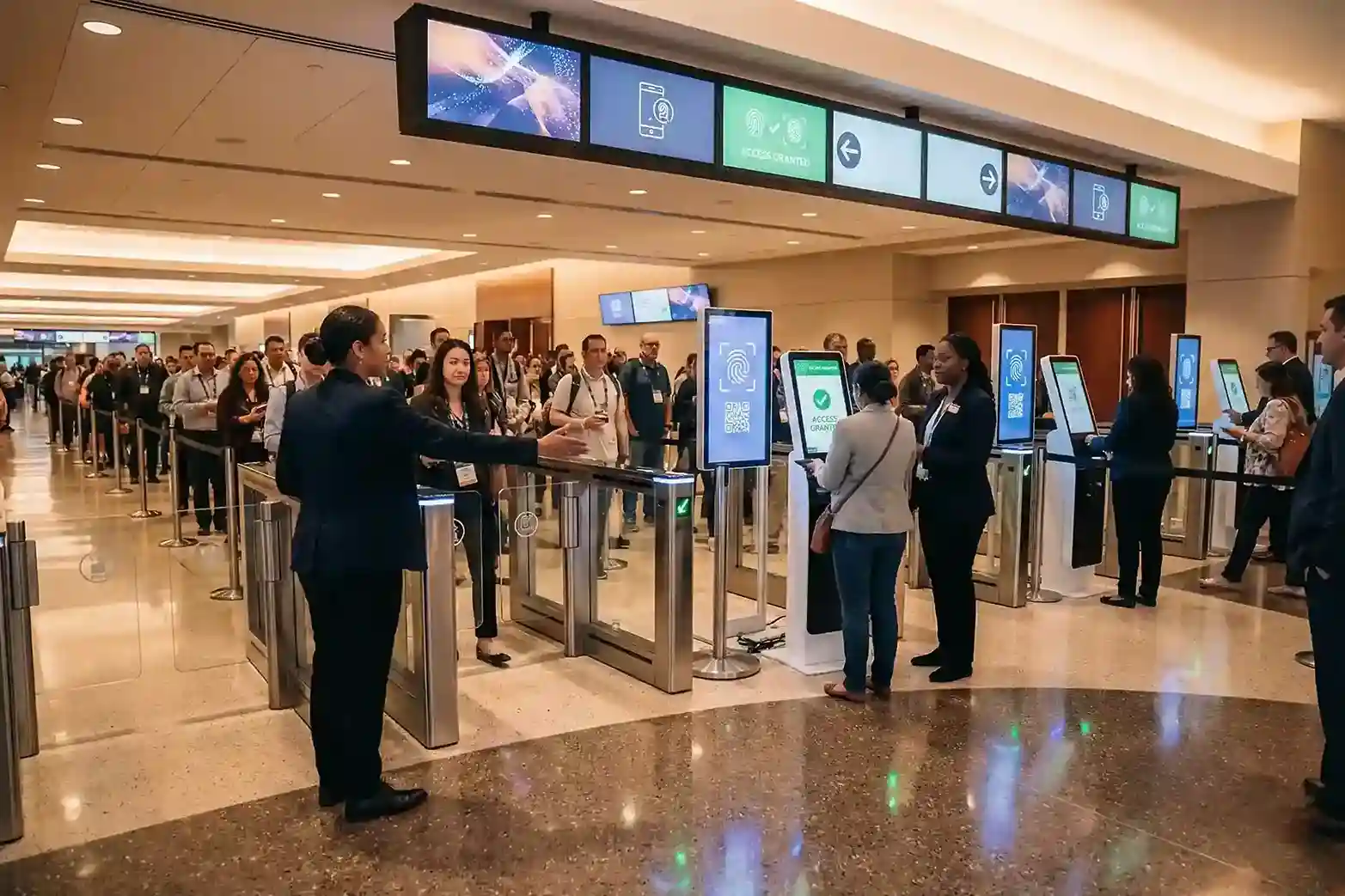
High-Density Movement & Fragmentation
Watch a morning opening: movement pulses, then holds. When dwell time climbs past 11–14 seconds, expo crowd flow collapses. People slow down to interpret signs or angle toward a session. Crowds don’t move as one body; they fragment. A group loses seconds to uncertainty, and a trailing group catches them. Good teams act early, splitting streams before pressure accumulates. You don’t fix a jammed escalator downstream; you redesign the entry logic upstream. For deeper insights, read our guide on stadium flow psychology.
Credential Friction: The First Failure Point
It always starts here. A badge won’t activate, a QR code won’t load. Each tiny delay adds seconds that multiply by thousands of arrivals. 2025 venues have tightened checks, adding more layers at the door. AI-linked kiosks introduce variable scanning throughput, fast when working, slow when not. Teams counter this by redirecting guests into secondary lanes and pre-validating credentials, solving small delays before they turn into line compression.
Venue Geometry and Multi-Level Confusion
Some venues split halls across floors or hide escalators behind columns. Movement becomes guesswork, and guesswork slows everything. Multi-hall layouts look elegant on paper but are brutal during peaks. Guests funnel through narrow junctions, creating stacking. Without staff redirecting flow early, delays echo across the building. This is why planners often scramble for convention lobby congestion solutions after the fact.
Staff Roles That Prevent Bottleneck Formation
You can lose the first thirty minutes if your convention staffing model lacks the right people at friction points. Roles aren’t interchangeable. A strong registration lead doesn’t automatically know how to manage expo-floor pacing. ES’s layered approach is built around throughput benchmarks and real-time escalation.
.webp)
Registration & Check-In Teams
Convention entry operations succeed or fail on the first scan. You need three to five staff per lane for stable throughput. Anything less, and arrival spikes cause a full stop while guests troubleshoot apps. Experienced planners insist on expo badge scanning staff who spot trouble before the guest realizes they’re the problem. AI-linked dashboards now help captains shift staff instantly when a lane lags.
Wayfinding Staff & Greeters
Hesitation kills flow. Once people pause to interpret signage, everything behind them compresses. Wayfinding intelligence matters here. Good greeters read body language, the tiny signals that show someone is unsure. Directional micro-interventions prevent event bottlenecks at decision points. A quick redirect or verbal cue sends half the crowd left before the junction clogs. See how this works in our Chicago staffing guide.
Corridor Spotters & Floor Regulators
Spotters are your early-warning system, stationed at pinch points to read pacing. When pacing changes, they react using micro-queue segmentation to break lines into clusters. Inside the hall, expo staffing relies on floor regulators to keep exhibitors and attendees from interfering. They redirect movement before a booth’s popularity creates an aisle-blocking S-curve.
Common Bottlenecks & How Professional Staff Resolve Them
Every bottleneck has a signature. The difference between a minor slowdown and a meltdown is how fast your convention staffing team recognizes the signal.
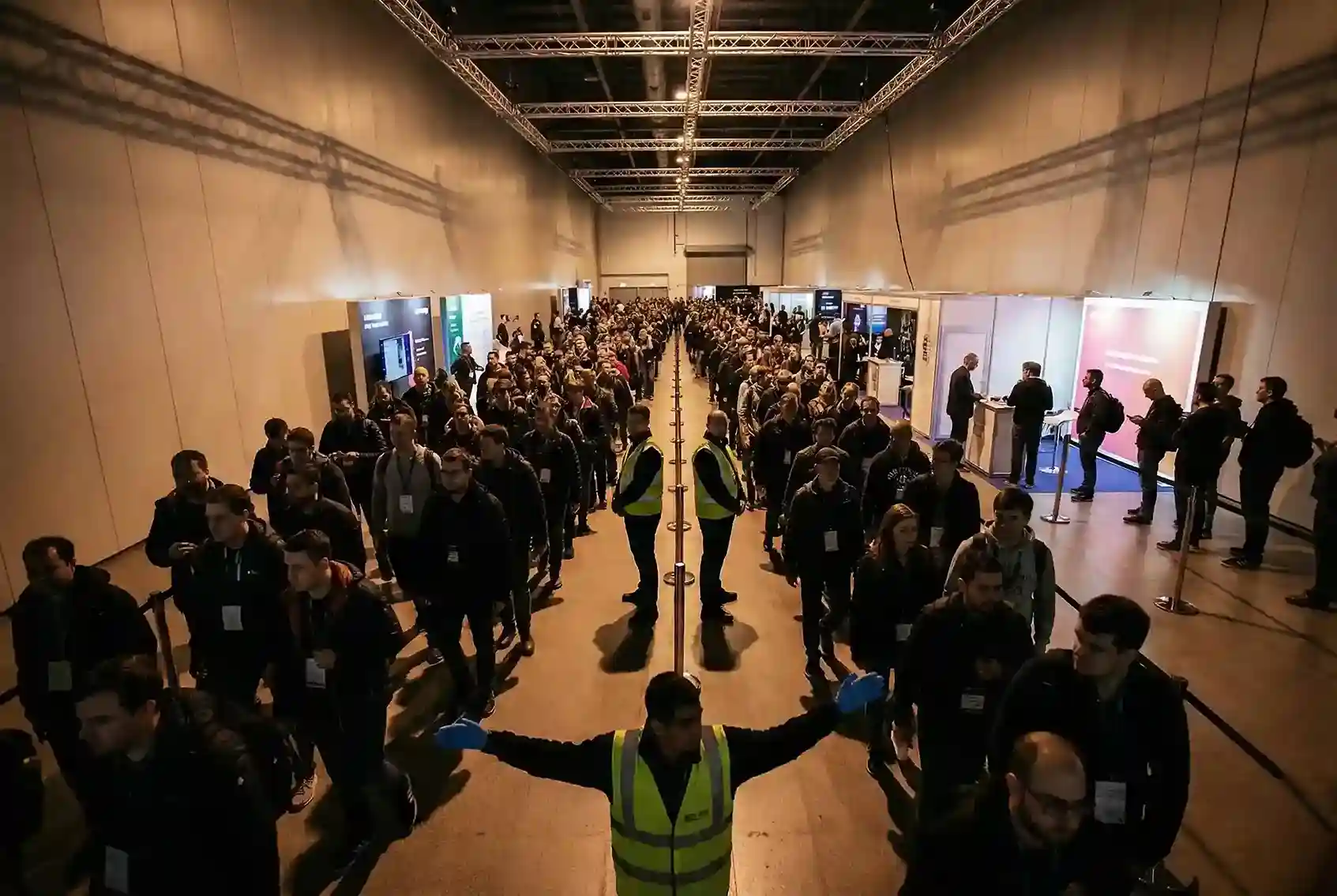
Lobby Congestion & Badge Backups
Lobbies are chaotic under volume. To prevent bottlenecks at conventions, you must control dwell time. Directional confusion increases dwell time, leading to path collapse. Staff split movement into micro-streams to keep momentum alive. Similarly, expo entry line management relies on preserving scanning throughput. Dual scanning setups and overflow lanes catch troubleshooting issues without slowing the main feed. Learn more in our post on large scale logistics.
Session-Change Surges & Expo Rushes
Session transitions are where event congestion management is tested. Hundreds move at once, contesting corridors. ES uses staged release timing, holding one room until the adjacent corridor clears. When the expo hall opens, teams trained in high-traffic queue management regulate the wave, pausing briefly between clusters so aisles don't seize. For high-volume tips, see trade show essentials.
Managing Multi-Level & Tech-Enabled Flow
Multi-level venues require trade show staff roles that understand vertical flow. Staff manage junction points, running triage to slow one stream while accelerating another. Escalators aren’t passive; they’re force multipliers that need active control, holding patterns at the top and timed releases at the bottom.
Technology accelerates operations only when staff interpret the data. Convention staffing plans pair humans with AI tools. While scanners and apps handle the bulk, competent expo scanning staff provide the override for anomalies. Hybrid wayfinding coordinates GPS nudges with staff cues, ensuring guests follow the timing you set. For tech trends, see event tech trends.
Building Anti-Bottleneck Plans & Managing Vendors
A stable event is engineered. ES builds layers into every model, including arrival curve, credential behavior, and labor constraint. Pre-event flow mapping identifies choke points early. Staffing ratios (1 per 300–500 attendees) create a safety net. Zone captains manage clusters, adjusting pacing based on live data.
Vendor flow is a separate hazard. Expo staffing must contain back-of-house chaos. We stagger move-ins and redirect vendors to service corridors to avoid conflicts with attendee movement. This protects large-venue guest flow from forklift traffic and early setups. See event logistics tips for more.
Convention Bottleneck Prevention Checklist
Here’s the operational backbone that keeps convention staffing stable while supporting high-traffic event staffing and trade show staff roles:
- Credential sequencing logic set before arrival
- Lane staffing ratios defined and validated
- Junction monitoring assignments locked
- Overflow routing paths pre-approved
- Live density dashboards active
- ADA flow considerations staffed
- Vendor conflict avoidance built into timeline
- Secondary entry points staffed
- Escalator landing zones monitored
- Session-release timing staggered
- Pre-hall holding zones prepared
- On-site captains empowered for escalation
These steps support entry bottleneck solutions expo planners rely on and reflect why ES remains the best staffing agency for conventions.
Why EventStaff Is the Preferred Partner
EventStaff adapts to the realities of 2025: hybrid scheduling, AI oversight, and union compliance. Strong convention staffing anticipates these pressures. Our multi-city capacity ensures rapid response; supervisors escalate early and adjust lanes fast. Integrated credentialing absorbs risk at the scanner, keeping expo staffing stable even during surges.
We design teams that rotate cleanly, allowing large programs to scale convention staffing past 10,000 attendees without losing control. Specialized trade show staff roles, floor regulators, junction captains, greeters, work together to prevent the failures most planners only discover when movement stops.
Prevent Bottlenecks Before They Impact Your Event
Don’t wait for congestion to disrupt your attendee experience. With the right convention staffing strategy, you can eliminate delays before they start and maintain smooth, controlled crowd flow from entry to exit.
EventStaff provides trained, high-performance teams who specialize in managing high-density environments, credential-heavy entry points, and complex venue layouts.
Book expert convention staff today and ensure your next trade show runs without bottlenecks, delays, or operational breakdowns.
👉 Get a customized staffing plan tailored to your event size, venue, and flow challenges.
Ready to elevate your next event?
Join thousands of event planners who trust EventStaff.com for reliable, professional staffing solutions.
Trusted by event professionals nationwide
1k+
Events Staffed
2 million+
Guests Served
97%
Positive reviews