

Executive Summary
Crowd management plays a critical role in ensuring safety, smooth flow, and a positive guest experience at events, with demand for skilled professionals rapidly increasing. Many enter the field through hospitality roles, building essential communication and crowd-handling skills before advancing. This guide outlines the career path from entry-level positions to leadership roles, along with key skills and certifications. It also helps event organizers structure teams effectively for safe and efficient event execution.
Introduction
Most large-scale events today rely on crowd management services not just for safety but for flow control, timing, and overall guest experience.
If you’re considering a career in this field or planning an event that requires structured staffing, it's important to understand how these roles actually work on the ground.
Many professionals start in hospitality staffing jobs such as ushers or guest services, then transition into specialized crowd management roles with greater responsibility and career growth.
This guide answers key questions like
- What do crowd management teams actually do at events?
- How do you start and grow in this career?
- What roles, skills, and certifications matter most?
CEO Excerpt
Crowd management is no longer a staffing afterthought; it is one of the most operationally critical functions in any large-scale event. The professionals in these roles make the difference between a venue that feels controlled and one that feels reactive. Building structured career paths within crowd management is how the industry retains the people who make that difference. — CEO Event Staff
What Crowd Management Services Actually Include
Crowd management services focus on how people move, behave, and are guided within an event environment before, during, and after peak activity.
At a practical level, this includes:
- Crowd flow control and density management Directing attendees to prevent bottlenecks and overcrowding at entrances, exits, and high-traffic zones.
- Access control and perimeter monitoring Managing entry points, credential checks, and restricted areas.
- Emergency response coordination Supporting evacuation procedures, medical incidents, or unexpected disruptions.
- Guest safety and conflict prevention Identifying risks early and using de-escalation techniques to prevent issues.
- Cross-team coordination Working with event operations, production teams, venue staff, and security personnel.
Understanding the full range of event staff roles across a live event helps clarify where crowd management sits within the broader staffing ecosystem and why it requires a distinct skill set from general event support.
Crowd Management vs Security vs Event Staffing
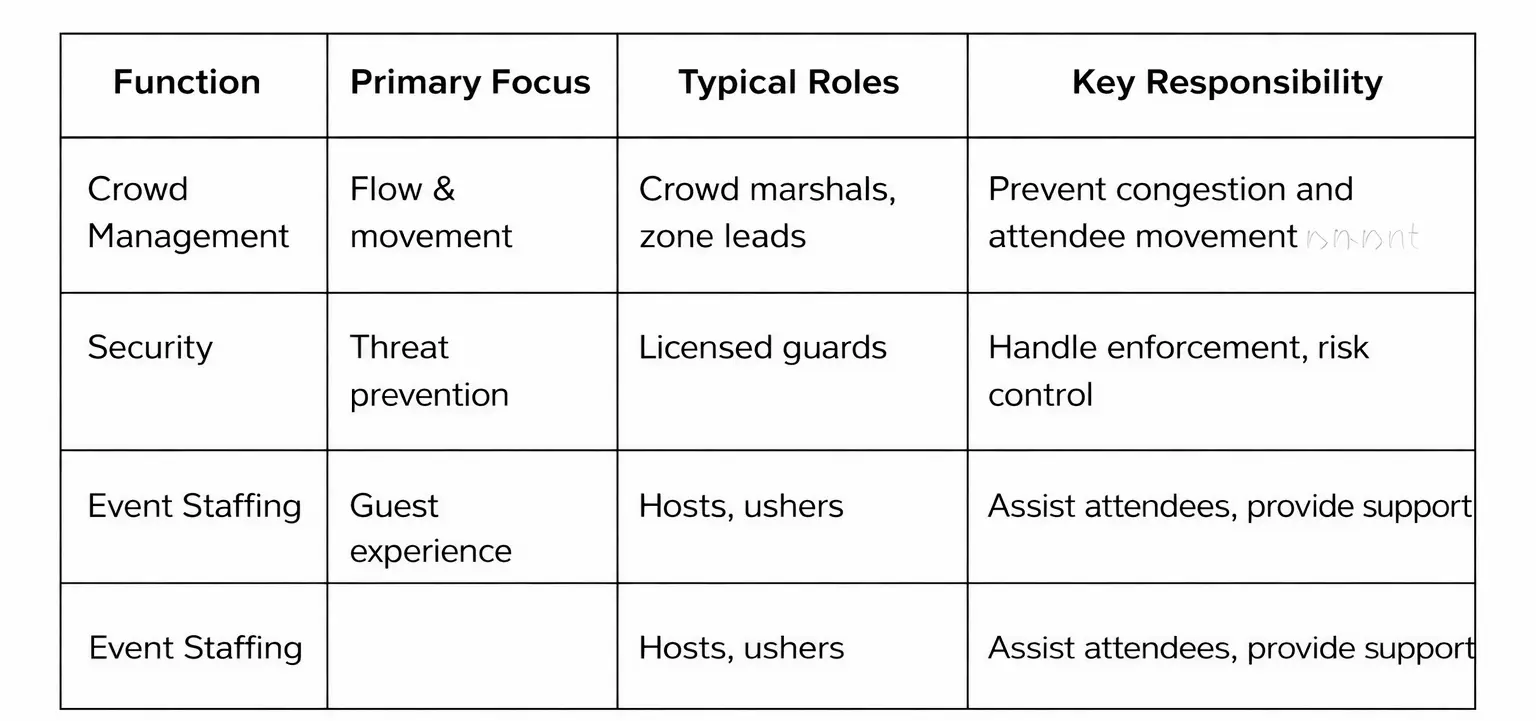
How Do You Start a Career in Crowd Management Services?
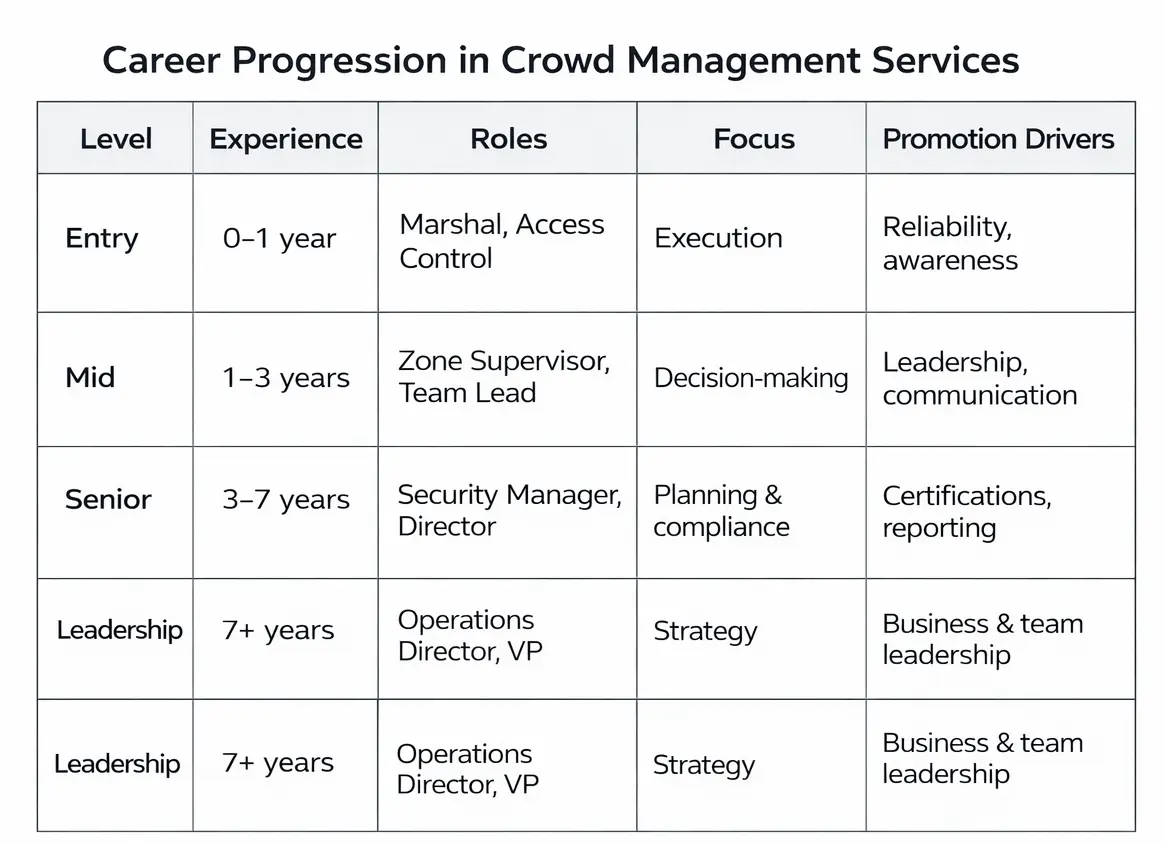
Most professionals enter crowd management through entry-level event roles and build experience on-site. No formal degree is required at entry level, but on-site hours and certifications significantly accelerate progression.
Typical path:
- Start in hospitality staffing jobs, such as usher, guest services, and front-of-house
- Transition into crowd marshal or access control roles
- Gain experience managing flow, queues, and entry points across different event types
- Move into zone supervisor or team lead positions
- Progress into event security management or crowd management director roles with certifications and documented event experience
The transition between steps two and three is where most people either stall or accelerate. The differentiator is almost always behavioral situational awareness, initiative during busy periods, and the ability to communicate clearly under pressure rather than formal qualifications.
Entry-Level Roles in Crowd Management Services
Most careers in crowd management services start with hands-on, on-site roles that build awareness, communication skills, and real-world experience under pressure.
- Event Crowd Marshal Directs attendee movement and prevents congestion in key areas.
- Access Control Staff Manages entrances, ticket validation, and restricted zones.
- Queue Management Assistant Organizes lines, reduces wait-time confusion, and improves flow.
- Guest Flow Coordinator Helps attendees navigate the venue efficiently.
.webp)
Core skills required at this level:
- Situational awareness
- Clear communication, especially in noisy environments
- Calm, fast decision-making
- Reliability and punctuality
- Physical stamina for long shifts
Where Hospitality Staffing Jobs Fit In
This is where many professionals get their start. Roles in hospitality staffing such as ushers, front-of-house staff, and guest services teams develop many of the same foundational skills required in crowd management. A closer look at what event staff do at corporate events and festivals shows how much of that day-to-day work directly overlaps with crowd flow, access management, and guest direction.
Hospitality vs Crowd Management: Skill Comparison
- Communication with guests is present in both Hospitality and crowd management.
- Directing large volumes of people Present in both Hospitality and Crowd Management
- Composure under pressure is present in both Hospitality and crowd management.
- A service-first mindset is present in both hospitality and crowd management.
- Safety and flow responsibility, Crowd Management only
- Zone ownership and decision-making, Crowd Management only
- Coordination with operations and security teams, Crowd Management only
- Because of this overlap, event staffing agencies often promote or retrain hospitality staff into crowd management roles once they demonstrate reliability and situational awareness.
How Hospitality Staffing Jobs Lead to Crowd Management Careers
.webp)
Hospitality roles are not a dead end; they are one of the most common entry points into event security and crowd management services.
Both fields require strong interpersonal communication, problem-solving in real time, a service-first mindset, and the ability to stay calm under pressure. The difference is that crowd management adds safety responsibility, flow control decision-making, and coordination with operations and security teams.
Common career transitions:
Host or Usher → Crowd Marshal
Floor Staff → Access Control Staff
Guest Services → Zone Supervisor (with experience)
What triggers the move
Most transitions happen when staff demonstrate awareness beyond their assigned role, the ability to handle difficult situations, and leadership potential during busy periods. Event staffing strategies built around hospitality staffing for conferences and festivals actively identify these signals because trained, reliable crowd staff are harder to source than general event workers.
Planning an Event That Requires Crowd Management?
If you are building a staffing plan and are unsure how many crowd management roles you need or how those roles should be structured across zones, it is worth mapping this out before the event, not during it.
EventStaff works with event teams to design staffing plans that balance flow, safety, and guest experience, especially for high-attendance or multi-zone events. View Event Staff's crowd management solutions to see how staffing is structured for events at different scales and formats.
Career Progression in Crowd Management Services
Mid-Level Roles in Crowd Management Services
Once professionals have 1–3 years of on-site experience, they typically move into roles with broader responsibility, zone ownership, and supervisory function.
- A zone supervisor owns a defined section of the venue, an entrance corridor, a bar area, or a stage perimeter and directs a small team of marshals or ushers in real time.
- The crowd flow team lead manages the movement strategy across multiple access points during peak entry and exit windows, coordinating directly with the event operations team.
- The incident response coordinator acts as the first point of contact for on-floor incidents, disturbances, medical situations, or congestion spikes and manages escalation to security or emergency services.
- VIP and Access Control Lead Oversees credentialing, backstage access, and restricted zone compliance, often working closely with production and talent management teams.
What changes at this level
Mid-level crowd management is less about executing instructions and more about reading the floor and making real-time decisions. Professionals at this stage are expected to anticipate flow problems before they become visible, reassign staff across zones without pulling focus from current tasks, communicate clearly both downward to their team and upward to the event manager, and maintain composure when conditions change rapidly.
In practice, mid-level crowd management roles are where most events succeed or fail. At a 1,500-person conference during peak entry, a zone supervisor may need to redirect staff across entrances, adjust queue flow in real time, and coordinate with registration teams all within minutes and without any instruction from above. This level of autonomous, pressure-tested decision-making is what separates basic event staffing from true crowd management. A common failure point at this stage is supervisors who wait to be told what to do rather than acting on what they can already see.
The global event security market reached $5.52 billion in 2025, which reflects how much professional-grade crowd management has grown beyond basic stewarding into a structured, specialized function with real career depth.
Senior and Leadership Roles in Crowd Management Services
The top of the career path in crowd management moves into planning, oversight, and operational design, not just on-floor execution.
- Event Security Manager Oversees the full security and crowd management plan for an event, from pre-event risk assessment through post-event reporting. Coordinates between venue management, external security contractors, emergency services, and the client.
- Crowd Management Director Responsible for staffing structure, deployment plans, and safety protocols across an entire event portfolio. Often works at the agency or venue level rather than at the individual event level.
- The site safety officer manages regulatory compliance, venue capacity limits, and emergency response readiness. In larger venues and events, this role may require formal accreditation and working alongside local authorities.
- Staffing Operations Lead bridges crowd management with the broader event staffing function, scheduling, briefing, deployment, and post-event review across a team of 20+ personnel.
Large-scale events require this level of structured leadership to function safely. Understanding cultural sensitivity in large-scale event planning is increasingly part of the senior crowd management brief, especially for events with diverse international audiences, where communication, signage, and staff behavior all carry heightened responsibility.
Certifications and Training That Accelerate Career Progression
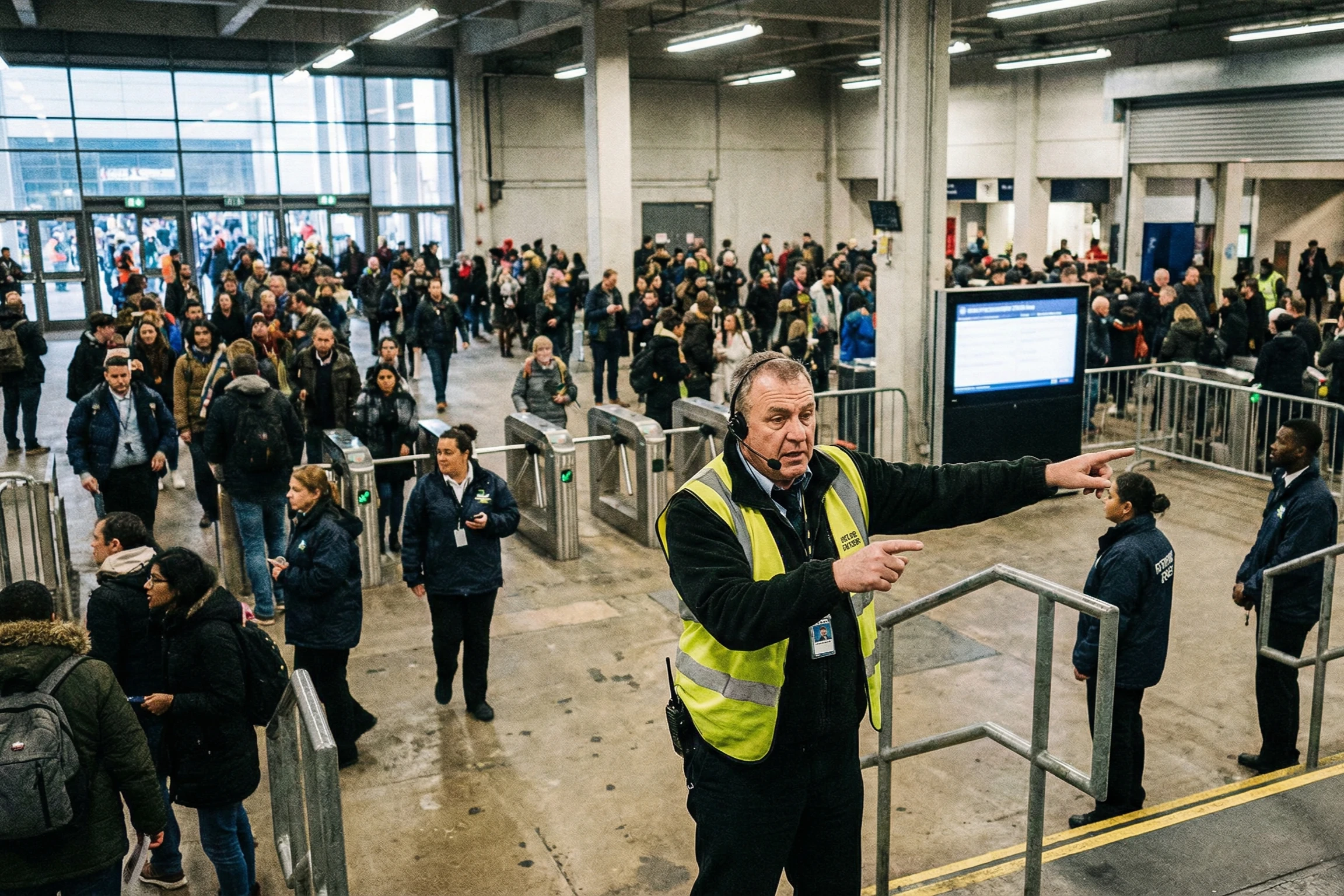
At the mid-level, crowd management shifts from following instructions to making decisions in real time.
For example, during peak entry at a 1,500-person event, a zone supervisor may need to:
- Reassign staff across entrances
- Adjust queue flow instantly
- Coordinate with registration and security teams
all without waiting for direction.
This ability to act before problems escalate is what separates basic staffing from high-performing crowd management professionals.
- FEMA Crowd Management Training (IS-15). b) A free online course from the Federal Emergency Management Agency covering crowd behavior, risk assessment, and emergency response at public gatherings. Widely recognized by venue operators and event organizers.
- Certified Protection Professional (CPP) ASIS International: The most recognized credential in the broader security industry. Relevant for professionals moving toward event security management or site safety officer roles.
- Emergency First Responder and first aid certifications are standard requirements for most crowd management leads and zone supervisors at mid-to-large events.
- State Security Guard License Required in most U.S. states for any role that involves enforcement authority. Requirements vary by state, but most involve a background check, training hours, and a written exam.
- Crowd safety management courses are offered by organizations like the Event Safety Alliance and Stadium Managers Association. These programs focus specifically on event-environment crowd dynamics, emergency planning, and operational coordination.
According to the U.S. Bureau of Labor Statistics, approximately 162,300 openings for security guards are projected annually through 2034, with a median wage of $38,370 as of May 2024, making formal certification one of the clearest ways to move into the higher-compensation tiers of this field.
Skills That Define Long-Term Growth in This Career Path
The difference between entry-level staff and high-performing crowd management professionals is rarely technical; it is operational judgment under pressure. On live events, the ability to read crowd behavior, anticipate pressure points, and communicate clearly across teams often matters more than formal training alone. These are the skills that consistently determine who progresses into leadership roles.
- Situational awareness at scale: The ability to read an entire venue environment, not just the zone directly in front of you, and identify risk patterns before they become visible to attendees or organizers.
- Real-time communication Crowd management requires clean, fast communication across radio, earpiece, and direct instruction simultaneously, often in loud and chaotic conditions.
- De-escalation: The majority of crowd management work is about preventing confrontation, not responding to it. Professionals who can de-escalate tense situations calmly and quickly are significantly more valuable than those who default to enforcement.
- Physical and mental stamina. Shifts are long, conditions are unpredictable, and the pressure spikes at exactly the moments when fatigue is highest.
- Documentation and post-event reporting Senior roles require clear incident logs, staffing reports, and debrief contributions. The ability to document accurately under pressure and extract useful operational insights is what separates people who stay in execution from those who move into management.
- Career Outlook for Crowd Management Professionals. The demand signal for this career path is unusually strong for 2025 and beyond. Event formats are growing more complex, regulatory expectations around venue safety are tightening, and the public's baseline expectation for managed, professional crowd environments has risen significantly.
Workforce planning decisions at the agency and venue level today are being shaped by a recognition that workforce planning defines event success, and crowd management is one of the areas where under-resourcing creates the most visible and consequential failures.
Professionals who invest in certifications, build leadership experience across multiple event types, and develop documentation and briefing skills will find that this field offers genuine long-term career structure, not just seasonal work.
Ready to Build Your Crowd Management Team or Join One?
Most crowd management failures are not caused by bad staff but rather by under-planned staffing structures. When roles are unclear, zones are under-covered, or the team is stretched across too many pressure points at once, the floor breaks down exactly when it cannot afford to. Internal planning only goes so far. High-attendance events, multi-zone venues, and time-pressured entry windows require experienced crowd management professionals who are briefed, positioned, and ready before the first guest arrives. If your next event has more moving parts than your current team can reliably cover, get a quote to see how a structured crowd management staffing plan can be built around your event size, venue layout, and format before the pressure is already on.
Ready to elevate your next event?
Join thousands of event planners who trust EventStaff.com for reliable, professional staffing solutions.
Trusted by event professionals nationwide
1k+
Events Staffed
2 million+
Guests Served
97%
Positive reviews