

Executive Summary
Experiential marketing technology improves live events when it increases participation, speeds up engagement, and supports reliable execution without creating bottlenecks. This guide shows which technologies actually work and how to align them with staffing and flow for consistent, scalable results.
Experiential marketing technology only works when it performs under real event conditions not just in pitch decks.
At high-traffic live events, the difference between a successful activation and a failed one comes down to three things: speed, simplicity, and scalability. While many brands invest in complex, high-cost technology, the highest-performing experiences are often the simplest to use and fastest to execute.
So, what actually works?
In this guide, we break down:
- Which experiential marketing technologies drive the most engagement
- Why many activations fail under real-world pressure
- How to design tech-enabled experiences that increase participation, capture better data, and scale across events
CEO Excerpt
I’ve seen firsthand that experiential marketing technology only works when it’s built for real event conditions, not just creative concepts. The difference between success and failure always comes down to how well your tech, staffing, and flow hold up under pressure.- Daniel Meursing, CEO of Event Staff
What Experiential Marketing Technology Increases Participation at Live Events?
Experiential marketing technology increases participation when the first interaction is immediate. Simple. Clearly valuable. That's pretty much the whole formula.
At live events, attendees decide within seconds whether to engage or keep walking. Seconds. They're scanning the floor, dodging badge scanners, thinking about their next session. If your tech requires a 30-second explanation before someone can even start, you've already lost half the crowd.
And the data backs this up, 64% of attendees say they prefer immersive, hands-on experiences over technology-heavy elements like apps and digital displays. People want to do something, not download something.
The formats that drive participation all share a few traits. Easy entry: scan a QR code and you're in, tap an NFC badge with no forms, walk up and understand the interaction without anyone explaining it to you. Instant payoff: a result, reward, or personalized output within 30 to 60 seconds. No waiting for backend processing. No "check your email later."
Where things go wrong is almost always friction. The experience requires a detailed explanation before anyone can start. It depends on an app download, which, let's be honest, nobody wants to do on the show floor. Or it involves so many steps before the first visible outcome that people bail halfway through.
Here's a good test. Watch someone approach your activation cold. If they can't figure out what to do and get a result within a minute, something needs to change. The tech might be brilliant. The execution is what kills it.

How Technology Enhances Experiential Marketing Campaigns Through Speed
How technology enhances experiential marketing campaigns often comes down to one thing: speed. At busy live events, the formats that perform best are the ones that shorten the interaction cycle without making the experience feel rushed or shallow.
Think about it this way. If one interaction takes 2 minutes, that's roughly 30 people per hour per station. Cut it to 45 seconds? Now you're at 80+. That's not a small improvement. That's a completely different ROI conversation.
The same principle that drives trade show staffing success applies here, structure determines throughput. Higher throughput means more total participation during peak hours. Shorter lines make the activation feel more approachable instead of intimidating. And faster cycles mean you're capturing more qualified interactions during the window that actually matters.
But speed gets misunderstood constantly. It doesn't mean rushing people through a bad experience. It means removing the unnecessary steps that slow things down and create visible lines. Two totally different things.
The approach that works best for most activations: keep the first interaction under 60 seconds. Make it fast, satisfying, and complete. Then offer a deeper second step for the people who want it. You get mass participation and qualified engagement from the same setup.
Speed protects both volume and guest experience. When those are working together, you've got something.
Experiential Marketing Technology Formats You Can Copy
The strongest experiential marketing technology formats are usually the simplest ones. They're easy to explain, quick to reset, and flexible enough to handle real event traffic. Nobody wants to hear that; everyone wants the bleeding-edge hologram booth, but the boring, repeatable formats are what actually perform on show day.
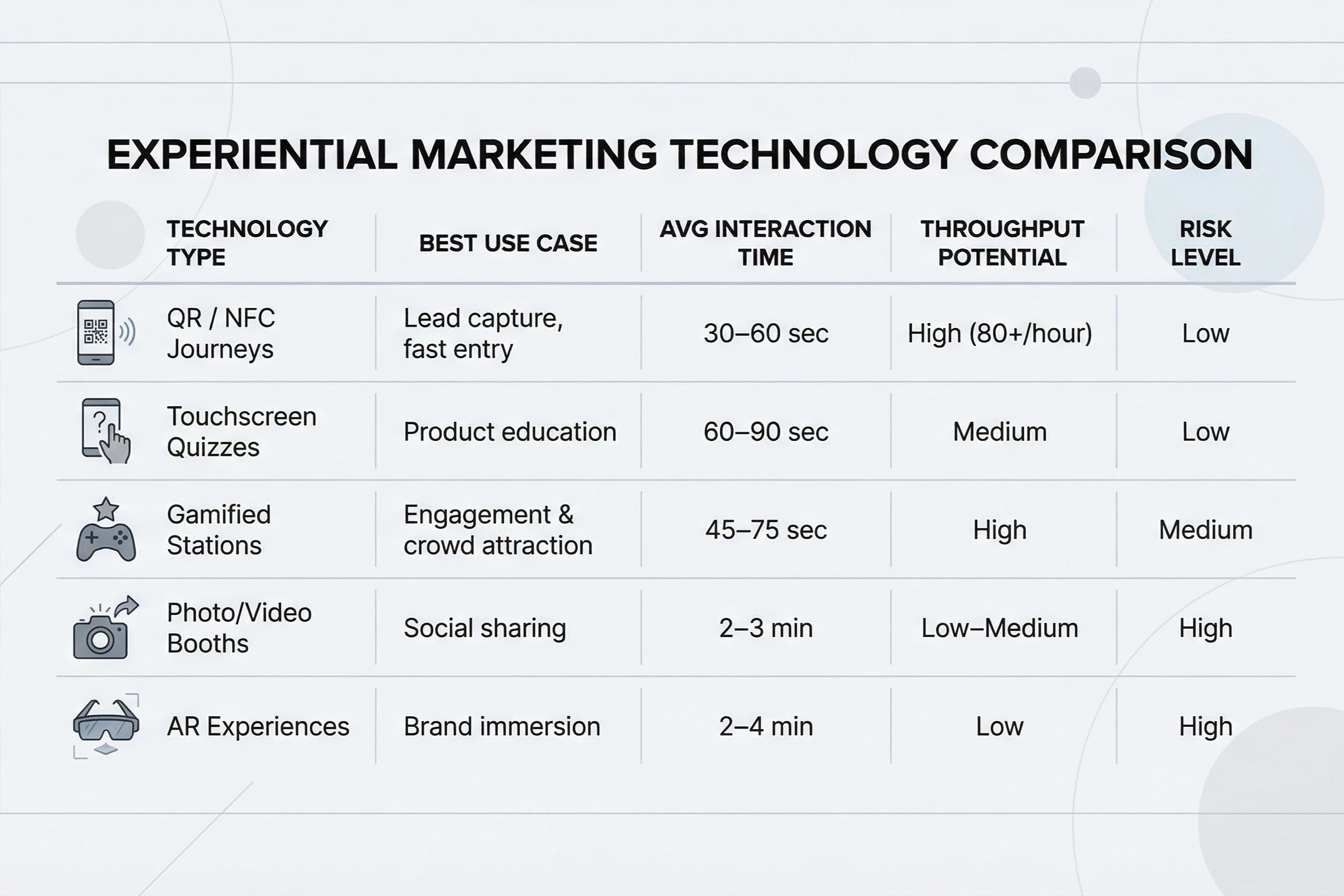
- QR or NFC Journeys. Fast entry, guided participation, simple lead capture. These are workhorses at trade shows and high-traffic events because they require almost zero staff explanation. Someone scans, they're in, and the journey handles the rest.
- Touchscreen Quizzes. Great for product matching, light education, or quick qualification. They guide people through something useful and give you data in return. Works best when you've got staff helping with flow, so people don't linger too long.
- Gamified Stations. Spin-to-win, timed challenges, and leaderboard competitions. These pull crowds in fast, and people replay them, which means repeat engagement without additional effort. They're not sophisticated. They work.
- Photo and Video Stations. Shareable outputs that drive organic reach. The catch is the reset speed; if each person takes 3 minutes to customize their photo, you'll have a line wrapped around the booth by noon. Pre-set templates and staff guiding the process solve this.
- Lightweight AR Experiences. These add novelty without the heavy infrastructure of full VR. Best in controlled environments where lighting and space are predictable. They need staff guidance for consistency, though, left to self-serve, completion rates drop.
How do you choose? Use high-speed formats for crowded trade shows and concourses. Use guided formats when product education matters. Use shareable formats when social reach is the primary goal. And avoid anything that requires long explanations or frequent resets under pressure.
The best format is the one that balances novelty, speed, and operational simplicity under real conditions. That's a less exciting answer than "build an AI-powered immersive tunnel," but it's the one that actually holds up at 2 pm on day two of a three-day expo.
Experiential Marketing Technology Comparison
Future of Experiential Marketing Trends That Are Actually Practical
The future of experiential marketing is less about new technology and more about better integration. Physical experiences connected to measurable digital outcomes. That's where the money's going, and the data shows it, 84% of consumer marketers plan to increase event spending this year, with a third raising budgets by 8–15%.
What's becoming standard across live events: QR and NFC-based entry replacing manual or paper-based capture. Real-time data syncing across platforms for faster follow-up. Hybrid experiences that connect what happens at the booth to what happens in the CRM afterward.
Personalization is evolving too, but probably differently than you'd expect. We're not talking about AI-generated custom videos for every attendee. We're talking about quick-input experiences that deliver tailored results instantly. A 5-question quiz that recommends the right product. A guided journey that adapts based on one or two choices. Practical personalization. The stuff you can actually staff and scale.
What matters more each year: data accuracy over raw lead volume, clean attribution from event engagement to pipeline, and consistent execution across multiple cities and venues. Teams that can prove their activations influenced pipeline, with real numbers, not vibes, are the ones getting bigger budgets next year.
Where teams still get burned is chasing tech that sounds impressive but doesn't fit the venue or audience. Understanding event flow psychology matters more than adding another screen. A crowd that flows well through your experience will outperform a crowd that's confused by your technology every single time.
The future of experiential marketing rewards teams that prioritize usability, speed, and measurable outcomes over novelty. That might sound obvious, but walk any major expo floor and you'll see how many teams still haven't figured it out.
Experiential Marketing Technology That Improves Data Capture
Here's where most activations quietly fail. The tech is great, the experience is fun, and then data capture ruins everything because it feels like a toll booth at the end of a theme park ride.
Experiential marketing technology improves data capture when it fits naturally into the experience. When it feels like a next step, not a tax. The most effective setups collect information at the right moment, usually after someone's already engaged and gotten something valuable, without slowing participation or creating friction.
Timing matters more than most teams realize. Capturing before participation only makes sense when it's required for access or gating. Capturing after participation, when engagement and trust are higher, consistently produces better quality leads. Capturing during the experience works only if it doesn't interrupt flow, and it usually does, so be careful there.
On the assisted vs self-serve question: assisted capture improves accuracy and completion rates. Self-serve capture is faster but you'll get more incomplete or incorrect data. At high-traffic events, a hybrid approach, self-serve with a staff member nearby to help when someone hesitates, tends to produce the best results.
What to protect above everything else: clear consent and compliance practices, accurate contact details and qualification signals, and minimal required fields to reduce drop-off. Every additional form field you add costs you completions. That's a trade-off worth thinking about before you build.
And always plan for failure. Offline backup systems for unstable connectivity. Manual fallback options for critical leads. Post-event syncing to prevent data loss. Because the one thing you can count on at any live event is that something won't work the way it did in rehearsal.
How Technology Enhances Experiential Marketing Campaigns with Shareable Output
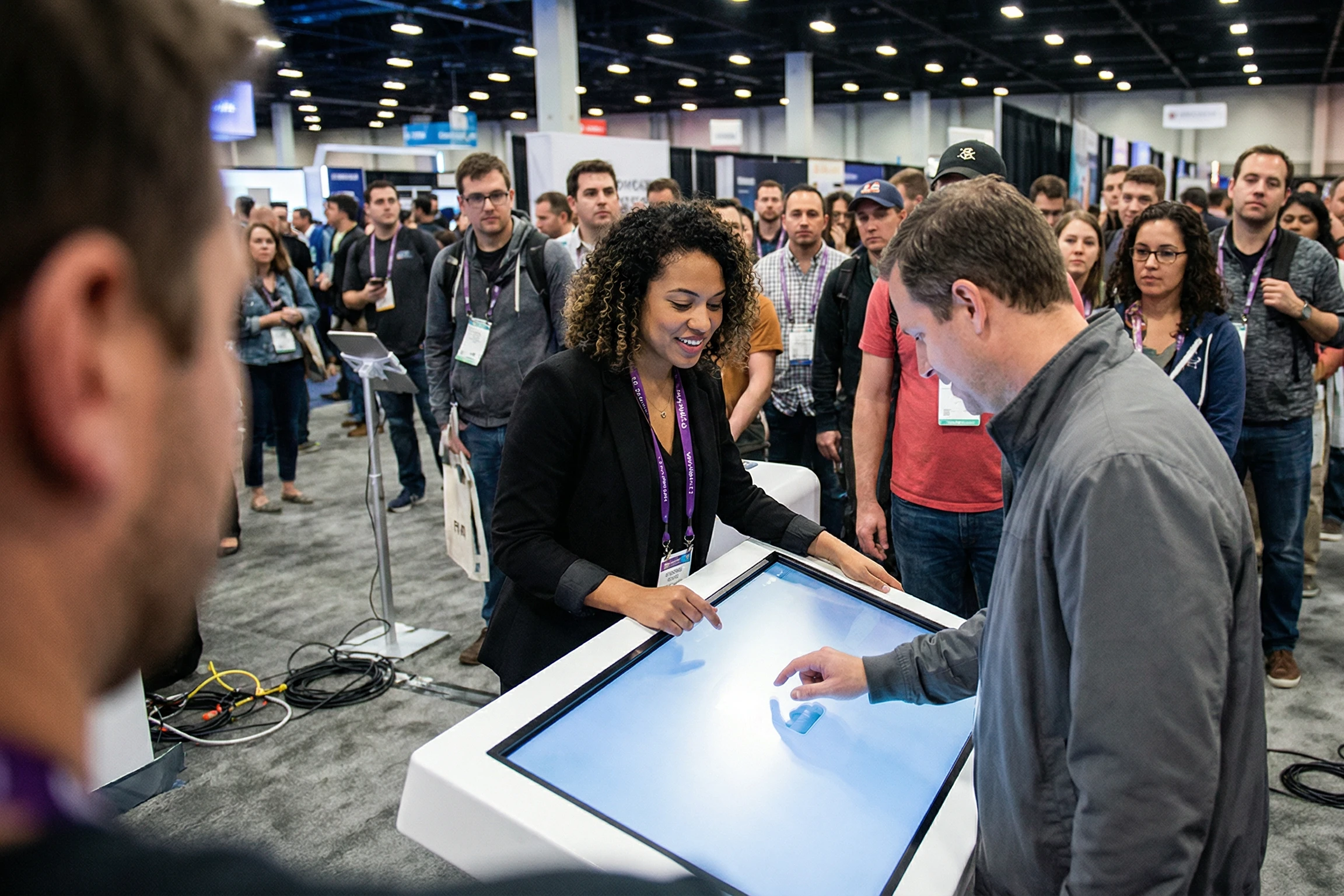
How technology enhances experiential marketing campaigns becomes most visible when someone posts about you 20 minutes after leaving the booth. That's the whole point of shareable output: extending the experience beyond the event itself without spending another dollar on media.
And here's why it matters at scale: 98% of consumers create digital or social content at live brand experiences. So if you're not making that content easy to produce and share, you're leaving organic reach on the floor.
Shareable output in practice means branded photos, videos, or short-form content. Personalized results tied to your brand. Instant delivery via QR, email, or text, not "we'll send it to you later." Later doesn't get posted. Later gets forgotten.
The hidden factor that separates good content stations from disaster is reset speed. People don't think about this during planning, but it's everything on show day. Slow resets create long lines. Long lines make the station feel unapproachable. Fast resets keep participation moving and prevent that dreaded moment where a crowd forms around your booth and nobody's actually engaging.
Preventing bottlenecks comes down to a few things: use pre-designed templates instead of full customization, limit the steps required before content gets generated, and assign staff to guide users through the process quickly. Don't let someone spend 4 minutes choosing a filter while 12 people wait behind them.
For high-traffic activations, a two-lane model works well. Fast lane for quick content creation, mass audience, high volume. Secondary lane for deeper, more customized experiences that take longer. You get scale and quality from the same footprint.
Experiential Marketing Technology Staffing Plan That Prevents Downtime
Experiential marketing technology doesn't run itself. I know that sounds obvious, but you'd be surprised how many teams assume guests will move through every station without guidance. They won't. Even simple tech formats slow down when traffic spikes, devices need resets, or someone hesitates at step one and blocks the whole line.
The math behind staffing cuts costs when roles are clearly separated and coverage stays consistent. One person trying to greet, run the tech, troubleshoot issues, AND capture data isn't a staffing plan. It's a recipe for a stressed-out employee and a mediocre activation.
Here's a staffing model that actually holds up:
- The greeter pulls attendees in and explains the value in seconds. This person is your conversion engine. Without a good greeter, people walk past even the most impressive setups.
- The station lead runs the interaction and keeps pacing consistent. They're the metronome. Same quality experience for person #5 and person #500.
- Tech Support Floater, resets devices, solves minor issues fast. This role seems optional until a tablet freezes during peak hour and suddenly you're dead in the water for 10 minutes.
- Capture Support helps with forms, scans, or follow-up data entry. Protects data quality so you don't end up with 600 leads and half of them are missing email addresses.
- The supervisor manages redeployments, responds to traffic spikes, makes the call when something needs to change. Every activation needs someone watching the big picture instead of working a single station.
This model works because it prevents any one person from handling too many functions. It keeps the guest experience smooth during peak traffic. And it creates faster recovery when equipment or connectivity issues come up, because they will.
Future of Experiential Marketing Means Planning for Failure
The future of experiential marketing belongs to the teams that plan for problems before the event opens. Full stop.
Even strong experiential marketing technology can fail under live conditions. Wi-Fi drops during the keynote break when 3,000 people hit the floor simultaneously. Devices overheat after running for 6 hours straight. Batteries die. Guests move through the experience completely differently than expected, which, honestly, happens at almost every event.
The most reliable activations aren't the ones that assume perfect performance. They're the ones with fallback options that protect flow, preserve credibility, and keep participation moving when something breaks.
Building a run of show that accounts for tech failure keeps teams aligned when things go sideways. And things will go sideways. The question is whether you've already rehearsed the backup.
Common failure modes worth planning for: unstable connectivity during peak hours, device crashes or software lag, power loss or charging issues, and staff confusion during resets or handoffs. That last one is underrated, if your team doesn't know who handles what when a screen freezes, the response time doubles.
Redundancy basics that are worth the money: backup devices and charging equipment, printed instructions for manual fallback, and a simplified offline version of the activation. You don't need to mirror the full experience. You need something that keeps people moving and keeps your brand looking competent.
Pre-brief every single person before doors open. Cover the escalation steps for tech issues. Make role assignments during service disruption crystal clear. And define the fastest fallback version that still keeps guests engaged. If you can switch from Plan A to Plan B in under 90 seconds, you're ahead of 90% of activations out there.
How Technology Enhances Experiential Marketing Campaigns Measurement
%20A.webp)
How technology enhances experiential marketing campaigns becomes most clear when measurement is baked into the experience from day one. Adding tracking after the event is like trying to reconstruct a conversation from memory, you'll get the gist, but you'll miss everything that actually matters.
The key metrics to track during live events: awareness signals like foot traffic and impressions, engagement signals like participation rate and dwell time, lead capture volume and data quality, and conversion signals tied to post-event actions. Most teams over-index on the first two and under-index on the last two, which is why so many post-event reports look impressive but don't actually prove pipeline impact.
Measuring without slowing the experience is the real challenge. Use automated tracking through QR or NFC interactions wherever you can. Keep manual inputs minimal. And assign at least one staff member to monitor capture quality during peak periods, because that's when data quality drops fastest and nobody notices until the export.
What to watch in real time: peak versus off-peak engagement patterns, drop-off points within the interaction flow, and throughput changes when lines start forming. If you see a drop-off at step 3, that's not a reporting problem. That's a design problem. Fix it on the floor, not in the debrief.
Weak reporting usually comes from measuring the wrong things. Vanity numbers, total badge scans, raw foot traffic, tell you something happened. They don't tell you what it was worth. Align your measurement with campaign goals from the start. Log issues and adjustments during the event so your post-event analysis has real operational context, not just dashboards.
Experiential Marketing Technology Examples That Show What Works
Experiential marketing technology works best when the format, staffing, and flow are designed together. The difference between an activation that performs and one that doesn't usually comes down to how well the experience holds up during peak traffic, not how it looked during the pitch meeting.
Example 1: High-Traffic Trade Show Booth
QR-based entry lets attendees start instantly. No scanning, no badge hand-off, no line at a registration desk. A greeter pulls traffic in while capture support assists with completion on the back end. Result: high participation volume without visible congestion. The kind of booth people walk into without hesitating.
Example 2: Product Demo with Guided Interaction
Touchscreen quiz helps attendees find relevant products quickly. It's guided, so people don't stall or get confused. A station lead keeps pacing consistent while a tech floater resets devices between users. Result: smooth experience with consistent messaging and faster turnover. Attendee #200 gets the same quality as attendee #20.
Example 3: Shareable Content Station
Pre-set templates enable fast photo or video creation without unlimited customization that kills throughput. Staff manage entry, delivery, and reset timing. Result: high shareability without long lines or delays. People get their content, post it, and clear the way for the next person.
What all three have in common: a clear first step for the attendee, fast interaction cycles, and dedicated roles to maintain flow. The technology matters, but the execution is what makes it work.
So, What Actually Makes Experiential Marketing Technology Work at Live Events?
The biggest factor isn’t the technology; it’s how well it performs under real event conditions like high traffic, limited space, and unpredictable guest behavior. Before finalizing your setup, consider foot traffic, interaction time, reset speed, data capture needs, venue constraints, and staffing coverage. Strong activations come down to execution. The right mix of format, staffing, and flow ensures technology drives engagement instead of delays. For high-traffic events, success depends on execution, not just the tech. Get a custom staffing and flow strategy tailored to your event setup.
Ready to elevate your next event?
Join thousands of event planners who trust EventStaff.com for reliable, professional staffing solutions.
Trusted by event professionals nationwide
1k+
Events Staffed
2 million+
Guests Served
97%
Positive reviews