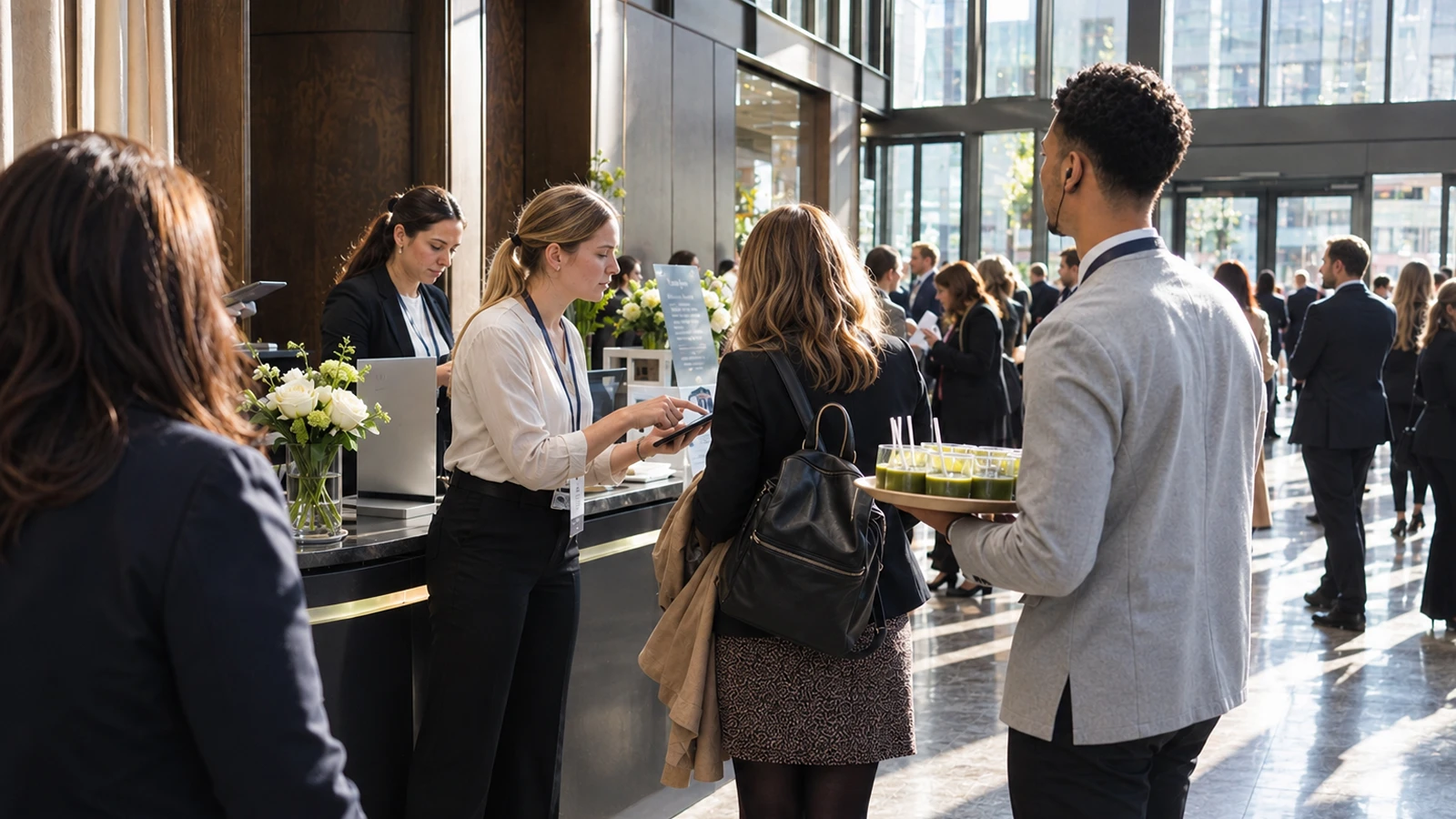

Choosing the best event organizer for brand activations in 2026 is more than picking a vendor. You are investing in a partner who will turn your creative ideas into real, measurable experiences. A strong organizer ensures your brand activation event management is seamless, engaging, and efficient from concept to execution.
Services for branded event activations are easy to buy, but buying them correctly is rare. Small missteps in staffing, flow, or logistics can turn a carefully planned activation into a frustrating guest experience. And brands don’t get graded separately from the activation if the experience feels messy; that’s what people attach to your name.
PwC’s 2025 survey found that 29% of consumers stopped buying from a brand due to poor customer experience. A brand activation is essentially customer experience in public, with no redo button. In high-stakes environments, every delay, awkward line, or unclear staff instruction reflects directly on your brand.
In this guide, you will learn:
- What services truly matter in brand activation event management
- How to evaluate agencies beyond their portfolios
- The questions to ask to avoid costly mistakes
- How to ensure your event delivers measurable results
By the end, you will understand how to select a brand activation agency that protects your investment, maximizes engagement, and delivers a polished experience.
CEO Excerpt
“Over the past 20 years, I’ve seen that successful activations depend on how teams respond in real time. When plans change, WiFi drops, or lines grow unexpectedly, experienced staff make the difference. At EventStaff, I’ve focused on building teams that adapt quickly and solve problems on-site, which is why global brands trust us with their most important moments.” — CEO, EventStaff
Quick Answer: How to Choose the Best Event Organizer for Brand Activations
To choose the best event organizer for brand activations, prioritize partners who specialize in "concept-to-floor translation," converting creative ideas into operational systems where staffing, flow, and engagement KPIs are protected. Focus on agencies that offer role-specific training and real-time leadership, ensuring your on-site execution matches your brand promise in 2026’s high-stakes environment.
What the Best Event Organizers for Brand Activations Actually Do
%20(1).webp)
When most people talk about brand activation event management, they mean “make the event happen.” That is only part of the picture. The best organizers do more than execute a plan; they provide concept-to-floor translation, turning your creative idea into a controlled guest journey where timing, staffing, and flow work together seamlessly.
Because when execution breaks, it rarely breaks in one obvious place. It fails as a chain reaction.
Late load-in turns into a rushed setup. Rushed setup turns into unclear zones. Unclear zones force staff to improvise. Improvisation slows lines. Slow lines make guests bounce. And then the brand team blames the concept when the real issue was execution.
This is the failure chain you should picture:
Late load-in → rushed build → unclear zones → staff improvises → line grows → guests bounce → “the concept didn’t work.”
This is exactly why Fortune 500 brands trust large-scale staffing and experienced operational leadership—to prevent these systemic failures before guests ever feel them.
A successful brand activation is a living system. Guests arrive in waves, lines form unexpectedly, and questions repeat. The right organizer anticipates these moments and responds without disrupting the guest experience.
Key elements to look for when hiring an organizer include:
- Concept-to-floor translation: Turning creative ideas into operational plans with clear roles and workflows
- Staffing and leadership: Experienced leads who can make real-time decisions to keep the activation on track
- Flow management: Anticipating bottlenecks and adjusting guest movement to maintain engagement
- Measurement integration: Collecting data naturally during the activation to evaluate performance
In 2026, operational complexity is higher than ever. Credentialing, labor costs, and guest expectations are more demanding. Your organizer should be prepared to handle these challenges with precision and clear systems.
Core Services the Best Event Organizers for Brand Activations Provide
Strong services for branded event activations aren’t one thing. They’re a stack of controls that hold the day together.
Here’s the trap: brands hire someone for “production” and assume staffing, flow, and reporting are automatically included. They’re not. Or they’re included in the most minimal way possible (which is how you end up with a team that can smile but can’t steer a line).
You want five buckets covered, and you want to know what each one is protecting.
Services Breakdown
.webp)
Operationally, throughput is where fantasy meets physics. Quick example: if a demo takes 90 seconds and you run one station, you don’t have an activation. You have a line. Add stations, shorten steps, or redesign the interaction so guests aren’t stuck waiting to “participate.”
That’s not a creative compromise. That’s making the experience actually happen. It aligns with the principles of event flow psychology, where managing wait times is critical for guest satisfaction.
A Simple Throughput Gut-Check: If your interaction takes longer than your crowd’s patience, your “experience” turns into a bottleneck. And bottlenecks kill engagement before your staff even speaks.
2026 adds layers here, too, mostly because the floor is less forgiving. Some teams are using simple tools, QR timestamps, counter clicks, and even heat maps, to spot where guests stall, then redeploy staff before the line becomes the headline. And sustainability isn’t just a brand value slide anymore; it can mean extra touchpoints onsite (waste sorting, refill stations, packaging handling). If nobody staffs those moments, the guest journey gets choppy fast.
EventTrack 2026 found 61% of consumers are more inclined to purchase after an event, which is why you should ask your organizer what they’re tracking on the floor: demos completed, leads captured, content created, not just “attendance” after the fact.
Close the loop: you’re not buying a vendor list. You’re buying predictable performance.
Quick Answer: Tell Me Best Event Organizer for Brand Activations
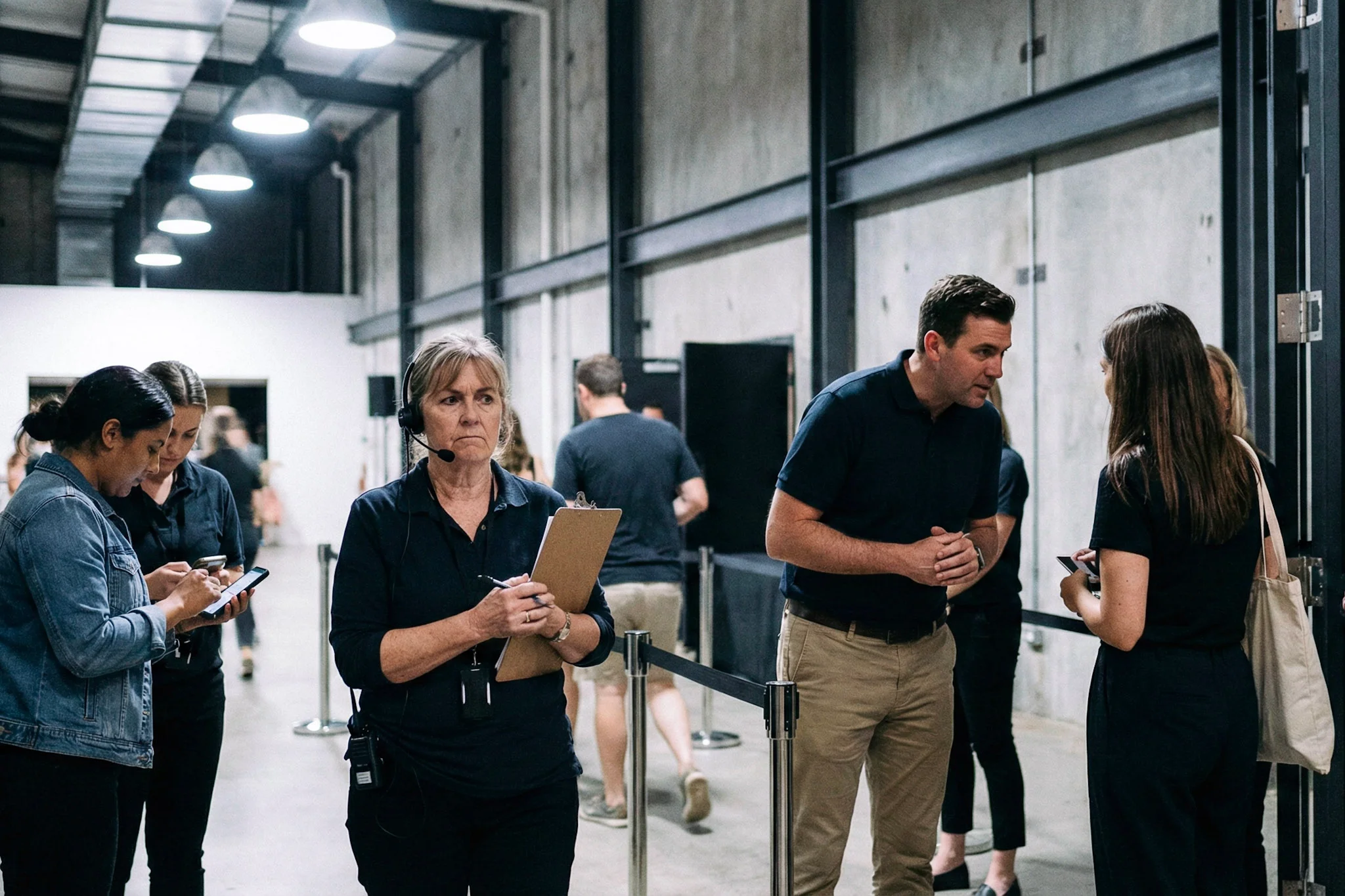
If you need a fast way to choose the best event organizer for brand activations, focus on operational depth and measurable results rather than just aesthetics or portfolios.
Here are the key steps to identify the right partner:
- Specialization: Confirm they focus on brand activations, not general events.
- Case Studies: Request real examples with operational detail, including staffing plans, run-of-show, and reporting.
- Staffing Depth and Training: Evaluate how they staff roles, train brand ambassadors, and supervise on-site.
- Flow Management: Ask how they handle peak moments, line control, dwell time, and station adjustments.
- On-site Leadership and Contingency: Ensure supervisors, leads, and backups are in place for unexpected issues.
- Measurement of Engagement: Verify they track meaningful KPIs beyond attendance, such as demos completed, leads captured, and content created.
Now the opinionated part: If they can’t explain what happens when the line doubles at 2:15 pm, you’re not hiring an organizer. You’re hiring hope. And hope is not a staffing strategy.
The “2:15 pm Question.”
Ask: “What do you do when volume doubles unexpectedly?”
- A competent operator answers in clear steps.
- A weak organizer gives vague responses like “We’ll adapt.”
The ability to respond to this scenario is a clear signal of who can deliver a smooth, high-impact brand activation.
Brand Activation Agency vs General Event Organizer: Which Is Best for Activations?
A real brand activation agency doesn’t just complete logistics. They design for the moment where a stranger decides, “Yeah, I’ll stop.”
That decision is fragile. It gets wrecked by awkward lines, unclear instructions, or staff who are present but not leading the interaction. So specialization shows up in the foundational work: role definitions, rehearsal discipline, flow control, and reporting structure.
Specialist vs General Comparison

Here’s a tiny onsite moment that tells you everything. A lead notices the demo station is backing up. They don’t panic. They move one ambassador to pre-qualify guests, shorten one step in the interaction, and re-route overflow toward a second touchpoint that still feels on-brand. Suddenly the line becomes a conversation again.
That’s what a specialist looks like. Calm decisions. Fast adjustments. No drama. And that’s why execution is the whole game. Freeman’s 2025 research reported 92% of working professionals say live events have a positive impact on their perception of brands, so if your organizer can’t run flow and staff well, you’re wasting one of the few channels that reliably lifts perception.
The Specialist Signal: If they can’t explain how they pull people into the experience (and keep them moving through it), they’re not built for activations.
Specialists reduce surprises. That’s the whole point.
Questions to Ask Before Hiring an Event Organizer for Brand Activations
Most organizers sound competent in a pitch. Everyone says they “handle staffing” and “manage flow.” The only way to tell who’s real is to ask questions that force them to get specific. Not gotcha questions. Pressure questions.
Specialization & proof
- What percentage of your work is brand activations?
- Can you show an activation case study with a staffing plan and run-of-show?
- Who leads onsite, and what’s their decision authority?
Staffing & training
- How do you staff roles, not just headcount?
- Who writes scripts and trains ambassadors?
- When does training happen, and how do you confirm it stuck?
Here’s why this matters. If training is vague, staff improvise. Improvisation slows the interaction. Slow interactions create lines. Lines quietly kill engagement. See how experiential marketing staff boost revenue when they are properly trained to engage rather than just attend.
Flow, peaks, and crowd control
- How do you plan for peak moments?
- Who owns line management and guest redirection?
- What do you do when a station slows down and volume keeps coming?
Onsite leadership & contingencies
- Do you provide onsite supervisors or team leads?
- What’s your escalation ladder if something breaks?
- What’s your plan if staff don’t show?
That last one matters more than people admit. Call-outs happen. Traffic happens. Illness happens. A real answer includes standby options, cross-trained floaters, and lead coverage. A weak answer is “we’ve never had that problem.”
Measurement, reporting, and cost transparency
- How do you define success beyond attendance?
- What does the post-event report include, specifically?
- What’s included vs extra cost, and what triggers add-ons?
Red Flags vs Green Flags
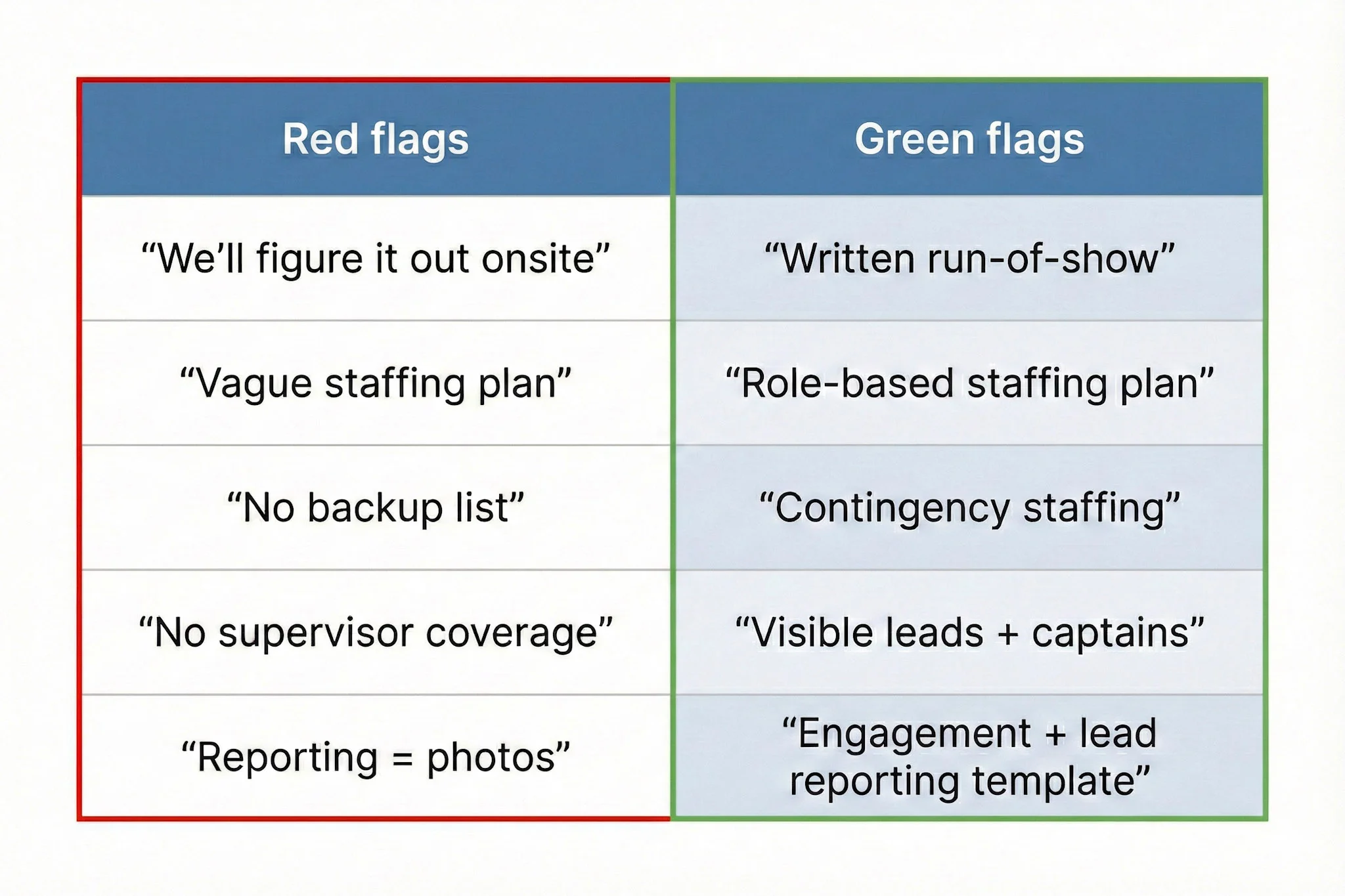
Cost mechanics matter here, too. Last-minute adds usually cost more. Rush staffing. Overtime. Compressed training. The quality hit shows up on the floor, even if nobody says it out loud. Good questions don’t just protect the event. They protect your internal credibility.
Corporate Event Brand Activation: What Changes at Enterprise Scale
Corporate event brand activations are more than larger versions of standard activations. They operate in a higher-stakes environment with stricter requirements, multiple stakeholders, and greater brand risk.
Key differences to consider:
- Stakeholder Complexity: More approvals and tighter governance increase the need for precise planning.
- Credentialing and Compliance: NDAs, background checks, union rules, and stricter access control require early coordination.
- Media and VIP Management: Enterprise events often involve press, high-profile guests, or executives, requiring additional operational oversight.
- Multi-City Execution: Success in one city does not guarantee consistency across multiple locations. Scripts, training, and supplies must be standardized.
- Hybrid Staffing Timelines: Remote prep, shorter onsite windows, and faster approvals demand disciplined execution.
- Guest Behavior Shifts: Audiences opt out faster if interactions feel disorganized or overly sales-focused.
Enterprise activations succeed through control, not chaos. Clear role ownership, consistent training, and operational oversight ensure that the brand experience remains consistent, measurable, and high quality across every location. If an organizer relies on heroics, the model collapses under scale. This is where you need a multi-city plan to ensure consistency.
2026 adds layers of complexity, making it essential to hire an organizer who can scale operations without relying on heroics. This ensures that even large, complex activations run smoothly and deliver predictable results.
How to Compare Organizers with a Simple Scoring Framework (and Avoid the Glossy Trap)
If you want to take emotion out of the decision, use a framework. Not to be fancy. To stay sane.
Organizer Scoring Framework
.webp)
Score with artifacts, not promises. Ask for a sample run-of-show. A staffing plan. A training outline. A reporting template. An escalation ladder. If all you’ve got is a deck of pretty photos, you can’t score it. That’s the tell.
Cost is where people get uncomfortable. Quotes swing because labor swings.
You’ll also see more volatility in staffing quotes because wage pressure isn’t hypothetical. FRED’s Employment Cost Index for wages in leisure and hospitality increased from 185.200 (Q3 2024) to 190.303 (Q3 2025), and that rise hits hardest when you add supervisors, standby coverage, or tight load-in windows.
Translation: staffing bids get sensitive to timing and complexity. The more leadership coverage and contingency you want, the more the rate moves, especially on weekends and tight load-ins. Frameworks are great. But you’ll feel quality most clearly on the floor.
What Great Looks Like Onsite (and How Experiential Brand Activations Actually Win)
%20(1).webp)
Great experiential brand activations feel smooth and controlled. The best organizers create an environment where guests enjoy the experience without noticing the complexity behind it.
Key signs of high-quality onsite execution:
- Pre-Shift Briefing: Roles, scripts, and escalation paths are clearly communicated before doors open.
- Clear Zones and Flow: Lines, stations, and guest movement are planned and actively managed.
- Real-Time Adjustments: Leads redeploy staff, shorten steps, or redirect overflow to maintain engagement without disruption.
- Staff Training and Leadership: Brand ambassadors know their roles, remain on script, and respond confidently to issues.
- Data Capture and Measurement: Engagement metrics, lead capture, and event insights are collected naturally during the activation.
- Clean Closeout: Teardown is organized, data is handed off promptly, and incident notes are recorded for future improvements.
In 2026, micro-engagement windows are shorter, so decisions must happen quickly. Some teams use AI-assisted reporting, heat maps, and counters to monitor throughput and adjust staffing before issues affect guest experience.
Ultimately, the best brand activation services protect performance, maintain consistency, and deliver measurable results. Guests notice the experience, but not the work that went into keeping it seamless.
AI-assisted reporting helps, but only if data capture was designed into the flow from the start.
Final Advice on Choosing the Best Event Organizer for Brand Activations
If you remember one thing, make it this: the best organizer doesn’t just “produce.” They protect performance. They plan for peaks. They are staff roles. They lead on-site. They build measurement into the flow. They carry backups like they expect reality to show up (because it will). That’s what you’re buying when you buy services for branded event activations. Not vibes. Not renderings. A day that runs clean, converts clean, and leaves you with proof it worked. If you’re planning a brand activation, think multi-day, staffing depth, supervision layers, compliance, and backups. That’s what protects the experience and your reputation when it counts. If you’re ready to plan, you can Get a Quote without turning this into a sales pitch.
Ready to elevate your next event?
Join thousands of event planners who trust EventStaff.com for reliable, professional staffing solutions.
Trusted by event professionals nationwide
1k+
Events Staffed
2 million+
Guests Served
97%
Positive reviews