
Lead Value
$0.00

Measuring experiential ROI isn’t about tracking more metrics it’s about tracking the right ones. Use a simple formula: (Revenue + Attributed Value) / Total Cost to capture both direct and indirect impact. Most ROI gaps come from execution, especially staffing quality, which directly affects lead quality, engagement, and conversion. When measured correctly, experiential marketing becomes a predictable and optimizable
.webp)
If you're investing in brand activations, understanding your experiential ROI is critical to proving impact and optimizing future campaigns.
Most event teams track attendance, engagement, and social reach but struggle to answer one key question: Did this activation actually drive business results?
The challenge isn’t a lack of data. It’s using the wrong framework.
In this guide, you’ll learn:
If this feels familiar, you're evaluating a common problem: most experiential teams measure everything except the one thing that matters, whether the activation actually converted.
Experiential marketing has a 38.34% success rate, making it the #1 most successful marketing tactic, but only when measurement and execution are aligned.
Use this calculator to estimate the business impact of your experiential marketing activation in a simple, practical way. It combines direct revenue, lead value, influenced customer revenue, and earned media to show the total return your event may have generated. If you need a fast sense of whether an activation likely paid off, this tool gives you a clear ROI percentage and return ratio. Adjust the inputs to model different scenarios and benchmark future event performance.
"As a CEO, you don’t just want engagement metrics you want clear proof that your event investment drives revenue and growth. Experiential ROI must connect brand interactions to measurable business outcomes. Anything less makes it difficult to justify scaling future activations." - Daniel Meursing, CEO of Even Staff
A standard ROI formula looks like this:
(Revenue - Cost) / Cost
That works well when the customer journey is short and easy to track. If someone clicks an ad, lands on a page, buys a product, and receives a confirmation email, the revenue path is direct. Experiential marketing is different because the event often creates value before the sale happens.
At an event, one guest might scan a QR code but buy three weeks later. Another might speak with a brand ambassador, share the activation on social media, and influence several other people without making a direct purchase. A third might become a qualified lead for the sales team, even though the deal does not close until the next quarter.
That means the ROI calculation has to look beyond same-day revenue. For example, a brand may spend $30,000 on a pop-up activation and generate:
If those 6 sales produce $48,000 in revenue, the basic ROI looks positive. But that still does not capture the full value of the activation. The remaining leads may continue moving through the pipeline, the email list may support future campaigns, and the social content created during the event may keep producing visibility after the physical experience ends.
The problem is that many teams measure experiential marketing like a direct-response campaign. When they do that, they either undervalue the activation or over-focus on surface metrics like attendance, impressions, and foot traffic. Those numbers matter, but they do not prove ROI on their own.
A stronger framework should separate three types of value:
The solution is not to abandon ROI. It is to build an ROI model that matches how experiential marketing actually works. Measure the immediate revenue where you can, but also track the behaviors that move people closer to purchase after the event ends.
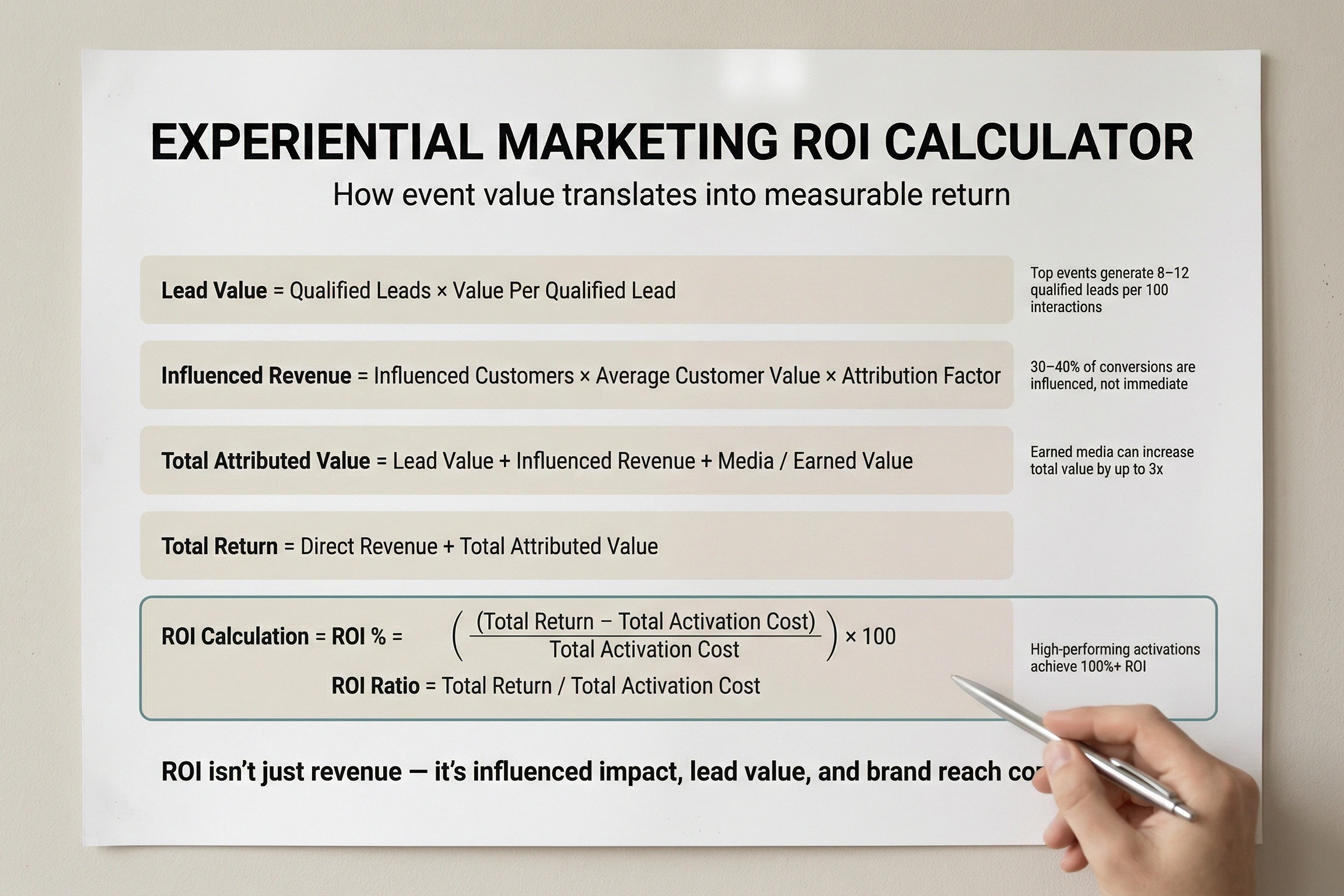
To calculate experiential marketing ROI, you need to measure both the revenue that happened directly because of the event and the value created by audience actions that may convert later. A simple event ROI model should include direct revenue, attributed value, and total activation cost.
Experiential ROI = (Revenue + Attributed Value) / Total Activation Cost
Here’s how to break it down.
Direct revenue is the easiest part to measure because it is tied to a clear transaction. This includes sales made during the activation, purchases made through event-specific QR codes, discount codes, POS tracking, post-event offer links, or subscriptions that can be connected directly to the campaign.
For product launches, pop-ups, sampling campaigns, and retail activations, this number may come from same-day purchases or short-window follow-up sales. For B2B events, it may come from booked demos, signed contracts, or pipeline that later closes with clear event attribution.
Attributed value is where most experiential ROI becomes more interesting. Not every valuable interaction turns into immediate revenue, but that does not mean it has no measurable worth. A qualified lead, product trial, email signup, social share, or post-event consultation can all carry value if the brand has a reasonable way to assign it.
This is where you can include:
Total activation cost should include every major cost required to make the experience happen. If you only count the venue or production spend, your ROI number will look better than reality but it will not help you make better decisions.
Common activation costs include:
👉 The key insight: If you ignore attributed value, you significantly undervalue your experiential ROI.
Budget: $40K
Total attributed value: $15.5K
Total revenue and attributed value: $23.5K
ROI: ($23.5K - $40K) / $40K = -41.25%
That result matters because it shows the campaign did not generate enough measurable value to justify the full activation cost. But it also gives the team something useful: a clear diagnosis. The issue may not be the event format itself. It may be low lead capture, weak post-event conversion, poor staffing, a limited follow-up system, or a budget that was too high for the size of the opportunity.
This is where experiential marketing ROI becomes useful as an operating tool, not just a reporting number. If direct sales were low but lead quality was strong, the next campaign may need better follow-up automation. If foot traffic was high but qualified leads were low, the brand may need better audience targeting or stronger brand ambassadors. If earned media was weak, the activation may need more shareable moments, better creator planning, or clearer content prompts onsite.
74% of consumers are more likely to convert after engaging in branded experiential marketing activities, which means the difference between a well-executed activation and a poorly-executed one isn't just a percentage point it's the difference between capturing significant value and missing it entirely.
A “good” experiential ROI depends on the type of activation, the sales cycle, the audience, and the role the event plays in the wider marketing plan. A pop-up built for immediate sales should be judged differently from a B2B roadshow designed to create qualified pipeline. A VIP experience may have a smaller guest count but a much higher value per relationship, while a festival activation may generate thousands of interactions but fewer immediate purchases.
As a planning benchmark, many brands use ranges like these:
The important point is that ROI should be judged against the activation’s job. If the goal was lead generation, the real question is not only how many people attended. It is how many qualified contacts entered the pipeline and how many converted later. If the goal was product trial, the key question is whether people sampled the product, understood the value, and took a next step. If the goal was brand lift, the campaign needs pre-event and post-event measurement so the team can prove a change in awareness, favorability, or purchase intent.
If your experiential ROI falls below the expected range, the issue is rarely just “bad strategy.” More often, the weak point is execution. The campaign may have attracted the wrong audience, failed to capture leads, used undertrained brand ambassadors, created too much friction at the booth, or lacked a strong post-event follow-up process. In that case, the ROI number should become a diagnostic tool. It should show you where the campaign lost value and what needs to improve before the next activation.
.webp)
Most ROI shortfalls don't come from a bad concept. They come from execution quality.
Your staff is the face of the brand during the brand activation. They determine whether a guest walks away energized or indifferent. Poor execution tanks attribution value in ways you can't see in the spreadsheet:
Guests with smooth, confident, knowledgeable interactions? They follow up. They share with their networks. They convert.
When you evaluate staffing partners, this is what you're really measuring: Can they move these three ROI drivers? Understanding what a brand activation agency actually does helps you ask the right questions when assessing fit.
Professional staff who understand your brand can screen for fit and communicate your message clearly. Teams trained in brand messaging generate measurably stronger leads than untrained or generic staff. A 20% improvement in lead quality (stronger prospects, better info capture) shifts $6K in attributed value in our skincare example above.
Guests share experiences that feel polished and attentive. Disorganized activations get fewer organic posts, less reach, and lower earned media value. Teams that feel professional, energized, and knowledgeable create the kind of guest experiences people actually photograph and share, and that's what drives amplification and organic reach.
A guest who experienced a rushed or confusing interaction is unlikely to follow up. One who felt heard, informed, and valued? Significantly more likely to engage after the activation and complete the customer journey.
92% of marketers plan to strengthen their post-event attendee follow-up in 2024 and beyond. They've learned that ROI depends less on the activation itself and more on how leads are nurtured after the event.
The impact: When staffing quality improves, all three drivers lead quality, social amplification, and follow-up the ROI outcome shifts materially. In the skincare example above, if execution quality improved lead quality by 15% and a slight increase in follow-up conversion, the -21% ROI could move toward break-even or positive. That's the power of a single controllable variable. Research on experiential marketing staff shows consistent ROI improvement across event types when execution quality is prioritized.
Benchmarks vary significantly by event format. Use these as comparison points, not fixed rules, because each activation type creates value in a different way. A product-trial pop-up is easier to measure through signups, samples, QR scans, and short-window purchases. A festival activation may reach far more people, but attribution is harder because many interactions are casual and top-of-funnel. VIP experiences and B2B roadshows usually have fewer attendees, but each relationship or account can carry much higher value.
If you're below these ranges, staffing is one of the first places to evaluate. Poorly briefed brand ambassadors, slow check-in, weak product explanations, messy lead capture, unclear guest routing, or inconsistent follow-up prompts can all reduce ROI even when the creative concept is strong. Before changing the entire strategy, look at where the activation lost value: the audience, the offer, the staffing model, the measurement system, or the post-event follow-up.
To convert these concepts into action, brand lift measurement is one of the most overlooked ROI drivers but industry leaders recognize that measuring perception shifts is just as valuable as tracking lead volume. To convert these concepts into action, brand lift measurement is one of the most overlooked ROI drivers but industry leaders recognize that measuring perception shifts is just as valuable as tracking lead volume. Run a short post-event survey within 24–72 hours to gauge influence on perception or purchase intent. Your survey should ask:
These questions help you connect the activation to measurable audience movement. A guest may not buy during the event, but if they leave with stronger recall, higher purchase intent, or clearer understanding of the product, that shift has value. The key is to ask quickly while the experience is still fresh and to keep the survey short enough that attendees will actually complete it.
Assign one owner for lead tracking and attribution before the event begins. That person should know where leads are captured, how they are tagged, what counts as qualified, and how post-event follow-up will be measured. When these systems are set up before the activation, ROI becomes measurable, and execution quality becomes obviously critical.
Run a short post-event survey within 24–72 hours to gauge influence on perception or purchase intent. Your survey should ask:
Assign one owner for lead tracking and attribution before the event begins. When these systems are set up before the activation, ROI becomes measurable, and execution quality becomes obviously critical.

When you're comparing staffing partners or planning your next activation, use this framework:
What to measure (before activation)
What to measure (during activation)
Many companies measure success only by business cards collected or names in spreadsheets, but accurate lead attribution requires tracking quality markers, including:
What to measure (after activation)
After the activation, the goal is to understand what actually converted and why. Focus on these key conversion tracking elements:
Mapping lead status changes in your CRM back to the original marketing source is critical. This is where you discover which campaigns generate high volume but low quality versus campaigns that generate fewer leads with higher close rates.
What staffing signals to evaluate
The best staffing partners understand that lead attribution depends on consistency. They'll ask: What defines a "good lead" for your specific business? How will we capture complete contact information? What follow-up process will be used post-event?
If your last activation underperformed, the issue may not be the concept. It may be the way the experience was executed on the ground. A strong idea still needs trained people who can engage guests, explain the offer clearly, capture usable data, and keep the activation moving when the event gets busy.
Our teams are trained to support the three execution drivers that directly impact experiential ROI:
That means the staffing model should be built around the outcome you want, not just the number of people you need onsite. If the goal is qualified leads, staff need clear qualification prompts and a clean capture process. If the goal is product trial, they need to guide guests through the experience without slowing the flow. If the goal is brand lift, they need to create interactions that feel consistent, confident, and worth remembering.
Better execution makes ROI easier to measure because the right actions are happening at the right moments. When guest engagement, lead capture, and follow-up prompts are planned before the activation begins, the campaign has a much better chance of turning live attention into measurable value.
👉 Talk to our team today to see how professional event staffing can turn your next activation into a measurable growth channel.
Join thousands of event planners who trust EventStaff.com for reliable, professional staffing solutions.
Trusted by event professionals nationwide
Events Staffed
Guests Served
Positive reviews

You calculate experiential ROI using the formula: (Revenue + Attributed Value) / Total Activation Cost. Revenue includes direct sales, while attributed value covers leads, brand lift, and media impact. This approach ensures you capture both immediate and long-term returns from your activation. For activations built around face-to-face engagement, see how EventStaff's Brand Activation staffing supports measurable outcomes.
You calculate experiential ROI by comparing the value created by the event against the total activation cost. A useful formula is: Experiential ROI = (Revenue + Attributed Value - Total Activation Cost) / Total Activation Cost. Revenue includes direct sales, while attributed value can include qualified leads, influenced customers, brand lift, media impact, and post-event conversions. The key is to define what counts as value before the event begins, so the team is not trying to prove ROI after the data has already been missed.
To measure experiential marketing ROI, track metrics that connect the live experience to business outcomes. Useful KPIs include qualified leads, cost per lead, samples distributed, QR scans, demo requests, email or SMS opt-ins, conversion rate, customer lifetime value, purchase intent, brand favorability, social reach, earned media, and post-event sales. Attendance and impressions can be useful context, but they should not be the only success metrics because they do not show whether the activation created measurable audience action.
Experiential ROI is difficult to measure because the value of a live event is often spread across multiple outcomes. A guest may try the product onsite, follow the brand later, purchase weeks after the event, or influence someone else without creating an immediate transaction. Traditional ROI models can miss this because they focus mostly on direct revenue. Better measurement requires attribution tools, lead capture, surveys, event-specific links, post-event follow-up, and a clear definition of what success looks like before the activation starts.
Event staffing impacts experiential ROI because staff control many of the moments that turn attention into measurable value. Trained brand ambassadors, product reps, and promotional staff can qualify leads, explain the offer, capture data accurately, guide guests through the experience, and encourage the next action. Poor staffing can reduce ROI through weak engagement, missed lead capture, inconsistent messaging, or slow guest flow. Strong staffing makes the activation easier to measure because the right interactions happen consistently onsite.