
LA Pride gave brands the kind of public attention most campaigns want. Hollywood Boulevard was packed with celebration, movement, sponsor activity, vendors, performers, food, and people drifting between the parade route and Pride Village.
That sounds like the perfect setting for brand engagement, but it also shows why event staffing in Los Angeles needs more thought than simply filling a booth. When the crowd is moving quickly, when the setting carries cultural meaning, and when dozens of brands and vendors are competing for attention, staff quality decides whether people stop, listen, scan, sample, talk, or keep walking.
For brands looking back at LA Pride, the lesson is clear. High foot traffic is useful only when the people representing the brand know how to turn attention into respectful, useful, measurable engagement.
CEO Excerpt
“I always look at brand activations by asking what the guest is being asked to do in that moment. Are they stopping, scanning, sampling, learning, or just passing through? At events like LA Pride, the staff need to understand both the action and the tone. A good ambassador knows how to start the right conversation without taking people out of the moment they came to enjoy.” - Daniel Meursing, CEO, Eventstaff
Quick Answer
Event staffing in Los Angeles supports LA Pride-style brand engagement by placing trained brand ambassadors, product reps, opt-in support, giveaway staff, and field leads across the full consumer journey. Strong staffing helps brands manage tone, crowd flow, product education, data capture, and quick interactions without making the activation feel intrusive.
The Crowd Was There, But Attention Was Split
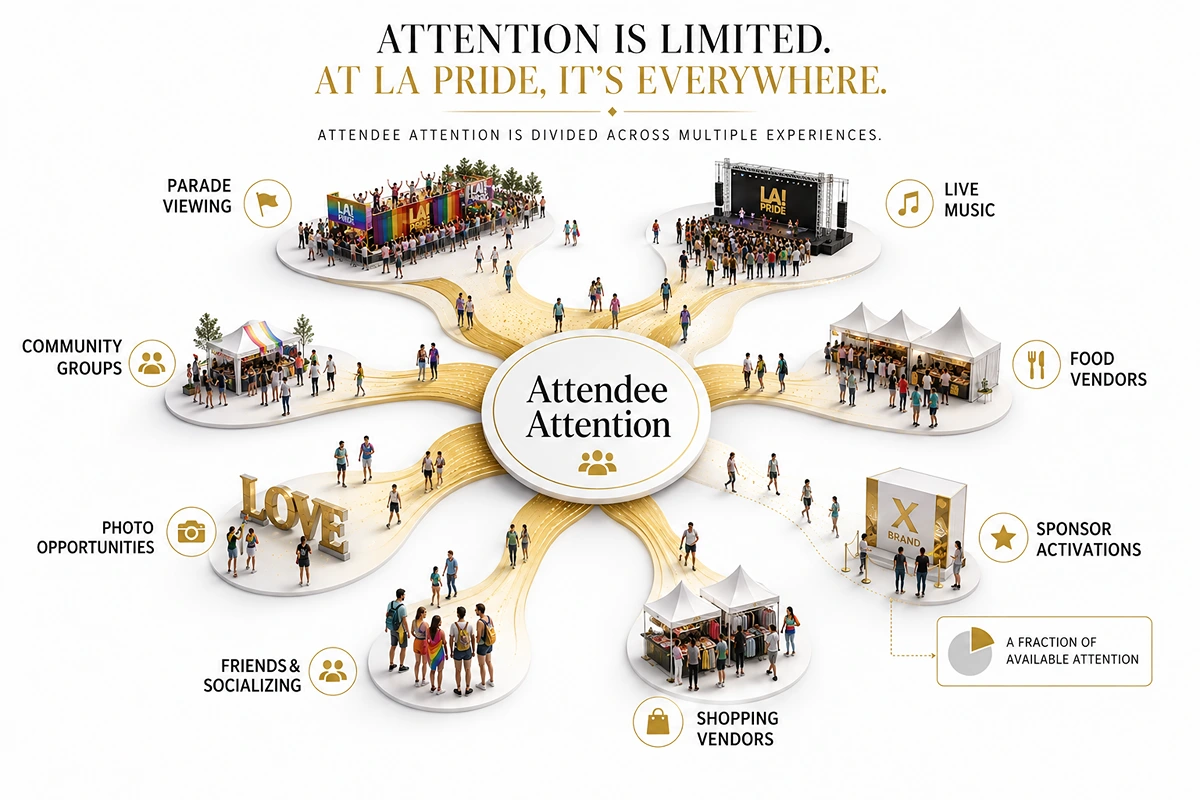
LA Pride was more than a parade moment. The official LA Pride 2026 event page described a full Pride Village next to the parade route, with sponsor activations, giveaways, over 100 vendors and exhibitors, food trucks, carts, and a live music stage on Hollywood Boulevard between Vine and Gower. The City of Los Angeles Department of Cultural Affairs also listed Pride Village as a street festival with sponsor activations, giveaways, over 125 vendors and exhibitors, and food trucks and stalls.
For a brand, that kind of setting creates opportunity and noise at the same time. People are already moving toward music, food, friends, performances, community groups, parade viewing spots, and other sponsor experiences. A booth can be visible and still fail to hold attention if the staff are waiting passively behind a table.
The mistake is assuming the crowd does the work. At a high-energy public event, the crowd gives the brand a chance to matter. Staff determine whether that chance becomes a real interaction.

The First Question Is Not “How Many Staff Do We Need?”
The better first question is: what do we need people to do when they reach us?
Some brands need quick samples moving cleanly without crowding the booth edge. Some need QR-code signups, product education, photo participation, social follows, app downloads, or qualified conversations. Some need staff who can explain why the brand is present at Pride without sounding like they are reading from a generic activation script.
This is where brand ambassador staffing for experiential marketing campaigns becomes more specific. The ambassador is not just there to smile, wave, and hand something out. They are the first person deciding whether a passerby feels welcomed, interrupted, rushed, or respected.
At LA Pride, the most useful staff would have been the ones who could read the moment quickly. They needed to know when to start a conversation, when to shorten the pitch, when to hand off to a product rep, and when to let someone keep moving without turning the interaction awkward.
A Brand Engagement Staffing Map for LA Pride-Style Events
For future Pride events, street festivals, fan zones, and high-traffic Los Angeles activations, brands should map staff by interaction point. A booth is not one job. It is usually several smaller jobs happening at once.

This map keeps the staffing conversation honest. If one person is expected to welcome guests, explain the product, hand out samples, manage the QR code, answer questions, and keep the booth clear, the activation is already relying on too much improvisation.
Good staffing for product launches and brand activations gives each moment a cleaner handoff. The first staffer starts the conversation. Another handles the product or sample. Another supports opt-ins. A field lead watches the flow and steps in when the team needs direction.

Pride Changes the Brand Ambassador Brief
LA Pride is produced by Christopher Street West, a nonprofit organization connected to LGBTQ+ events and community programming throughout the year. That matters because Pride is a community-centered setting where brand presence is noticed, welcomed, questioned, or ignored based on how relevant and respectful it feels.
This is where staffing quality becomes brand protection. A generic script can make a brand feel like it showed up only because the crowd was large. A better brief helps staff understand why the brand is there, what value it is offering, and how to approach people without turning the moment into a hard sell.
For brand ambassador staffing for experiential marketing campaigns, the brief should include more than campaign talking points. Staff should know the tone of the event, the language to use, the language to avoid, the offer, the opt-in rules, and how to step back when someone is not interested.
This does not mean staff need to over-explain the brand’s values to every person walking past. It means they need enough context to avoid sounding disconnected from the environment.
Where Event Staffing in Los Angeles Changes the Brand Plan
Event staffing in Los Angeles has to account for the way the city turns public events into layered audience moments. LA Pride was centered on Hollywood Boulevard, with the parade route running from Highland to Cahuenga and the official step-off at 11 a.m. on Sunday, June 14, 2026. Pride Village then extended the engagement window into the afternoon and evening on Hollywood Boulevard between Vine and Gower.
That means the brand audience was not one neat group. It likely included local attendees, visitors, families, performers, volunteers, vendors, influencers, media, tourists, sponsor guests, and people moving between the parade and the village. Each group could interact with a brand differently.
A tourist may want a fast photo or sample. A local attendee may care whether the brand understands the community context. A shopper may ask product questions. A fan may scan a QR code if the value is clear. A passerby may only have ten seconds before friends pull them toward the next stop.
The staffing plan has to work for all of that without becoming chaotic. That is why event staffing for consumer engagement campaigns should be planned around interaction quality, not just foot traffic.

Product Launches Need Cleaner Handoffs Than Brands Expect
A public event can look like an easy place to launch or promote a product because people are already there. The challenge is that people are rarely there only for the product. At LA Pride, they were there for the parade, the performances, the community, the vendors, the food, the atmosphere, and the people they came with.
That changes the product rep’s job. The explanation has to be quick enough for the setting but clear enough to create interest. If the product needs a demo, a claim, a safety note, or a more detailed explanation, the person handling that conversation should not also be responsible for moving the sample line.
Staffing for product launches and brand activations works better when the handoffs are deliberate. A brand ambassador can attract the right person. A product rep can explain the product. An opt-in support staffer can help with the QR code. A field lead can decide when the booth needs to speed up, slow down, or shift where staff stand.
That separation protects both sides of the interaction. The attendee does not feel trapped in a long pitch, and the brand does not lose the value of the launch because staff are rushing through every explanation.
Giveaways Can Create Movement Without Creating Value
Giveaways are useful at public events, but they can also trick brands into thinking the activation is working. A line for a free item looks good from a distance. It may even create energy around the booth. The real question is whether the people taking the item know what the brand is, why they should care, and what action they are being asked to take.
At LA Pride, where Pride Village included sponsor activations and giveaways, this distinction matters. A free item can start the interaction, but it should not be the whole interaction. Staff need a simple way to connect the giveaway to the brand’s goal without slowing down the line.
For example, one person can manage the handoff while another supports the QR code or explains the campaign in one short sentence. If staff are trying to do both at the same time, the line slows and the message gets weaker.
The better measure is not how many items left the table. It is how many useful conversations, qualified scans, product explanations, or positive brand moments came from those handoffs.

The June 2026 LA Context Raised the Stakes
LA Pride also sat inside a larger June 2026 moment for Los Angeles. LA Tourism has promoted the city’s role in the 2026 World Cup, including eight matches and 39 days of fan engagement across sports, culture, entertainment, and food. The Los Angeles World Cup 2026 Host Committee also announced official fan zones across the region during the tournament window.
For brands, that broader context matters because Los Angeles was already in a high-attention public-event cycle. Pride, fan zones, tourism campaigns, entertainment events, and neighborhood gatherings all create more chances for consumer engagement. They also raise the quality bar because attendees see more activations and compare them quickly.
In that kind of environment, a weak activation does not only underperform. It disappears. People move past it because something else nearby feels easier, clearer, more relevant, or more enjoyable.
That is why event staffing in Los Angeles has to be planned with local timing in mind. The same brand ambassador team that might work for a quiet retail event may not be right for a dense Pride Village, a fan zone, or a high-traffic product launch tied to a citywide event week.
What Brands Should Change Before Their Next LA Activation
Brands should begin by deciding what kind of engagement they actually want. A scan, a sample, a demo, a social post, a conversation, and a sale are different goals. They may happen in the same activation, but they need different staff behavior.
The second change is briefing for tone. At events like LA Pride, staff need to know the campaign message and the context around the event. They should understand how to welcome people, explain the offer, avoid pushy language, and represent the brand without making the interaction feel forced.
The third change is separating roles earlier. When volume rises, one generalist can become the bottleneck. A clearer split between first contact, product explanation, giveaway handoff, opt-in support, and field lead oversight helps the activation stay organized when the crowd gets heavier.
The fourth change is using the field lead properly. The field lead should not be a backup person waiting for a problem. They should watch the booth edge, staff positioning, guest reactions, giveaway pace, QR-code completion, and any signs that the interaction is starting to feel messy.
The fifth change is reporting. A strong event staffing plan should help the buyer understand what happened after the event. Which pitch worked? When did the crowd peak? Which questions came up most? Did people understand the product? Did scans or signups reflect genuine interest? Those answers are what turn one activation into a better next campaign.
How Eventstaff Fits This Kind of Brand Moment
Eventstaff fits LA Pride-style brand engagement when the buyer needs more than people in branded shirts. These campaigns need brand ambassadors, product reps, activation support staff, opt-in support, and field leads who can work in public-facing, high-traffic Los Angeles settings.
That kind of staffing matters when the brand’s reputation is visible. The staff need to be welcoming without being pushy, informed without overexplaining, and organized enough to keep samples, demos, QR codes, and conversations moving. They also need to understand that a public cultural event requires a different tone from a standard sales floor or trade show booth.
For brands planning future Pride events, fan-zone campaigns, product launches, and consumer activations in Los Angeles, the strongest staffing plans are built before the booth is live. The roles, language, handoffs, opt-in process, and escalation path should be clear before the crowd arrives.

Bottom Line
LA Pride showed why event staffing in Los Angeles needs to be planned around the quality of the consumer interaction. The crowd may be large, the placement may be strong, and the brand may have a good offer, but the activation depends on the people turning that moment into a real exchange.
For future LA Pride-style campaigns, brands should staff the approach, the booth edge, the product explanation, the giveaway flow, the opt-in point, and the field lead role with intention. If the goal is meaningful brand engagement, Eventstaff can help build a team that understands the campaign, the crowd, and the Los Angeles event environment around it.
Ready to elevate your next event?
Join thousands of event planners who trust EventStaff.com for reliable, professional staffing solutions.
Trusted by event professionals nationwide
1k+
Events Staffed
2 million+
Guests Served
97%
Positive reviews