
CEO Excerpt
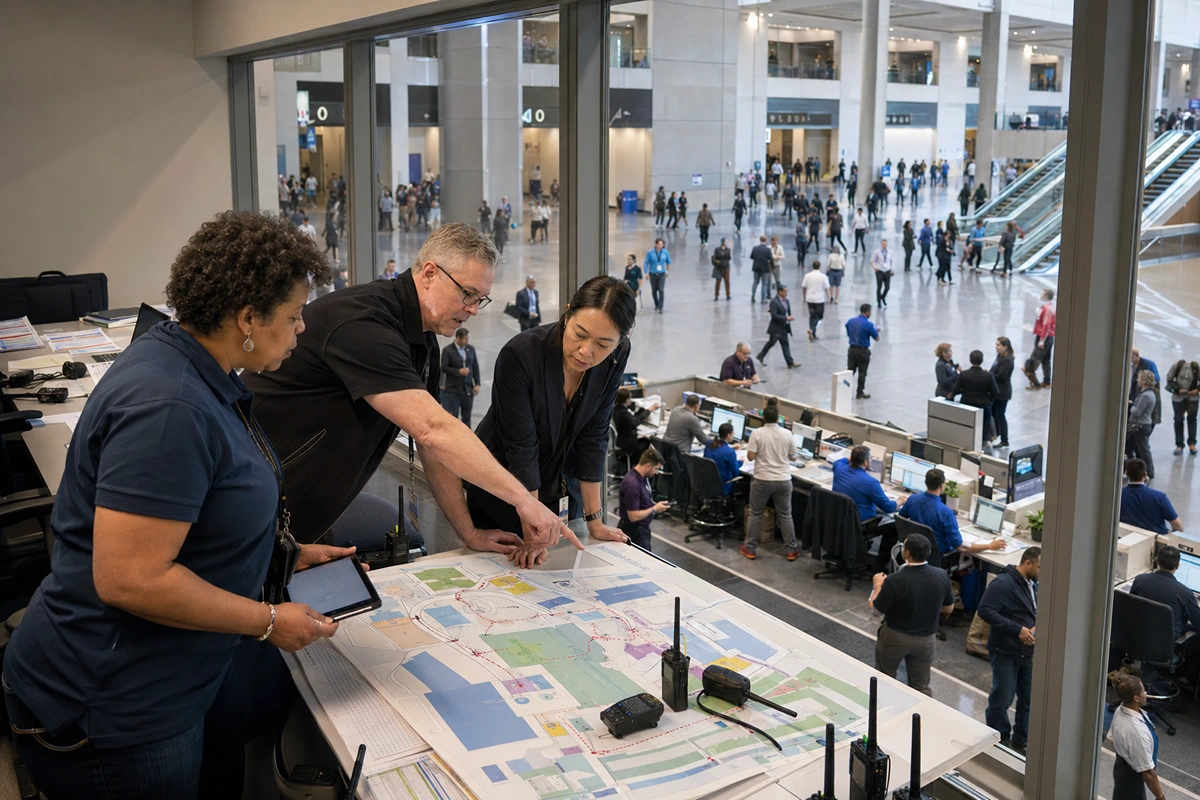
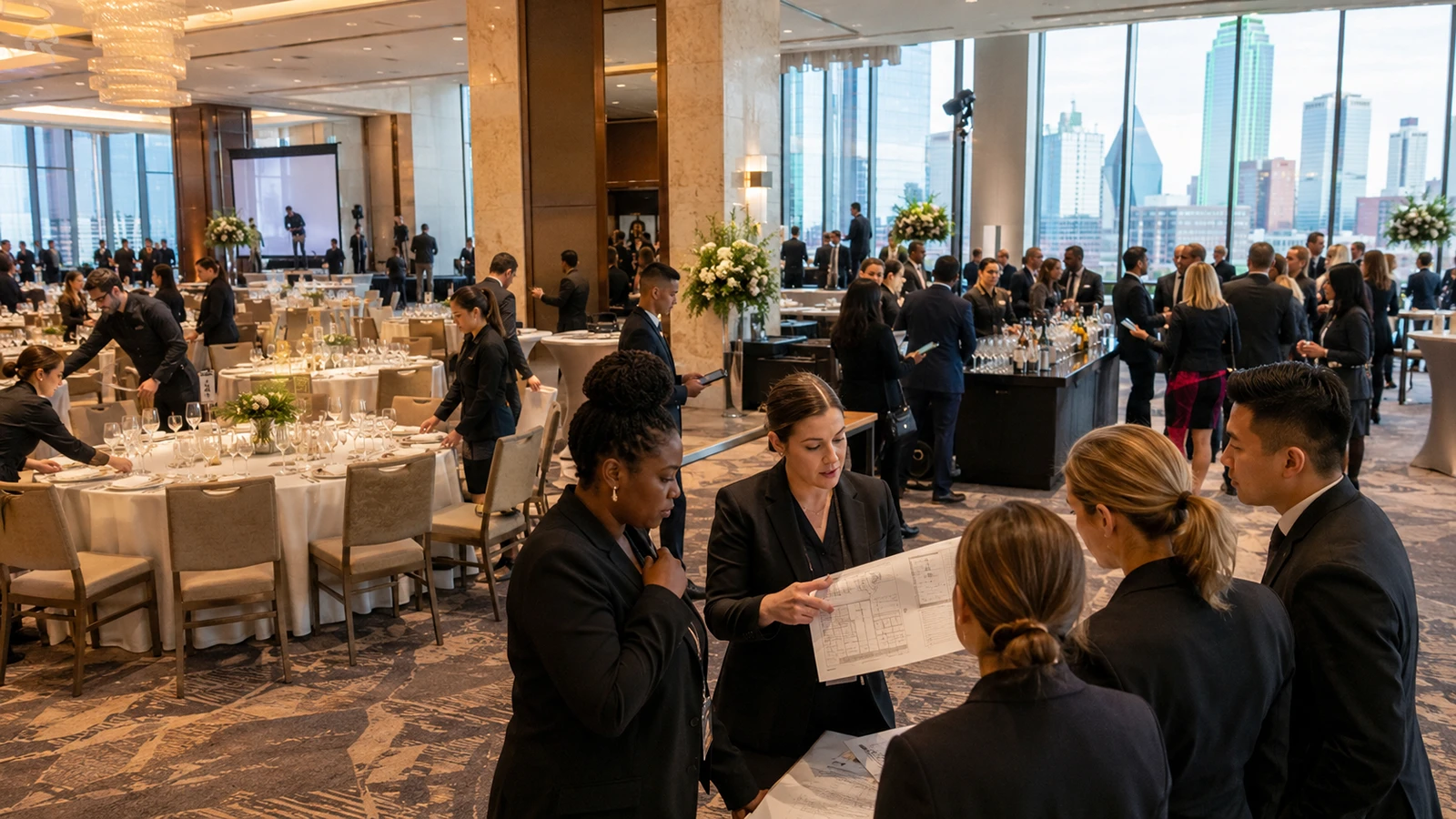
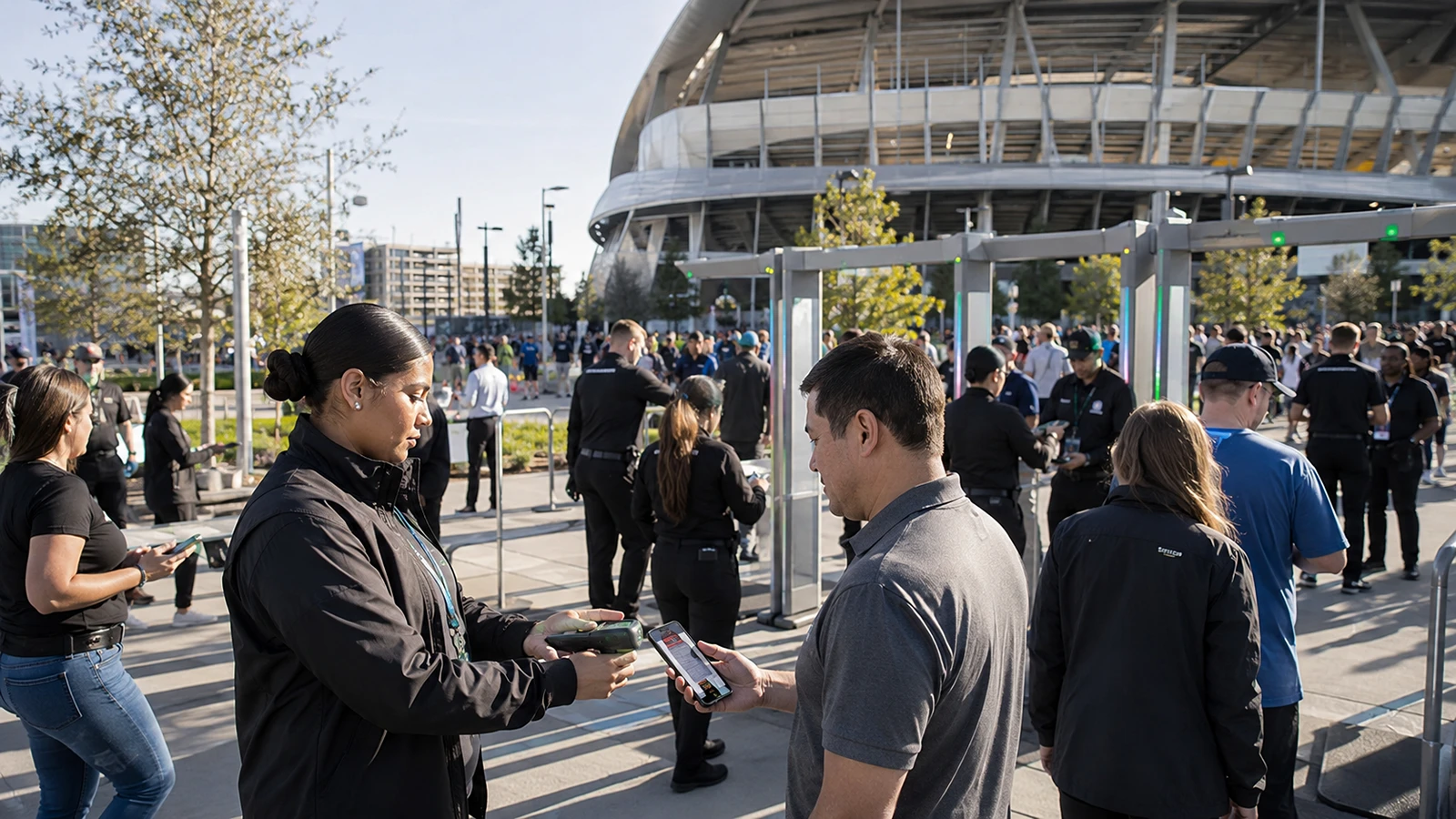
"I define success not by the rendering, but by the result. At Event Staff, we enforce strict throughput logic because a stunning activation fails the moment a guest walks away due to a stagnant line. We build systems that protect the brand promise under pressure."— CEO, Event Staff
Choosing the best event organizer for brand activations is not about who presents the most visually impressive concept. It is about who can execute consistently when real guests arrive, traffic surges, and conditions shift throughout the day.
When brands search tell me best event organizer for brand activations, they are rarely looking for inspiration alone. They are looking for predictable performance that protects engagement quality, lead capture, and return on investment under pressure.
In live environments, small operational failures compound quickly. Long lines reduce participation, unclear staffing roles slow interactions, and lack of on-site authority prevents real-time correction. This is why expert corporate event planners for experiential brand activations evaluate organizers based on execution systems, not creative promises.
This guide explains how to assess event organizers through an operational lens, focusing on staffing logic, throughput control, supervision authority, and measurable outcomes. By understanding what truly defines execution-ready organizers, brands can select partners who maintain performance across every hour of an activation, not just during ideal moments.
Executive Summary
Choosing the best event organizer for brand activations is an operational decision, not a creative one. High-performing organizers are defined by how they manage throughput, staffing fatigue, and on-site authority when traffic peaks and conditions shift throughout the day.
Brands should evaluate organizers based on:
- Staffing logic grounded in realistic interaction timing
- Supervision models with clear decision-making authority
- Measurable engagement output tied to footfall and completion rates
This guide outlines how expert corporate event planners for experiential brand activations assess real execution capability to protect ROI, maintain guest flow, and deliver consistent results across every hour of the event.
What actually defines the best event organizer for brand activations?
The best event organizer for brand activations is defined by operational control. They can plan, staff, supervise, and adjust an activation in real time to protect engagement quality from the first interaction to the last.
Strong organizers share three traits.
1. Staffing logic built on real throughput
They can clearly explain:
- Average interaction time per guest
- Realistic interactions per staffer per hour
- How staffing scales during peak traffic
If an organizer avoids this math, performance risk is already present. To understand the baseline costs associated with this level of planning, you should check labor stats to see how rising wages impact coverage models.
2. Supervision with real authority
Effective organizers assign on-site leadership that can:
- Adjust coverage when lines form
- Rebalance roles as engagement slows
- Manage breaks without degrading performance
- Make decisions immediately, not post-event
This is where expert corporate event planners for experiential brand activations outperform vendors who only supply staff.
3. Consistent execution under pressure
Strong teams plan for:
- Staff fatigue over long shifts
- Reduced guest patience during peak hours
- Lead capture or technology interruptions
- Venue constraints that affect flow
When someone asks “tell me best event organizer for brand activations,” they are asking who can protect the experience when conditions are no longer ideal.
What should you look for when choosing an event organizer for brand activations?
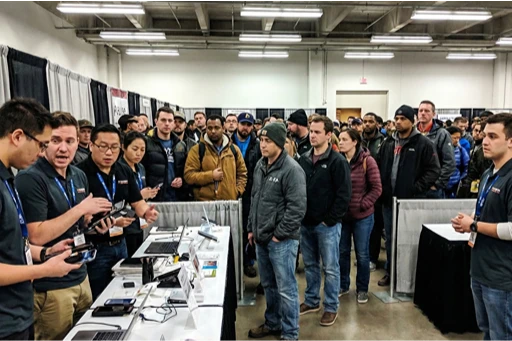
Most organizers can sell an idea. Fewer can execute it cleanly all day with real guests moving through the space.
Use the sequence below to evaluate organizers the same way expert corporate event planners for experiential brand activations do: test assumptions, request proof, then validate execution readiness.
The 60-second organizer test
Start here to pressure-test their operational thinking before reviewing visuals.
Ask:
- What interaction time are you assuming per guest?
- How does that translate into hourly capacity?
- How do you staff for peak demand, not averages?
- Who is the on-site decision-maker?
- What adjustments can they make without escalation?
- What does reporting include beyond photos and impressions?
Unclear answers signal real operational risk.
Proof that matters more than promises
Once assumptions are clear, ask for evidence tied to decisions, not highlight reels:
- Staffing grids for peak traffic windows
- Supervision ratios and role definitions
- Examples of mid-event adjustments and results
- Reporting that connects footfall to completed interactions and leads
Simple evaluation checklist
Use this checklist to compare organizers consistently across bids:
- Staffing model based on throughput, not guesswork
- Clear role separation across ambassadors, specialists, runners, and supervisors
- Training aligned to measurable engagement goals
- On-site supervision with authority to adjust coverage
- A plan to maintain performance after hour four
Why does operational capability matter more than creative claims?
Operational capability determines whether an activation performs under real conditions. Creative concepts do not fix slow throughput, unclear roles, or lack of authority on-site.
This is why many searches for "tell me best event organizer for brand activations" follow a previous execution failure.
Creative concepts do not fix throughput
Throughput is driven by:
- Interaction time per guest
- Number of engagement stations
- Staff coverage per station, including floaters and supervision
A strong organizer can translate a goal like 1,200 interactions into a staffing plan that works during peak hours, not just quiet periods.
Where activations break first
Most failures occur when:
- Peak traffic compresses small delays into long lines
- Staff fatigue reduces pace and quality
- Breaks overlap during high demand
- Lead capture slows and no one adapts
Teams with operational capability anticipate these stress points.
The clearest test
Ask one question:
“How many guests can one staffer realistically engage per hour in this setup?”
Strong organizers answer directly. Weak ones pivot to creative language.
How should brand activations be designed around real human behavior?
Brand activations work when they account for how people actually behave. Guests hesitate, lose patience, and make fast decisions based on perceived wait time and clarity.
This is a core advantage of expert corporate event planners for experiential brand activations. In high-traffic environments, behavior patterns are predictable. Unclear lines increase abandonment, weak first touchpoints reduce conversion, and drops in staff energy immediately impact completion rates. The goal is not to force participation but to remove friction.
Design levers that improve completion rates
Effective organizers focus on execution-ready levers:
- Line pulsing to show visible progress
- Intercept scripts before guests join the queue
- Pre-education through QR codes or prompts
- Floaters to reset energy and resolve micro-issues
- Clear station roles for speed and consistency
Staffing ratios must match behavior
As guest patience shortens, staffing models must adapt:
- Peak-period coverage, not averages
- Flexible role assignments
- On-site supervision that can reassign staff quickly
To ensure your investment yields returns, working with teams who know how to protect event Roi is essential for maintaining these ratios effectively.
What proof should you demand from an event organizer?
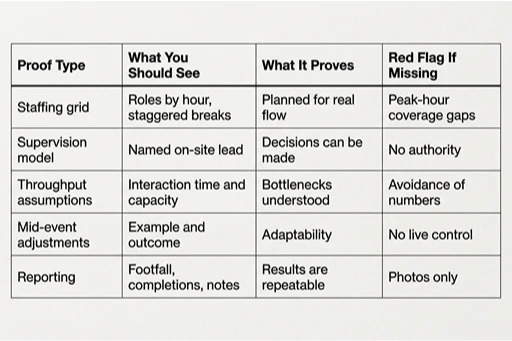
Proof should be operational and measurable. Claims matter less than evidence that connects decisions to outcomes.
Proof hierarchy
Evaluate in this order:
- Staffing plan and peak-hour coverage grid
- On-site supervision model and authority
- Throughput assumptions and interaction timing
- Reporting tied to footfall and completions
- Case examples showing what broke and how it was fixed
Vendor evaluation table
What good reporting includes
At minimum:
- Traffic by time block
- Completed interactions or demos
- Bottlenecks observed and corrective actions
By utilizing data-driven insights, you align with PCMA event trends that emphasize analytics as the future of event management.
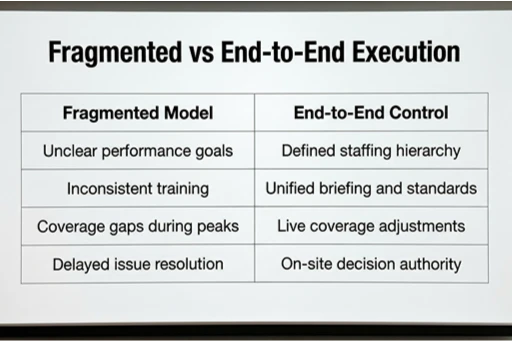
Why does end-to-end control outperform fragmented vendors?
Fragmentation increases risk. When design, staffing, and supervision are split, accountability breaks down.
The best event organizer for brand activations operates as one system.
Fragmented vs end-to-end execution
Multi-city execution requires standardization
Consistency depends on:
- Standard training and experience flow
- Defined staffing ratios
- Backup and replacement protocols
- Performance expectations tied to metrics
Rising labor costs make smarter coverage essential, not optional.
Why is staffing the biggest risk factor in brand activations?
Staffing failures cause most activation breakdowns. When coverage drops or roles blur, engagement slows, and guests leave.
Common staffing failures
- Undercoverage during peak traffic
- Wrong role mix for the experience
- No on-site authority
- Overlapping breaks
Core staffing roles
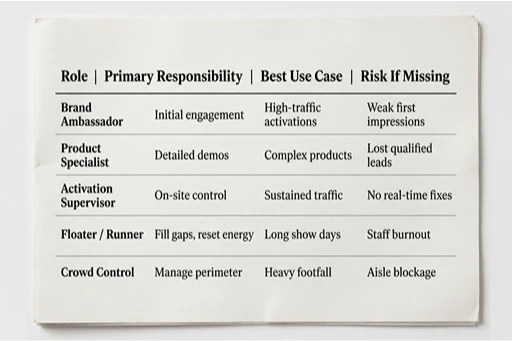
Supervision is the multiplier
Supervisors must be able to:
- Reassign staff
- Adjust breaks
- Troubleshoot issues
- Escalate decisions immediately
To understand the logistics of these roles, you should determine if you need to hire event runners to support your core team.
Establishing Activation Throughput Control
The best event organizer for brand activations is defined by execution, not presentation. Reliable partners can clearly explain how throughput is calculated, how staffing ratios are protected during peak demand, and how supervision authority prevents performance drop-off after hour four. Expert corporate event planners for experiential brand activations focus on minute-by-minute control rather than ideal conditions. They plan for fatigue, variability, and traffic compression so engagement quality remains consistent throughout the event.
Brands should prioritize organizers who can demonstrate:
- Clear throughput assumptions tied to realistic interaction timing
- Staffing ratios designed for peak periods, not averages
- On-site supervision with authority to make immediate adjustments
- Reporting that connects foot traffic to completed interactions
If your next activation must perform under real traffic, real fatigue, and real pressure, execution capability is non-negotiable. Request a quote to evaluate your activation against operational benchmarks and confirm whether your current plan can sustain performance when conditions change.
Ready to elevate your next event?
Join thousands of event planners who trust EventStaff.com for reliable, professional staffing solutions.
Trusted by event professionals nationwide
1k+
Events Staffed
2 million+
Guests Served
97%
Positive reviews