
Event Staffing Services in Los Angeles: What Actually Drives Results in Brand Activations
What do event staffing services in Los Angeles actually include, and why do so many activations still feel unstructured on the floor?
In LA, staffing is not just about filling roles. It is about managing creators, VIPs, press, and high-expectation guests in real time. A team that works in a standard promo environment can fail quickly in a Los Angeles activation.
This guide breaks down how to evaluate LA event staffing services based on what happens inside the room, from creator handling and VIP discretion to field leadership and contingency planning.
Executive Summary
This blog explains what stronger LA event staffing services should include beyond filling space: local audience awareness, creator handling, VIP privacy, media routing, field coordination, backup planning, and proper role fit. It helps brand managers evaluate vendors by what happens inside the room, not just the roles listed on a proposal.
LA Brand Activations Punish Generic Staffing Fast
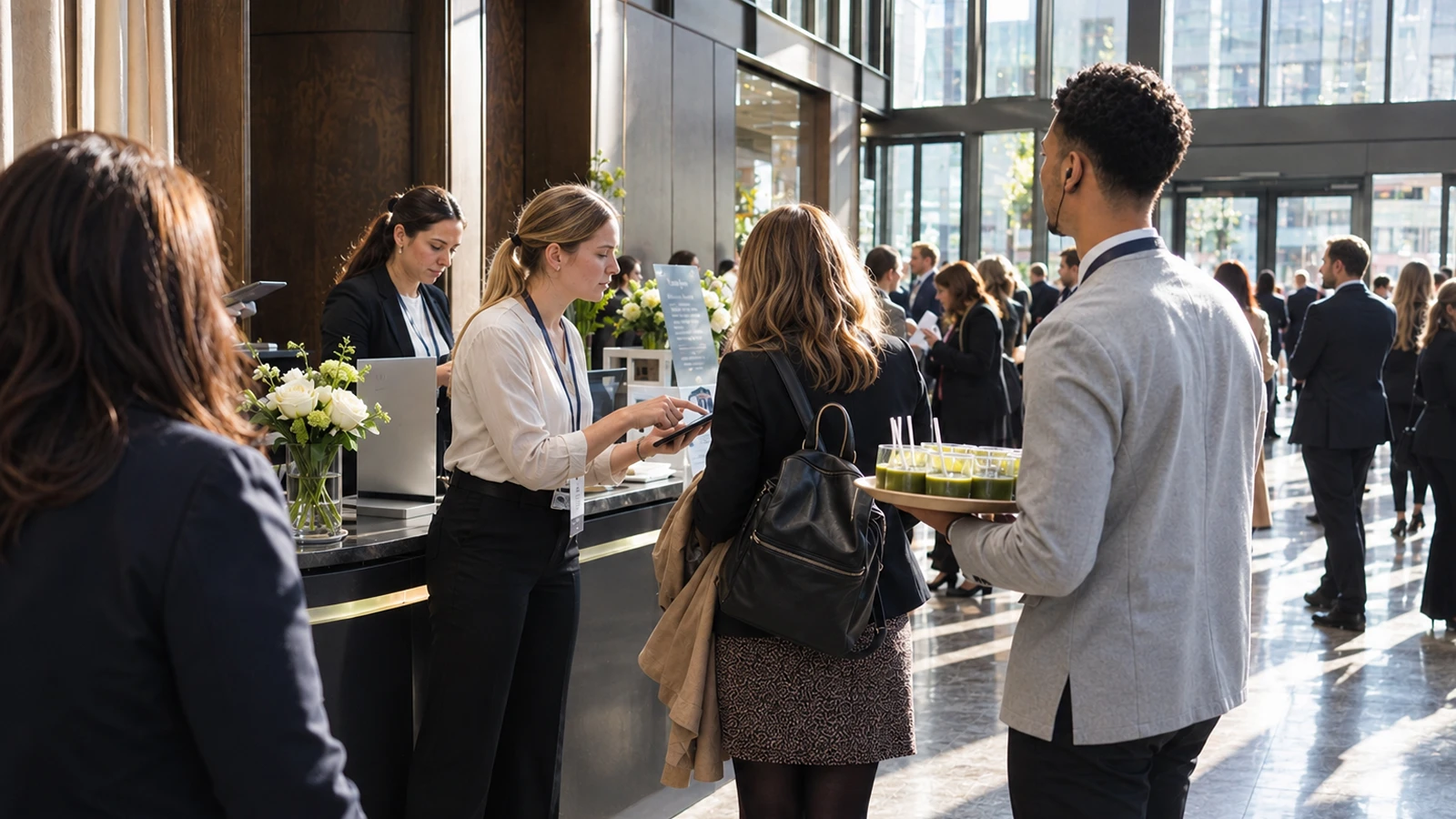
LA brand activations often pull in a different mix of people than a standard promotional event. A single room may include creators, entertainment professionals, managers, founders, buyers, VIP guests, press, and regular consumers who found the activation through social media.
Generic staffing breaks quickly in that kind of room.
A beauty pop-up in West Hollywood is a simple example. The staff may need to greet creators, keep the line moving, route press to the right contact, explain the product, protect the photo moment, and still make the activation feel relaxed. If every staffer is just repeating the same campaign line, the room starts to feel unmanaged.
The Los Angeles tourism board highlights the city’s long connection to film, television, music, fashion, and creative culture, which is exactly why activation audiences here often bring sharper expectations than a basic public sampling crowd. That LA context changes the staffing brief.

Strong Los Angeles event staffing should account for who is in the room before the campaign starts, not after the first problem appears.
Good Brand Activation Services Start Before the Staff Arrive
Good brand activation staff are not chosen only by availability. In Los Angeles, the pre-event work often decides whether the staff feel like part of the campaign or a group of people dropped into the room at the last minute.
A vendor should ask what the campaign is trying to create. Is the goal product trial, content, signups, press coverage, VIP handling, retail buyer conversations, or street-level visibility? Each goal changes the staff profile.
A Santa Monica beverage street team and a Beverly Hills luxury preview should not be staffed the same way. One may need fast public engagement, sampling confidence, and street movement. The other may require polished greeters, discretion, and staff who understand when to step back.
Event Marketer regularly covers brand activations where the staff, space, content, and audience flow work together. That kind of activation thinking is the standard LA campaigns should expect from staffing vendors.
Pre-event vendor checklist:
- Who is the audience?
- What should staff make guests do?
- What should staff avoid saying?
- Who handles VIPs, creators, or press?
- What can the field lead change without waiting for approval?
- What does success look like after the activation?
The staffing plan should be built around campaign behavior. A team hired only to “cover the space” will usually miss the moments that matter.
CEO EXCERPT
In Los Angeles, the staffing mistake I see most often is treating every activation like a standard promo shift. The room changes fast here. A creator walks in, a VIP needs a quiet path, press asks for the right contact, and the staff either know how to move or the brand team ends up managing the floor themselves. - Daniel Meursing.
Entertainment-Industry Guests Can Tell When Staff Are Underbriefed
Los Angeles staff often have to speak to people who are used to polished rooms. Producers, agents, stylists, managers, creators, founders, and entertainment-adjacent buyers can usually tell when someone is reciting a script.
That does not mean every staffer needs to be an industry insider. It means the briefing has to prepare them for the room they are entering.
At a tech activation for entertainment professionals, the guest may not ask a basic product question. They may ask how the tool fits production timelines, creator workflows, rights, approvals, editing, or team collaboration. A staffer who only knows the tagline cannot hold that conversation.
BLS classifies demonstrators and product promoters under sales-related roles, which is useful context because good promotional staffing is still a persuasion and explanation job, not only a presence job. The role requires people who can present products and interact with potential customers, not just stand near a display..
Staff briefing upgrade:
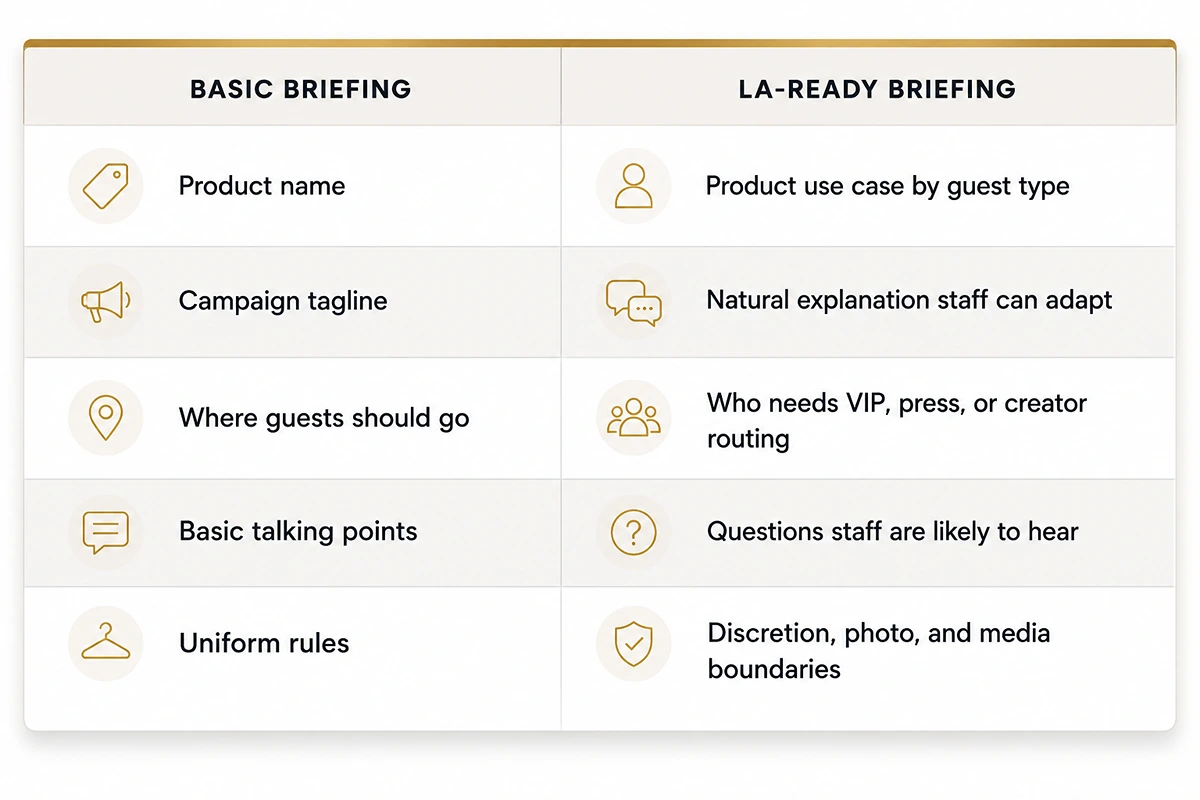
Underbriefed staff makes the campaign feel smaller than it is. LA-ready staff makes the product easier to understand without making the conversation feel forced.
VIP Discretion Is Part of the Service, Not a Bonus
VIP handling in Los Angeles is not only about a separate line or a nicer greeting. It is about discretion, timing, privacy, and staff who know how to stay calm when a high-profile guest enters the room.
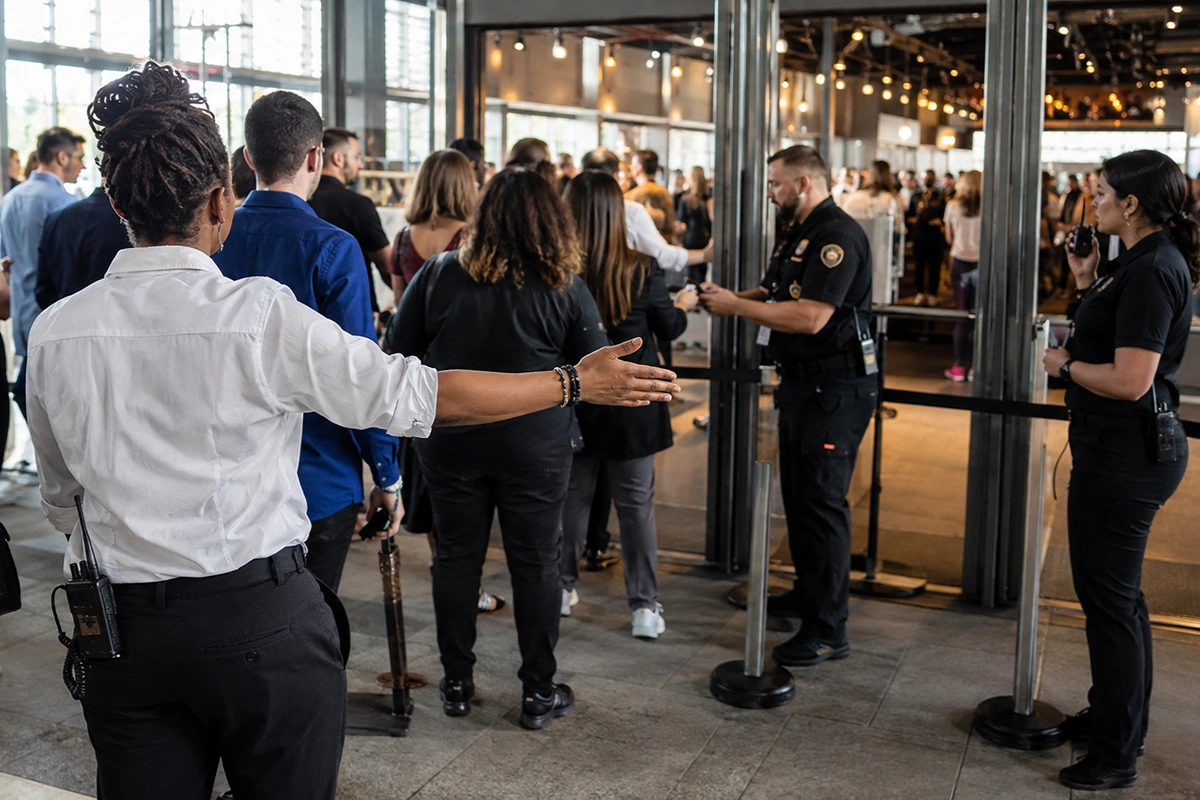
A celebrity-attended activation does not need staff acting impressed. It needs staff who can recognize the guest, route them quietly, protect restricted areas, and avoid turning the arrival into a scene.
That includes rules around phones, photos, names, guest lists, social posting, and private areas. If staff do not know what can be shared, photographed, or repeated, the brand takes on unnecessary risk.
Event safety and access planning often involves crowd, privacy, media, and guest movement decisions. For broader context, the Event Safety Alliance publishes event safety resources that can support discussions around controlled guest movement and event protocols. Use safety as the external anchor.
VIP protocol checklist:
- NDA or confidentiality briefing completed where needed
- Phone and photo policy explained before doors open
- VIP names and photos briefed privately
- Restricted-area rules made clear
- Media questions routed to PR
- Staff know what not to discuss after the event
For LA event staffing services, discretion should be treated as part of the job description. A VIP should never have to explain why they need a quieter path through the room.
A Field Lead Is the Difference Between a Busy Room and a Controlled One
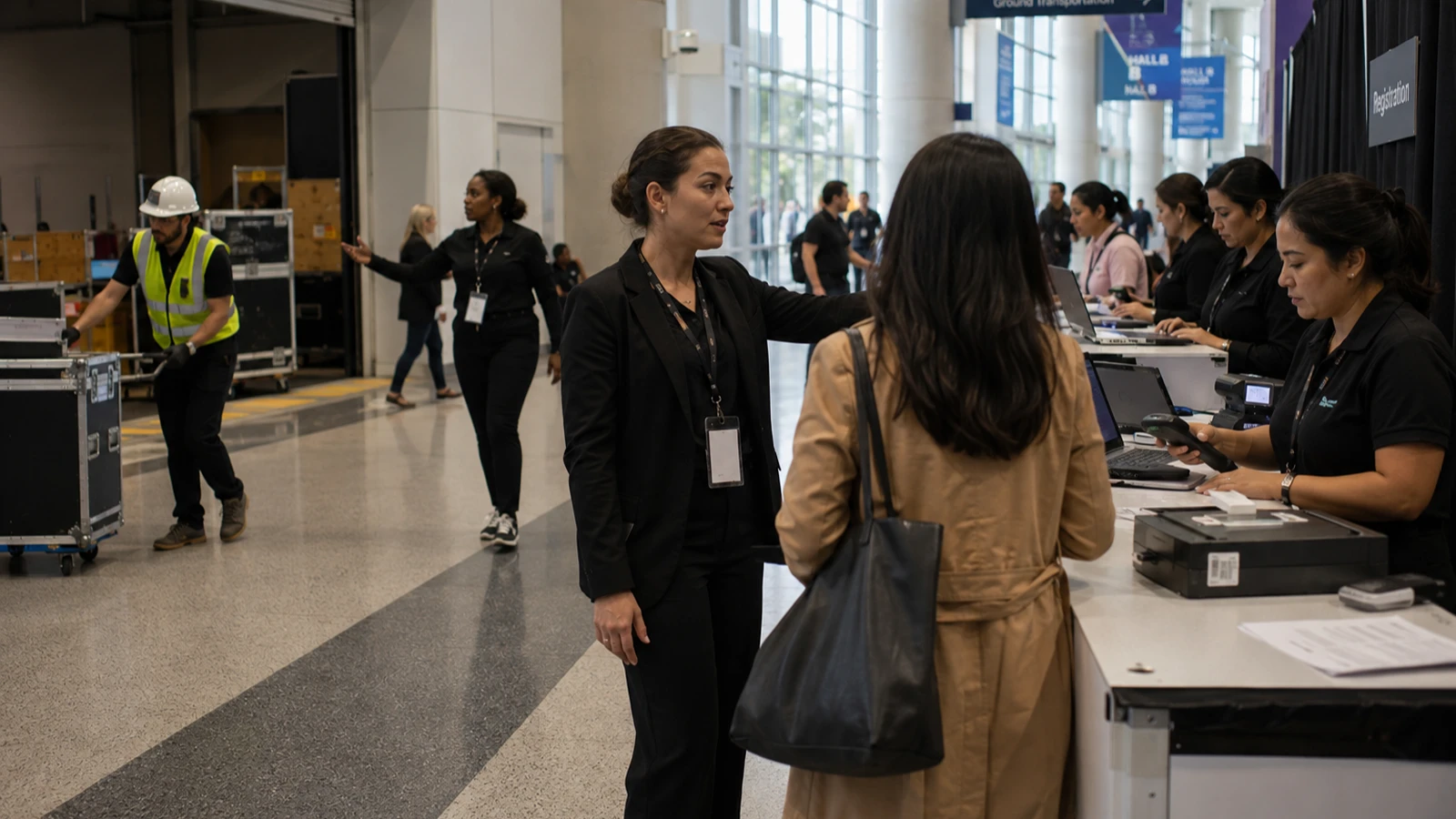
Weak event staffing services often stop at deployment. The staff arrive, someone confirms the headcount, and the brand team is left to manage the room once pressure starts moving.
That model breaks quickly in LA.
A Melrose pop-up can shift in ten minutes. A creator walks in. The photo area gets crowded. Guests outside start asking how long the wait is. A VIP arrives early while the product table is backed up. If the field team waits for the client to notice each problem, the activation starts looking reactive.
A field lead should be watching the room before the brand manager has to text anyone. They move staff from a quiet corner to the line. They pull one ambassador toward the content area. They send a product rep to the demo table when questions get deeper. They keep the client out of small fires.
BizBash’s coverage of brand-heavy festival and pop-up moments shows how fast live campaigns can move once guests, creators, media, and sponsor areas overlap. A Coachella activation environment is a clear example of why field decisions cannot wait for a post-event recap.
For EventStaff, activation staffing should include someone watching campaign behavior in real time, not only staff attendance.
Field lead watchlist:
- where the line is forming
- which questions staff keep hearing
- whether creators are finding the content moment
- whether VIPs are being routed quietly
- which demo table is slowing down
- when ambassadors look underused or overloaded
- whether the brand team is being pulled into staff problems
A crowded room can look exciting in photos and still be poorly managed on the floor.
Creators Won’t Wait While Staff Figure Out the Content Moment
Los Angeles activations often depend on creator behavior inside the room. A post, story, short video, tagged photo, or behind-the-scenes clip may carry the campaign further than the guests who physically attended.
Generic promotional staff can miss that moment. They may block the best angle, interrupt filming, give a long product explanation on camera, or fail to point creators toward the hero display. The creator still gets content, but the brand loses control of what gets captured.
A skincare pop-up makes the problem easy to see. A creator may need the hero product, clean lighting, a quick product line, access to samples, and a staffer who knows when to step away. If the team crowds the shot or starts overexplaining, the content moment gets awkward.
Vogue reported that Coachella brand activity has become deeply tied to influencer marketing and creator-led visibility, with brands using controlled spaces and service-led activations to stand out in a crowded cultural setting. Use Vogue as a source for the creator-heavy activation context.
EventStaff ambassadors should be briefed on creator behavior before the event opens. They should know the photo spot, product line, sample rules, and who handles partnership questions.
Creator handling checklist:
- keep the hero display camera-ready
- give one short product line staff can repeat naturally
- route partnership questions to the brand or PR lead
- protect the content spot from random traffic
- avoid hovering while creators film
- know which products can be sampled, gifted, or shown
The staff should make the content easier to capture without turning the moment into a forced pitch.
Street Teams, Pop-Up Staff, and Booth Staff Solve Different LA Problems
A street team, pop-up team, booth team, product rep team, and brand ambassador team should not be treated like different labels for the same labor pool.
Each role fits a different campaign behavior.
A Venice street campaign for a fitness app may need people who can approach fast, explain the offer in one line, and move before the public loses interest. A Fairfax fashion drop may need pop-up staff who can manage the line, protect the product display, guide guests toward photos, and keep the brand environment from feeling messy. A trade show booth in downtown LA may need booth staff who can scan leads, qualify visitors, route serious buyers, and keep sales reps out of low-fit conversations.
EventStaff’s own roles page separates service types like product reps, brand ambassadors, street teams, and pop-up staff, which is useful because the wrong role can make a good campaign feel poorly planned.
For outside context, Event Marketer’s brand activation coverage regularly shows how live campaigns vary by format, audience, space, and interaction style. A format built around public sampling does not create the same staffing problem as a photo-heavy pop-up or buyer-facing booth.
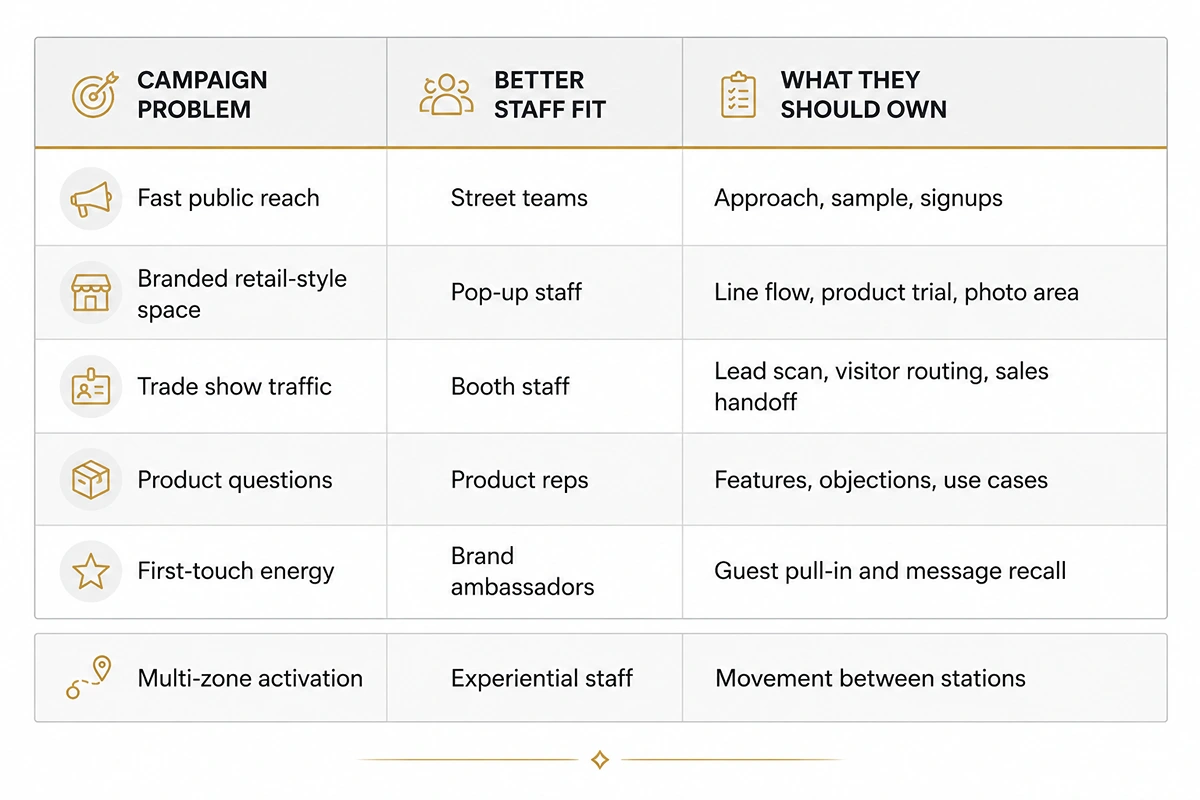
The staffing question should start with guest behavior: Are people passing, waiting, filming, sampling, asking, buying, or scanning? The role follows that answer.
LA Backup Plans Need More Than One Extra Person
A basic backup plan usually means one spare staffer and a phone number. That is too thin for many Los Angeles activations.
The risk is not always a missing person. A VIP can cancel. A creator can arrive two hours late. Paparazzi can change the entrance pressure. A street team can hit a weak foot-traffic pocket. A venue can adjust access rules. Traffic can delay half the team. A line can form in the wrong place and block the photo moment.
If a celebrity host cancels the morning of a launch, sending one extra ambassador does not solve the room. The field lead may need to adjust talking points, push more guests toward product demos, route press differently, and keep staff from answering questions they should not answer.
The Event Safety Alliance publishes event planning and risk resources covering crowd management, communication, and event-specific preparation. Use risk as a supporting source for the idea that live-event plans need clear protocols before the room is under pressure.
For Los Angeles campaigns, EventStaff’s LA staffing plan should account for backup staff, local travel realities, media routing, VIP privacy, and field decision authority.
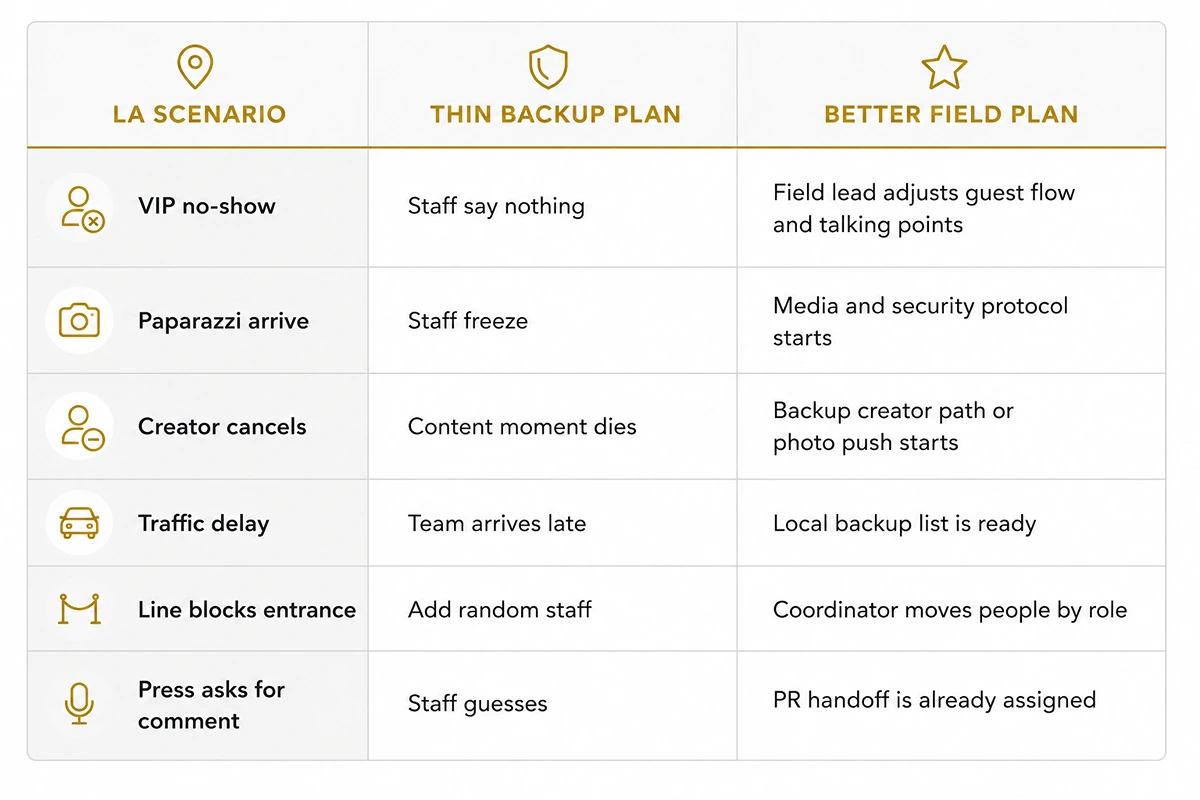
A strong contingency plan gives staff the next move before the client has to invent it on-site.
A Vendor Call Should Reveal How They Handle the LA Room
Event staffing services can sound similar on a sales call. Most vendors will say they have brand ambassadors, promotional staff, street teams, and event leads. That does not tell you how they behave when a creator arrives early, a VIP wants a quieter entrance, or the line outside starts blocking the storefront.
A better vendor conversation should get specific quickly. Ask how they source staff for Los Angeles campaigns, who briefs the field team, what the on-site lead can change without approval, and how they separate street teams, pop-up staff, booth staff, product reps, and brand ambassadors.
Event Marketer’s research section includes EventTrack, its annual experiential marketing study, which is useful context because serious activation work is measured through audience behavior, not only attendance photos. Use EventTrack as a source when explaining why vendor evaluation should focus on campaign outcomes and on-site actions.
EventStaff’s Los Angeles team page gives you a local internal link for this section, especially when discussing LA staffing coverage and market familiarity.
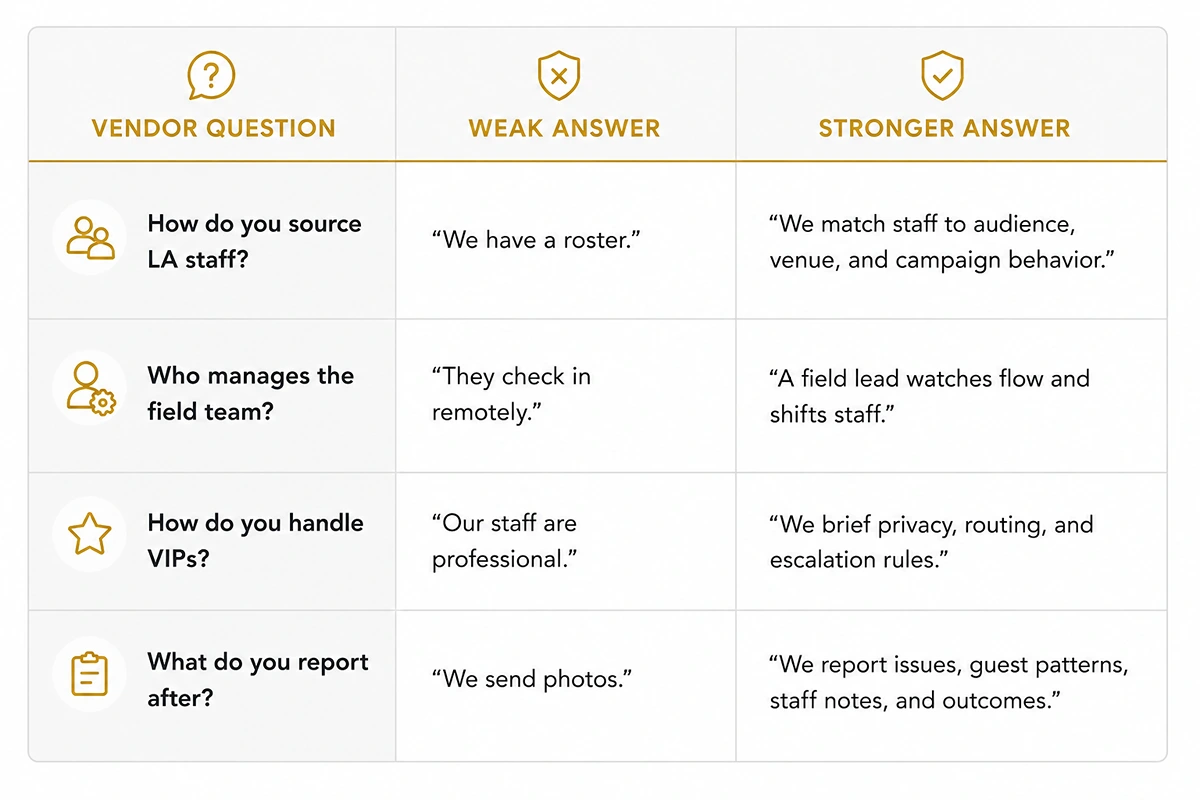
A good vendor call should make the campaign feel more controlled before the contract is signed.
EventStaff’s LA Approach Should Be Built Around Campaign Behavior
The strongest Los Angeles staffing plan starts with what the campaign needs people to do. Street teams may need to create quick public contact. Pop-up staff may need to manage lines, product trials, and content areas. Booth staff may need to qualify visitors before sales gets pulled into low-fit conversations. Product reps may need to answer deeper questions. Brand ambassadors may need to keep the front layer of the activation active.
A generic staffing list does not solve that. The staff mix should follow the campaign behavior.
For a beverage street campaign near Santa Monica Pier, the plan may lean on street teams who can move through public traffic and keep outreach fast. For a fashion or beauty pop-up, pop-up staff may be better suited for guest flow, content moments, product display care, and controlled entry.
EventStaff’s activation page also gives you the cleanest internal anchor for LA brand activation staffing.
Campaign behavior checklist:
- Are guests passing by, waiting, filming, sampling, scanning, or buying?
- Does the staff need to explain the product or only spark interest?
- Will creators need a clean photo or video path?
- Will VIPs, press, or buyers need separate handling?
- Who moves staff if the room changes?
- What gets reported after the activation?
If your LA activation depends on creators, VIPs, press, guest flow, or product conversations, do not build the staffing plan around headcount alone.

Plan Your Los Angeles Event Staffing the Right Way
If your activation includes creators, VIP guests, or press, your staffing strategy cannot be generic.
EventStaff helps brands build LA-ready event teams that
- Manage guest flow in real time
- Handle VIPs and creators with discretion
- Support content capture without disruption
- Adapt instantly to on-site changes
Request a Los Angeles staffing plan and see how your activation can run with full control, not reactive fixes.
👉 Get a custom staffing strategy for your next event
Ready to elevate your next event?
Join thousands of event planners who trust EventStaff.com for reliable, professional staffing solutions.
Trusted by event professionals nationwide
1k+
Events Staffed
2 million+
Guests Served
97%
Positive reviews