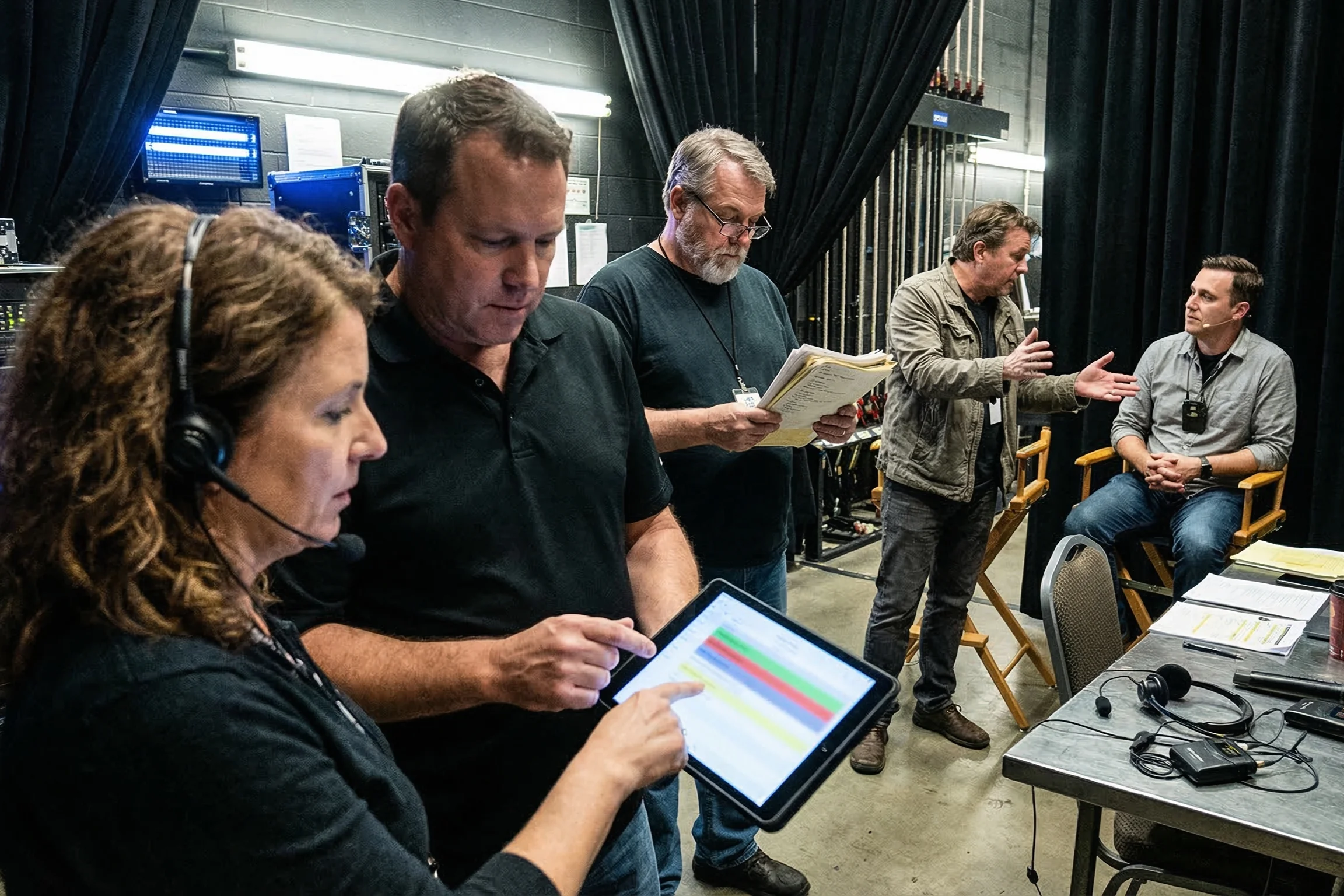

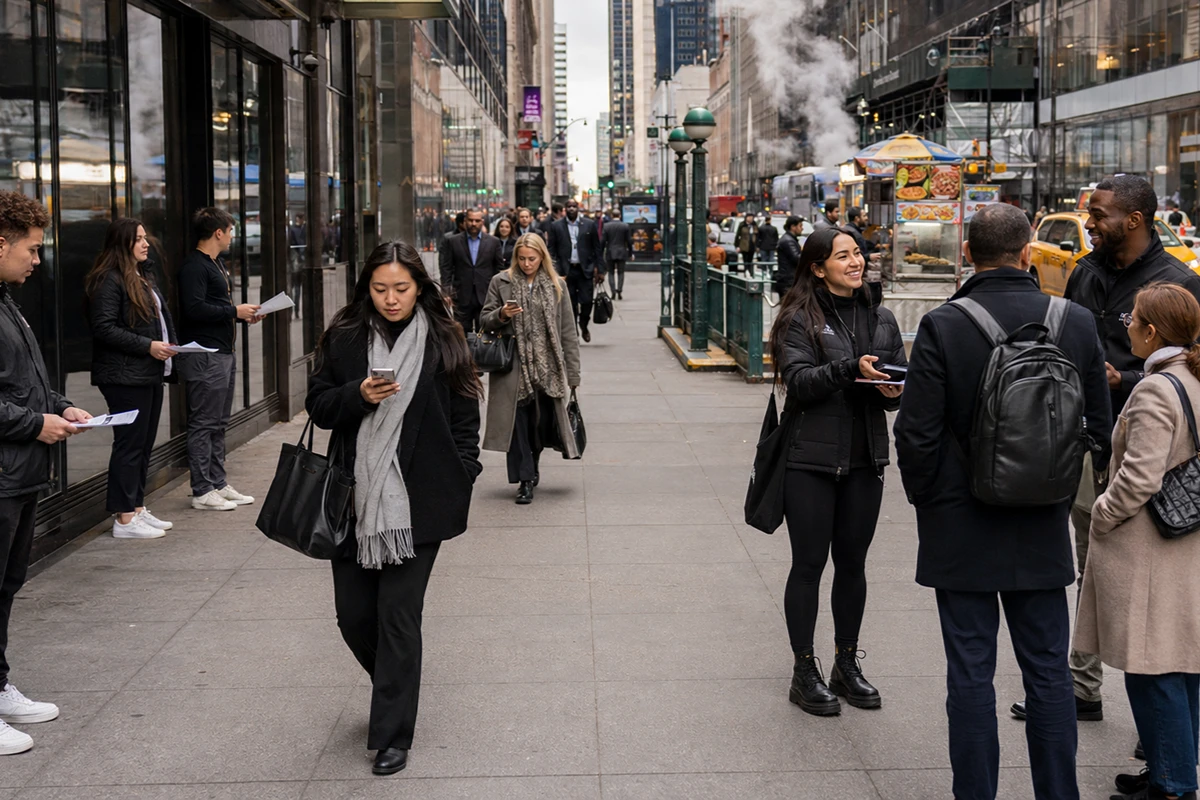
A NYC sidewalk gives promotional staff only a few seconds to make the interaction matter. Someone slows down, glances at the flyer, looks toward the setup, asks what is happening, or takes one step closer before deciding whether to keep moving.
That short moment is where many promo teams lose value. They hand over the flyer, say a vague line, and let the person walk away without explaining the offer, the event, the location, or the next action. Strong promotional staff treat that pause as the start of a useful exchange, especially in New York where attention is brief and foot traffic moves quickly.
CEO Excerpt
“Promotional staffing works best when the team understands the moment they are creating. In New York, you may only have a few seconds to make the message clear, so staff need to be trained, alert, and ready to connect attention with action. A good sidewalk team does more than distribute materials. They help the campaign become memorable." -:Daniel Meursing, CEO, Eventstaff

Why the sidewalk pause matters in NYC
The sidewalk pause is small, but it is usually the clearest signal a promo team will get. In New York, people rarely stop for long unless the message feels relevant, immediate, or easy to understand.
A person may slow down near Bryant Park, glance at a flyer in SoHo, ask one question near Union Square, or turn their head toward a pop-up in Williamsburg. Those signals are easy to miss when staff are focused only on handing out as many flyers as possible.
NYC’s street environment makes this moment more valuable because sidewalks are central to how the city moves. NYC DOT describes New York as a city of pedestrians supported by an interconnected sidewalk and crossing network, which reinforces why sidewalk timing, comfort, and movement matter for public-facing campaigns.

Why promotional staff need more than a handout script
Promotional staff need more than a handout script because the flyer is rarely enough on its own. The staff member still has to explain why the person should care, what the offer means, where they should go, and why the action matters today.
A generic “check this out” line gets ignored quickly in New York. A sharper line connects the flyer to a real reason, such as a pop-up around the corner, a launch happening that afternoon, a limited offer, a free trial, a nearby event, or a scan that gets the person onto the list.
Good promotional staff also read the person in front of them. A Midtown office worker may need a direct benefit in five seconds, while a SoHo shopper may respond better to product relevance, style, or a nearby retail hook. The role is about timing, awareness, and message control, not just distribution volume.
How flyer distribution loses value when there is no next step
Flyer distribution loses value when the handout becomes the whole interaction. A person can accept a flyer, keep walking, fold it into a pocket, and forget the brand before the end of the block.
The flyer should support the message, not carry the full campaign alone. Staff need to connect it to a clear next step, whether that is visiting a store, scanning an offer, joining a guest list, attending an event, redeeming a promotion, or walking toward a nearby activation.
That matters in a city where people are constantly moving through competing messages. The MTA reported 3.376 million average weekday subway riders in 2024, which reflects the scale of daily movement around the city’s transit, business, and retail corridors.

Why New York sidewalks change the pitch
New York sidewalks change by block, time of day, and audience type. A team handing out flyers near Grand Central during a commuter rush has a very different window than a team promoting a weekend pop-up in Williamsburg or a retail launch in SoHo.
In Midtown, the pitch usually has to be quick and practical because people are moving between offices, meetings, transit, and lunch plans. Around Union Square, the audience may include students, commuters, shoppers, tourists, and locals in the same hour, which means staff need to adjust quickly instead of repeating one line all day.
Times Square shows why this kind of local context matters. Times Square Alliance collects district data on pedestrian flows, retail activity, real estate markets, and demographics, which shows how much audience behavior can vary by location even within one city.
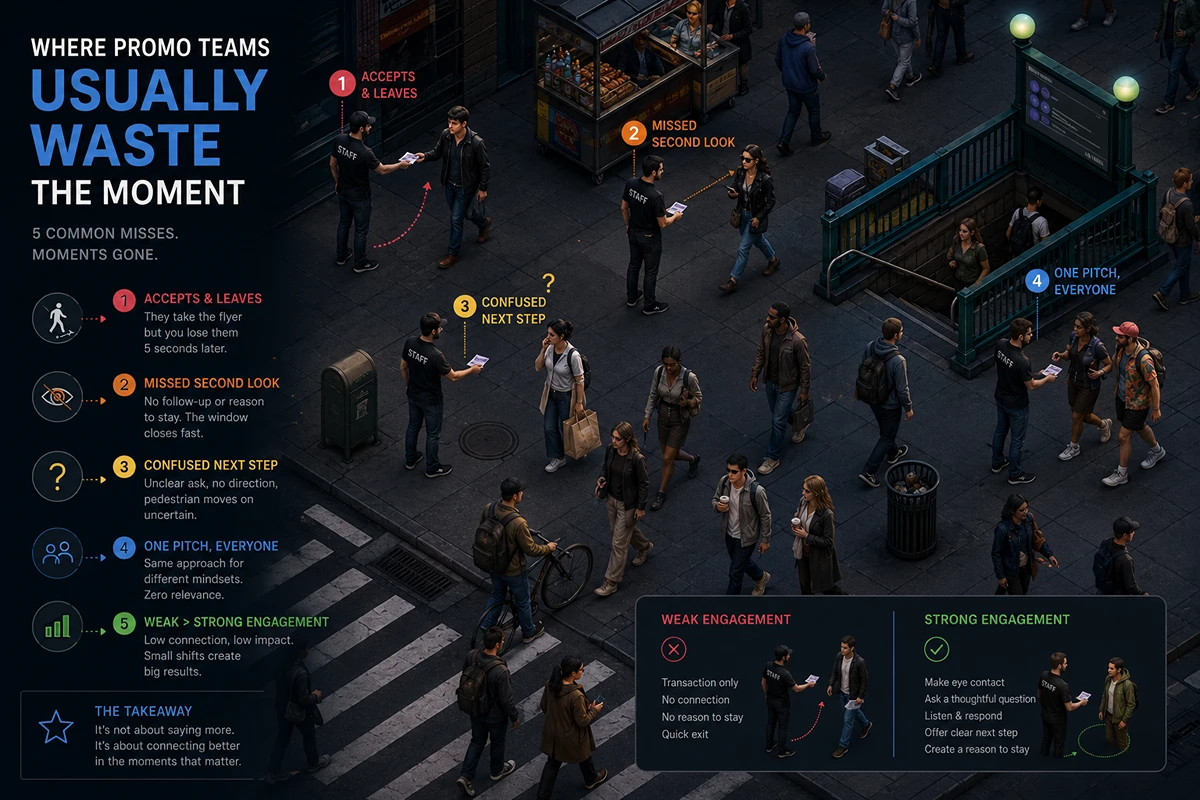
Where promo teams usually waste the moment
The wasted moment usually happens when the staff member sees the person accept the flyer and mentally counts the interaction as complete. That creates activity, but it does not create enough memory, intent, or action for the campaign.
- They treat acceptance as success.
Someone taking a flyer is only the beginning of the interaction. The staff member still has to make the message clear enough that the person remembers what to do after they keep walking. - They miss the second glance.
A second look often signals curiosity, especially in a fast-moving sidewalk environment. Trained promotional staff know when to step in with one useful line instead of letting the person drift away. - They cannot explain the next step quickly.
If staff cannot say where to go, what to scan, what to redeem, or why the offer matters today, the campaign loses momentum. The best sidewalk teams can explain the action in plain language before the person moves past them. - They use the same pitch on every block.
A Midtown lunch crowd, SoHo shopping crowd, and Williamsburg weekend crowd need different pacing and language. Strong teams adapt the message without drifting away from the campaign brief.
How trained promotional staff turn sidewalk attention into action
Trained promotional staff turn brief attention into action by connecting the handout to a reason. They know how to open with a short line, match the message to the audience, explain the value, and point the person toward the next step.
That next step may be a store visit, pop-up entry, QR scan, sign-up, offer redemption, event attendance, or visit to a nearby booth. The staff member should be able to make that action feel simple and immediate, especially when the person has only a few seconds to decide.
The strongest promo teams also report what they are hearing. If people keep asking the same question, ignoring the same phrase, or responding better to one offer than another, that feedback can help the campaign team adjust while the promotion is still live.
What a weak sidewalk team costs the campaign
A weak sidewalk team can make a campaign look active while producing limited results. Flyers move, staff stay busy, and the street presence looks visible, but the campaign may still end with low scans, weak redemptions, poor foot traffic, or little useful feedback.
That creates pressure for marketing teams because print spend, staffing spend, location planning, and creative work all depend on the moment of contact. If the person on the sidewalk does not understand the offer or destination, the campaign loses value at the exact point it was supposed to create action.
In New York, that cost is magnified because the opportunity moves quickly. A strong sidewalk moment can send someone into a pop-up, store, event, or offer flow within minutes, while a weak one turns the flyer into something people carry briefly and forget.
When NYC campaigns should add Eventstaff support
NYC campaigns should add Eventstaff support when the promotion depends on more than visibility. Product launches, pop-ups, retail pushes, restaurant openings, campus promotions, event invitations, sampling campaigns, and limited-time offers all need staff who can do more than stand in position.
Support is especially useful when the campaign location has heavy foot traffic, mixed audience types, or a short promotional window. In those conditions, flyer distribution needs staff who can qualify interest, explain the offer, answer basic questions, and direct people toward a clear action without slowing the sidewalk.
This also matters when the brand needs feedback from the street. Trained promotional staff can help identify what people respond to, where confusion appears, and which message makes someone stop long enough to act.

How Eventstaff supports promotional staffing in New York
Eventstaff supports promotional staffing in New York with trained teams who understand street-level engagement, location pressure, and public-facing campaign goals. The team can support flyer distribution, product sampling, pop-up traffic, event promotion, retail awareness, and sidewalk outreach across high-volume NYC areas.
The focus is not just getting materials into hands. Eventstaff promotional staff help turn a short sidewalk pause into a clearer brand moment by explaining the message, pointing people toward the next step, and keeping the team aligned with the campaign goal.
That matters in New York because attention is always competing with movement. When promotional staff understand timing, audience type, and the value of a short interaction, the campaign has a better chance to turn sidewalk attention into measurable action.
Bottom Line
The NYC sidewalk moment most promo teams waste is the brief pause before someone keeps moving. That is when a person shows enough interest to receive the message, ask a question, scan an offer, or walk toward the campaign destination.
Strong promotional staff protect that moment by making flyer distribution more intentional. With trained Eventstaff teams, brands can turn New York sidewalk attention into clearer engagement, stronger campaign action, and better value from every public-facing
Ready to elevate your next event?
Join thousands of event planners who trust EventStaff.com for reliable, professional staffing solutions.
Trusted by event professionals nationwide
1k+
Events Staffed
2 million+
Guests Served
97%
Positive reviews