

Why Your Quote Looks Higher Than Expected
Conference staffing costs in 2026 are rarely as simple as multiplying headcount by an hourly rate. Many planners expect a predictable number based on guest count, but the final quote often comes back significantly higher.
The reason? Conference staffing costs are driven less by attendee numbers and more by agenda complexity, attendee movement, role specialization, and city-specific labor conditions.
In this guide, you’ll learn:
- What actually affects conference staffing costs in 2026
- Average hourly rates by role
- How agenda structure changes staffing needs
- How to estimate staffing more accurately for your event
If your quote feels higher than expected, this breakdown will show you exactly why and how to plan smarter.
Executive Summary
This blog explains why conference staffing costs in 2026 can change even when the guest count looks the same. It covers hourly rate ranges, convention staffing rates, city pricing, staff-to-attendee ratios, multi-track conference staffing, specialist roles, break-time pressure, and late booking so organizers can build a more accurate staffing budget.
Your Guest Count Is Not the Budget
A planner may look at a 500-person conference and think the staffing math should be simple. Get a few people at registration, place some staff near session rooms, add one person to answer questions, and call it done. That works only if the day is simple: one main room, one check-in point, no messy transitions, no speaker movement, and no sponsor or breakout traffic pulling attendees in different directions.
The quote starts changing once the agenda has real movement. A finance summit with one keynote room has a very different staff pattern than a healthcare conference where attendees are bouncing between breakout rooms, badge issues, speaker check-ins, sponsor tables, and lunch lines. The attendee count may look clean on the planning sheet, but people never move through a conference in a clean spreadsheet pattern.
Event staffing rate guides also point out that pricing changes by role, market, dates, shift length, training, attire, and coordination structure, which is why a flat headcount estimate misses the real number behind conference staffing costs in 2026. TSM’s 2026 guide makes the same point: staffing prices are not one universal hourly number.
EventStaff would start with the agenda before talking headcount. For conference staffing, the better first question is where attendees pile up, where they get confused, and which staff roles cannot be shared once the day starts moving.
The Cheapest Hourly Rate Can Hide the Weakest Plan
The hourly rate gets most of the attention because it is the easiest number to compare. One quote says $24 an hour, another says $34, and suddenly the cheaper one looks better. The problem is that the hourly rate does not tell you what kind of person is being priced or what responsibility they are carrying during the conference.
A general event staffer may be fine for wayfinding, room support, or basic guest questions. A registration lead is different. A floor manager is different again. An AV liaison who can sit near a breakout room and handle presentation panic is not the same as someone pointing people toward Ballroom B. TempGuru’s cost guide gives a wide 2026 event staffing range because role type, market, and event type all move the number.
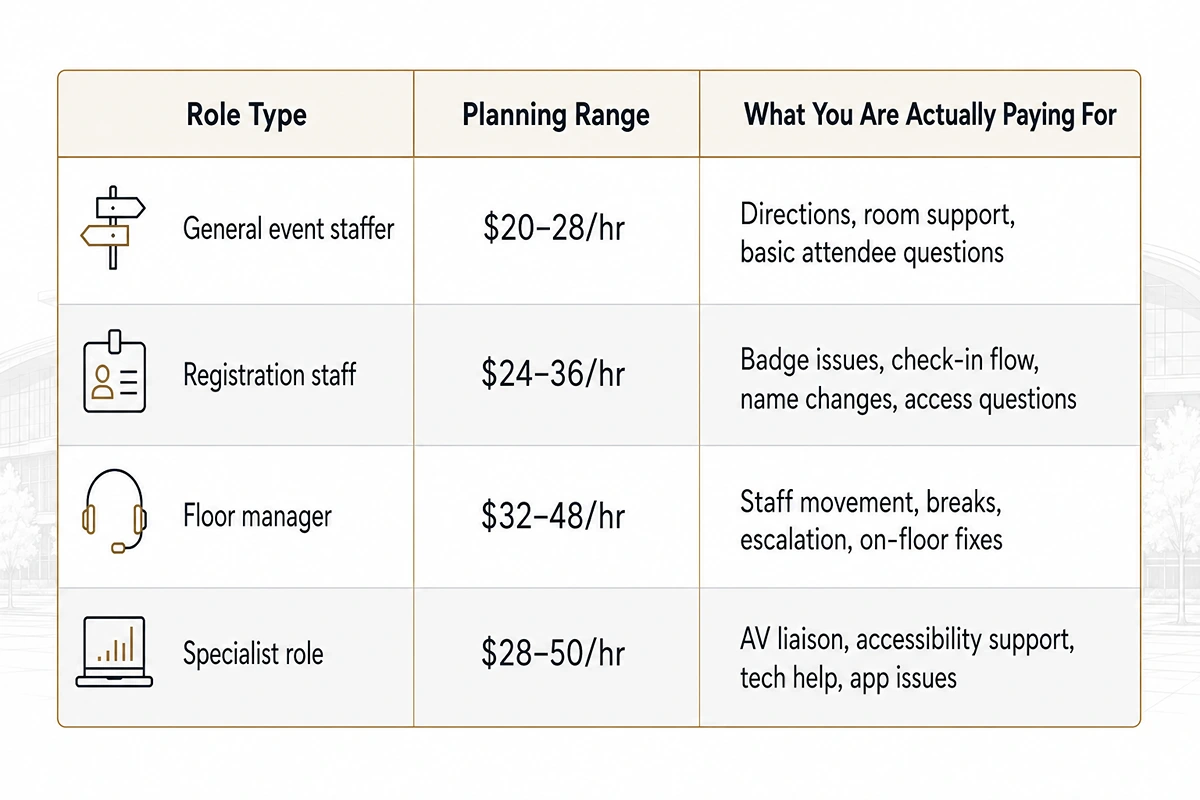
That table is the part many budgets skip. The event staffer hourly rate 2026 is useful, but only after the role mix is clear. A cheap quote with no lead, no registration specialist, and no backup for session transitions may cost less because it has removed the roles that stop the day from getting messy.
EventStaff would break the estimate into actual jobs instead of giving one blended number. For conference staffing, that means showing who is covering check-in, who is moving between rooms, and who is there to solve problems rather than just be present.
CEO Excerpt
The biggest budgeting mistake I see with conferences is treating headcount like the whole story. A 700-person conference can be easy to staff if everyone moves through one clear flow. A 400-person conference can get messy fast if people are split across tracks, elevators, badge desks, sponsor areas, and speaker rooms. I’d tell planners to price the movement first, then the people. - Daniel Meursing
A Dallas Budget Can Break in New York
A conference budget from Dallas will not always survive New York. The same staffing plan can become more expensive once the event moves to a city with higher labor costs, longer commutes, tighter availability, and more competition for experienced event staff. That is usually where planners get annoyed because nothing about the agenda changed, but the number still moved.
StreetTeams’ city pricing guide gives a simple example: a brand ambassador listed at $30 per hour in Dallas may cost $48 per hour in Manhattan for the same broad role type. That kind of spread matters fast when the team is covering registration, room monitoring, sponsor traffic, and multi-day shifts.
A conference in New York or Los Angeles also tends to bring different expectations. Staff may need to look sharper, handle more formal venues, deal with tighter loading windows, and arrive through busier transit routes. In a smaller market, the hourly rate may be lower, but the pool of people who can handle a technical or high-pressure conference may also be thinner.
A quick way to think about conference staffing rates by city:
- Mid-size market: easier baseline for budgeting
- NYC or LA: higher rate pressure and tougher availability
- Convention-heavy week: fewer strong staff left open
- Smaller market: lower cost possible but less depth for specialist roles
EventStaff would price the market before locking the final model. For conference staffing, the same agenda in Austin, Chicago, Phoenix, and Manhattan should not be quoted like the labor pool behaves the same way.
Four Breakout Rooms Change the Quote Fast
A conference agenda can quietly double the staffing headache before anyone changes the guest count. The messy part is not always “more people.” It is where those people are going at the same time. One ballroom with one keynote has a pretty simple staffing shape. Four breakout rooms running at once is different. Now attendees are choosing rooms, leaving sessions early, asking where Track C moved, and looking for someone when the speaker’s deck does not load.
Multi-track agendas are known for creating planning problems around room capacity, attendee movement, and competing sessions. Eventpage’s agenda guide talks about how multiple stages and rooms turn a simple timetable into a more complex planning problem. For staffing, that shows up on the floor as more doors, more questions, more handoffs, and less room for one person to “float” everywhere.
A 500-person conference with one main room may mainly pressure registration, wayfinding, and lunch flow. Give that same 500-person crowd four tracks and the staff plan changes. Someone has to watch each room door. Someone has to handle late arrivals. Someone has to help the speaker or AV tech. Someone has to catch the people who picked the wrong session and are now standing in the hallway annoyed.
Event Staff would read the agenda grid before giving you a number. For conference staffing, the count should come from where attendees move, pause, and ask questions, not just the total badge count.
One Ratio Will Not Survive Check-In
A conference staff to attendee ratio is useful only when it is tied to a job. One ratio for the whole day can look clean in a spreadsheet and still fall apart at 8:45 AM when everyone wants their badge, coffee, Wi-Fi code, and room location at the same time.
Liveforce’s staffing guide recommends breaking an event into zones instead of guessing one overall staff number. That is the better way to think about conference staffing because every zone behaves differently. Registration gets slammed early. Session doors get busy right before start times. Help desks get random spikes. Expo or sponsor areas may be quiet during sessions and packed during breaks.
A sharper ratio check looks more like this:
- Registration needs heavier cover during arrival and badge pickup.
- Session rooms need staff right before start time and during transitions.
- Help desks need people who can answer Wi-Fi, schedule, app, and access questions.
- Sponsor areas need cover when sessions release.
- VIP or speaker movement needs fewer people but better judgment.
- Accessibility support should be planned around movement points, not hidden at the back of the venue.
EventStaff would not average the ratio across the full day and call it done. For conference staffing, the useful ratio is the one that matches the pressure window. The number that works during a keynote may be useless during check-in.
The Roles You Forget Are Usually the Expensive Ones
The roles that move the quote are often the ones that look optional during early planning. A general event staffer can point someone to the right hallway. They probably should not be the person handling a broken check-in scanner, a speaker’s missing deck, an accessibility request, or a sponsor lead asking why their meeting room is locked.
That is why convention staffing rates can jump even when the headcount does not look crazy. The quote may include people with narrower jobs: registration leads, floor managers, AV liaisons, tech support, accessibility coordinators, or speaker handlers. TempGuru’s 2026 staffing data shows how role type changes hourly cost, with rates moving higher as responsibility and specialization increase.
A quick check before cutting the budget:
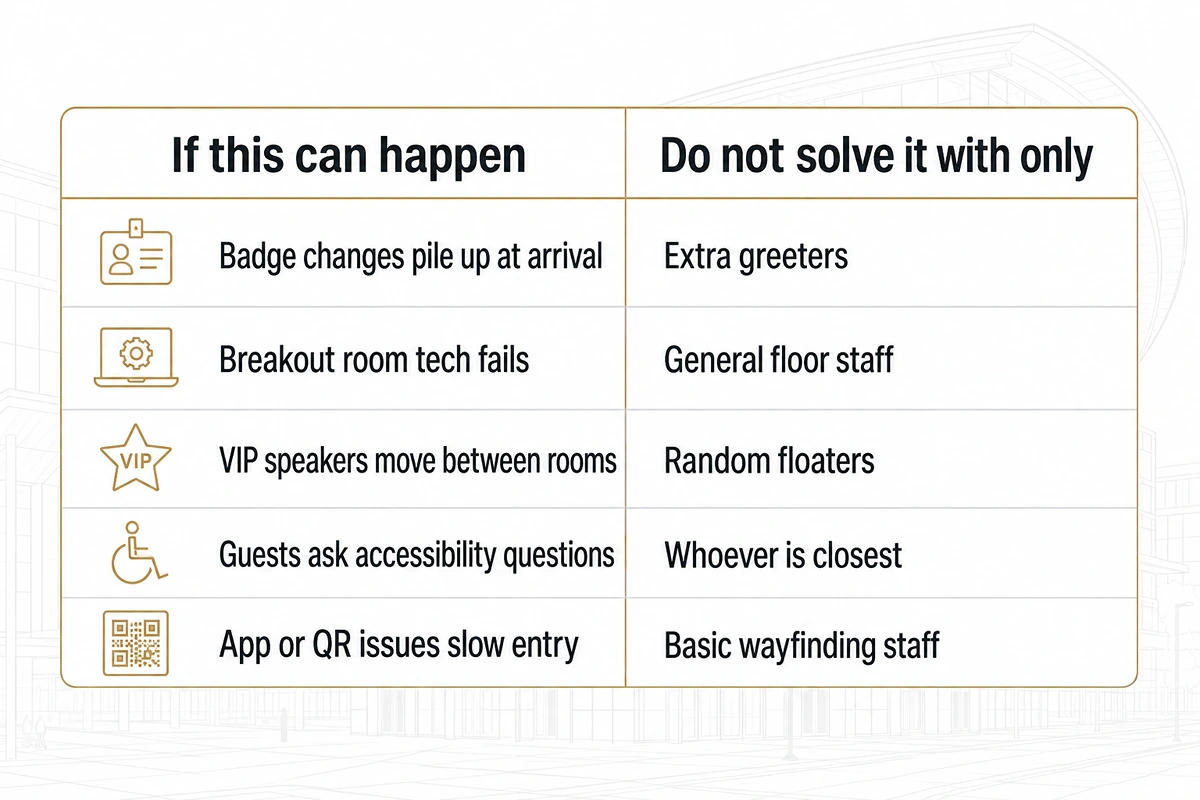
EventStaff would identify specialist roles before adding more general bodies. For conference staffing, ten extra floaters are not always cheaper than one person who can fix the actual bottleneck.
The Hallway After a Session Is the Real Test
Conference staffing often feels fine while everyone is seated. The problems usually hit when 400 people leave a session at the same time and all want coffee, bathrooms, directions, sponsor booths, phone chargers, Wi-Fi help, and the next room within the same 15-minute window. The quietest part of the staffing plan may be the session itself. The messy part is the hallway right after it ends.
Queueing research on batch arrivals explains why groups arriving together can create wait problems even if the average traffic looks manageable. That maps cleanly to conferences. Attendees do not move one by one across the day. They move in waves after keynotes, lunch, breakouts, and networking blocks.
A planner who staffs only for the average hour will feel short during the pressure windows. The help desk gets buried. Room monitors get pulled into direction questions. Registration staff is suddenly dealing with badge reprints and late arrivals while the next session is already filling up.
Break coverage check:
- Coffee break after keynote
- Lunch entry and return
- Room changes between tracks
- Sponsor area traffic after sessions
- Bathroom and wayfinding pressure
- Late arrivals after long breaks
- Attendees asking app or Wi-Fi questions
EventStaff would staff the wave, not the quiet hour. For conference staffing, the team should be placed where attendees bunch up, not where the floor looks calm during sessions.
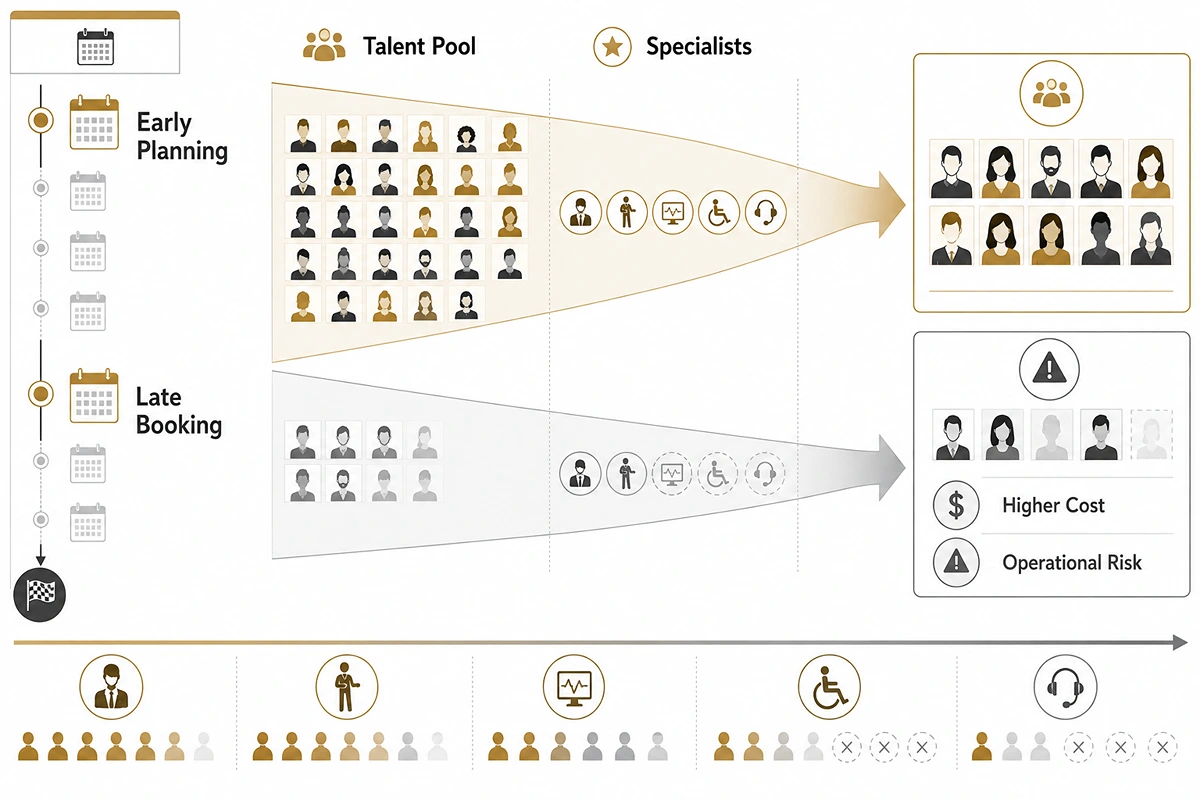
Late Booking Leaves You With the Hardest Roles Unfilled
Late booking hurts because the best conference staff are rarely sitting around waiting for a last-minute request. Supervisors, registration leads, tech-aware staff, and strong room monitors usually get booked first, especially in convention-heavy cities or during busy event seasons. So the quote does not rise only because the agency wants more money. The pool gets thinner, and the role mix becomes harder to protect.
A late booking window also gives less time to brief people properly. A 1,000-person conference with multiple tracks may require staff who know the venue layout, check-in process, session timing, speaker movement, escalation contacts, and attendee questions before they walk in. If that is rushed, the staff may show up physically present but mentally underprepared.
Convention staffing rates often look worse under pressure because the hard roles are the first to disappear:
- floor managers
- registration leads
- AV or tech liaisons
- accessibility support
- experienced room monitors
- general event staff
Event Staff would lock the harder roles first and then build the rest of the team around them. For conference staffing, the worst plan is filling easy roles early and realizing too late that no one strong is left to run check-in or manage the floor.
What Affects Conference Staffing Costs the Most?
The biggest factors influencing conference staffing costs in 2026 include:
- Agenda complexity – number of sessions, rooms, and transitions
- Attendee flow – how people move through the venue
- Role mix – general staff vs specialists
- Event location – city labor rates and availability
- Peak pressure times – check-in, breaks, session changes
- Booking timeline – earlier booking = better rates and talent
Understanding these factors helps you build a more accurate staffing budget and avoid surprises.
Price the Day People Will Actually Live Through
A cleaner conference staffing budget starts with the shape of the event, not the first hourly rate you see. Look at the agenda, number of active rooms, arrival pattern, city, venue type, registration setup, sponsor area, VIP movement, and tech load. After that, the quote starts making more sense because each role is tied to a real pressure point.
The easiest formula is:
Format + city + role mix + pressure windows + booking timeline = staffing budget
A convention staffing cost breakdown should answer simple questions before it gives the final number. How many rooms are active at once? Where do attendees get stuck? Which staff can be shared and which roles need to stay fixed? Which parts of the day create lines? Which roles require judgment instead of basic coverage?
A flat per-head estimate skips too much. It may work for a rough first pass, but it will miss the parts of the conference where staffing actually gets tested. Conference staffing costs in 2026 should be built around the day attendees will live through, not the clean version sitting in the planning deck.
Get a Conference Staffing Plan Built Around Your Event
If your current staffing estimate is based only on headcount, you’re likely missing the real cost drivers.
A better approach is to build your staffing plan around:
- Agenda flow
- Attendee movement
- Role-specific needs
- City-based pricing
That’s how you avoid understaffing and overpaying.
👉 Talk to EventStaff to get a custom conference staffing plan based on your actual event structure, not a generic estimate.
Get clarity on:
- Exact roles you need
- Where staff should be placed
- How to optimize cost without risking experience
Ready to elevate your next event?
Join thousands of event planners who trust EventStaff.com for reliable, professional staffing solutions.
Trusted by event professionals nationwide
1k+
Events Staffed
2 million+
Guests Served
97%
Positive reviews