
CEO EXCERPT
"A keynote speaker’s momentum can be destroyed by a single heavy door slamming shut. We train our teams to treat the door threshold as a soundstage boundary, where entry is timed, silent, and invisible to the audience." - CEO Event Staff
Event door control staff prevent session disruptions by enforcing a timed entry protocol that aligns with natural speaker pauses rather than random attendee arrival. Unmanaged entry creates an immediate 30-second distraction penalty through hinge noise, light bleed, and aisle congestion. Professional teams mitigate this risk by treating the door threshold as a controlled release valve, holding latecomers in the hallway and releasing them only in micro-groups of two to four during slide transitions. This operational discipline protects the integrity of the recording and ensures the audience remains focused on the stage content.
Executive Summary
Event door control staff utilize timed release cycles and silent-entry routing to prevent late arrivals from breaking speaker concentration and disrupting session schedules, ensuring the content remains the sole focus of the room.
Why Door Control Is a Session Protection Role
Event door control staff are operational controls, not hospitality extras. The door is where disruption enters the room: hinge noise, foot shuffles, seat-hunting whispers, phone brightness, and the sharp distraction of a moving silhouette in the audience’s peripheral vision. Those disruptions don’t just “feel” annoying; they change speaker rhythm and compress content delivery.
On-site, the predictable failure chain looks like this: late arrivals self-enter in a cluster, doors open repeatedly letting hallway sound spill in, and attendees pause in aisles to scan for seats. The speaker slows down, and the room’s attention breaks. where enterprise event staffing solutions focus heavily on ROI, protecting the content delivery is critical. One late cluster can cost 20–40 seconds of regained focus.
Operational Protocol #1: Late Entry Works Only When It’s Timed Like a Release Valve
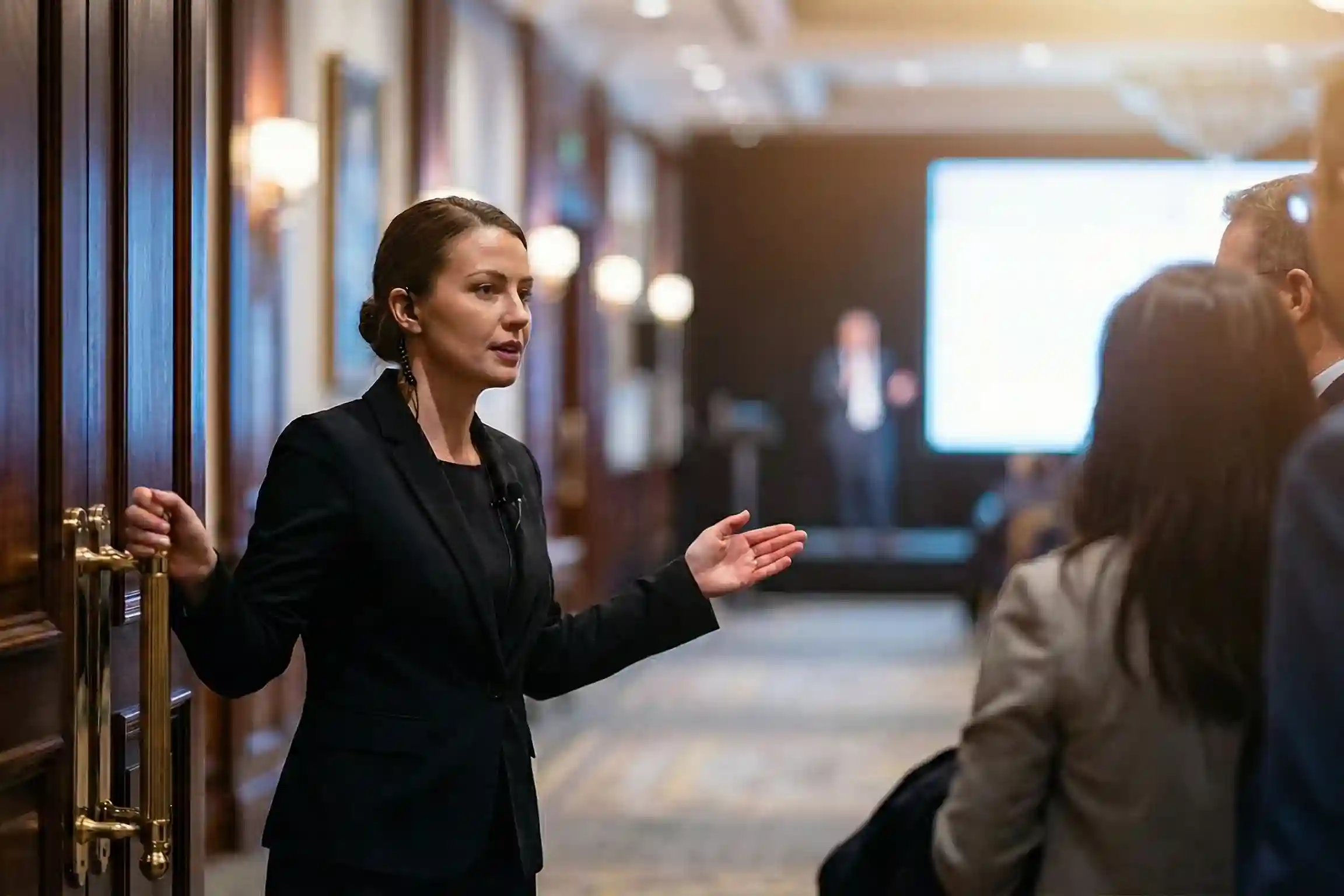
The best event door control staff don’t stop late entry; they pace it. What works is a door sweep combined with a timed release cycle, run like a valve instead of a gate. One staffer holds outside traffic and builds a small queue, while a second identifies "masking windows" such as slide transitions, video rolls, or applause beats.
Entry happens during those attention resets because the audience is already shifting focus. Here’s the operational rule most volunteer teams miss: Never release more people than the aisle can absorb in 8–10 seconds. In most breakout rooms, that is 2–4 people. When larger groups enter, the back half becomes seat-hunters, triggering whispering and aisle pauses.
Operational Protocol #2: Hallway Noise Bleeds In Unless Someone Owns the Door Zone
Conference hallways behave like sound pipes. If you let guests cluster at the door, every entry becomes a noise transfer. Without trained staff, lines spill into the corridor and block other sessions. Professional teams treat the hallway like part of the room, utilizing "holding zones" 10–20 feet back so conversation isn’t sitting on the seam.
This is also where accessibility needs to be operational, not performative. As per ADA standards for accessible design, accessible routes must remain unblocked. VIP and ADA entry should be timed so an attendee using mobility support isn’t navigating a moving crowd in the aisle.
Operational Protocol #3: Door Control Protects the Session Schedule
Most schedule drift isn’t caused by AV failures; it’s caused by micro-stoppages. Presenters pause or slow their pace when attention breaks. Event door control staff reduce those stoppages by coordinating with room monitors. Best practice is simple: door staff hold late arrivals, the room monitor signals safe entry windows, and the door lead releases micro-groups only when cleared.
This matters even more because session production is complex. With live captioning, speaker timers, and multi-camera recording, late entry can misalign captions and disrupt recording continuity. Following a guide to successful events means treating door control as a recording integrity role.
The Rubric: Door Team Performance Scorecard
This scorecard is used to evaluate the effectiveness of your current staffing partner or volunteer door team. Each performance metric should be scored on a scale from 0 to 5, where higher scores indicate stronger execution.
Entry Timing Discipline assesses how well the door team controls audience entry during high-attention moments. A high score reflects the team’s ability to pause entry during key segments such as keynote speeches, panel discussions, or Q&A sessions to avoid disruptions.
Micro-Group Control measures the team’s discipline in releasing attendees in small groups. Strong performance means allowing only two to four people at a time, preventing aisle congestion and maintaining smooth audience flow.
Hallway Noise Buffering evaluates the team’s ability to maintain a quiet zone near entry points. A top score indicates proactive clearing of the door area from conversations, creating a sound buffer that protects the in-hall experience.
Monitor Coordination focuses on communication and alignment with internal monitors or show callers. High-performing teams use clear visual cues or radio confirmation before releasing a hold, ensuring entry aligns with program timing.
The ROI of Invisible Operations
For multi-day conferences with multiple breakout tracks, door control is one of the highest ROI staffing layers you can add. It protects speaker flow, reduces schedule drift, and keeps hallway noise from bleeding into sessions. If you want distraction-free sessions that don’t require constant planner intervention, Get a Quote today to secure professional door teams for your next event.
Ready to elevate your next event?
Join thousands of event planners who trust EventStaff.com for reliable, professional staffing solutions.
Trusted by event professionals nationwide
1k+
Events Staffed
2 million+
Guests Served
97%
Positive reviews