
CEO EXCERPT
"In the world of high-capacity conferences, time is not a suggestion; it is a metric of professional integrity. Our session changeover staff operate like a pit crew, where a ninety-second micro-reset is the difference between a satisfied attendee and a scheduling disaster." - CEO Event Staff
Session changeover staff manage the high-pressure window between presentations to ensure guest flow remains fluid and sessions start on time. Most transitions run late because events fail to account for the physical collision of five hundred exiting guests meeting five hundred incoming attendees. This friction creates changeover delays that derail the entire daily program.
Executive Summary
Professional session changeover staff eliminate schedule drift by enforcing door timing logic and standardized micro-resets to prevent the collision of attendee waves during high-density transitions.
The Financial Cost of Schedule Drift: Protecting Attendee Hourly Value (AHV)
In the corporate world, time is the most expensive asset on the balance sheet. When a session for 500 C-suite executives starts just 10 minutes late, the organization doesn't just lose time,it loses 5,000 minutes of collective executive productivity. If we assign a conservative Attendee Hourly Value (AHV) to that room, a single 10-minute delay can represent tens of thousands of dollars in "sunk cost" productivity.
Professional session changeover staff act as a high-precision tool to protect this AHV. By ensuring that every transition starts and ends with surgical precision, we prevent the "invisible tax" of waiting. When you invest in a trained team, you aren't just paying for room monitors; you are insuring the literal value of your attendees’ time and the overall ROI of the conference.
Reason #1: Outflow and Inflow Collide Without Controlled Release
Most instances of why session changeovers run late originate at the door threshold. I have seen transition waves turn into total gridlock because no one was managing the door release logic. Without a dedicated session changeover staff presence, guests trying to exit hit a wall of guests trying to enter. This creates aisle congestion inside the room and a hallway spill that blocks adjacent breakouts.
The Priority Outflow Solution
We solve this by prioritizing outflow for a sixty-second window. By holding the entry line, the session changeover staff lead ensures the room is at 50% capacity before the next group enters. This prevents the conference session turnover from becoming a physical struggle. In 2025, we use hybrid scheduling oversight to track these transition waves in real time. We make sure the entry hold is communicated clearly so guests feel guided rather than blocked.
Reason #2: Micro-Resets Are Missed Without Dedicated Staff
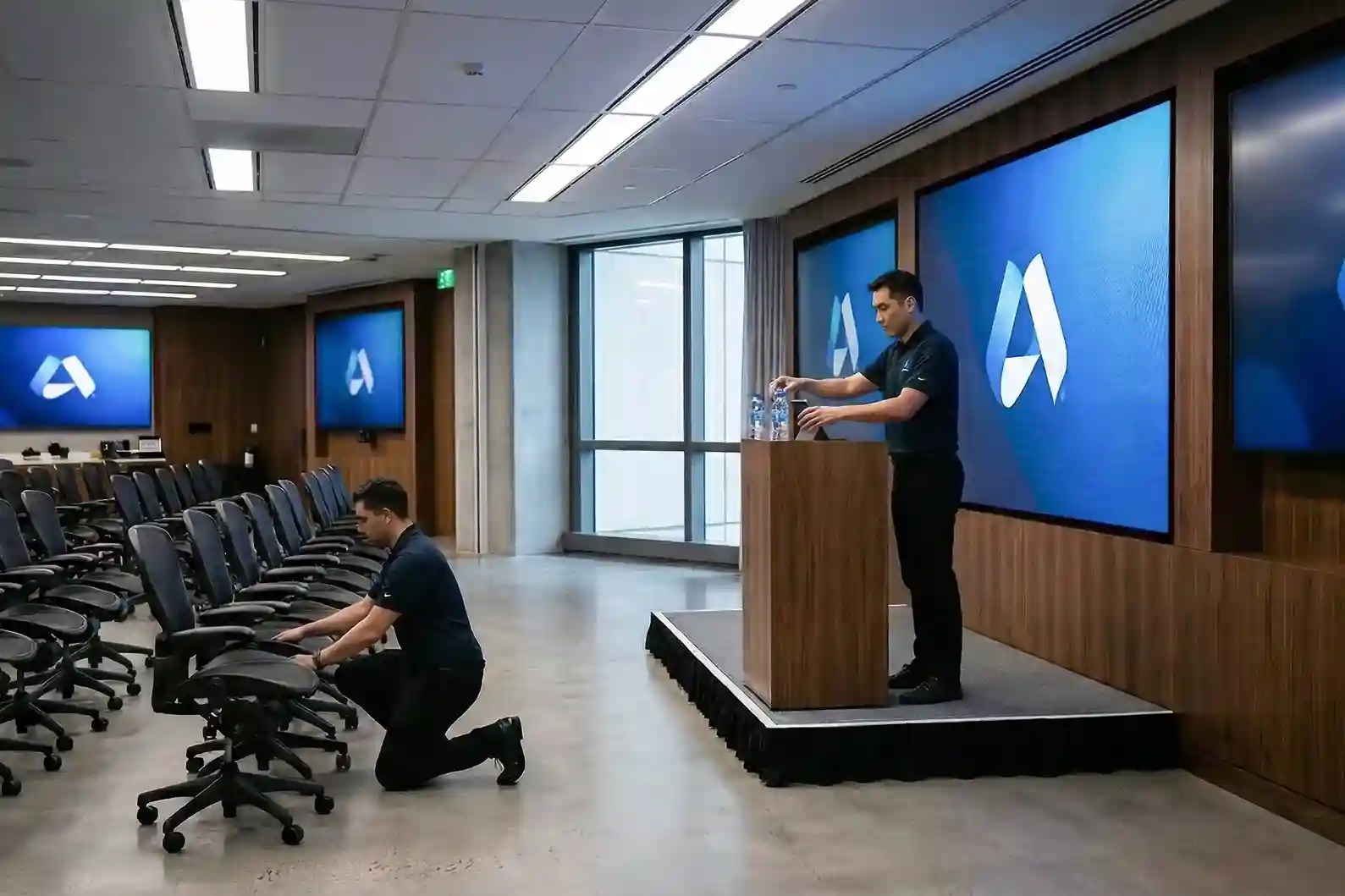
A session changeover staff member treats every ten-minute window as a tactical reset. If the speaker turnover takes too long because of AV friction, your multi-room event timing is compromised. We train our teams to perform an AV quick-check and a conference session reset in under ninety seconds.
Avoiding Avoidable Delays
If you do not have specialized session changeover staff, these micro-resets fall on the AV tech or the speaker. This leads to causes of session delays events that are entirely avoidable. Our team manages chair alignment and materials replenishment while the speaker prepares. To understand how these micro-actions influence the bigger picture, see our guide to workforce planning for large-scale success.
Reason #3: Hallway Density Spikes Derail the Schedule
High-density US venues require a strict session changeover staff workflow to manage corridor throughput. Hallway spillover effectively shuts down the venue when guests bunch outside doors. Understanding how to manage session turnover means knowing when to activate secondary hallway routes.
Density and Safety Alignment
Our session changeover staff leads use specific door timing logic to thin the crowd. We look at the hallway spill and coordinate with zone supervisors to stagger room releases. This prevents a density spike that could block ADA-compliant paths. In 2025, we align our movement patterns with updated Event Safety Alliance standards to ensure every transition is compliant. Without event transition management, the hallway becomes a bottleneck that prevents the next session from starting.
The Cascade Effect: Why Five Minutes Matters
A common mistake in conference planning is viewing a minor 5-minute delay in a morning breakout as a localized incident. In reality, event schedules suffer from the "Cascade Effect." A 5-minute drift in Room A at 10:00 AM creates a friction point that compounds with every subsequent turnover. Because the hallway density is now out of sync and AV resets are rushed, that initial gap often swells into an unavoidable 20-minute delay by the 3:00 PM session.
Turnover friction is additive. Without session changeover staff to "reset the clock" between every wave, the schedule naturally drifts toward chaos. Our teams are trained to identify the first signs of drift and deploy aggressive micro-resets to absorb the time loss. We stop the ripple effect at the source, ensuring that the afternoon keynote, your most expensive and high-profile session, starts exactly when the program promises.
How Event Staff Changeover Teams Protect Session Timing
.webp)
Choosing a professional session changeover staff team means your room monitors are actively managing density release. We anticipate a session overlap by tracking the actual end time versus the printed program. This level of session turnover staff coordination ensures the rest of the conference remains stable.
Our session changeover staff teams use real-time communication to flag issues before the speaker walks on stage. We provide a buffer for the conference breakout changeover timing by managing the room environment aggressively. This includes temperature checks and trash removal during the transition. Planners who hire session changeover staff are buying insurance for their schedule. We ensure that the 2025 labor cost bands you invest in result in a flawlessly executed event.
Fast Estimate: Changeover Success Metrics
- Outflow Priority: 60 seconds of exclusive exit time.
- Micro-Reset Speed: 90 seconds per room.
- Staff Ratio: 1 per 50 guests.
Door Timing: Synchronized within 5 seconds across the zone.
Conclusion: Mastering the Transition
Maintaining a multi-room schedule requires a session changeover staff dedicated to timing discipline. By managing density release and micro-resets, you protect your speakers and guests from a chaotic experience. Schedule drift is the enemy of any high-tier activation. Because we understand that poor flow leads to the hidden costs of poor staffing, we treat every door as a critical checkpoint. To ensure your next conference remains on track, you can get a quote mid-sentence and let our operations leads design a custom turnover strategy for your venue. Would you like me to generate a "Door Timing Script" for your session changeover staff to use when managing ingress holds?
Ready to elevate your next event?
Join thousands of event planners who trust EventStaff.com for reliable, professional staffing solutions.
Trusted by event professionals nationwide
1k+
Events Staffed
2 million+
Guests Served
97%
Positive reviews