
Big Events Expose Every Weak Staffing Decision
Large event staffing is not just about adding more people. It’s about building a system that can handle thousands of moving decisions at once.
At a 500-person event, a planner can still fix problems by walking the room. At a 5,000-person conference, problems happen simultaneously across registration, sessions, expo floors, and exits.
The real question is no longer “How many staff do we need?” It’s “Who owns each pressure point before attendees feel it?”
Executive Summary
This blog explains what changes when an event grows into a large-scale conference, trade show, stadium program, or multi-zone venue. It shows why planners need earlier staffing timelines, zone leads, role-specific training, backup coverage, field coordination, and better budget planning before small staffing gaps affect hundreds of attendees at once.
You’re Not Planning a Bigger Version of the Last Event
A 500-person corporate meeting may have one registration desk, one main ballroom, and a planner who can walk the whole space in two minutes. If check-in slows down, someone notices. If a guest asks for the breakout room, the answer is usually simple.
A 5,000-person conference behaves differently. Registration may sit far from the expo floor. Breakouts may change rooms midday. Sponsors may send guests to the wrong entrance. The help desk may get flooded because wayfinding staff are answering different versions of the same question.
The U.S. Bureau of Labor Statistics describes meeting, convention, and event planners as coordinating event activity with staff, clients, and convention personnel. That coordination piece becomes much more visible when the guest count moves into the thousands. BLS event planners is a useful source for grounding this section. (Bureau of Labor Statistics)
For EventStaff, large-scale events should be staffed around zones, traffic points, and role ownership before the headcount is finalized.
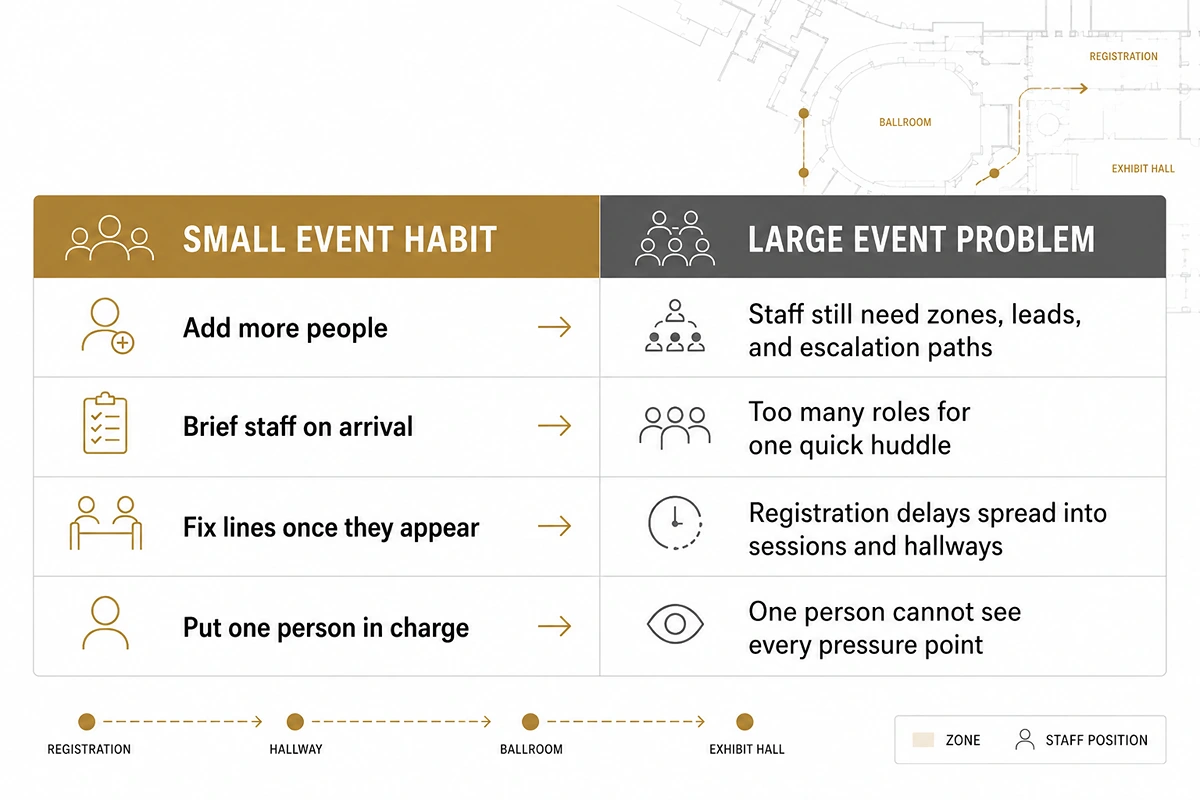
At scale, the staffing plan has to show people where to stand, who they answer to, and what they do when the room starts moving in the wrong direction.
How Early Should You Start Staffing for a Large Event?
Late staffing at a small event can be annoying. Late staffing at a large event changes the quality of the team.For a 300-person reception, four to six weeks may leave enough time to book floor staff, send the schedule, and confirm uniforms. For a trade show, stadium event, or multi-day conference, that same window can leave the planner with a weaker staff pool, rushed training, and backup people who have never seen the floor plan.
Large events require earlier staffing conversations because the work is heavier before event day. Someone has to map arrival waves, decide where leads sit, separate registration from wayfinding, plan breaks, prepare backup teams, and brief people on the questions attendees are likely to ask.
IAEE’s CEIR division houses exhibition-related research and benchmarks for business events, which makes it a relevant external source for the exhibition and major-event planning context behind this timeline. Use CEIR research when referencing the planning depth behind large exhibitions. (IAEE)
EventStaff’s staffing plan conversation should happen before the event is close enough that the only remaining option is filling shifts.
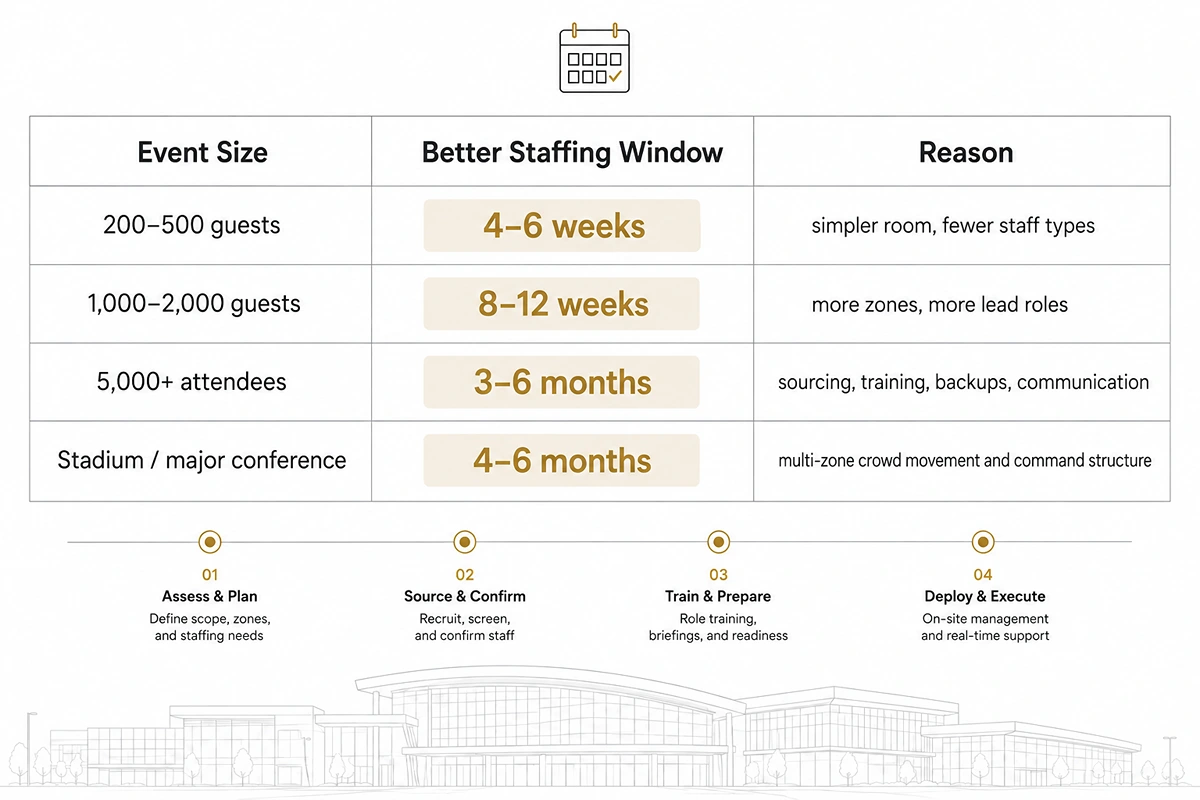
The event may still get staffed late. The harder question is whether those people have enough time to become useful before guests arrive.
One Coordinator Can’t See a 5,000-Person Problem Fast Enough
At a smaller event, a single coordinator can often carry the room. They see the line, answer the venue manager, redirect a guest, check on speakers, and still keep the timeline moving.
At a large event, the room breaks into separate pressure zones. Registration may have a scanner issue while session doors are filling, sponsor staff are asking for help, VIP check-in is backed up, and lunch traffic is already forming near the wrong corridor. One coordinator can be talented and still be physically too far from the next problem.
Large-event staffing needs a field model: one lead watching registration, another watching session movement, another watching the expo or sponsor area, and a central coordinator who can shift people before the client team gets pulled into staff management.
Meeting Professionals International describes itself as the largest meeting and event planner industry association worldwide, focused on education and networking for meeting professionals. Use MPI events as an external anchor when discussing the professional planning environment around larger meetings and conferences. (MPIWeb)
EventStaff’s conference staffing should account for the areas where attendee movement piles up: registration, session doors, help desks, sponsor zones, and exits.
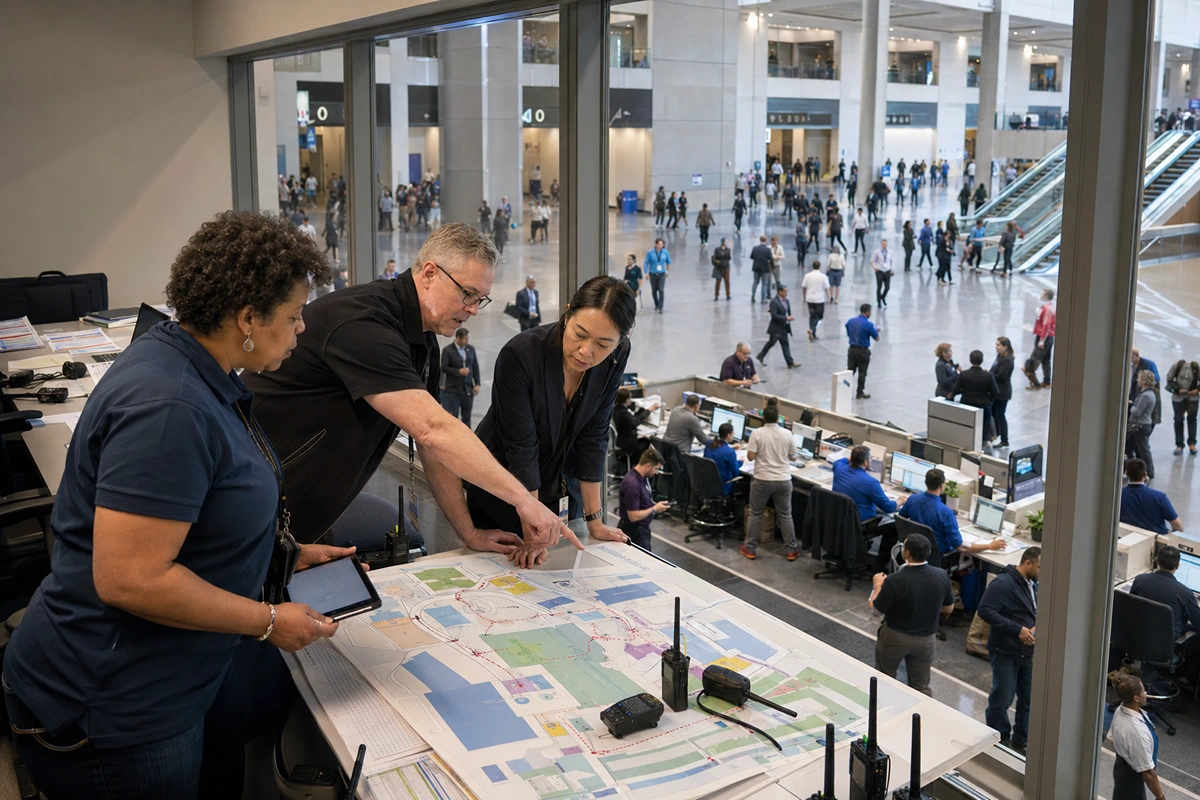
Field coordination map:
- registration lead watching scan speed and line shape
- Wayfinding leads to watching wrong turns and repeated questions
- session lead watching room entry, overflow, and door timing
- expo lead watching aisle build-up and sponsor needs
- backup lead watching breaks, call-outs, and staff fatigue
- central coordinator moving staff before one zone drains another
The planner should not be the first person to notice that one area is drowning.
CEO EXCERPT
At smaller events, a good planner can still fix things by walking the room. At large events, the room is too spread out for that. Registration, sessions, VIP areas, sponsor zones, and exits all move at once, so the staffing plan has to decide who owns each zone before guests arrive. - Daniel Meursing.
What Happens When Large Event Staffing Fails?
At a 4,000-person conference, a delayed badge pickup team caused a 25-minute check-in backlog.
That delay pushed attendees into session start times, created hallway congestion, and forced staff to redirect traffic without clear instructions.
The result wasn’t just long lines; it was a ripple effect across the entire event experience.
This is why large event staffing isn’t reactive. It must be mapped, owned, and coordinated before doors open.
Staff Training Has to Get More Specific Than a Pre-Shift Talk
A small-event briefing can be short because the room is easier to understand. Staff hear the schedule, see the ballroom, learn where the restroom is, and adjust as the event moves.
A large event punishes vague roles. A wayfinding staffer cannot simply know “breakouts are down the hall” if there are ten session rooms, two badge types, a speaker entrance, a sponsor lounge, an overflow room, and a VIP route. Registration staff cannot only know how to scan badges if they also need to handle missing names, wrong credentials, group pickups, and sponsor access.
Training should give each person a job boundary. Who answers general attendee questions? Who handles badge problems? Who calls the zone lead? Who can leave the post? Who covers breaks? Who gets radioed when the hallway starts filling?
The Event Safety Alliance’s guidance library notes that live-event safety planning covers emergency planning, crowd management, weather preparedness, communication, venue design, and event-specific issues. Use event guidance as a source when grounding the need for clearer planning, communication, and crowd-facing preparation. (eventsafetyalliance.org)
For EventStaff, large-scale events should include role training that matches the actual guest path, not a generic “be helpful” briefing.
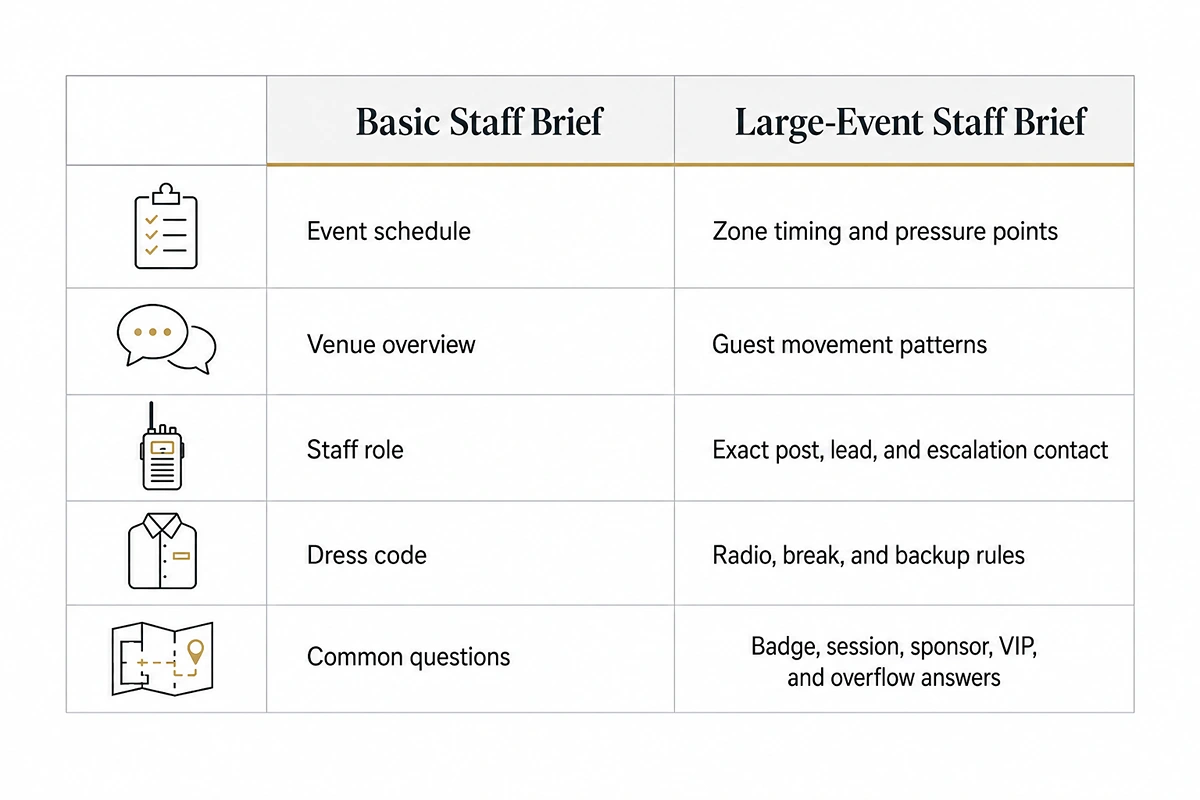
At 500 people, a confused staffer may slow down a handful of guests. At 5,000 people, the same confusion can send hundreds of people toward the wrong line.
Backup Staffing Becomes Part of the Floor Plan
A 300-person reception can often absorb one late staffer. Someone covers the door for ten minutes, the planner shifts a floating person, and most guests never notice.
At a 6,000-person conference, a small staffing gap can land in the worst possible place. If three people call out and all three were assigned to badge pickup, the first hour changes. If the missing staff was assigned to session doors, attendees would start entering wrong rooms. If break coverage is vague, posts go empty one by one.
Large-event backup staffing should be mapped before event day. Backup staff should know the venue, the role, the lead, and the zone they may cover. A replacement who arrives cold can fill a shirt, but they may still send attendees the wrong way.
The Event Safety Alliance’s guidance library covers live-event concerns like crowd management, communication, venue design, and event-specific planning. Use event guidance as the external source for the planning and communication angle.
For EventStaff, large-scale staffing should include backup coverage for the posts guests feel immediately: registration, wayfinding, session doors, help desks, and access points.
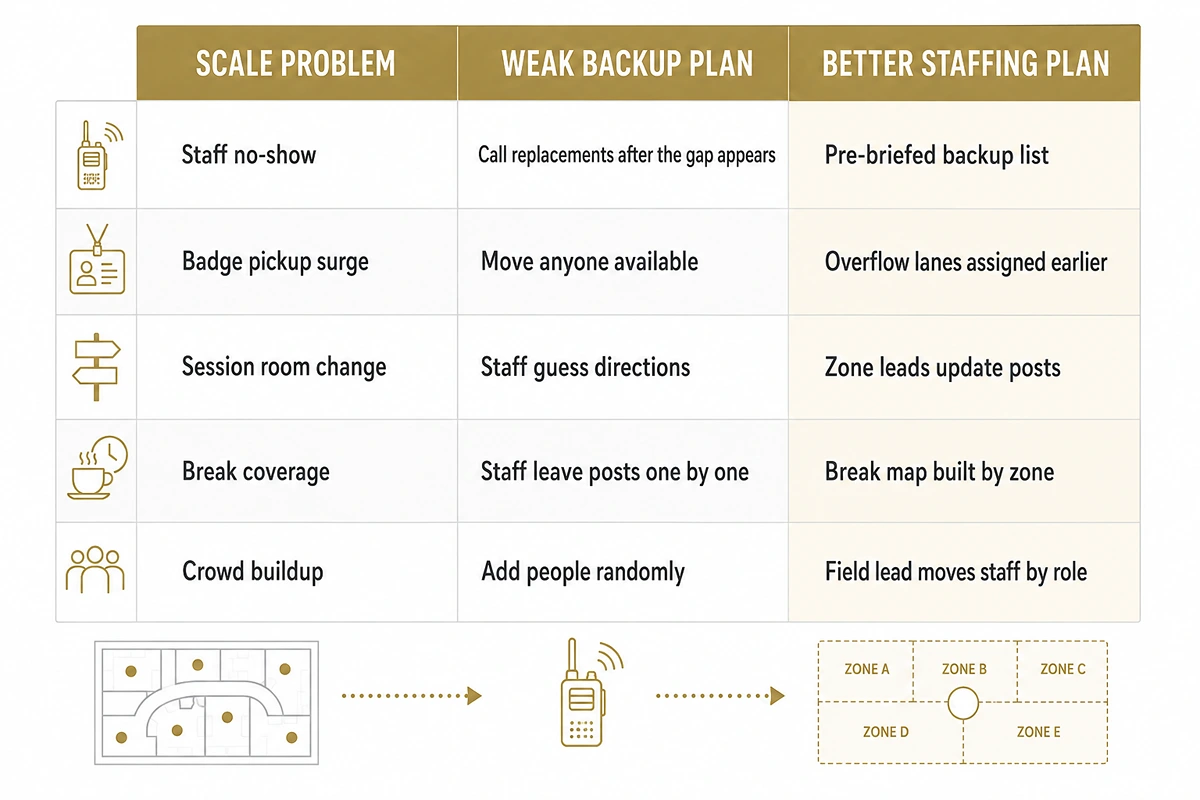
Backup staffing is not there because something might go wrong. At scale, something usually shifts. The plan should already know which roles cannot sit empty.
Attendees Start Seeing Staffing Gaps Everywhere
At a small event, guests may interact with staff once or twice: check-in, maybe a directional question, maybe coat check. At a large event, staff becomes part of almost every movement.
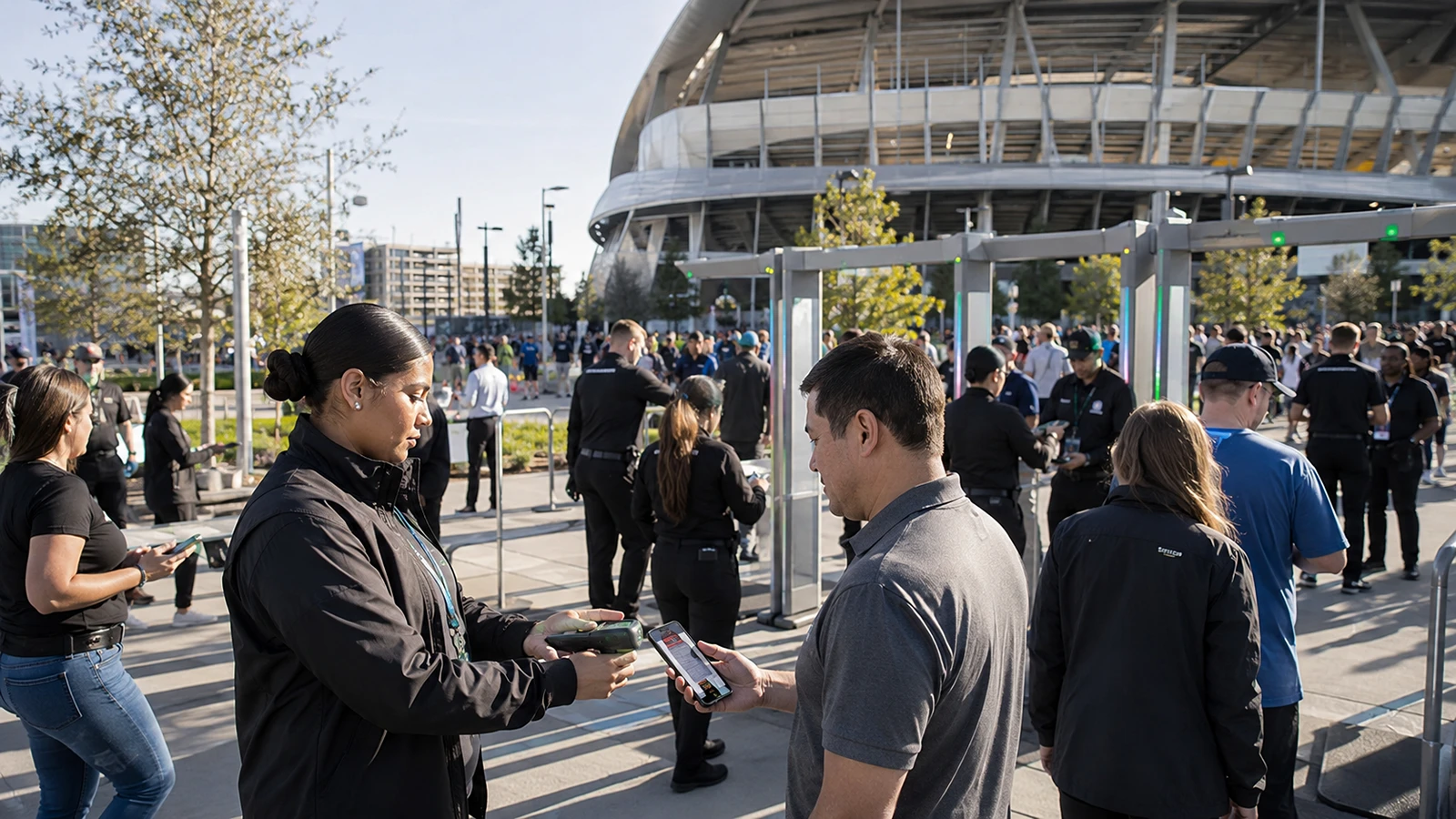
The attendee may speak to staff before they reach the keynote. Parking direction. Badge pickup. Bag check. Help desk. Session entry. Expo floor. Sponsor lounge. Lunch line. Overflow room. Exit route.
If the answers are inconsistent, the event feels harder than it should. One staffer says badge pickup is in Hall A. Another points to Hall C. A third does not know where speaker check-in is. The guest may still attend the event, but the day starts feeling like work.
The Center for Exhibition Industry Research says it houses the world’s largest collection of primary exhibition-related research studies, which makes CEIR research a useful source when discussing major exhibitions, attendee movement, and large-event planning context. (IAEE)
For events with expo floors, breakout rooms, or sponsor areas, conference staffing should cover the places attendees hesitate, not only the main entrance.
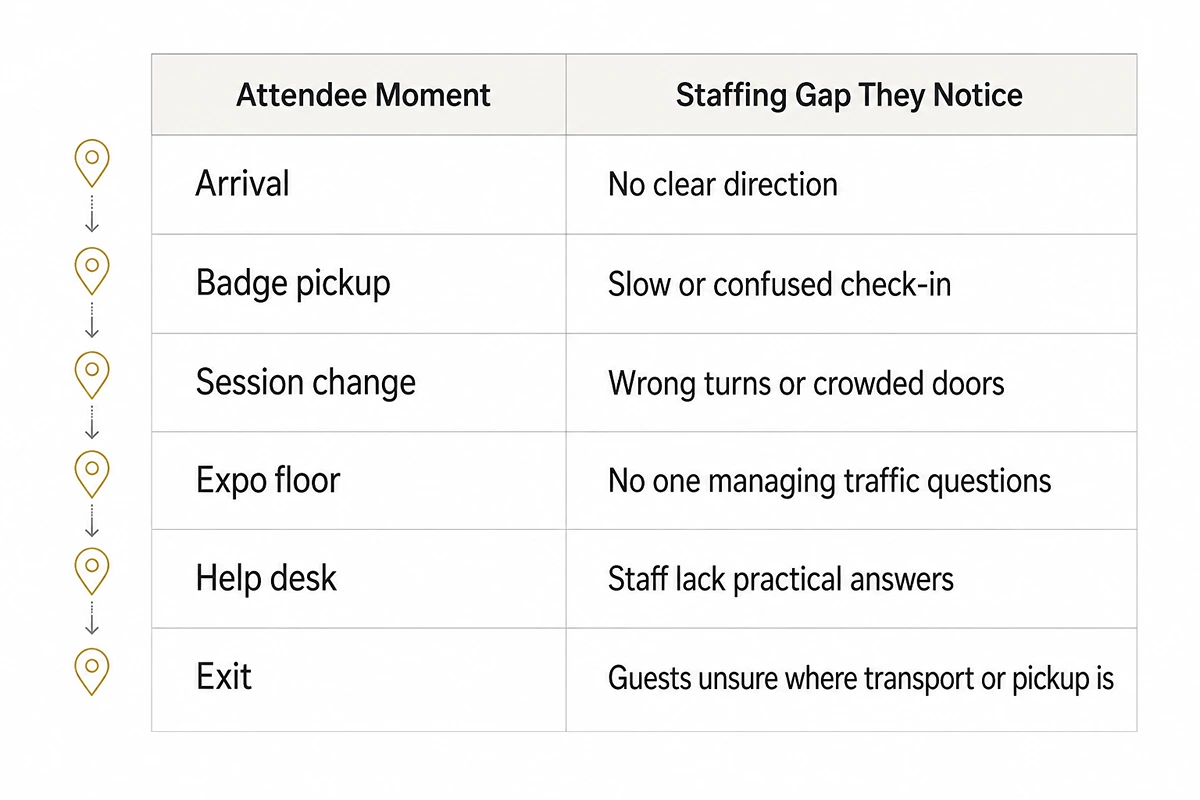
A large event can have great speakers and still feel poorly run if guests keep asking basic questions and getting different answers.
The Staffing Budget Has to Cover the People Guests Don’t Notice
A large-event staffing budget often looks heavy because planners focus on visible staff: registration, greeters, ushers, wayfinding, booth support, and help desk.
The hidden roles are usually the ones that stop the event from leaking. Field coordinators. Zone leads. Break relief. Backup staff. Radio runners. Staff check-in support. People assigned to watch pressure points instead of holding a single guest-facing post.
Cutting those roles may make the quote look cleaner. It also pushes the work back onto the client team. Suddenly the event manager is solving radio issues, moving staff to lunch breaks, answering a lost exhibitor, and texting the staffing vendor while the keynote is starting.
Meeting Professionals International describes itself as a global community for meeting and event professionals, with chapters, education, and industry resources. Use MPI resources as outside context for the professional planning environment around large meetings and conferences.
EventStaff’s event staffing plan for a major program should price the system behind the floor, not only the people standing at the posts.
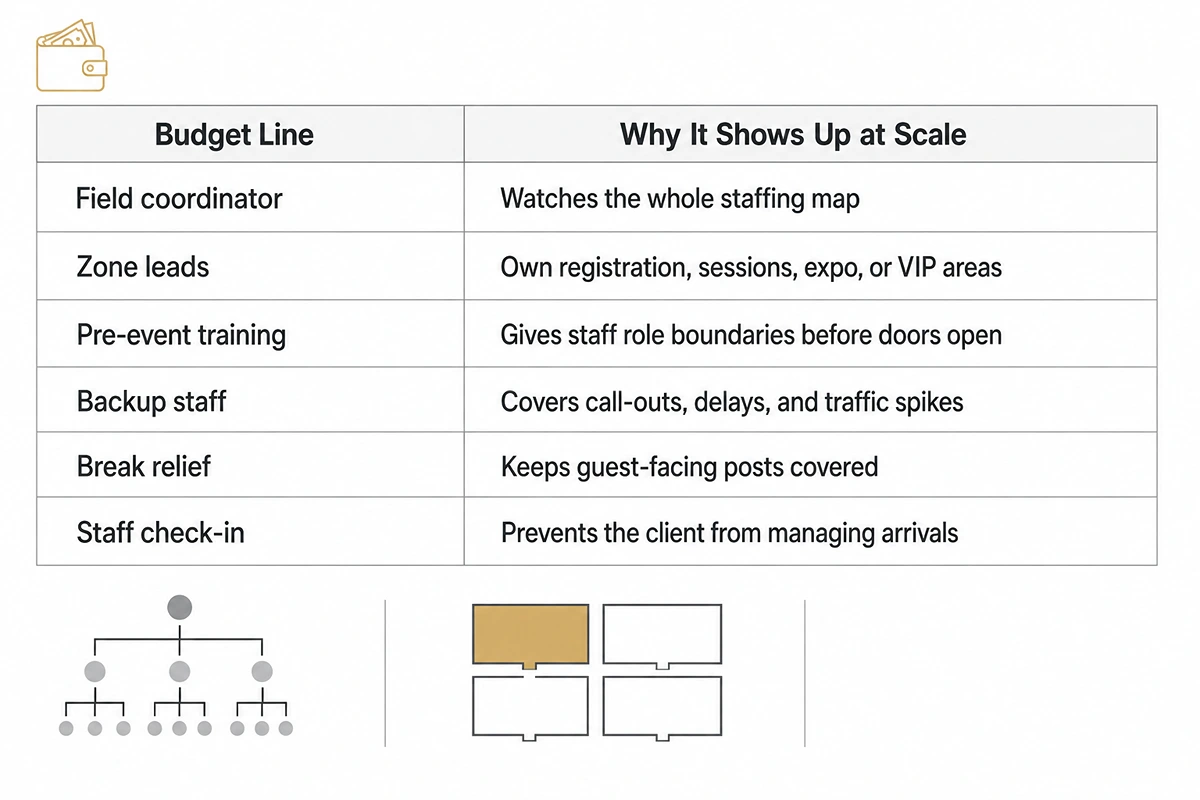
A thin budget often looks fine until the client team becomes the backup coordinator.
Event Planning Staffing at Scale Has to Work Like a System
Large-scale event planning starts to feel different when the staffing plan stops being a roster and starts becoming a map.
The map should show entrances, registration lanes, high-traffic corridors, session doors, help desks, sponsor areas, VIP spaces, rest points, and exits. Then each point needs an owner. Who is watching it? Who gets called when it backs up? Who covers the post during breaks? Who has permission to move staff?
That is the real shift in event planning staffing. The team is no longer placed around the venue. It is placed around guest movement.
BLS occupational data describes meeting, convention, and event planners as coordinating staff, clients, and convention personnel to arrange group meetings, events, and conventions. That coordination role becomes the skeleton of the staffing plan once the event crosses into large-scale territory.
For EventStaff, talk through the venue map, arrival waves, zones, lead roles, and backup plan before the staff count becomes final.
Large-event staffing system check:
- Which zones will feel pressure first?
- Which posts cannot go empty?
- Who owns registration, wayfinding, sessions, VIP, and exits?
- Which role gets radioed when a line forms?
- How are breaks covered without draining one area?
- Which backup staff are already briefed?
- What questions will attendees ask most often?
A large event runs better when the staff plan is built around movement, not headcount.
Plan Your Large Event Staffing the Right Way
Large events don’t fail because of one big mistake. They fail because small staffing gaps multiply across the venue.
A strong staffing plan gives every zone an owner, every problem a response path, and every guest a smoother experience.
If you're planning a conference, trade show, or large-scale event, now is the time to map your staffing system, not just fill shifts.
Talk to EventStaff to build a staffing plan that works at scale.
Ready to elevate your next event?
Join thousands of event planners who trust EventStaff.com for reliable, professional staffing solutions.
Trusted by event professionals nationwide
1k+
Events Staffed
2 million+
Guests Served
97%
Positive reviews