
How to Staff a Dallas Corporate Event Without Guessing the Headcount
A 200-person corporate dinner in Dallas can require a completely different staffing plan from a 200-person reception five miles away. The number on the guest list looks the same, but the pressure on the room is different. A seated dinner at a hotel ballroom has timing, service pacing, and executive visibility. A Design District reception has arrival rushes, bar flow, and guest movement. A conference near Kay Bailey Hutchison Convention Center has registration, breakout rooms, speaker flow, and wayfinding pressure.
Executive Summary
This blog explains how to plan event staffing in Dallas without relying on guest count alone. It shows why a 200-person seated dinner, standing reception, boardroom dinner, and multi-track conference require different staffing plans. The article covers Dallas venue pressure, corporate formality, event staffing costs, staffing ratios, booking windows, TABC considerations, bilingual support, and how to build a staffing plan around the event failure point the planner most needs to avoid.
The 200-Guest Guess That Breaks Dallas Event Budgets
Dallas corporate events expose weak staffing math quickly. A planner may ask for ten staff members because the guest count is 200, but that number can be too high, too low, or wrong for the room. A seated dinner, standing reception, board dinner, and multi-track conference do not fail in the same way.
At a formal dinner, the weak point is usually pacing. Courses drag, VIP tables receive uneven attention, and the floor lead spends the night fixing delays that should have been planned before doors opened. At a reception, the problem shows up around movement. Guests bunch near the entrance, the bar gets crowded early, and no one pulls people deeper into the room. At a conference, staffing gaps start earlier: badge lines, confused attendees, late speakers, and breakout rooms that feel abandoned between sessions.
Dallas venues make this mistake more expensive because many of them are built for different kinds of corporate pressure. Omni Dallas, for example, lists 110,000 square feet of meeting space and 41 meeting rooms, with capacity for up to 2,500 attendees. A 200-person event inside that kind of property does not automatically behave like a small event. It may still need registration support, directional staff, room coverage, and a lead who understands hotel flow. Omni Dallas
Mistake to avoid: do not ask, “How many staff do I need for 200 guests?” Ask what kind of pressure those 200 guests will create in this venue, with this format, and this level of formality.
For EventStaff’s broader approach to corporate event staffing, the planning starts with those pressure points before the final headcount is built.
Venue, Formality, Format Are The Three Things Planners Forget to Price
A stronger Dallas staffing plan starts with three details: venue type, service formality, and event format. Guest count still matters, but only after those three pieces are clear. Without them, the budget is mostly a guess with hourly rates attached.
The first detail is the venue. Kay Bailey Hutchison Convention Center creates a different staffing problem than a hotel ballroom or private restaurant buyout. KBH welcomes more than a million visitors annually and hosts conventions, meetings, concerts, athletic events, auto shows, and other large programs. Its own venue materials show the scale: exhibit halls, ballrooms, meeting rooms, and event spaces that can spread guests across multiple zones. Kay Bailey Hutchison Convention Center
The second detail is formality. A healthcare leadership dinner, finance client event, or oil-and-gas executive reception will usually have a different service expectation than a casual employee mixer. The difference may not be in the invitation. It shows up in how closely staff manage arrivals, who handles VIP movement, how polished the floor team feels, and how visible service gaps become.
The third detail is format. A seated dinner puts pressure on timing. A standing reception puts pressure on movement. A multi-track conference puts pressure on transitions. A boardroom event puts pressure on discretion. Once those details are named, the Dallas corporate event cost breakdown becomes clearer because you are no longer budgeting for bodies. You are budgeting for failure points.
Planning insight: if the planner cannot describe the venue, formality level, and format in one sentence, the staff count is not ready yet.
CEO Excerpt
When I look at a Dallas corporate event, I don’t start with the guest count. I look at the room first: where people arrive, where they slow down, where VIPs need attention, and where the planner cannot afford confusion. That tells me the staffing plan faster than a headcount ever will. - Daniel Muersing
The Building Decides Half the Staffing Plan
The Dallas venue choice often decides the staffing model before the planner sees the final RSVP list. A convention center, hotel ballroom, and private venue may all host corporate events, but the work happening on the floor is completely different.
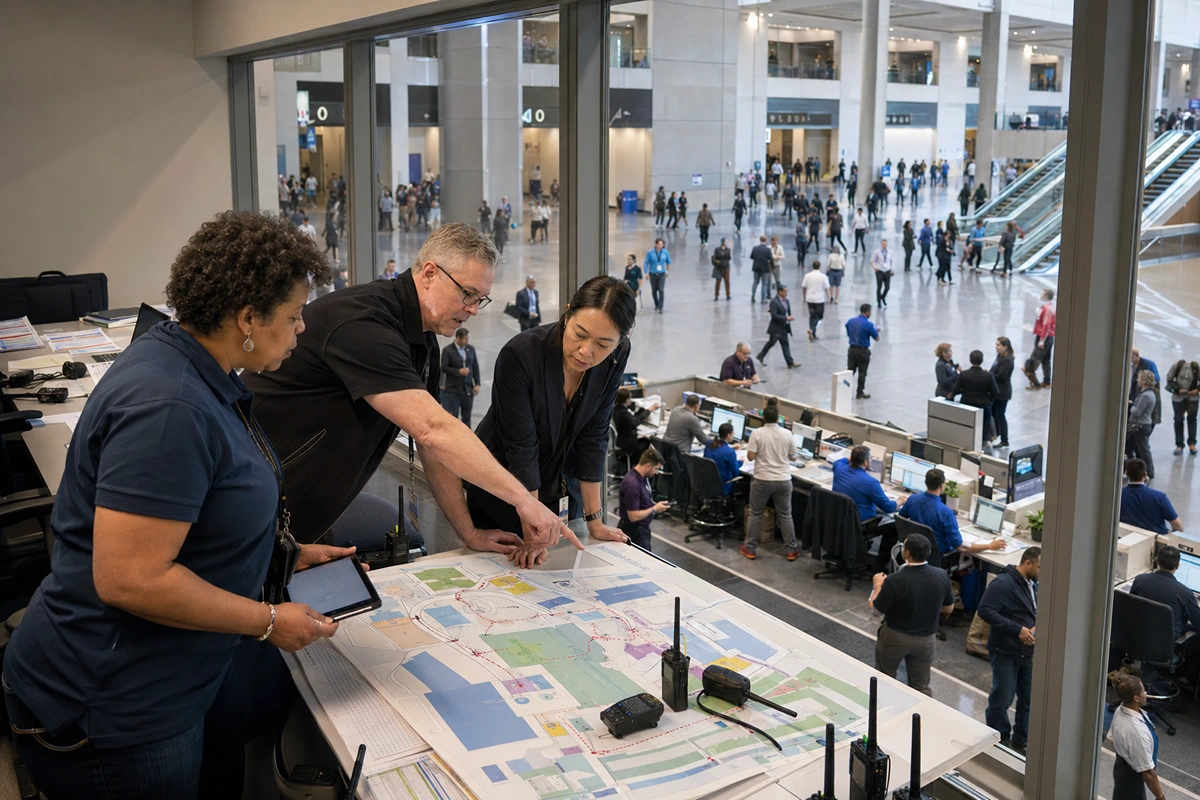
At Kay Bailey Hutchison Convention Center, the staffing plan usually leans toward movement and coordination. Large properties create small frictions: attendees entering from the wrong side, sponsors asking where to set up, speakers moving between rooms, and guests missing breakout sessions because signage was not enough. In that setting, conference staffing often includes registration support, directional staff, room monitors, speaker runners, and a lead who can adjust coverage when the crowd shifts.
Hotel venues create a different kind of pressure. Omni Dallas connects directly to the convention center and has 110,000 square feet of meeting space, while Hilton Anatole lists more than 600,000 square feet of function space, including nine ballrooms and 79 meeting rooms. Those venues can carry large corporate programs, but they also raise the service expectation. Guests notice uneven check-in, unclear room movement, slow coat check, or staff who seem unfamiliar with the property. Hilton Anatole
Private venues and restaurant buyouts usually create the opposite problem. The setting may feel more flexible, but the staffing plan has to compensate for fewer built-in event systems. A 150-person client reception in a Design District space may need stronger guest routing, arrival coverage, bar-line support, and a floor lead who keeps people from gathering in the wrong pockets of the room.
Pro tip: do not assume a “nicer” venue needs fewer staff. Luxury hotels may need fewer people for movement, but more polished staff for protocol. Convention centers may need less formal service, but more people to manage distance, rooms, and timing.
The Cheapest Hourly Rate Can Still Be the Expensive Quote
Dallas staffing quotes can look simple on paper: role, hourly rate, number of staff, and number of hours. The mistake is thinking the lowest hourly number gives you the cleanest budget. A cheap rate can turn expensive quickly if the staff is not trained for the room they are walking into.
For planning, Dallas corporate event staffing usually falls into three broad ranges:
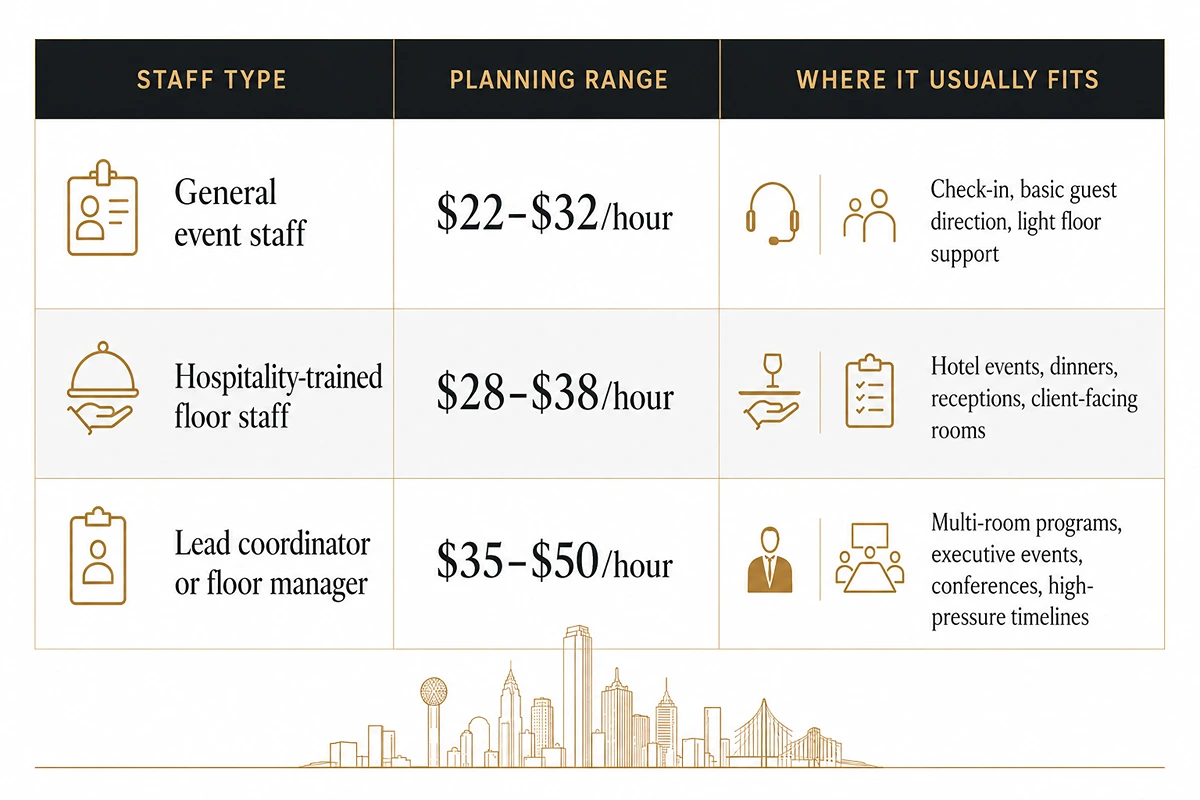
Multi-room programs, executive events, conferences, high-pressure timelines
The better way to read these numbers is by pressure, not title. A 300-person casual mixer may need more general floor coverage. A 75-person leadership dinner may need fewer people, but a higher service standard. A 500-person conference may need staff who can manage registration, room turns, session movement, sponsor areas, and speaker needs without waiting for the planner to catch every issue.
Quick Dallas Cost Lens
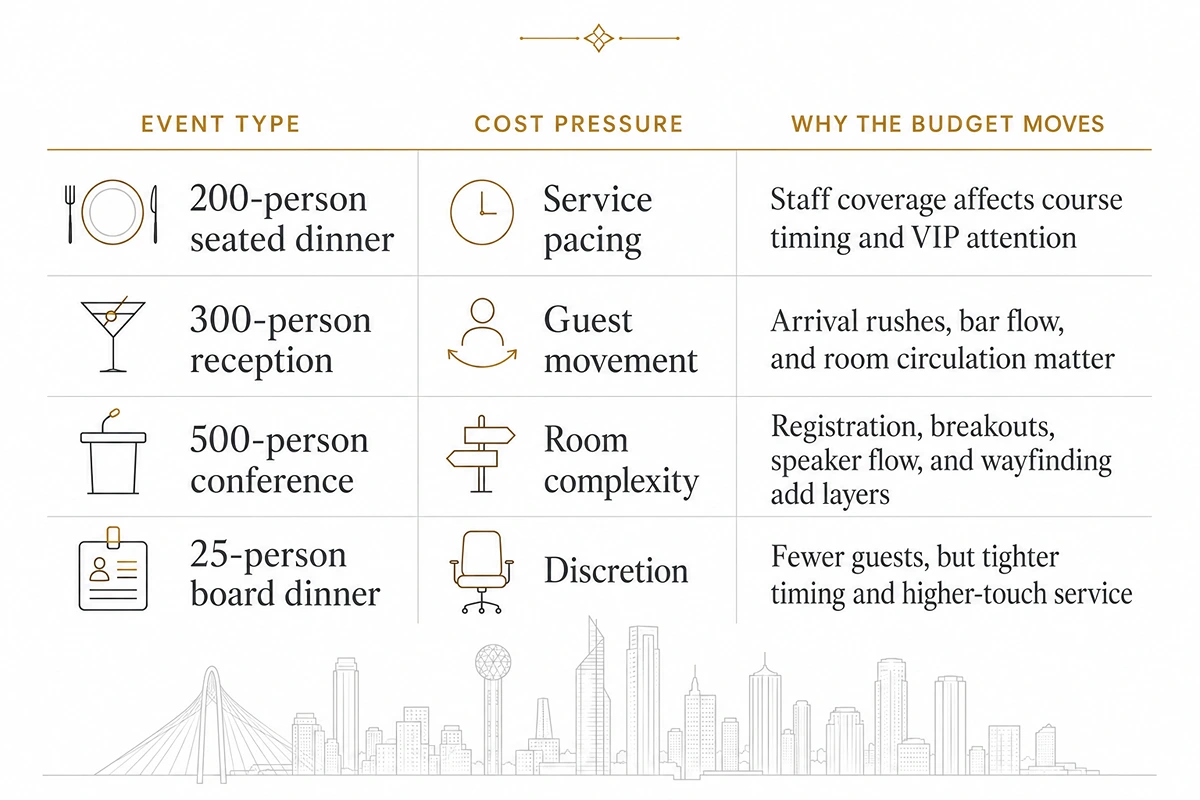
A practical Dallas corporate event cost breakdown should answer one question before the quote is built: what would make this event feel understaffed? For a dinner, it may be slow service. For a reception, it may be a crowded entry. For a conference, it may be a registration line that makes the first session start late.
Budget mistake to avoid: comparing two staffing quotes by hourly rate alone. A quote with fewer trained staff can look cheaper and still leave the planner paying for delays, weak guest handling, or last-minute add-ons.
Here’s the same section with only internal and external links added.
A 200-Person Dinner and a 200-Person Reception Are Not the Same Staffing Problem
A guest count tells you how many people are coming. It does not tell you what those people will be doing at the same time. That is why a 200-person dinner in Dallas and a 200-person reception should not be staffed from the same formula.
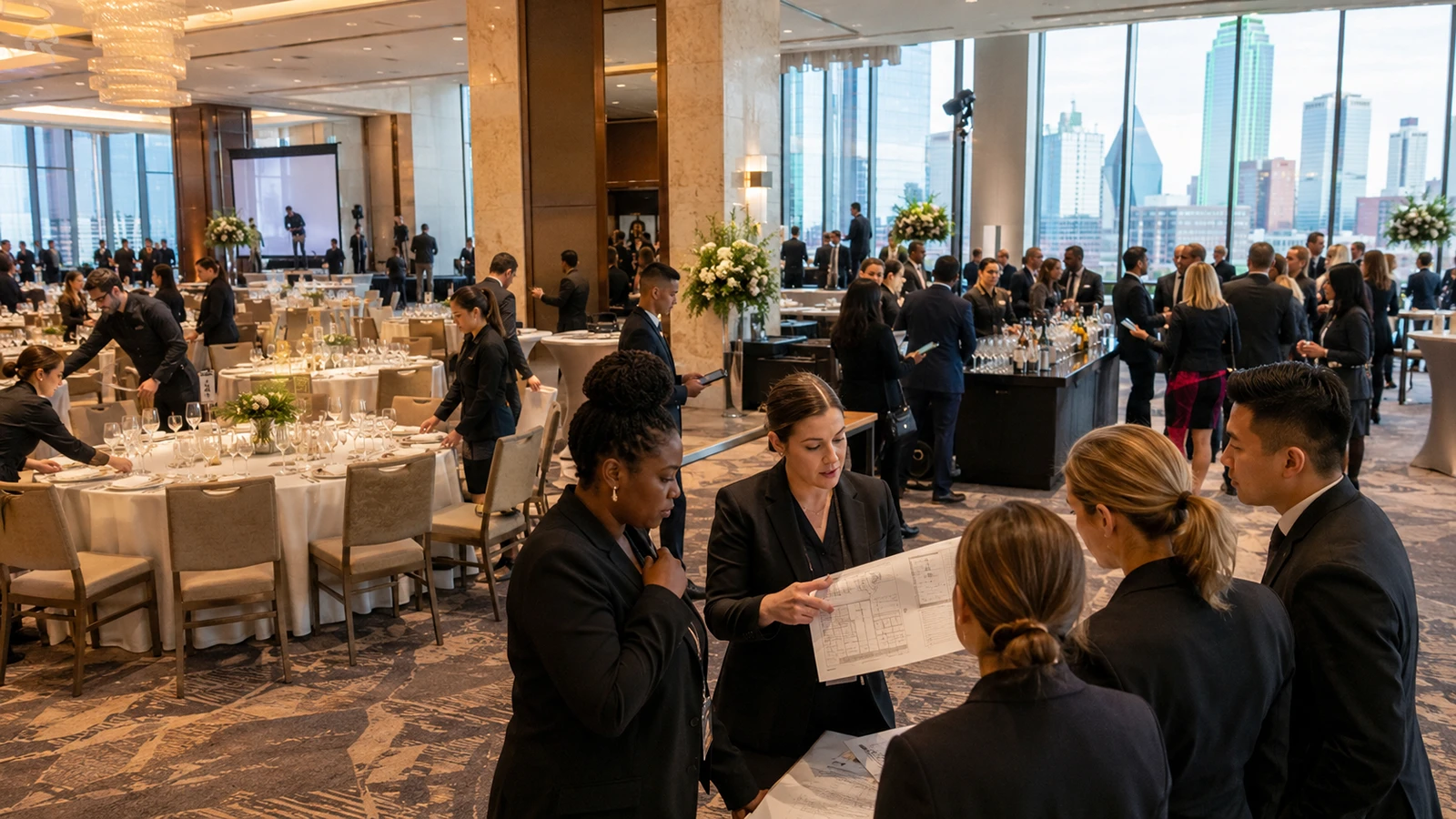
At a seated dinner, the pressure is timing. Guests are mostly stationary, which means service gaps become visible fast. If one side of the room gets attention before the other, people notice. If VIP tables wait too long, the floor feels uneven. If staff are unclear on pacing, the dinner starts to feel slower than the agenda allows. For this kind of event, the event staff-to-guest ratio corporate dinner planners use is usually tighter because the room depends on rhythm.
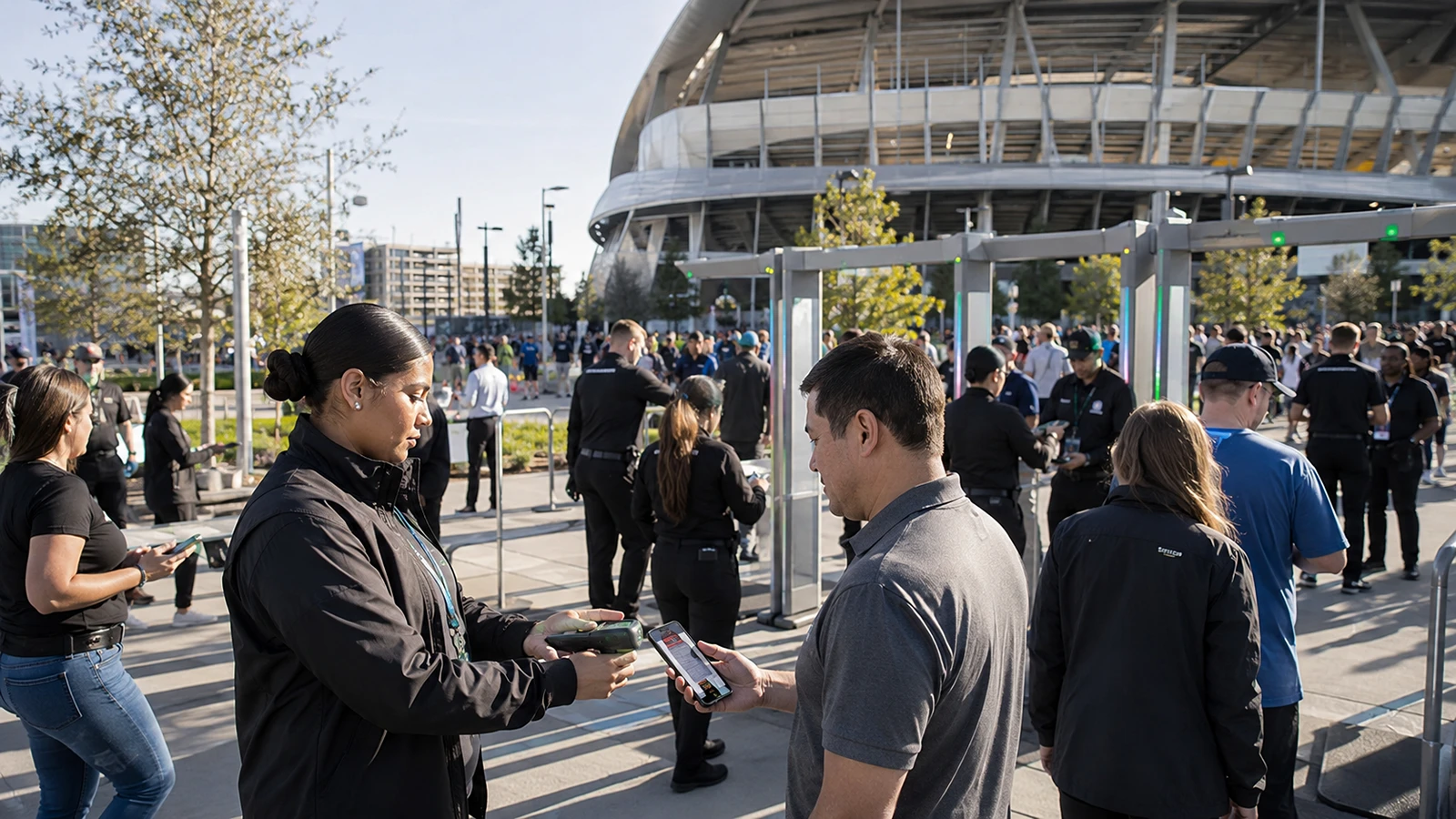
A reception breaks differently. Guests move, cluster, leave, return, and gather wherever the room feels easiest. The staffing plan has to account for arrival rushes, bar pressure, food stations, coat check, VIP movement, and guests who stay near the entrance instead of spreading through the venue. A reception may need fewer people per guest than a dinner, but those staff need to be placed better.
A multi-track conference creates another problem entirely. The busiest moments are not always during sessions. They happen before the first keynote, between breakout rooms, during lunch, and when attendees are trying to find the next room while checking messages and talking to colleagues. For conference staffing, the better planning method is to look at the program map: entrances, registration, breakout rooms, sponsor areas, speaker movement, and food transitions.
A boardroom dinner is smaller, but not easier. A 25-person executive dinner may need fewer staff on paper, but the margin for awkward service is lower. Staff has to move quietly, time interruptions carefully, and understand when not to be visible. Per guest, this can cost more than a larger banquet because the service expectation is tighter. Dallas hotel properties like Omni Dallas and Hilton Anatole show how wide the range can be between ballrooms, meeting rooms, and executive-style spaces.
Use-case shortcut:
- If guests are seated, staff for pacing.
- If guests are standing, staff for movement.
- If guests are rotating rooms, staff for transitions.
- If guests are executives, staff with discretion.
The Best Dallas Staff Are Gone Before the Event Feels Urgent
Dallas staffing gets tighter when corporate event clusters hit the city. A 150-person reception may be easy to staff three weeks out in a quiet month, but the same request can become harder during healthcare, energy, finance, or convention-heavy periods.
For smaller corporate events, three weeks is a decent minimum. For hotel ballroom events, multi-day programs, or convention-center work, plan closer to six to eight weeks. At venues near Kay Bailey Hutchison Convention Center, late booking can limit the quality of available floor leads, registration staff, and room support.
The risk is not just “no staff available.” The bigger issue is weaker matching. A rushed booking leaves less time to place staff who understand the venue, the service tone, and the pressure points of the event.
Booking shortcut:
- Under 200 guests: 3 weeks minimum
- 200–500 guests: 4–6 weeks
- Multi-day or convention-scale events: 6–8 weeks
- Peak Dallas corporate periods: add 1–2 extra weeks
For staffing agencies for events in Dallas, earlier planning usually means a better staff mix, not just more names on a roster.
Real Example: Why a 200-Person Dallas Event Needed 18 Staff (Not 10)
A corporate client planned a 200-person reception in a Design District venue and initially requested 10 staff.
After reviewing:
- Entry bottleneck
- Bar placement
- VIP guest flow
- Coat check demand
The final plan included:
- 6 guest flow staff
- 4 bar support
- 2 registrations
- 1 VIP handler
- 3 floaters
- 2 floor leads
👉 Result:
- No entry congestion
- Faster drink service
- Smooth guest distribution
This is why event staffing in Dallas must be planned around flow, not headcount.
The Small Dallas Details That Make Staff Look Unprepared
A generic event staffing plan often misses the details that make Dallas corporate events feel different in the room. The staff count may look right, but the team still struggles if the event has alcohol service, bilingual guests, executive attendees, or a venue with awkward movement patterns.
For alcohol-adjacent roles, planners should check TABC certification Dallas corporate events requirements early. The Texas Alcoholic Beverage Commission explains seller/server certification around responsible alcohol service, age checks, and intoxication-related intervention. Even when EventStaff is not replacing bartenders, alcohol service can affect guest-flow support, line control, and floor coverage.
Bilingual support can also matter. Bilingual event staff Dallas planning is especially useful for registration, guest direction, VIP support, and large corporate receptions with mixed client groups.
Pro tip: local venue familiarity saves time. Staff who understand hotel ballroom layouts, downtown arrival friction, convention-center movement, and Dallas corporate service expectations reduce the number of small problems the planner has to personally fix.
Plan Your Dallas Event Staffing the Right Way
If you’re planning a corporate event in Dallas, guessing staff numbers based on guest count can cost you more than overstaffing.
The smarter approach is to build your staffing plan around:
- Venue complexity
- Guest movement
- Service expectations
- Event pressure points
👉 Need help building the right staffing plan?
Work with experienced Dallas event staff who understand local venues, corporate expectations, and real event flow.
Ready to elevate your next event?
Join thousands of event planners who trust EventStaff.com for reliable, professional staffing solutions.
Trusted by event professionals nationwide
1k+
Events Staffed
2 million+
Guests Served
97%
Positive reviews