
Executive Summary
For 500 guests, plan for 14–22 staff using a 1:25–35 guest-to-staff ratio, but this number shifts significantly based on three variables: service format (plated dinner demands more staff than cocktail), venue layout (multi-room events need proportionally more coverage), and event duration (6+ hours triggers shift overlap and adds 15–20% to your headcount).
How Many Event Staff Do You Need for 500 Guests? (Complete Planning Guide)
If you're planning an event with 500 attendees, one of the most important decisions you'll make is how many event staff for 500 guests you actually need.
Get it wrong, and your event feels slow, crowded, or disorganized. Get it right, and everything flows effortlessly from check-in to last call.
The short answer: most 500-guest events need 14–22 staff, based on a typical staff-to-guest ratio of 1:25–35. But that number changes depending on your service format, venue layout, and event duration.
Events that are understaffed can see up to 30% longer wait times at bars and food stations, which directly impacts guest satisfaction and engagement.
In this guide, you’ll learn exactly how to calculate your event staffing headcount, avoid common mistakes, and build a team that performs under real event conditions.
CEO Excerpt
"Most teams calculate staffing for ideal conditions. Real events aren't ideal; 500 guests don't move in straight lines. The gap between a smooth event and a frustrating one is almost always hidden in how well your team handles that chaos." - CEO, EventStaff
Quick Staffing Ratios for 500-Guest Events
Here's the bottom line: your baseline ratio depends on your service format.
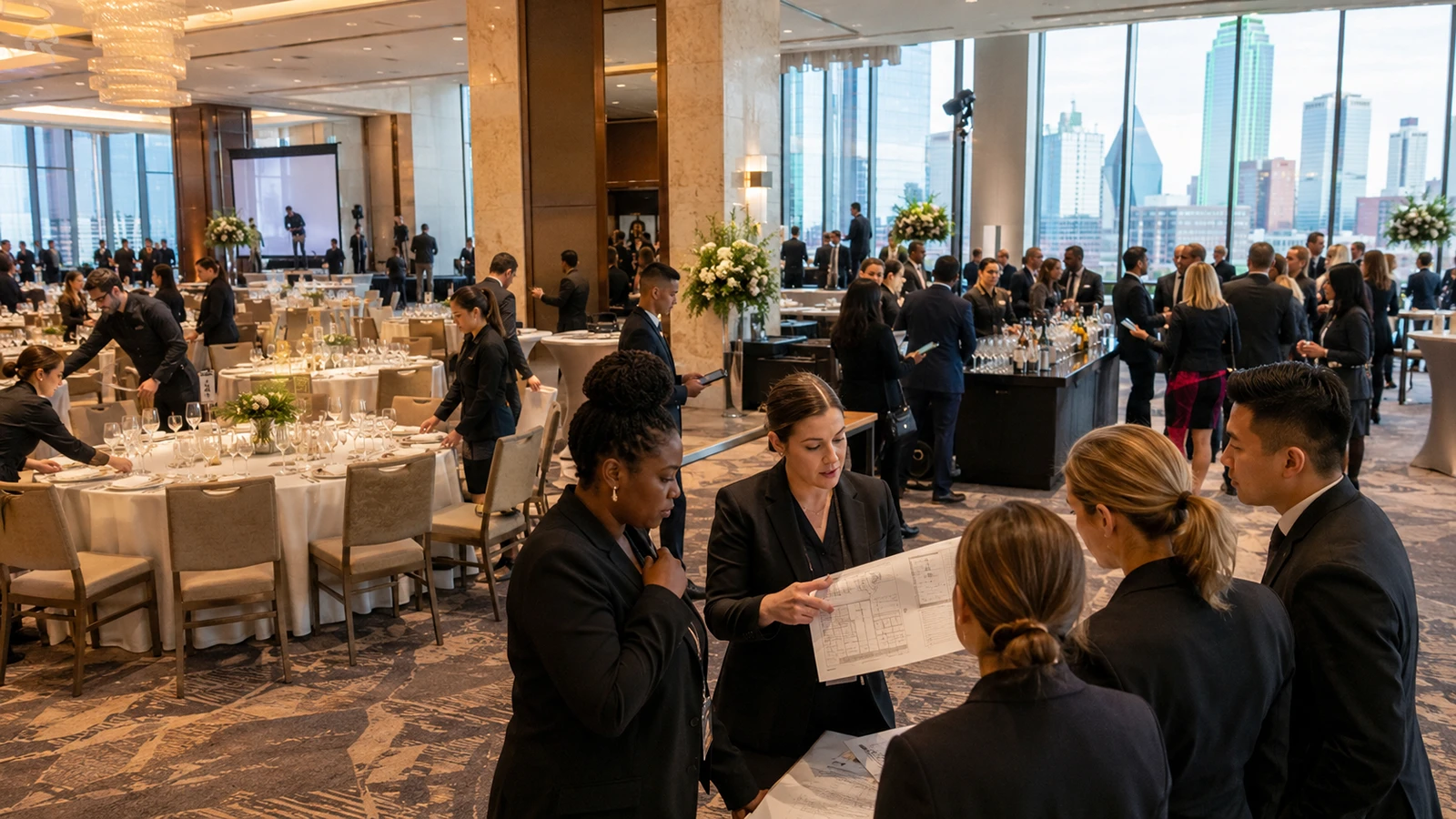
- For a plated dinner, use 1 server per 25–28 guests. That's 18–20 servers for 500 people. Add a bartender for every 50–75 guests, plus bar support, plus runners, plus event coordinators who solve problems before they become your problems.
- For a buffet or cocktail reception, the ratio loosens. You need 12–16 staff, but concentrate them differently, with more runners, crowd management, and check-in coverage instead of table servers.
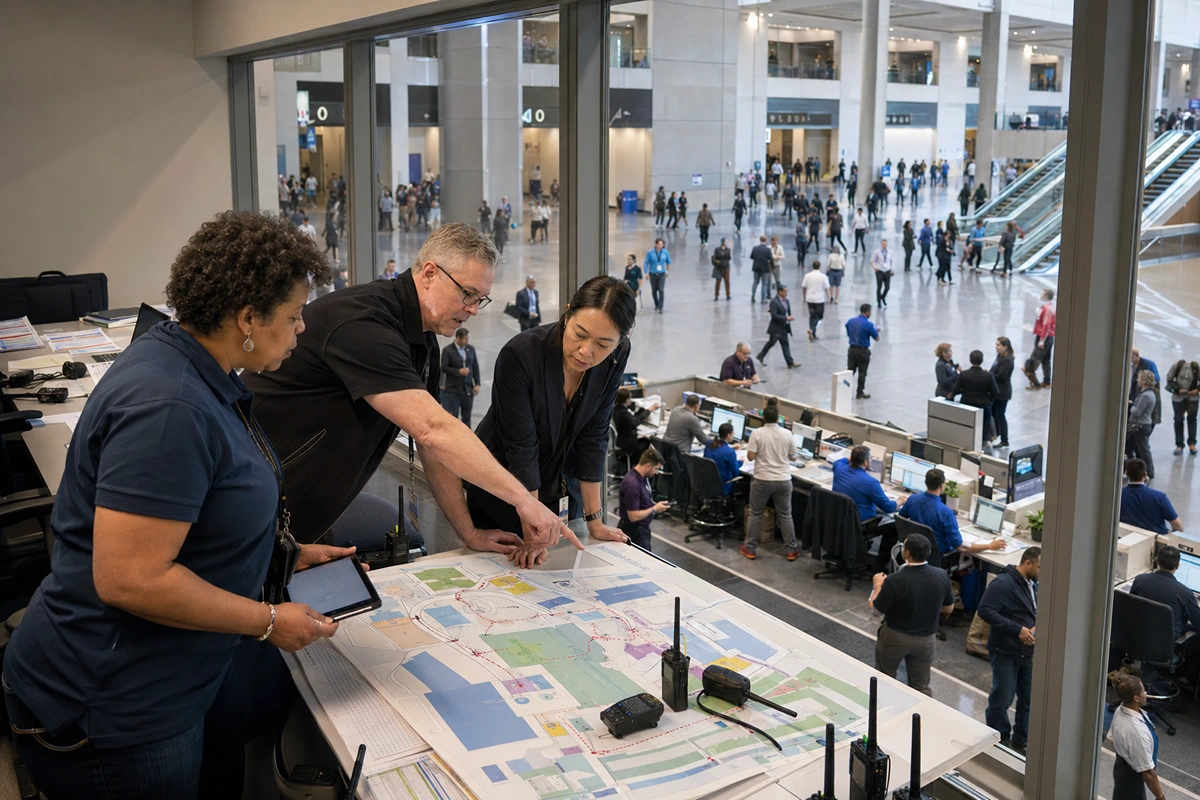
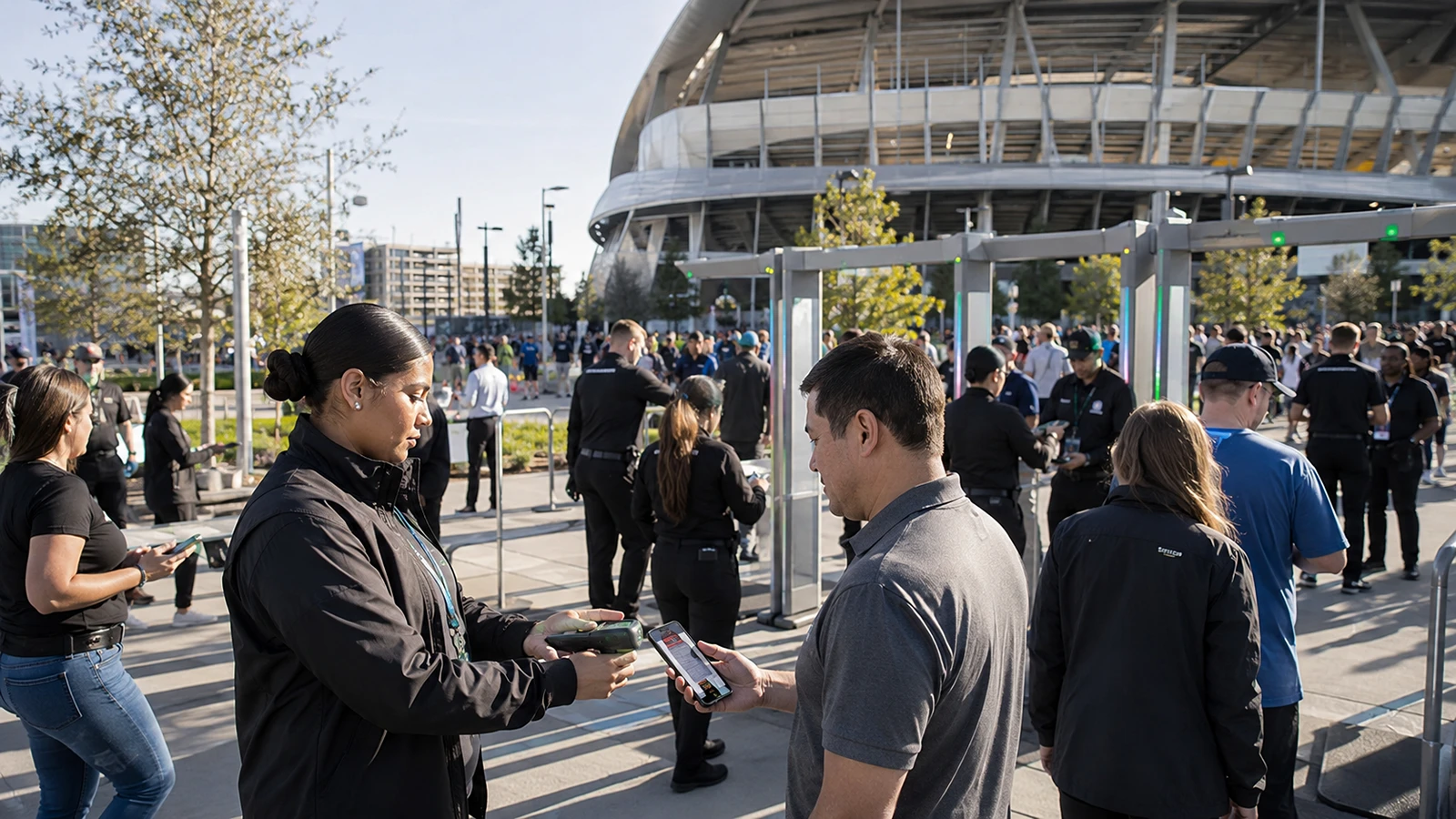
- For a standing reception or high-volume activation, you're looking at 14–18 staff positioned at decision points (entrances, drink stations, food stations, crowd control zones) where they prevent bottlenecks before they happen.
How Does Service Format Affect Event Staff for 500 Guests?
Plated dinners, buffets, and cocktail receptions all require different staffing strategies and the difference is significant.
Plated service demands precision and timing. Staff must deliver meals in sequence, clear efficiently, and maintain a polished presence throughout the event.
Buffet service shifts the workload. Instead of table service, your team manages food stations, reduces wait times, and keeps guest flow moving.
Cocktail receptions require speed and high-volume interaction. Staff are everywhere offering drinks, clearing empties, redirecting foot traffic, and answering questions. You need fewer formal servers but more operational presence overall.
Four Factors That Change Your Headcount
Even within your format, four variables either increase or decrease the number of staff you need.
Venue Layout: A single-room event is straightforward. Two rooms? Add 15–20% more staff. Three rooms or an outdoor component? Add another 10–15%. Multi-space events need more people simply because the service becomes distributed. You cannot have one bartender covering two bars.
Event Duration: A 3-hour event uses your baseline. A 5-hour event adds 10%. A 6+ hour event triggers shift overlap (staff fatigue drops after 3–4 hours), which means you need about 20% more people to maintain consistent service quality.
Venue Complexity: Some venues are designed for flow. Others have bottleneck zones—tight hallways, single bathroom areas, narrow pathways to the parking lot. Tight venues need more crowd management staff to prevent congestion.
Guest Profile: A room full of executives standing and mingling (low interaction staff needs) is different from a multigenerational family celebration with children, elderly guests, and different mobility levels (higher service needs).
The DIY Formula
This is simple enough; you can calculate it yourself. No event staffing calculator is needed.
- Pick your format ratio: Plated = 1:25; Buffet = 1:30; Cocktail = 1:35
- Divide guest count by ratio: 500 ÷ 28 (plated midpoint) = 17.8 staff
- Add 10% as backup: 17.8 × 1.1 = 19.6 staff (round to 20)
- Adjust for your venue factors: If multi-room, add 15%. If 6+ hours, add 20%. If a tight venue, add 10%.
Your final number: 20–24 staff for a 500-guest plated dinner in a multi-room venue running 6+ hours. This is your staff needed for a 500-guest event baseline.
Real Example: Staffing a 500-Guest Corporate Event
For a recent 500-guest corporate gala, the event included a cocktail hour, seated dinner, and awards presentation across two rooms.
The initial estimate was 18 staff based on a plated service ratio. However, due to the dual-room layout and a 6-hour timeline, the final headcount increased to 24 staff.
This included:
- 16 servers
- 4 bartenders
- 2 runners
- 2 event coordinators
The result: smooth transitions, no bar congestion, and consistent service throughout peak moments.
Event Staff Calculator for 500 Guests (Simple Formula)
You don’t need a complex event staff calculator to estimate your staffing needs. Use this simple formula:
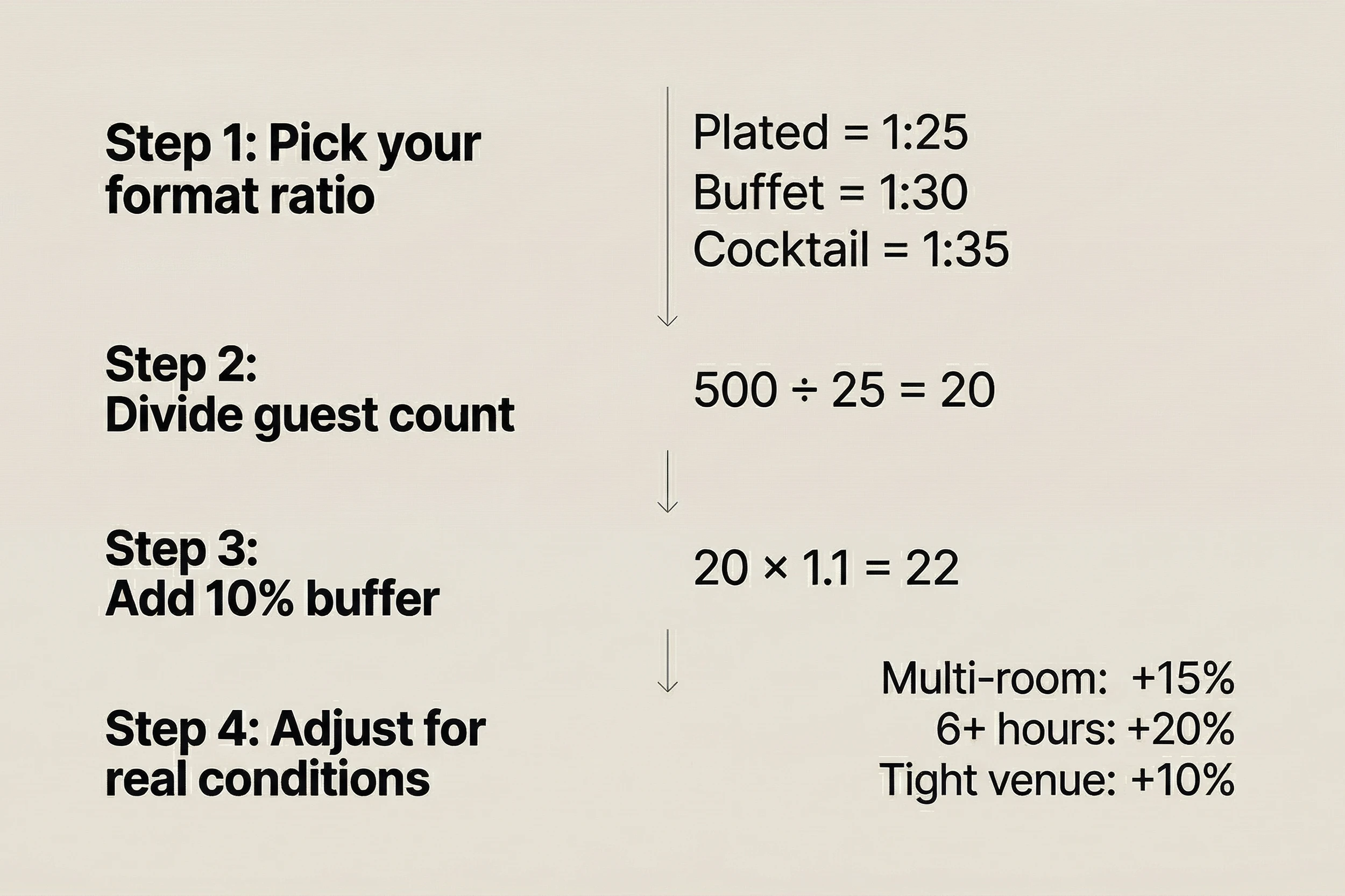
Start with your service ratio:
- Plated: 1:25
- Buffet: 1:30
- Cocktail: 1:35
Divide your guest count:
- 500 ÷ 28 = ~18 staff
Add a 10% buffer:
- 18 → 20 staff
Adjust for real conditions:
- Multi-room venue: +15%
- 6+ hour event: +20%
- Outdoor or complex layout: +10–15%
Final estimate: 20–24 staff for most 500-guest events.
What Experienced Teams Already Know
Experienced teams don't just show up with a headcount; they show up with a plan. They arrive with:
- Clarity on which roles are critical (don't cheap out on bartenders at a cocktail event)
- Positioning strategy (where staff stand to prevent bottlenecks, not just react to them)
- A pre-event timeline so guests never sense adjustment
- Backup plans for no-shows or unexpected volume spikes
- Understanding that the first hour and the peak transition (dinner to dancing, ceremony to reception) demand the most staffing precision
If your quoted team cannot answer why they're recommending their headcount, that's a red flag.
Red Flags That Signal Understaffing
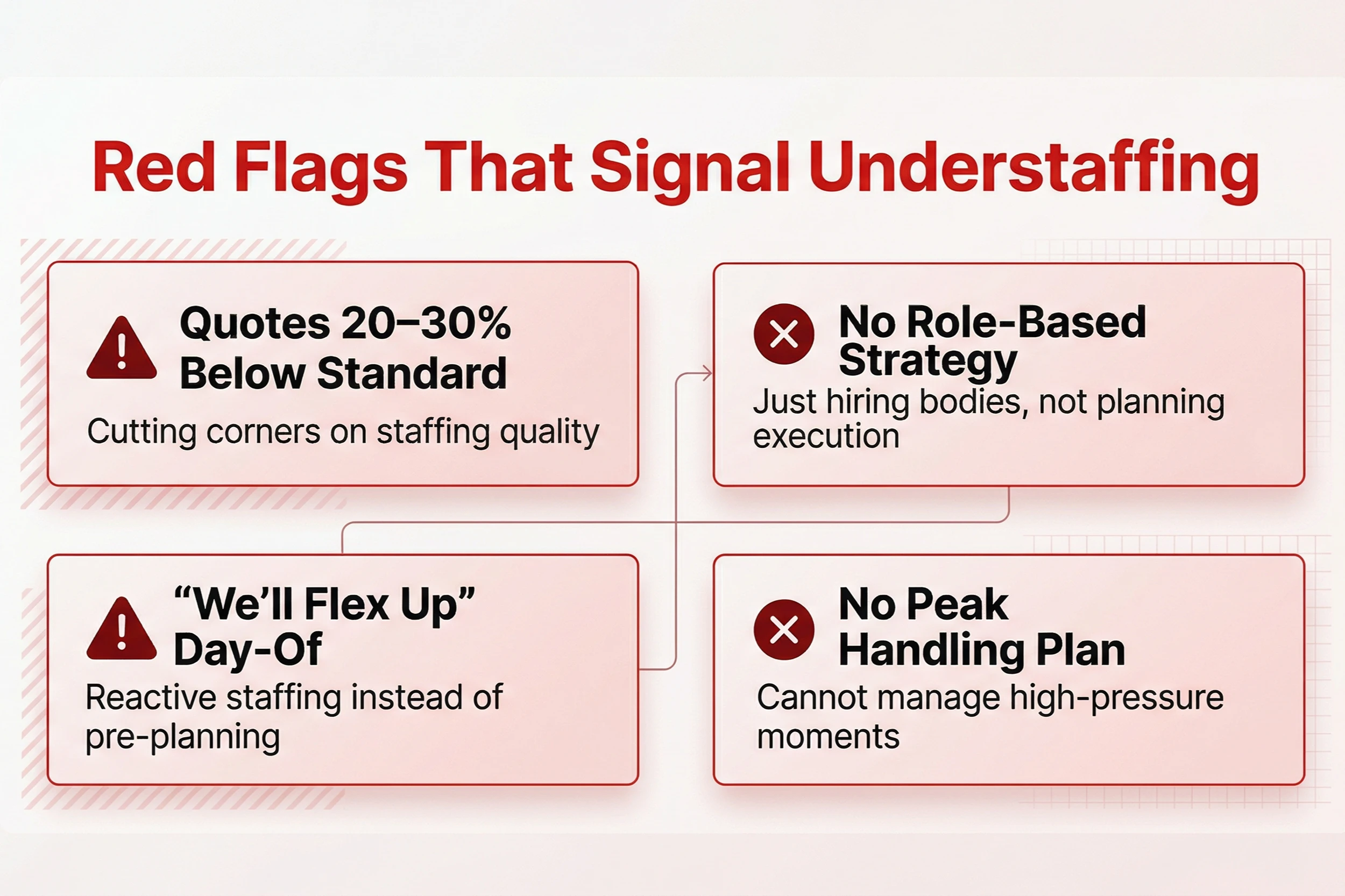
- Quotes that seem 20–30% below industry standard for your format (they're cutting corners)
- No mention of role-specific positioning or strategy (they're just hiring bodies)
- Claims they can "flex up" if needed the day-of (professional teams pre-staff correctly, not reactively)
- Inability to explain how they'll handle peak moments (cocktail hour, transitions, final hour)
The Real Question Isn't "How Many?" It's "Which Roles Matter Most?"

For a gala, your spending priority: bartenders > servers > event coordinators.
For a standing reception, your priority: runners and crowd control > bartenders > check-in staff.
For a corporate dinner, your priority: servers and transitions coordinators > bartenders > general support.
A team that understands your event type will allocate their headcount to your priorities, not a generic formula.
Conclusion
For 500 guests, start with 14–22 staff depending on your format, then adjust up for venue complexity and event duration. The number is not a guess. It's a calculation based on what actually works. The real win is hiring a team that understands why these numbers matter and positions people to make your event feel effortless instead of just operational. Get a precise staffing plan for your 500-guest event. Don’t rely on guesswork. Our team will calculate your exact staffing needs based on your format, venue, and timelines, so your event runs smoothly from start to finish. Request your custom staffing estimate now.
Ready to elevate your next event?
Join thousands of event planners who trust EventStaff.com for reliable, professional staffing solutions.
Trusted by event professionals nationwide
1k+
Events Staffed
2 million+
Guests Served
97%
Positive reviews