
CEO Excerpt
"Hallways are the arteries of an event. If they clog, the schedule dies. Floor support involves more than just directing attendees to the restroom; it involves actively managing the crowd's movement against the venue's friction. In high-volume environments, these teams are the only thing standing between a fluid transition and a fire code violation." -CEO, EventStaff
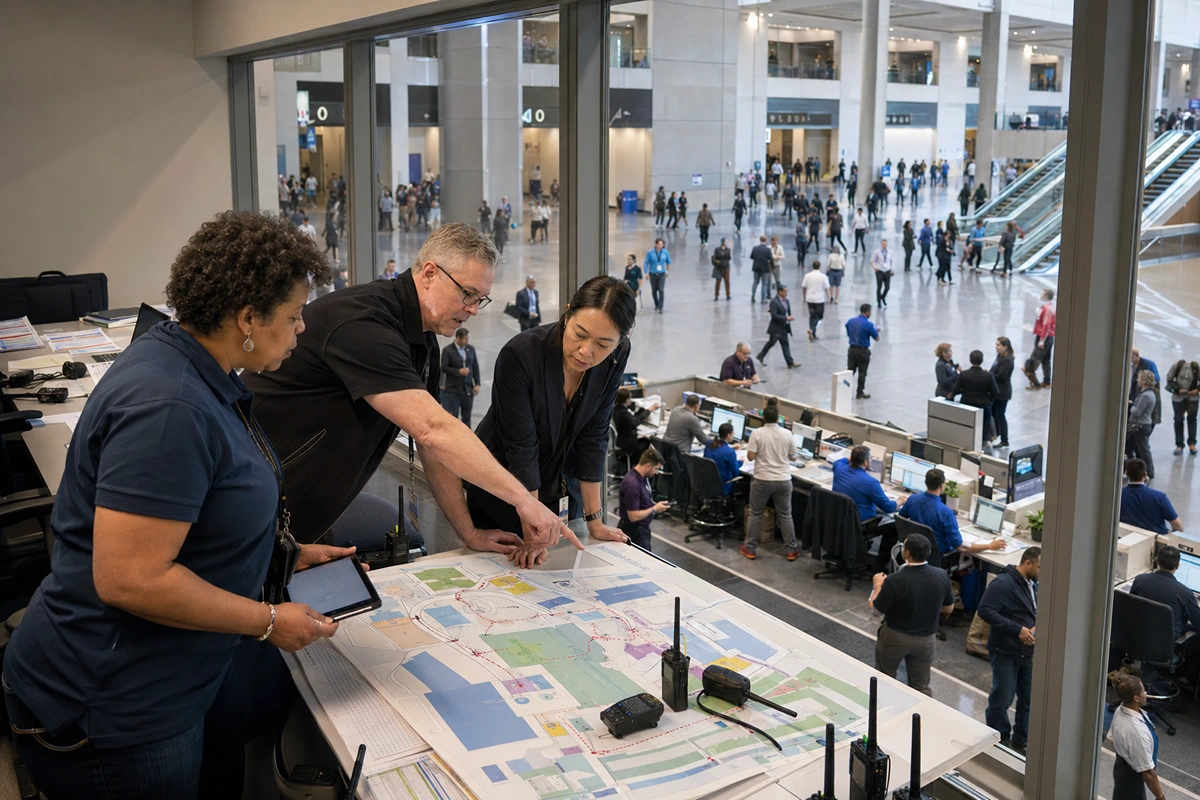
Event floor support staff determine whether large events move predictably between sessions or stall into hallway backups that disrupt schedules and trigger compliance pressure. When thousands exit rooms within a three-to-seven-minute release window, corridors near escalators, restrooms, and session doors reach saturation quickly. Without active control, ADA routes collapse, transition waves stack, and congestion bleeds into adjacent programming. Floor support staff stabilize these moments by managing corridor flow as it forms, not reacting after backups harden.
Executive Summary
At large-scale events, the most critical failure points often exist outside the session rooms. This guide details how specialized floor support staff mitigate hallway congestion through three operational mechanisms: controlling density at pinch points, enforcing split-flow routing during transitions, and proactively identifying invisible bottlenecks. By shifting focus from static ushering to dynamic corridor management, organizers can secure their schedules and ensure compliance even during peak movement windows.
Strategy #1: Floor Support Staff Control High-Density Pinch Points
.webp)
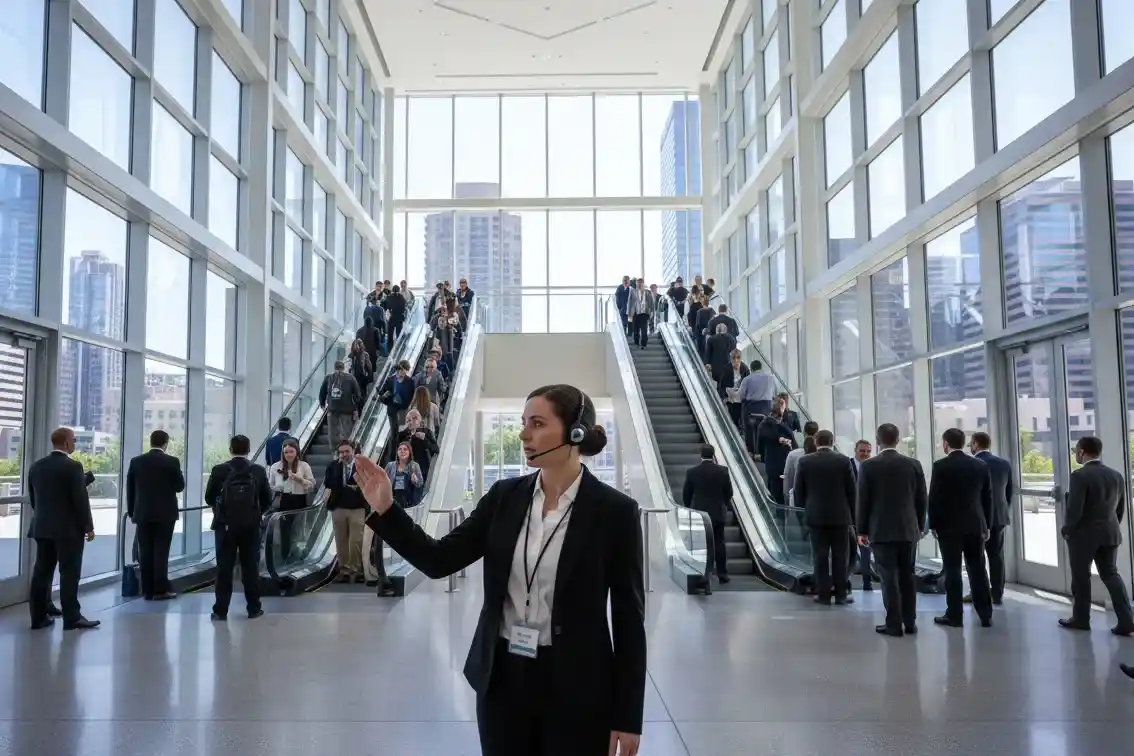
Hallway congestion rarely spreads evenly across a venue. It concentrates at corridor pinch zones such as escalator landings, stairwells, restroom corridors, and food service intersections. After session releases, multiple guest streams converge on these points at once, overwhelming corridor capacity long before rooms refill.
In professional event floor support staff deployments, personnel are stationed directly at these density points rather than inside rooms. Their job is to regulate pressure by redirecting movement early, opening secondary paths, and sequencing competing streams before density locks. This prevents the stop-and-stack pattern that turns short delays into sustained backups. This proactive approach aligns with the psychology of event flow, where managing visual cues and movement helps maintain order.
ADA routing
When ADA lanes are not actively protected, they are typically blocked within seconds by mixed-speed traffic. Floor support staff prioritize mobility routes early to preserve access and prevent mid-event compliance escalation, ensuring alignment with ADA Standards for Accessible Design.
Density cues
Short micro-directions such as “keep right” or “move forward to the corner” prevent guests from pausing at decision points where corridor flow must remain continuous.
Strategy #2: Managing Inflow and Outflow During Session Transitions
The most volatile hallway conditions occur during session transitions. One audience exits while another enters, and a third group stops mid-corridor to check schedules or messages. Without control, these movements collide.
Effective event floor support staff manage this by enforcing split-flow routing. One direction moves while the opposing flow holds briefly. This sequencing reduces collision points that otherwise double corridor dwell time and cascade backward into surrounding halls.
Micro-direction
Calm, directive cues guide guests without raising tension. These instructions prevent clustering at doorways, signage, and narrow connectors where congestion escalates fastest.
Door coordination
Floor support teams coordinate with door and usher staff so hallway release aligns with room readiness. This prevents corridor overflow while still supporting steady crowd flow during sessions.
Strategy #3: Identifying Bottlenecks Before Guests Feel Them
The operational difference between professionals and volunteers is anticipation. Trained floor support staff track transition waves, breakout spillover, and density creep before congestion becomes visible to attendees.
In large venues, event floor support staff monitor corridor fill rates, elevator queue buildup, and stairwell routing simultaneously. When pressure rises, they communicate immediately with supervisors to adjust timing, open alternate corridors, or hold upstream zones temporarily to rebalance flow. This level of oversight is a critical component when creating a safety plan for events.
Early detection
By the time a corridor feels “tight” to guests, it is already failing operationally. Early redirection prevents frustration from forming.
Zone adjustments
Holding one release for sixty seconds often prevents ten minutes of recovery later, preserving schedule integrity across multiple sessions.
How EventStaff Trains Effective Floor Support Teams
EventStaff treats conference floor support as a specialized operational role, not an add-on. Teams are trained in bottleneck detection, flow balancing, and ADA lane stabilization using post-2023 behavioral data showing higher stop frequency and lower patience under compressed schedules.
Staff rehearse corridor management by zone rather than by job title. Supervisors use human–AI hybrid scheduling oversight to redeploy teams dynamically as congestion risk shifts throughout the day. This keeps event floor support staff positioned where hallway failure is most likely, not evenly distributed for optics.
Why This Matters for Large Events
When event floor support staff are missing or undertrained, hallway congestion escalates quickly. Session transitions slow, ADA complaints rise, and fire marshal interventions become more likely due to violations of codes like the NFPA 101 Life Safety Code. Recovery requires additional labor and disrupts programming.
When floor support is executed correctly, corridors remain fluid, transitions feel invisible, and guest frustration never spikes. Schedules hold, risk drops, and venues remain compliant.
That control is the value floor support teams deliver.
Secure Seamless Transitions with Professional Floor Support
Large conferences, expos, and multi-session programs require active hallway control to stay on schedule and compliant. EventStaff provides trained event floor support staff with supervisory oversight, transition planning, and real-time corridor management. Request trained floor support staff for your next conference or large venue event to ensure your corridors move as smoothly as your sessions.
Ready to elevate your next event?
Join thousands of event planners who trust EventStaff.com for reliable, professional staffing solutions.
Trusted by event professionals nationwide
1k+
Events Staffed
2 million+
Guests Served
97%
Positive reviews