
How Much Does an Event Bartender Cost in Los Angeles?
Event bartender costs in Los Angeles typically range from $50 to $100 per hour, but the final price is rarely that simple.
Most event planners underestimate bar staffing because the hourly rate doesn’t include minimum shift requirements, agency fees, late-night premiums, or logistics costs tied to LA venues.
In this guide, we break down:
- Real bartender pricing by role
- What agencies actually include
- Hidden costs most planners miss
- How to budget accurately from the start
If you're planning a corporate event, private party, or large-scale activation in LA, this is the real cost breakdown you need before requesting quotes.
Executive Summary
Event bartender costs in Los Angeles typically range from $35 to $80 per hour per bartender depending on role type, experience level, and whether you're booking through an agency or independently. But the hourly rate is only one component. Minimum hour requirements, agency overhead of 18–25%, equipment costs, and LA-specific premiums for late-night events and union venues all affect the final number. This guide explains every component, gives you real scenario math, and tells you exactly what to ask before you commit.
How LA Event Bartender Costs Were Analyzed
To estimate realistic event bartender cost in Los Angeles, we reviewed staffing quotes, agency pricing models, and common operational requirements across hospitality events, corporate functions, and large-scale activations.
Pricing insights in this guide reflect several factors commonly included in LA bartender staffing. Quotes:
- Typical hourly rate ranges for bartenders and bar captains
- Minimum shift requirements used by staffing agencies
- Event-specific premiums such as late-night service or large guest counts
- Operational roles required to run a functioning bar setup at live events
Because pricing structures vary across agencies and event types, the ranges in this guide are designed to reflect what planners typically encounter when requesting event bartending staff in Los Angeles.
Why Event Bartender Costs in LA Are More Complex Than a Simple Hourly Rate
Los Angeles is one of the most expensive event markets in the United States. The combination of high cost of living, strong minimum wage floors, union venue requirements across a significant portion of the city’s premier event spaces, and a competitive talent market for experienced bar staff means that bartender pricing in LA operates differently from most other U.S. cities.
The local event map also makes pricing more variable. A private event in Beverly Hills, a rooftop reception in Downtown LA, a brand launch in West Hollywood, and a beach-adjacent event in Santa Monica can all require different travel timing, parking planning, load-in access, service pacing, and venue coordination. Even when the bar service looks similar on paper, the labor conditions behind that service may be very different.
When you search for bartender rates online, you typically find national averages that reflect mid-tier markets. Those numbers underrepresent what quality bar staffing actually costs in LA, and they often miss the additional cost layers that professional agencies build into their quotes for legitimate operational reasons. In Los Angeles, the rate is rarely just the person pouring drinks. It is also the cost of reliability, travel tolerance, polished guest interaction, venue readiness, and staffing depth in a market where event standards are high.
The planners who get blindsided are the ones who anchor their budget to a national average and then encounter the LA reality. The planners who budget accurately are the ones who understand the full rate structure before they request their first quote.
CEO EXCERPT
"Every week, I talk to event planners who budgeted for bartenders based on an hourly rate they found online and ended up paying thirty percent more than expected. The rate is rarely a whole number. Minimums, agency overhead, late-night premiums, and equipment costs are all part of the real figure. The planners who get this right are the ones who ask for the all-in number before they sign, not after.—CEO, EventStaff
Event Bartender Hourly Rates in Los Angeles: What the Numbers Actually Look Like
Base Rates by Role Type
Not all bartenders cost the same. The role determines the rate, and LA has a tiered market that reflects experience, certification, guest expectations, venue complexity, and the practical cost of staffing across a spread-out metro area.
- General event bartender: $50–$65 per hour. Suited for corporate receptions, casual private events, beer and wine service, and lower-complexity open bar formats. These bartenders can handle volume, but they are not usually hired for craft cocktail production, high-touch VIP service, or complex menu execution.
- Experienced cocktail bartender: $65–$85 per hour. Handles full cocktail menus, custom signature drinks, higher-volume service, and more polished guest interaction. The right choice for branded events, upscale galas, studio events, private estate gatherings, and LA venues where the bar is part of the guest experience rather than only a utility.
- Bar captain / lead bartender: $80–$100 per hour. Manages the bar team, oversees inventory and setup, coordinates with venue staff and event operations, and handles escalations. For events with three or more bartenders, a lead is often the difference between a bar team that simply shows up and a bar team that can adjust when service pressure builds.
- Barback: $35–$50 per hour. Handles restocking, ice management, glassware movement, trash, garnish support, and behind-the-bar logistics so bartenders stay front-facing and service-focused. In LA, barbacks become especially important at rooftops, private homes, studios, galleries, and venues where storage, elevators, parking, or load-in access can slow service.
These ranges usually reflect agency-supported event staffing rather than a direct independent bartender quote. Independent bartenders may quote lower base rates, but the comparison should account for screening, replacements, scheduling, insurance requirements, supervision, and backup support. In Los Angeles, the cheapest hourly rate often stops looking cheap once parking delays, venue access, guest volume, setup needs, or last-minute staffing gaps enter the picture.
Agency vs. Independent Bartender: What the Rate Difference Means
An independent bartender quoting $28–$35 per hour looks significantly cheaper than an agency rate of $45–$60 for an equivalent role. That gap is real. What it doesn't show is what disappears when you go independent.
Agency rates for bar production and catering staff typically include payroll compliance, FICA, FUTA, and state unemployment contributions that the client would otherwise be responsible for when booking direct. They include workers' compensation and general liability insurance, which most venues in LA require as a condition of service.
They include vetting, background checks, and scheduling infrastructure. And critically, they include replacement coverage: if your independently booked bartender cancels the morning of your event, that's your problem. If your agency-booked bartender cancels, the agency's problem is finding a replacement before your guests arrive.
The rate premium for agency staffing is a risk transfer. Whether that transfer is worth the cost depends on how much operational risk you're willing to carry yourself.
Minimum Hour Policies: The Hidden Cost Most Clients Overlook
Minimum hour requirements exist because professional bartenders cannot economically accept a two-hour booking that requires travel, prep, setup, breakdown, and coordination on either side. In Los Angeles, a four-hour minimum is still common for event bartender bookings, while some weekend, late-night, or higher-demand events may carry a five or six-hour minimum.
What this means in practice: if your cocktail hour runs ninety minutes and you planned to pay for ninety minutes of bar service, you are usually paying for the full minimum regardless. That is not a hidden fee. It is a standard staffing policy, but it is frequently missed in early budget calculations.
For a three-bartender booking with a four-hour minimum at $65 per hour, the base math would look like this:
- Base cost: 3 × $65 × 4 = $780
- Agency overhead at 20%: $156
- Minimum commitment before any other variables: $936
If your event actually runs five hours, you pay for five. If it runs three, you typically pay for four. Building minimum hour requirements into your initial budget prevents one of the most common causes of bar staffing cost surprises.
Late-night finish premiums are also worth planning for in Los Angeles. For shifts ending after 11 p.m., many event staffing arrangements add roughly 10–20%, especially when the booking involves weekend demand, extended travel, or venue load-out requirements. In a city where late-format events are common, that premium should be treated as a normal budget variable rather than an exception.
What's Actually Included in the Rate (and What Isn't)
Professional agency rates for event bartenders in Los Angeles usually cover the labor system behind the booking, not every physical item connected to the bar. That distinction matters because many LA events involve venues, rooftops, private homes, studios, galleries, and hotel spaces where the bar setup varies widely from one location to another.
Included in most agency quotes:
- Bartender wages for confirmed shift hours
- Payroll taxes and employment compliance
- Workers’ compensation and general liability insurance
- Pre-event staff briefing and brand or event orientation
- Attendance confirmation and check-in management
- Replacement support for no-shows or last-minute staffing issues
- Basic coordination around arrival time, dress code, reporting location, and onsite contact
Usually priced separately or confirmed case by case:
- Bar equipment, including shakers, jiggers, speed rails, pour spouts, ice bins, mats, and service tools
- Glassware rental, specialty cups, or disposable serviceware
- Garnishes, mixers, syrups, napkins, straws, ice, and other consumables
- Liquor, wine, beer, and nonalcoholic beverage supply
- Gratuity or service charges, depending on the event format and agreement
- Parking, valet, transportation, or access surcharges for difficult venues
- Extra setup, breakdown, or waiting time caused by venue access rules
The clearest source of post-event billing disputes in the LA market is the assumption that “bar service” automatically includes the physical bar, products, equipment, and supplies. It usually does not unless the quote states that clearly. A bartender staffing quote may cover the people, compliance, scheduling, and shift management, while rentals and beverage production sit in a separate budget category.
Before signing, ask the agency to separate labor, equipment, consumables, beverage supply, parking, and gratuity into clear line items. This is especially important in Los Angeles because venue access can change the true cost quickly. A Downtown rooftop with freight elevator windows, a Malibu estate with limited parking, or a Hollywood venue with tight load-in timing may require more coordination than the hourly bartender rate suggests.
What Drives the Cost Up: LA-Specific Pricing Factors
1. Venue Labor, House Rules, and Access Requirements
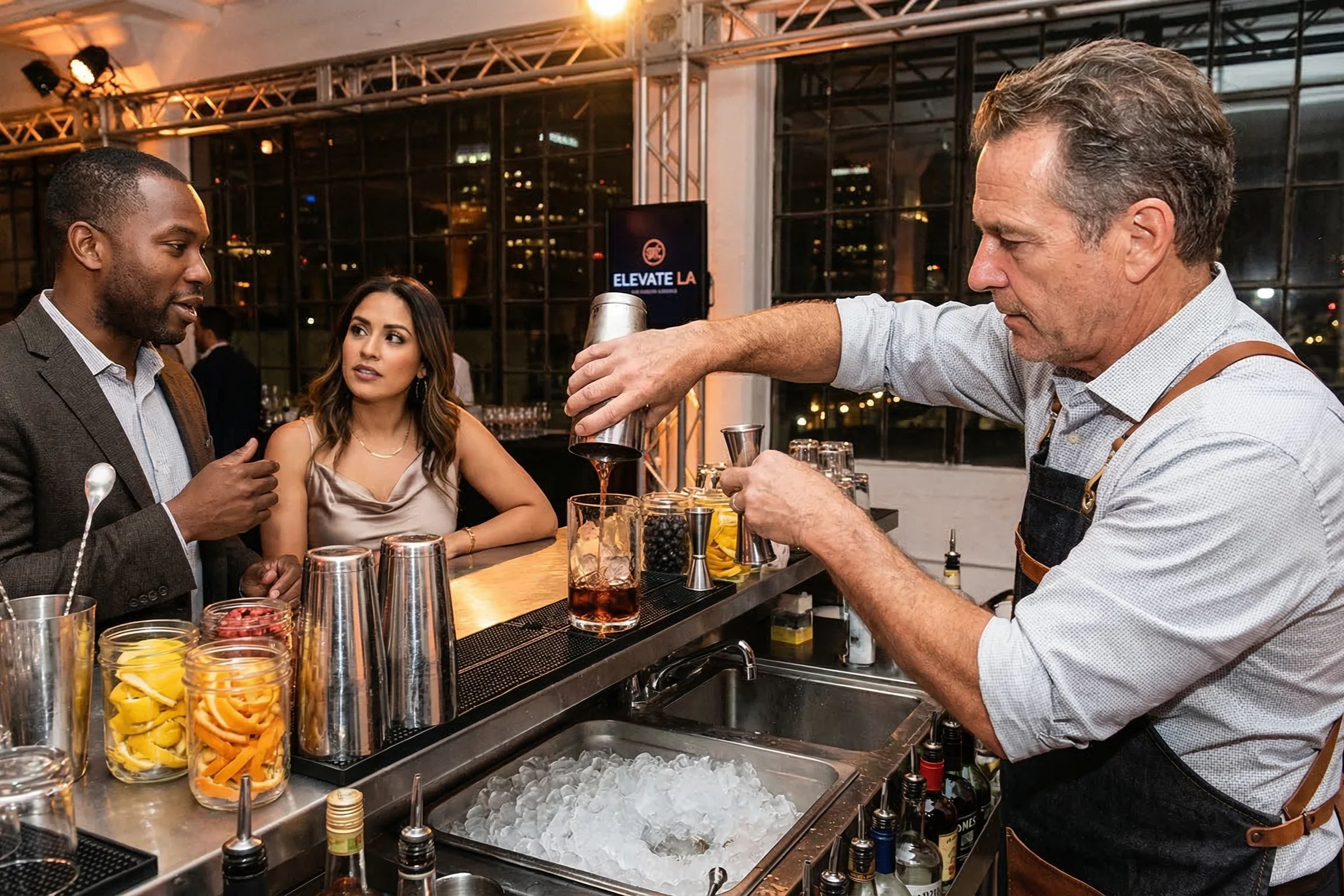
Many Los Angeles event venues operate with strict labor rules, preferred vendor lists, house-team requirements, insurance standards, or detailed load-in procedures. These requirements affect how outside staffing agencies coordinate with venue teams, especially when bartenders need to work around in-house service staff, catering teams, freight elevators, dock access, security check-in, or venue-approved setup windows.
Common LA venues and event districts where planners should confirm labor and access rules early include:
- Los Angeles Convention Center
- L.A. LIVE and Crypto.com Arena event district
- Downtown LA hotel ballrooms
- Hollywood production venues and studios
- Beverly Hills and Westside luxury hotels
- Private estates in Malibu, Bel Air, and Pacific Palisades
In these settings, the bartender’s hourly rate may be only one part of the real cost. The staffing agency may also need to account for arrival buffers, compliance documentation, certificate of insurance requirements, dock timing, security clearance, parking logistics, and coordination with house operations. At large venues such as the Los Angeles Convention Center, official planner resources specifically reference load-in procedures and union labor, which is why early confirmation is essential before finalizing a bar staffing quote.
Planning tip: Always confirm the venue’s labor rules, vendor requirements, load-in path, and insurance expectations before requesting final pricing. The more information your staffing agency has up front, the fewer surprise adjustments you will see later.
2. Traffic and Logistics Premiums
Los Angeles is a large, geographically spread city, and travel logistics can influence staffing costs more than many clients expect. A bartender working a Downtown LA reception, a Santa Monica beach-adjacent event, a Malibu estate party, or a private home in the hills may face completely different commute timing, parking access, and load-in conditions, even when the shift length looks identical on paper.
Events outside central event corridors may involve additional travel considerations. Common examples include venues in:
- Malibu
- Palos Verdes
- Topanga
- Calabasas
- Pacific Palisades
- San Fernando Valley
- Orange County-adjacent South Bay locations
Staffing agencies whose rosters are primarily based in central LA may apply travel or logistics surcharges for these areas, especially when staff must arrive during peak traffic windows or stay late after limited transit options. In practical terms, a 6 p.m. call time in West Hollywood is a different staffing challenge than a 6 p.m. call time at a Malibu estate with narrow access roads and limited parking.
Planning tip: Share the exact venue address, parking instructions, load-in location, and required arrival time before asking for a firm quote. In LA, geography can change the cost almost as much as guest count.
3. Peak Season Demand
Certain times of the year create significant demand for experienced event bartenders in Los Angeles. Award season alone can tighten availability across private parties, studio events, hotel receptions, brand activations, after-parties, and entertainment industry gatherings. Add corporate calendars, summer social events, and fall fundraising season, and the best bar staff can get booked well before the event date.
High-demand periods often include:
- Award season from January through March, when entertainment, studio, and hospitality events compete for polished bar staff.
- Spring and early summer social season, when weddings, outdoor receptions, and private estate events increase demand.
- Summer festival and rooftop season, when high-volume service and guest-facing polish matter.
- Fall corporate and nonprofit event season, when conferences, galas, fundraisers, and brand events return heavily.
- December holiday events, when corporate parties and private celebrations compress demand into a short window.
During these windows, staffing availability tightens, and last-minute bookings can become difficult to fulfill at standard rates. Booking earlier improves access to stronger bartenders, better barbacks, and lead staff who can manage service flow instead of simply filling a shift.
Planning tip: For large events, premium venues, or peak-season dates, try to secure bar staff several weeks in advance. For award-season events, luxury private events, or high-volume corporate receptions, earlier planning is safer.
4. Craft Cocktail Complexity
Los Angeles event culture often favors elevated bar programs and custom cocktail experiences. That can increase staffing costs compared to basic beer, wine, and simple mixed-drink service because craft cocktails require more prep, more tools, more coordination, and often more time per guest. A beautiful signature drink can become a service-flow problem if the staffing model is built like a basic open bar.
Higher pricing typically reflects factors such as:
- Custom cocktail menus
- Signature drink preparation
- Branded or themed bar programs
- Higher ingredient complexity
- Fresh garnishes, syrups, infusions, or batching needs
- More detailed setup and breakdown time
- Greater need for barbacks during peak service
For example, a bartender mixing a four-ingredient spirit-forward cocktail at high volume needs more time, attention, and bar support than someone pouring wine or opening beer. At LA events where presentation matters, such as studio parties, luxury brand launches, rooftop receptions, and private estate gatherings, the staffing plan has to protect both speed and guest experience.
Planning tip: If you are planning a craft cocktail menu, discuss service flow with your staffing agency before finalizing headcount. The right number of bartenders and barbacks will usually depend on drink complexity, guest count, service window, and whether cocktails can be batched in advance.
How Many Bartenders Do You Actually Need?
Underbooking bar staff is the single most consistent cause of long lines, slow service, and guest frustration at LA events. The ratios below are starting benchmarks that adjust based on your specific service format, bar layout, and guest consumption profile.
Beer and wine service only: 1 bartender per 75–100 guests Full open bar, standard cocktails: 1 bartender per 50–75 guests Craft cocktail or signature drink program: 1 bartender per 35–50 guests High-volume reception or festival format: 1 bartender per 40–60 guests, plus 1 barback per 2 bartenders Bar captain required: Any event with 3 or more bartenders
Scenario calculation 300-person gala, full open bar, Beverly Hills hotel:
- 300 guests ÷ 60 (standard open bar ratio) = 5 bartenders
- 5 bartenders ÷ 2 = 3 barbacks (rounded up)
- 1 bar captain (mandatory at this scale)
- Total bar team: 9 staff
- Base cost: 9 staff × $55 blended rate × 5-hour shift = $2,475
- Agency overhead at 20% = +$495
- Late-night finish premium at 15% = +$371
- Estimated bar staffing total: ~$3,341
Most planners budgeting for this event initially estimate $1,500–$1,800 for bar staff. The gap is real and it's not the agency overcharging it's the full picture of what professional bar service at this scale actually costs in Los Angeles.
The Roles Most Clients Confuse: Bar Captain vs. Bartender vs. Barback
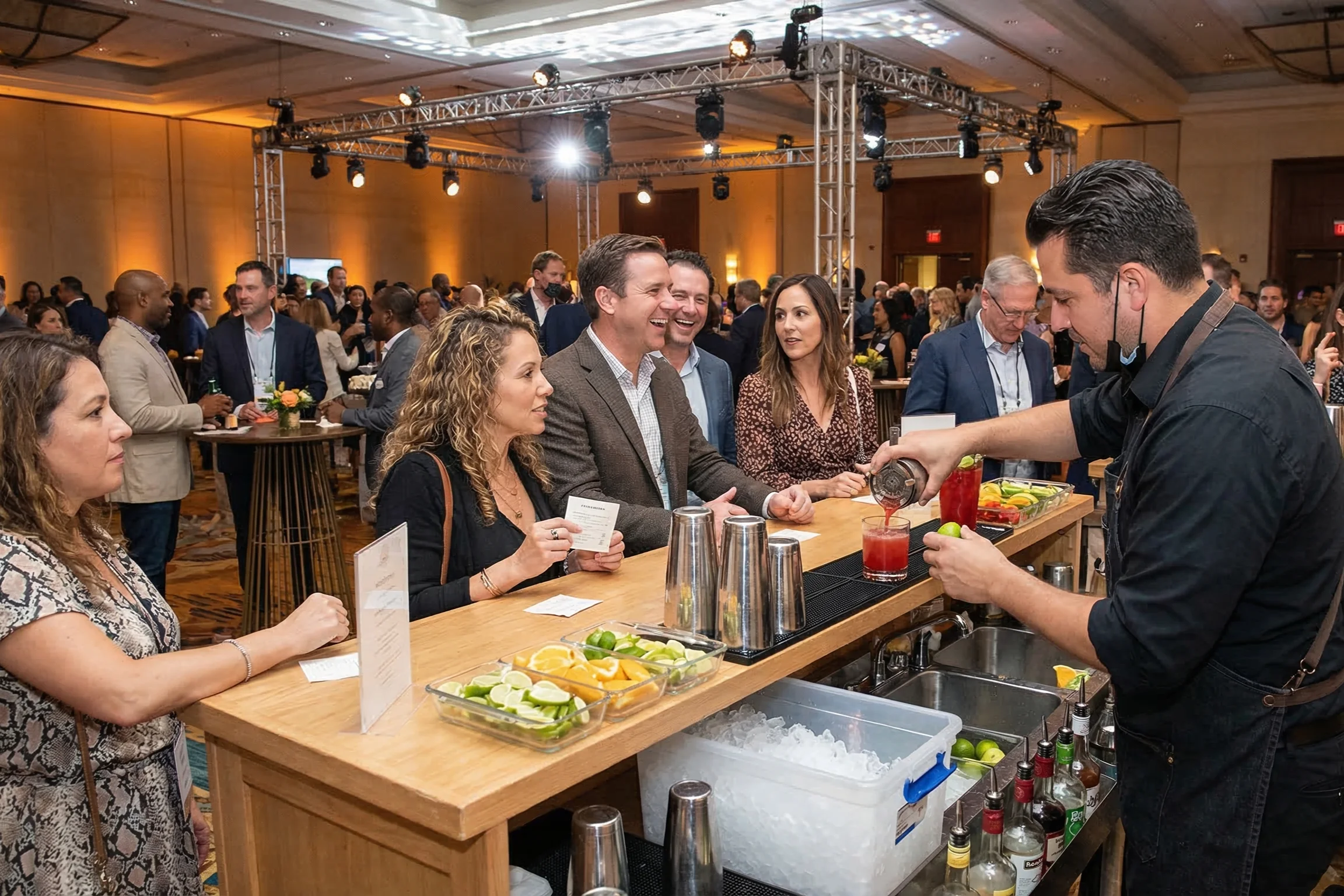
These three roles operate as a functional unit at any event above a certain scale. Treating them as interchangeable or assuming one can substitute for another is where bar service breaks down.
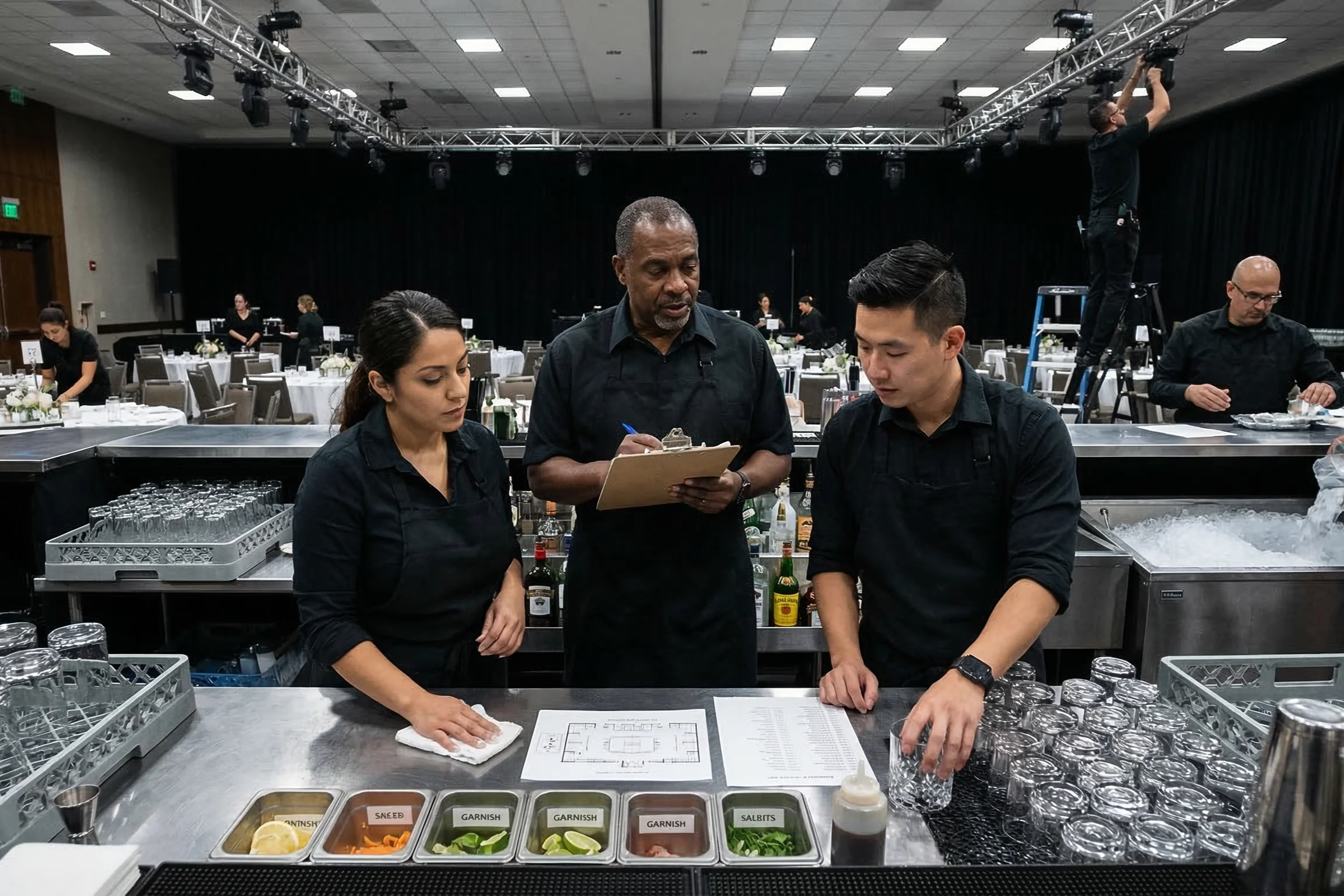
Bar captain: The operational decision-maker behind the bar. Manages setup, coordinates with the venue and event team, oversees the bartender team, manages inventory, and handles mid-event problems without pulling the bartenders off service. At events with multiple bars or high-volume service, the bar captain is what keeps the whole bar operation coherent. Their rate is higher because their function is higher they're not pouring more drinks, they're making sure the bar team can pour drinks at full capacity for the entire event.
Bartender: The primary service layer. Faces the guest, executes the cocktail menu, manages the bar surface, and drives the guest experience at the bar. A good bartender at a high-volume LA event is managing guest interaction, drink quality, speed, and social dynamics simultaneously. Experience and venue familiarity matter significantly at this role level — a bartender who has worked The Ace Hotel or NeueHouse operates differently from one whose background is neighborhood bars.
Barback: The operational support layer. Keeps ice stocked, glassware rotating, garnishes prepped, and the bar surface clean. A good barback is invisible to guests and invaluable to bartenders. Without a barback at volume, bartenders spend a meaningful portion of their shift on logistics rather than service, and bar speed drops noticeably.
For events utilizing bar production services, all three roles are typically available within a single staffing request. Clarify which you need and in what ratio when you submit your brief.
Mini Case Examples
Corporate Awards Gala: 400 Guests at JW Marriott, L.A. LIVE
Result: Bar wait times stayed under four minutes at peak arrival. The signature cocktail program ran consistently for three hours without a single out-of-stock incident.
What made it work: Six bartenders deployed across two bar stations, three barbacks rotating supplies continuously, and one bar captain who had pre-walked the venue layout and coordinated with the hotel’s in-house labor team two days before the event. The client had originally requested four bartenders. The staffing partner reviewed the guest count and service format and recommended six. That conversation happened before booking, not after the event.
Brand Activation Rooftop Product Launch in West Hollywood
Result: 280 guests were served across a three-hour activation with zero service complaints and a post-event NPS score that cited “the bar experience” as a top-three highlight.
What made it work: Three experienced cocktail bartenders were briefed on the brand’s signature drink build, with prep time built into the shift start rather than counted against service hours. The client had requested general event bartenders at a lower rate. The staffing partner flagged that the signature cocktail program required craft-level experience and recommended the upgrade. The rate difference was about $15 per hour per bartender, roughly $135 for the full event. The outcome difference was significant.
Private Wedding Reception: 180 Guests at a Malibu Estate
Result: The full five-hour reception ran with no bar lines, no service gaps, and no overtime billing.
What made it work: Accurate ratio planning from the start: three bartenders plus two barbacks for a full open bar with a wine and craft beer component. The venue location carried a travel surcharge that the client had not factored into the initial budget. Because the staffing partner raised it during the quote phase rather than on the invoice, the client had time to adjust elsewhere in the budget without a last-minute scramble.
What to Ask Before You Book a Bartender in LA
Hiring a bartender in Los Angeles is not just about checking hourly rates. The details in the agreement can affect your final cost, staffing reliability, service quality, and overall event execution. LA adds its own complications too: venue access rules, traffic, late-night schedules, parking, union coordination, and peak-season staffing demand can all change the true cost of bar service.
Use the checklist below before you confirm your booking. The goal is to make sure your bar staffing quote is transparent, complete, and built around the actual conditions of your event.
1. What Is the Minimum Hour Requirement?
Many bartender bookings in Los Angeles include a minimum shift length, typically between four and six hours. Confirm the minimum requirement early so you understand how staffing costs are calculated, even if your actual service time is shorter. This matters for cocktail hours, product launches, and wedding receptions where the bar may only be active for part of the event. A short service window can still require setup, briefing, breakdown, travel, and staff commitment before and after guests arrive.
2. Is the Quoted Rate All-In?
Some agencies quote a base hourly rate and add agency fees, administrative charges, service costs, or late adjustments later. Ask whether the rate you’re being quoted is the full all-in price or if additional fees will appear on the final invoice. In LA, this is especially important because parking, travel time, extended setup, and late-night scheduling can change the final cost. A clear quote should separate labor, agency fees, equipment, gratuity, and any venue-related charges before you sign.
3. Are Insurance and Payroll Compliance Included?
Professional event staffing agencies usually include workers’ compensation, liability coverage, and payroll tax compliance in their pricing. Clarifying this protects you from unexpected legal or financial responsibility if something goes wrong during the event. It also matters at LA venues that require proof of insurance or specific compliance documents before outside staff can work onsite. If a provider cannot explain coverage clearly, the lower hourly rate may come with risk the client ends up carrying.
4. What Is the No-Show and Replacement Policy?
Reliable agencies have backup staff and a clear contingency plan if a bartender cannot make it to the event. Ask how replacements are handled, who monitors attendance, and how quickly they can provide a substitute if a last-minute issue arises. This is important in Los Angeles because traffic, parking delays, long travel distances, and overlapping event demand can all affect arrival reliability. A strong agency should have check-in systems, standby options, and a real escalation process before guests reach the bar.
5. Do Rates Change for Late-Night Service?
Some staffing rates increase after a certain hour, particularly for events running late into the night. Confirm when late-night pricing begins so you can budget accurately if your event schedule extends past that time. LA has many event formats that run late, from private estate parties and rooftop receptions to entertainment-industry after-parties. If the bar closes after 11 p.m. or staff must stay for breakdown after guests leave, the quote should explain whether premium rates, extended minimums, or transportation considerations apply.
6. Is a Bar Captain Included?
For larger events, a bar captain may oversee multiple bartenders, manage bar flow, coordinate with the event team, and handle onsite issues. Ask whether this supervisory role is included in your quote or priced separately. A bar captain becomes especially useful when there are multiple bar stations, signature cocktails, barbacks, replenishment needs, or venue staff to coordinate with. Without one, the client or planner may end up managing service problems that should have been handled behind the bar.
7. What Bar Equipment Is Included?
Not all bartender bookings include equipment. Clarify what is provided, such as bar tools, ice bins, garnish trays, portable bars, speed rails, glassware, or disposable serviceware. Understanding what is included helps you avoid last-minute rentals and vendor confusion. In Los Angeles, this is especially important for private homes, rooftops, galleries, and studios where a functional bar setup may need to be built from scratch rather than supplied by the venue.
8. Does the Venue Require Union Coordination?
Some Los Angeles venues require union labor, house-team coordination, preferred vendors, or specific staffing policies. If coordination is required, it may affect staffing structure, arrival timing, documentation, and pricing. Confirm this early if your event is at a convention center, stadium, hotel, studio, or large entertainment venue. The key question is not only whether bartenders can work there, but how outside staff are allowed to enter, set up, coordinate, and operate alongside the venue’s internal team.
9. What Information Is Needed to Confirm the Booking?
Most agencies will request details like the event timeline, venue contact, guest count, bar menu, service style, parking instructions, and run of show before confirming staffing. Providing this information early helps the team arrive prepared and prevents quote changes later. For LA events, the venue address alone is often not enough. Share loading instructions, elevator access, check-in procedures, dress code, expected guest arrival pattern, and whether the event includes beer and wine, full bar, or craft cocktails.
10. What Is the Cancellation Policy?
Events can change, so it is important to know the cancellation window and refund policy. Ask how far in advance you can cancel without penalty and whether deposits are refundable, transferable, or credited toward a future booking. This matters more during peak LA event seasons, when agencies may turn down other work once your team is reserved. A clear cancellation policy protects both sides and prevents confusion if the timeline, venue, guest count, or event format changes.
A professional staffing agency should be able to answer all of these questions clearly and without hesitation. In particular, vague answers around insurance coverage, staffing guarantees, replacement policies, equipment, or late-night pricing should be treated as warning signs before committing to a booking.
Conclusion
Planning a bar for your event in Los Angeles is about more than just hiring a bartender. Hourly rates, minimum booking policies, service roles, agency fees, and event duration all affect the final cost. Understanding these factors early helps planners budget accurately and avoid last-minute surprises.
Whether you're organizing a corporate event, private party, or large conference reception, the right bar team ensures smooth service, faster guest flow, and a better overall experience. The key is matching the right number of bartenders, barbacks, and support staff to your event size and service style.
When you price your bar team correctly from the start, you’re not just paying for drinks to be poured; you’re investing in service efficiency and guest satisfaction.
Ready to price your bar team? Share your event details and get a role-matched bar staffing quote that reflects the real all-in cost before you commit, not after. Get a bartender quote for your LA event
Ready to elevate your next event?
Join thousands of event planners who trust EventStaff.com for reliable, professional staffing solutions.
Trusted by event professionals nationwide
1k+
Events Staffed
2 million+
Guests Served
97%
Positive reviews